Robotics Professor Answers Robot Questions | Tech Support | WIRED
WIRED
0:00 I'm Aaron Ames.
0:00 I'm a professor of mechanical engineering.
0:02 I'm here today to answer your questions from the internet.
0:05 This is robotics support.
0:11 Fred Bone says, "I don't understand the benefits of these food delivery robots.
0:15 You know, this is a job that could be automated,
0:17 so let's have robots automate it.
0:18 They obviously work in some scenarios, but they're not super robust.
0:22 I think the bigger thing they're trying to solve is a proof
0:24 of concept demonstration to see if we
0:26 can solve things like automated package delivery,
0:28 last mile delivery, things like that.
0:30 A lot of these are first steps towards
0:32 trying to solve this more general delivery problem,
0:35 which is actually a really hard problem.
0:36 And by the way, putting these robots on the road has taught us
0:38 a lot about both what works and also a lot of what doesn't.
0:41 If you've seen these delivery robots, they get stuck a lot.
0:43 They can hit things.
0:44 They can fall off the road.
0:46 It does tell you how hard robots is.
0:48 And I think that's sort of something to keep in mind when we're talking
0:50 about humanoids and all these other things is look at the robots that are
0:53 actually in the field today and how they sort of still kind of fail
0:57 quite a bit and it tells you we got a lot of work to do.
0:59 And by doing that, at least on the robotics side,
1:01 we will learn a lot from Paradise Knights WTFs with dancing robots.
1:07 I thought they were supposed to be our slaves
1:09 before they enslave us at least for a bit.
1:12 They're just partying.
1:13 It's pretty good.
1:14 Yeah, WTF on multiple levels.
1:16 First and foremost, why are they having robots dance?
1:20 First, there's amazing progress that's happened in humanoids.
1:24 Among other things, back flipping, running.
1:26 I mean, really, the behaviors we've achieved is
1:28 in the last year or two has been absolutely remarkable.
1:32 We figured out a very nice pipeline in which to get robots to do this.
1:35 And the way you do it is you start with a human doing those actions.
1:38 The reason why the dancing looks so humanlike is it's a human dancing.
1:42 It's it's really just puppetry.
1:44 very beautiful and advanced engineering puppetry, but puppetry nonetheless.
1:48 So, a human puts on a mocap suit or you use cameras and the human dances,
1:52 not me because I'm a very bad dancer, but you know, a good dancing human.
1:54 And then you take that data and you get the trajectories from that data.
1:57 That is the motion of of the human over time.
1:59 And then you train a reinforcement learning
2:01 algorithm on the humanoid robot that basically mimics
2:04 or copies that human data as much as possible with the morphology of the robot.
2:07 And the end result is it dances like the person that was dancing.
2:10 And as long as everything is just the way you expected it to be,
2:13 meaning the environment's like it was when the human did the thing,
2:16 we can get robots to do that now.
2:17 But you asked about this, aren't they supposed
2:19 to be helping us sort of before they party?
2:22 And the answer to that is that we still don't know how to solve that problem.
2:26 That's sort of the not very secret secret
2:28 is that all of the hard problems getting
2:30 robots to be truly autonomous and in our homes
2:32 are still hard problems that are unsolved.
2:35 The next question is from project guy 111.
2:37 What percentage chance do you think we'll end up in a Terminator future?
2:42 So, I think there's two answers to this.
2:43 One is what's the chance that AI and learning will do bad things?
2:48 And I think that probability is actually fairly high if we're not careful.
2:51 And and now's the time to be careful.
2:52 If you trust AI to be the decision maker,
2:55 if you're not very careful about having guard rails for that AI,
2:58 it will make bad decisions.
2:59 I mean, if you've ever used chat GPT or LLMs,
3:01 you see that it can produce really nice answers sometimes and it's impressive,
3:04 but then sometimes it just it's wrong.
3:07 So, we cannot trust AI.
3:09 In my opinion, you can never trust AI, but you can use AI as a powerful tool.
3:13 Just like if you search something online on Google,
3:16 you get a lot of results back,
3:17 gives you a lot of information, but you have to verify and double check.
3:20 So, I think if we put like AI in charge of our, you know,
3:23 weapons or something silly like that, then, you know, bad things will happen.
3:27 At the same time, the second part of Terminator was it became sensient, right?
3:30 It actually learned to think on its own.
3:32 And I don't think we're anywhere near that.
3:34 So, I have no concern of sensient AI.
3:36 Right now, AI is not intelligent.
3:39 They say AI, artificial intelligence.
3:41 There's no actual intelligence.
3:42 It has no notion of what it's saying or doing.
3:45 It is simply pattern matching at a scale we've never pattern matched before.
3:49 From I got too silly.
3:51 What benefits do legged robots have over wheeled or tracked vehicles?
3:54 legs are inherently beneficial if you want to operate in environments for which
3:59 they're built for humans and more importantly where things are not flat.
4:03 So wheels are massively efficient in how you can
4:06 move around environments as long as there's not uneven terrain.
4:08 If you've ever been in a wheelchair
4:10 or wheeled someone out around in a wheelchair,
4:13 you realize very quickly how flat the world is not.
4:16 Even what you perceive as flat,
4:17 even in a city environment where there's sidewalks and everything,
4:20 you realize there's curbs that don't dip enough.
4:22 There's big brakes in them and all
4:23 those little things for wheels become big problems.
4:25 They become sort of sticking points and legs have
4:28 the inherent ability to walk more robustly over multiple terrain types.
4:32 Quadripeds being one example.
4:33 I mean where your dog or your cat can go on four legs is pretty incredible.
4:37 Bipeds of course are sort of the ultimate expression of mobility
4:40 in human environments because the environments are built for us.
4:43 So if you need to get into a small space and and get up
4:46 a small set of stairs or something like that or climb up a ladder,
4:49 only a biped can do that.
4:50 Give a ladder to a quadriped.
4:51 is not going to know what to do.
4:53 Give a ladder to a human.
4:54 As long as they're reasonably healthy, they can climb up that ladder no problem.
4:57 From Sammy 514, what are robot dogs actually being used for?
5:02 So, we've actually come a long ways in robot dogs,
5:05 which are actually technically called quadripeds because they have four legs.
5:09 It's really amazing what's happened in the last sort
5:11 of decade where we've gone from these robot dogs
5:14 being in really lab environments and research environments to being
5:18 things that you can buy at insanely low prices.
5:21 The hardware has made immense progress.
5:24 I think the practical use cases are still a little thin.
5:28 They're thinking about doing them as things like inspecting buildings,
5:31 sending robots ahead in disastrous scenarios, right?
5:33 And for that legs are definitely better than wheels.
5:36 The next question is from Levon21.
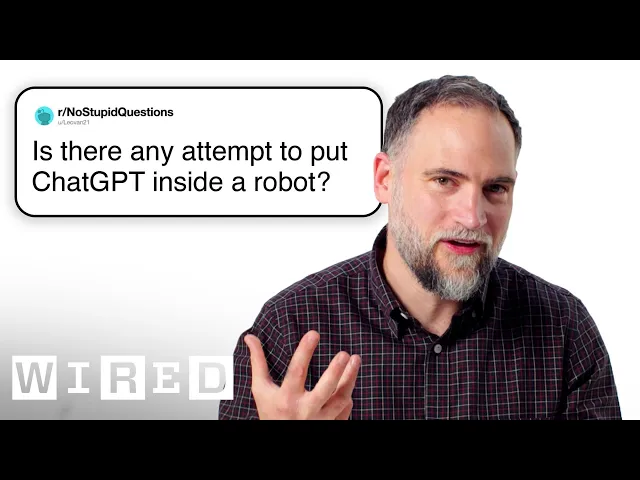
5:38 Is there any attempt to put chat GPT inside a robot?
5:41 Yeah, there's lots of attempts.
5:43 So, right now there's many humanoid robot makers
5:45 that have that as a layer in their humanoid robots.
5:48 And so, the way to think about this more
5:50 generally is that as we're making robots do things,
5:54 there's no one thing that's going to make them do all things, right?
5:56 So, imagine your body, you have a brain,
5:58 you also have a spinal cord, you have propriception.
6:01 So, you sort of intrinsically have multiple computers
6:03 running in your body at any given time.
6:05 like your spinal cord is a computer in its
6:07 own right and those computers run different algorithms.
6:10 So at the highest level, at our cognitive level,
6:12 that's where LLMs will sort of play a role if you'd like.
6:15 So you want to ask the robot a question and have
6:17 it perceive something about the environment and make a decision.
6:20 So ask the robot, you know, where is the red apple on the table?
6:23 It can use an LLM to parse that language into code.
6:26 Use computer vision then to to detect all the apples on the table
6:30 and return based on that an estimate of where it is.
6:33 When you actually want to reach for the apple,
6:34 an LLM is not going to reach for the apple.
6:37 That's where traditional robot control will
6:38 come in or where reinforcement learning will
6:40 come in, which is a whole another type of learning that's different from LLM.
6:44 And those are what's actually running on the robot, right?
6:46 Those are what are making the robot go,
6:48 just like your spinal cord is really what moves your body
6:50 most of the time without you having to think about it.
6:53 From I want to be free 10, are autonomous vehicles mobile robots?
6:57 Yeah.
6:57 I mean, if you want to ask what the most advanced robot is today,
7:01 you would take autonomous cars and mobile warehouse robots like Amazon has.
7:07 Autonomous cars, I think,
7:09 are one of the prime examples of the farthest that we've pushed autonomy.
7:14 So, yeah, it's absolutely a robot.
7:16 It's an advanced robot that's a beautiful work of engineering.
7:18 From Vite Persona, how does the Roomba know what's what?
7:23 I think what they're asking is how does the Roomba
7:25 have a semantic understanding of the environment is the way we
7:29 would technically phrase this question that is able to identify
7:32 things around the room that it sees and correctly identifying them.
7:36 So basically we've been able to take
7:38 a bunch of training data a bunch of examples
7:40 of pictures on the internet videos on the internet
7:43 and teach robots how to correctly identify those.
7:45 By teach what we mean is we can train up basically this big
7:49 neural network that takes images in and produces what's in the images out.
7:54 And as a result, we can now correctly identify most things in an image.
7:58 And so what Roomba does is simply it has
8:01 a camera that's perceiving those things in the environment.
8:03 It's checking with the internet based on these large models and then identifying
8:06 the things in the environment and using
8:08 that information to tell you what's going on.
8:10 The next question is from Fireplace Air.
8:12 Why make robots humanoid shaped when they could have six arms?
8:15 Humanoid robots are the most suited to do the most things,
8:19 even if they're not the best suited to do any given thing.
8:22 Again, the world is built for us.
8:25 We've built the robot for something of our shape and our function.
8:30 Doors, stairs, narrow corridors, all these things.
8:34 And if you want a robot that can slot into any scenario where a human can go,
8:38 which is pretty much most scenarios we care about, not all, but most.
8:41 You want somebody to start making you sandwiches at at in your kitchen or you
8:45 want a robot that can be dropped
8:46 into an existing factory and automate some tasks, right?
8:50 I want to say all that as a preface to the fact
8:52 that humanoid robots are not the best form for again a given application.
8:58 For example, right now the largest owner of robots is Amazon.
9:01 It has over a million.
9:03 And as a result, one of the largest sector of robotics is warehouse robots.
9:07 robots with two wheels that go under
9:10 these pallets and then move them around warehouses.
9:12 In particular, what Amazon does is have the robots
9:14 go pick up a pallet with the thing
9:15 you order from Amazon and it moves that over to a human who's filling the order.
9:19 So, the human can just stand there and they never have
9:21 to move and basically all of this stuff comes to them.
9:23 Now, you could theoretically have a humanoid robot do
9:25 this, like push these big pallets around the warehouse,
9:28 but the question would be why?
9:30 Like, these robots are very good at doing what they're meant to do,
9:33 and that environment is designed to work synergistically with the robot.
9:36 So, you could have six arms on a humanoid if you had
9:38 an application that determined that six arms would make a big difference.
9:42 Maybe you have a firefighting robot and you find that two
9:44 arms is not enough and you want four more arms
9:46 cuz you want to hold the hose and you want
9:47 to hold a camera and you want to hold the fire extinguisher.
9:50 That's the great thing about robots, by the way,
9:52 is we can make them any way we want.
9:53 A Reddit user asks, "When it comes to automation,
9:55 how close is Amazon to actually automating most, if not all,
9:59 warehouse work with robots?" The answer is very,
10:02 very close to parts and then other ones are further away.
10:06 So in terms of automation of warehouses,
10:08 Amazon is by far the leader in this domain.
10:11 Amazon robotics in particular has been working on warehouse robots,
10:16 specifically robots that move around warehouses
10:18 to move pallets around to move your order
10:19 to a person filling the order for, you know, 20 plus years now.
10:23 And they've really refined that process so they maximally and efficiently can
10:26 move packages to the sorter and then the sorder packages them up.
10:30 So the question becomes what remains?
10:32 And what remains is then the part that the human's currently doing
10:35 which is grabbing these things off the shelf and putting them in boxes.
10:39 And so this is much more an open-ended
10:41 work where they're testing out solutions right now.
10:44 So for that you can use things called local
10:46 manipulators meaning you have robot arms maybe on mobile bases
10:49 and maybe use suction cups or soft graspers and you
10:52 would pick up objects and put them in boxes.
10:54 And you can do this with varying success levels right now,
10:57 but you're not at the success level to truly automate that where you don't need
11:01 a person present for all objects cuz you
11:03 imagine all the objects that go in Amazon boxes,
11:05 all the different geometries and how they feel and look.
11:08 I mean, it it's it's a very complicated
11:10 problem to automatically and autonomously load all these objects.
11:13 So, that problem's sort of open-ended.
11:15 Kaleidoscope Inside asks,
11:17 if you could commission a robot to be built with no financial barriers,
11:21 what would your robot do?
11:23 So if I had no financial constraints,
11:25 I would try to sort of solve the exoskeleton problem.
11:30 Like a billion could get it done.
11:31 A billion in my mind could develop something
11:34 that would eradicate the need for wheelchairs essentially.
11:37 A Reddit user asks, "Why do most of the four-legged robots,
11:41 see Boston Dynamics, have their knees look backwards?
11:45 It's the inverted leg morphology.
11:47 There's potentially mathematical advantage to having your legs like this.
11:50 It's actually a two-fold thing.
11:52 It's not just that they're inverted, but that they're very light.
11:54 So, it turns out the way you control robots
11:56 and the way you get really stable locomotion behavior
11:59 on robots is by having very light legs
12:02 and having most of your mass centered in one spot.
12:04 There's lots of mathematical reasons for that that leverage
12:07 that as sort of an assumption.
12:08 And what that means is as you're walking, if your legs are very light,
12:11 you can place them very quickly to catch yourself as you fall.
12:14 A lot of the robots were designed based on that morphology.
12:17 And in addition, the inverted leg is
12:19 actually what birds have cuz birds actually have
12:21 this type of morphology where they have
12:23 very heavy big bodies and very light legs.
12:26 And as a result, birds have some of the most robust locomotion out there.
12:29 They can actually step down huge holes and then step up out
12:32 of the hole without ever changing how their main body is moving.
12:36 And so if you can get that kind of behavior on robots,
12:38 they'll be very robust and able to go all
12:40 the places where you want to take robots with legs.
12:41 A Reddit user asks, "What is so special about the Mars rover?" Curiosity.
12:47 I mean, what's not special about a Mars rover?
12:50 Pretty much everything.
12:51 It was on Mars.
12:52 I mean, the reality is these robots are incredible engineering feats.
12:57 First, just getting it to Mars is special.
12:59 And then the rover itself,
13:01 all the rovers that have gone, Curiosity and all of them,
13:04 they have these amazing engineering sort of gems in them that they built up.
13:08 You know, their suspension system is specifically
13:10 built so that it can handle rough terrain.
13:12 Their wheels are specifically built so they'll be robust to going over
13:16 rocks and things like that and you won't blow out a tire, right?
13:18 So, the entire structure is built to maximally
13:21 be robust to this really harsh environment.
13:23 I mean, there's the electronics which have to deal with this very
13:26 sandy and and and windswept environment where there's dust storms.
13:30 You know, there's power limitations just the power alone.
13:33 I mean, the sun doesn't come through at the same intensity.
13:36 You have to have good solar panels that actually charge the electronics.
13:39 The electronics have to be battery efficient, right?
13:41 And then after all of that, you have to do science with it.
13:43 And then, oh, of course, you have to talk back with Earth at the same
13:46 time and make sure you don't lose that signal.
13:47 I mean, the list goes on and on.
13:48 But to build a system like that, I mean,
13:50 every one of the rovers we've sent to Mars is an immense
13:53 and remarkable engineering feat that sort of just makes me happy as an engineer.
13:59 The next question is from F.
14:00 Kruski, 3411.
14:02 Wait, how do autonomous cars even work?
14:05 like are we trusting robots with our lives now?
14:09 Not sure about this.
14:10 It turns out that autonomous cars have gone through some things.
14:14 About a decade ago when when it seemed to be close,
14:16 there were all these startup companies that formed and they all tried to do
14:20 autonomous cars many different ways and then
14:22 exactly what you're worried about happened.
14:25 There were crashes, people got hurt despite the fact
14:28 that they'd already been working on making the system safe.
14:30 But they really realized and I think that the entire autonomous car industry
14:34 pushed more and more to make sure there was really rigorous safety methods.
14:38 So both in the algorithms to keep them safe
14:40 and then also protocols around that software architectures etc.
14:43 and then data to support it.
14:45 And so in that way there's a lot of evidence
14:47 to show that autonomous cars if they're currently deployed have very
14:50 rigorous safety standards and there's a lot of data to back
14:53 that up with the limited number of crashes that they've had.
14:56 I'm not saying they can't get better, but you know,
14:59 after a decade, autonomous cars have done the hard work.
15:02 The decade ago, we could have autonomous cars drive around on the street.
15:05 But the difference between driving around on the street for, you know,
15:08 a demo and actually driving around and all
15:10 of a sudden other cars pull out or, you know,
15:11 a ball bounces into the street and a kid chases after it, right?
15:14 Those corner cases kill and safety kills.
15:17 Meaning, if you're not safe, you die.
15:19 Both as a company, but also as a as a technology.
15:22 The next question is from Time is Grand Noob question.
15:25 Why does Elon Musk think LA lidar is not a good idea?
15:28 I don't know Elon Musk's mindset, but in my mind, lidar is awesome.
15:34 So, you have really two main sensing modalities in robots, autonomous cars, etc.
15:38 I mean, there's many more, but but in terms of perceiving the environment,
15:41 the two most popular things are using cameras, of course,
15:43 which is what Tesla does, and you have lidar.
15:45 Now, lidar sends out a bunch of laser pulses,
15:48 and those bounce back and tell you what's around you.
15:50 So, it's sort of 3D radar, but now it's using lasers.
15:53 Liidar cameras, of course, have a lot of information present.
15:57 They can tell you not just how far objects are,
15:59 if you can properly estimate distance,
16:01 but what objects there are and where they're at in the environment.
16:04 So, you can get semantic understanding in the environment and things like that.
16:07 LiDAR does an incredible job of precisely
16:10 identifying everything in the environment with like
16:12 a full 360 view so you know exactly where all the objects are,
16:15 but you have no idea really what the objects are.
16:17 Liidar is super effective on robots and on autonomous cars because
16:22 what you want to do is make sure you're not hitting anything.
16:24 And that means anything.
16:25 It doesn't matter if you're sort of hitting another car or hitting,
16:28 you know, the guardrails on the side of the road.
16:30 You don't want to hit any of that stuff.
16:32 And for that, LAR can work really quickly
16:34 and really robustly to do things like dynamic collision avoidance.
16:37 Cameras again give you the semantic understanding.
16:40 And so I imagine that what they're thinking at Tesla
16:43 generally speaking is if they can solve the camera
16:46 problem and make them as good as LAR then
16:47 this will extend to a lot of other application domains.
16:50 But I think what I found on robots is you
16:52 want to use every sensor you can get your hands on.
16:54 And so for that, for safety critical applications,
16:57 which Tesla cars could still improve on, to be honest,
17:01 you want LAR in the loop so you can
17:03 quickly and rapidly respond to dynamic changes in the environment
17:06 and not have to deal with the latency that's
17:08 present in a lot of perception based um representations.
17:11 We've got a Reddit user who asks,
17:13 "Why is a surgical robot better than a surgeon?"
17:16 The reality is that robots are really good at certain things.
17:20 They're very very good at precise small motions and doing
17:25 those precise motions repeatedly again and again and again.
17:28 There's also places where humans are infinitely better than robots.
17:31 Basically any place where you have to interact
17:34 with the environment in a soft and tactile way.
17:37 And so here's where actually surgical robots
17:39 get complicated because our skin is soft,
17:41 our organs are soft, our bodies are soft.
17:43 And so as this robot is moving through your body to perform surgery,
17:46 you need to be aware of those soft
17:48 and sort of compliant interactions with the human body.
17:51 And that's why a surgeon is in the mix.
17:53 The surgical robot can do those precise
17:55 motions while the surgeon operates the robot
17:57 and they get all this haptic and tactile
17:59 feedback while they're doing the robotic surgery.
18:01 So they can take advantage of the precision of the robot
18:03 while still being able to do what humans do really well,
18:06 which is operate in these complex environments.
18:10 This is from the balisand.
18:11 Why is it so difficult to make a closed clothing robot?
18:14 The problem with clothes is that clothes are really difficult to model.
18:18 They move around.
18:19 There's fabric.
18:20 I mean, it's very difficult to handle.
18:22 So, a robot has to interact with something
18:24 in the environment that we can't put in a computer easily.
18:27 And so, that's why this is a big challenge and why there's been a big push
18:30 to use things like machine learning and AI
18:32 to try to understand this clothes folding problem.
18:35 That is you train a robot with the humans folding clothes like you telly
18:39 operate the robot so that it folds the clothes a bunch of times and then
18:41 you try to teach the robot that task without it actually having a model
18:46 of the environment itself but just these reference
18:48 trajectories that humans generated through tea operation.
18:51 The next question is from surprise news 763.
18:53 Whatever happened to the neo robot?
18:56 It's interesting because there was this big announcement that you could buy like
18:59 a humanoid robot as soon as this year in fact and have in your home.
19:03 Now to give them credit,
19:05 they completely were transparent about the fact that this robot
19:10 couldn't actually do a lot without teley operation.
19:12 There's even in the app,
19:14 they show you how you will book time on the robot with a teley operator.
19:18 So this is interesting from a couple of perspectives.
19:20 One is it's a tacit at least acknowledgement that humanoid
19:24 robots are not actually ready to be deployed in your homes.
19:26 I mean that's the that's the clear and obvious ramification.
19:29 So the question is why are they going to put
19:31 a robot in the home that's not actually ready?
19:32 I mean it can't do a lot of tasks on its own very few.
19:35 The reason why is right now the idea in the robotics
19:37 industry is that the only thing that's missing is data.
19:40 So we have internet scale data and that's what made LLMs possible.
19:44 So what they're betting on is if we can get
19:46 sort of internet scale humanoid robot data we will be able
19:49 to solve all these problems just like chat GPT solved the problems
19:52 for language we'll be able to solve in this other way.
19:54 So, the idea with the Neo robot is not so much that they think they're really
19:57 going to sell all of these robots
19:58 and make money off them by having them teleyoperated,
20:01 but rather this is an amazing way to do data collection.
20:03 You put all these robots in homes and then
20:05 people agree to let you teleyoperate them in their home.
20:07 They collect all this data and then they're going to use this data to train
20:10 a large model to determine how to make the robot do these tasks automatically.
20:14 If you can get early adopters to sign up for that because it's cool,
20:17 you'll be able to generate enough data to actually train
20:20 large models to to learn how to do these tasks.
20:23 But I want to say one final thing is that I don't think it's going to work.
20:26 I don't think that there's enough data you can collect
20:30 in this way to solve this problem with just human data.
20:32 People tend to confuse LLMs and text
20:35 with robots which are fundamentally different things.
20:38 In particular, the amount of data needed to understand how a robot moves.
20:43 These trajectories, think about them as trajectories as the language
20:47 of robots and they include position, velocity, force,
20:50 all this rich dynamic information,
20:52 but they're so variable because there's so many
20:54 degrees of freedom that it makes language seem simple.
20:57 And in fact, the way to really understand this is look at evolution.
20:59 We developed language in a very small fraction of our total evolution.
21:04 Most of the time we spent evolving was to do these other basic things, right?
21:08 Things that require motion of our body.
21:10 That's why they say you only use 10% of your brain.
21:12 What they what they mean by that is that a lot of your brain
21:14 is being used for these very complicated motions that we that we do, right?
21:18 And so the point of this all being is I don't think that data is going to work.
21:21 I think that what we're missing is not more data.
21:24 Not that it can't be helpful or help to polish things,
21:26 but we need to understand physics as well.
21:29 You need to merge physics with human data and that's the only way you're
21:32 going to solve the general intelligence problem
21:35 on humanoid robots because robots are not language.
21:39 That's it.
21:40 That's all the questions.
21:41 Hope you learned something along the way.
21:43 Thanks,