Why Hives Turn Against Their Queens
MinuteEarth
0:00 A honeybee hive might seem like a peaceful utopia,
0:03 but in reality, it’s buzzing with internal conflict between warring factions.
0:08 And the biggest conflict is between the queen and the worker bees.
0:12 Hi, I’m Cameron, and this is MinuteEarth.
0:15 There are three types of bees in a hive: the queen,
0:17 who lays all the eggs, her daughters– the worker bees– and her sons– the drones.
0:22 From the queen’s perspective, both workers and drones are valuable.
0:25 She needs daughters to run the hive,
0:27 find food, nurse the larvae, and even feed her.
0:30 But she also needs sons to pass along her genes by mating with other queens.
0:35 So it makes sense for a queen bee to lay
0:37 as many eggs of both types– workers and drones– as she can.
0:41 But the worker bees are the ones actually caring for those eggs,
0:44 and their priorities are way different;
0:46 they’d benefit from more sisters to share the workload.
0:49 What’s more, because of the weird way
0:51 honeybee genetics works, which, by the way,
0:52 we made a whole other video about already,
0:55 workers share about 75% of their genes with each other,
0:58 only 50% with the queen, and a mere 25% with the drones; in other words,
1:03 it's genetically beneficial for workers to favor
1:06 their sisters over their much more distantly-related brothers.
1:09 So they preferentially feed female larvae,
1:11 leaving male larvae to beg for scraps–
1:14 which aren’t always enough to keep them alive.
1:17 Sometimes, workers will even kill drone larvae
1:18 to free up food and care for more workers.
1:21 So even though the queen is in charge of producing offspring,
1:25 the workers ultimately control the sex ratio of the hive,
1:28 and they make sure that it’s producing mostly females; as a result,
1:32 honeybee workers can outnumber drones by a un-bee-lieveable ten to one.
1:36 In other communal insects– like termites– where workers,
1:39 soldiers and royalty can be male or female,
1:42 workers don’t give any preferential treatment;
1:44 these species’ sex ratios end up much more balanced.
1:47 But honeybees’ worker-queen conflict goes
1:49 much deeper than just spoiling sisters.
1:52 Workers are also constantly keeping tabs on the queen’s health,
1:55 and as soon as her egg-laying slows down,
1:57 they start feeding one of their baby sisters a special formula that triggers
2:01 her ovaries to start developing– this makes her a potential new queen.
2:05 In order to keep her crown, the old queen has to constantly find
2:09 and kill these queens-to-be before they grow up.
2:11 And if one does, two things can happen.
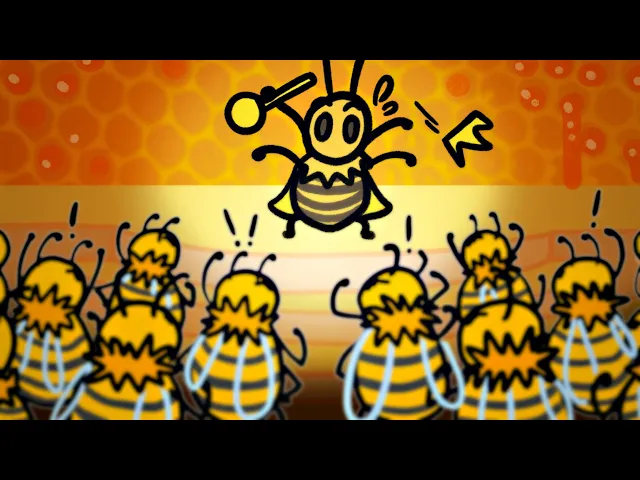
2:14 The workers might gang up on the old queen
2:16 and assassinate her –Julius Caesar style– or, the hive might fragment,
2:19 with a ton of workers swearing fealty to their new
2:22 sister-queen and flying off to start a new hive with her.
2:25 In either case, some, if not all,
2:27 workers are supplanting their own mother with a sister they’re more
2:31 closely-related to, so that she can pass on their shared genes.
2:35 But while things will be great for the new queen for a while,
2:39 her daughters might eventually decide to get rid of her too.
2:41 So while it might seem awesome to be the Queen Bee,
2:47 the reality can really sting.
2:50 Bees are awesome, but like many other important pollinators,
2:53 they are rapidly disappearing.
2:55 The good news is we can actually help: that’s why we joined Planet Wild.
2:59 Every month, we, as a community, fund a mission to restore our planet.
3:03 We love that they tackle problems with very specific
3:05 goals and show the results on their Youtube channel.
3:08 Like, how they helped save the habitat of Monarch butterflies in Mexico.
3:12 If you want to make a difference in nature,
3:14 consider joining us over at Planet Wild.
3:16 You can give whatever amount you like and the first 100 people to sign
3:19 up using our code MinuteEarth1 will get their first month paid for by us.
3:23 Just scan this QR code or click the link in the description.
3:26 And there's no catch here– you can cancel anytime.
3:29 If you want to see Planet Wild in action,
3:34 check out their butterfly mission here.