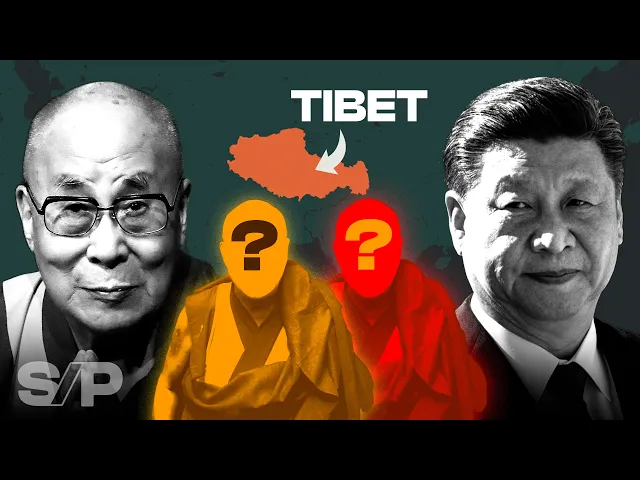
The battle for the next Dalai Lama
Search Party
0:00 [Sam] This is the Dalai Lama.
0:02 He's the spiritual leader for more than 7 million Tibetan Buddhists worldwide.
0:06 He's also an activist, humanitarian, and Nobel Peace Prize winner.
0:11 (crowd applauding) The Dalai Lama is also 90 years old,
0:15 and he's having a difficult time planning for the next Dalai Lama.
0:19 Since 1391, there have only been 14 Dalai Lamas.
0:23 It's believed that when they die,
0:25 they are reborn as their successor, a process called reincarnation.
0:30 The 15th Dalai Lama should be no different,
0:32 except he'll face a dilemma that no other Dalai Lama has before.
0:37 A rival Dalai Lama.
0:39 (bright music) China has occupied Tibet for more than seven decades.
0:43 It oppresses Tibetan culture and erases nearly
0:45 all the signs that Tibet was once independent, except for the most famous one.
0:51 Now China sees the Dalai Lama's impending death
0:53 as its best chance to finish the job.
0:56 What they see in the Dalai Lama institution,
0:58 the reincarnation system, is actually a launch pad for power.
1:03 They want their own puppet.
1:05 [Sam] So, how does China plan to install its own Dalai Lama?
1:09 What does it mean for Tibet?
1:11 And could it all backfire?
1:13 (upbeat music) (keypads clicking)- The reincarnation system
1:26 is a really unique form of succession.
1:30 [Sam] Tenzin Dorjee is a researcher at the Tibetan
1:33 Action Institute and a teacher at Columbia University.
1:36 Indians are the ones who developed the idea of rebirth,
1:38 the idea that every person has this kind of soul that is reborn after you die.
1:44 The Tibetans really took this idea and basically turned it into a practice.
1:49 [Sam] Tibetan Buddhists believe that Dalai
1:50 Lamas can control their own consciousness.
1:52 In 1933, the 13th died and directed his into a new person.
1:57 Then a group of senior Lamas went looking for him.
2:01 They found Lhamo Thondup in rural Tibet.
2:03 He was only two years old, but passed the tests they gave him.
2:07 They reported that he recognized the lead deputy
2:09 and items that belonged to the recently passed Dalai Lama.
2:14 In 1939, they recognized him as the 14th Dalai Lama.
2:18 They whisked him to this monastery in Lhasa, drilled him in Buddhist philosophy,
2:23 and prepared him to be the leader of Tibetan Buddhists.
2:26 But that was just half the job.
2:29 In 1950, the Dalai Lama assumed political leadership of Tibet the country.
2:33 A historically tricky job.
2:36 Tibet is located at the center of Asia between
2:39 three huge powers who see it as a buffer state.
2:42 Buffer states don't last for very long because there are power vacuum and all
2:47 these powers nearby in the neighboring region worry
2:50 about somebody else taking over that buffer state.
2:54 [Sam] In the 1700s, the Chinese Qing Dynasty invaded Tibet.
2:57 In the 1900s, the British Indian Empire invaded,
3:00 then handed Tibet over to the Qing Dynasty again.
3:03 When the Dalai Lama took power,
3:05 Tibet was enjoying a rare moment of independence.
3:08 But a year after communists took over China, they took over Tibet.
3:13 Initially, they let the Dalai Lama stay.
3:15 [Reporter] Communist China had promised to respect Tibet's
3:18 religious institutions and its right to local self-rule.
3:22 [Sam] But Tibetans grew fed up with China's brutal policies.
3:25 In 1959, they revolted.
3:27 China cracked down and threatened the Dalai Lama's life.
3:31 [Reporter] Against the communists' reign of terror, Tibetans took up arms.
3:35 It was a cry for liberty.
3:38 [Sam] In March 1959, the Dalai Lama fled Tibet,
3:40 crossed the Himalayas, and entered India.
3:43 There, he set up a Tibetan government in exile.
3:47 He would never return to Tibet.
3:50 China crushed the rebellion there, then began to remake the country.
3:54 It caused so much destruction to the language,
3:57 religion, the monasteries, institutions.
4:00 They want to achieve cultural and civilizational
4:02 domination over Tibet by turning Tibetans into Chinese.
4:08 [Sam] But while China tightened its grip on Tibet,
4:10 the Dalai Lama built a movement to save it.
4:12 (upbeat music) He traveled the world on behalf of the Tibetan cause.
4:17 Thousands came out to hear him speak.
4:19 (Dalai Lama speaking foreign language)- [Reporter] He speaks
4:23 of the recent misfortune of the Tibetan people,
4:25 who are enduring great hardships.
4:28 [Sam] He won the support of world leaders,
4:30 and even recruited celebrities to the cause.
4:33 One thing I learned, that is the compassion, a sense of caring.
4:38 Your neighbor's interest is your interest.
4:44 [Sam] Historically, there are tensions between
4:45 the four schools of Tibetan Buddhism, as well as non-Buddhist Tibetans.
4:48 But the Dalai Lama united them under his leadership.
4:53 He kept the Tibetan identity alive, and it infuriated China.
4:58 They have called him all sorts of names.
5:00 He's a wolf in monk's clothing.
5:03 The Dalai Lama is basically a separatist.
5:06 [Sam] But the Dalai Lama is not a separatist.
5:08 He actually advocates for Tibet to remain within China,
5:11 just with some autonomy, a compromise he calls the Middle Way.
5:15 Self-rule, autonomy.
5:16 I do not consider these are most important issues.
5:20 Most important issue is preservation of Tibetan Buddhist culture.
5:27 Many Tibetans don't agree with that, but because it's coming from him,
5:31 people are willing to accept the deal that he may be able to accomplish.
5:37 [Sam] Above all else,
5:37 the Dalai Lama opposes the use of violence, especially by Tibetans.
5:42 Through non-violence, through human understanding,
5:45 although it may take more time, that I consider genuine achievement.
5:52 He's trying to be so reasonable,
5:53 but he hasn't really found the type of audience in the Chinese government.
5:59 [Sam] While China rejects the Middle Way,
6:00 it understands that this Dalai Lama is a uniquely powerful figure.
6:04 So, it's planning to make sure the next one isn't.
6:08 If they can control the Dalai Lama institution,
6:11 they can use that to achieve the final
6:13 phase of invasion through civilization and culture.
6:18 [Sam] China already figured out exactly how to do it 30 years ago.
6:23 When you give to a nonprofit, how do you measure success?
6:26 You'll hear a lot about low overhead costs and efficient fundraising,
6:29 but what about the actual impact it makes on people's lives?
6:33 This week's sponsor is GiveWell,
6:34 and it's an organization that focuses on that impact.
6:37 GiveWell spends more than 70,000 hours a year on research,
6:40 helping donors fund highly cost-effective programs that save
6:44 or improve the most lives per dollar.
6:46 GiveWell has also spent 18 years researching global health
6:49 and development and directing funds only to the most high-impact programs.
6:53 Over 150,000 donors have already trusted
6:56 GiveWell to give more than $2.5 billion.
6:58 Rigorous evidence suggests that this funding could save more
7:02 than 300,000 lives and improve the lives of millions more.
7:05 You can find all their research and findings on their website for free.
7:08 And thanks to the donors who chose to sponsor their research,
7:11 GiveWell doesn't take a cut
7:12 from your tax-deductible donation to their recommended funds.
7:16 To find out more or to make a donation this year, go to GiveWell.org.
7:19 If you want to make a donation, go to YouTube and select Search Party so
7:23 GiveWell knows that you heard of them from us.
7:25 Again, that's GiveWell.org to donate or find out more.
7:29 Thanks again to the great work that they do and for supporting our work.
7:32 Now I'll take you back to the episode.
7:37 [Sam] In 1989, the second highest-ranking leader in Tibetan Buddhism died.
7:41 His position is called the Panchen Lama, which is also believed to reincarnate.
7:46 Senior lamas began looking for his successor initially with China's blessing.
7:51 In 1995, they identified a five-year-old boy.
7:53 But a few days later, he vanished.
7:56 The Chinese government basically abducted that boy,
7:58 kidnapped his whole family and disappeared him.
8:01 Nobody knows where this family is.
8:04 Nobody has seen them.
8:06 [Sam] China presented a different boy,
8:08 whose name it claimed was drawn out of a golden urn.
8:11 It's a succession ritual that Tibetan
8:13 Buddhists briefly used under the Qing dynasty,
8:15 for example, to select the 11th Dalai Lama.
8:18 China revived it and claimed that it made him the Panchen Lama.
8:22 30 years later, he reliably toes the Chinese Communist Party line.
8:27 Recently, he vowed to make Tibetan Buddhism more
8:30 Chinese in a meeting with China's leader, Xi Jinping.
8:33 Most Tibetans don't recognize China's Panchen Lama, only the kidnapped one.
8:38 Many outside of Tibet do it openly.
8:40 Those inside Tibet do it privately.
8:44 But with him, China proved that even
8:46 an illegitimate lama can help achieve its goal.
8:49 They were not able to build legitimacy of their own,
8:52 but they were able to destroy Tibetan power, Tibetan leadership.
8:59 [Sam] China plans to run the same playbook on the Dalai Lama's successor.
9:02 It says his name must come from the golden urn
9:05 and that any candidate named by a foreign government is illegitimate,
9:09 something the current Dalai Lama has spent years rejecting.
9:12 My next life, ultimately, I will decide, no one else.
9:19 [Sam] But China's plan is an existential threat for the Dalai Lama's movement.
9:23 And so, he's considered changing his own succession plan, sometimes drastically.
9:29 In 2011, the Dalai Lama wrote that he would
9:31 re-evaluate whether the institution of the Dalai Lama should continue.
9:35 The prospect of no Dalai Lama
9:37 caused shock among Tibetan Buddhists and, interestingly,
9:40 anger from the Chinese government.
9:43 The Chinese government went nuts and they said, no, you must reincarnate.
9:48 As long as the Dalai Lama institution is there,
9:50 the Chinese government at least has something that they
9:54 can see and identify and try to control.
10:00 [Sam] In 2024, the Dalai Lama confirmed he would reincarnate
10:02 as a new person and be identified and named by senior leaders.
10:07 But he's also said that he may reincarnate as a boy
10:09 or a girl and one born in a free country.
10:14 There are around 150,000 Tibetans living in 40 countries.
10:17 Most are in India.
10:19 But while these changes give more flexibility for naming a successor,
10:22 they won't stop China from using the golden urn to name its own Dalai Lama.
10:27 So most likely there will be two people claiming to be the 15th Dalai Lama.
10:32 And while only this one will enjoy the recognition of most Tibetans,
10:35 they'll face two unprecedented challenges.
10:38 One, dealing with a Chinese-named Dalai Lama.
10:41 And two, holding together a worldwide movement
10:44 that has only ever known one uniquely talented leader.
10:47 We all pray and hope that the 15th Dalai Lama, he or she or they,
10:52 would be very, very successful both
10:54 at the national level and at the global level.
10:56 But it will be very difficult to see this type of total wholehearted devotion.
11:05 [Sam] That's what China's hoping for.
11:07 But could a Uyghur Dalai Lama backfire?
11:11 Recently, China's domination of other regions makes most of the headlines.
11:15 Its campaign to eliminate the Uyghur minority in western China.
11:18 (people singing) Its undermining of autonomy in Hong Kong.
11:25 [Reporter 1] Media mogul Jimmy Lai is convicted in Hong Kong
11:28 in a case that's become a symbol of Beijing's crackdown on dissent.
11:33 [Sam] Its aggression in the South China Sea.
11:35 [Reporter 2] And Beijing has been issuing warnings to other
11:37 ships and planes to stay away from these man-made islands.
11:41 [Sam] And of course, its threats to invade Taiwan.
11:43 [Reporter 3] China is sticking to its ambitions
11:44 to be ready to invade Taiwan by 2027.
11:48 [Sam] But it doesn't mean the dispute over Tibet is over.
11:52 In 1987, protests spiraled into riots.
11:55 And in 2008, Tibetans rioted and vandalized Chinese businesses.
11:59 Both times, the Dalai Lama condemned the violence and helped end it.
12:04 If you utilize the violent method, then I totally against it.
12:08 If violent thing, then my option, I resign.
12:13 [Sam] China may not like him,
12:15 but this Dalai Lama controls the most radical elements of his movement.
12:19 If the next one can't,
12:20 there could be another uprising in Tibet with no one to help stop it.
12:25 The Dalai Lama has always been an earnest
12:28 and genuine negotiator who wants to compromise,
12:31 who's willing to compromise, right?
12:33 And now the Chinese government is about to lose their person.
12:37 And I think the Chinese government will come to appreciate that too late.
12:42 [Sam] China thinks that hijacking the next Dalai
12:44 Lama will put to rest Tibetans' fight for independence.
12:47 But it may just reawaken it.
12:50 (upbeat music) Search Party covers the whole world,
12:56 so the next time we're covering a story from Tibet or Thailand or Tampa,
12:59 Florida, we want your help.
13:01 Newpress.com is a new website that I'm building with fellow journalists
13:05 that will put the community back at the heart of journalism.
13:08 At NewPress, you'll be able to follow stories I'm working
13:11 on from the very beginning and participate in story call-outs.
13:14 I need your ideas and your perspectives to cover some of these places.
13:17 So over at NewPress.com, you can join the waitlist right now.
13:20 We're getting started very soon.
13:22 So, join the waitlist at NewPress.com and you'll hear from us very soon.
0:00 That's our last video for the year.
13:27 This year we'll be back in January.
13:29 I just want to thank everyone who is here, who subscribed, and who watched.
13:35 I want to give a special thanks to my team as well.
13:36 These videos are not just me.
13:37 It's a whole team that comes together
13:39 twice a month to put together these stories.
13:41 They worked incredibly hard.
13:43 Their names are here in the credits.
13:44 So, thanks to them for an amazing 2025.
13:47 We'll be back in 2026 with a lot more videos.
13:50 I'm excited for you to see them and enjoy the new year.
13:54 And we'll see you then.