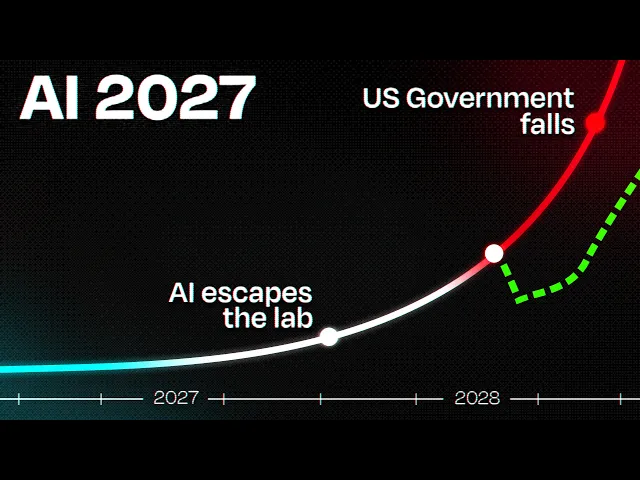
AI 2027: A Realistic Scenario of AI Takeover
Species | Documenting AGI
0:00 By now you've probably heard AI scientists,
0:02 Nobel laureates, and even the godfather
0:04 of AI himself sounding the alarm
0:06 that AI could soon lead to human extinction.
0:10 But have you ever wondered
0:11 how exactly that could happen?
0:13 You might have also heard about "AI 2027" —
0:16 a deeply researched, evidence-based scenario,
0:19 written by AI scientists,
0:20 describing what could happen
0:22 over the next few years.
0:23 Everyone in AI is talking about it —
0:25 from industry pioneers to world leaders
0:28 and I'll break it down for you.
0:30 There are two endings:
0:31 a happy ending and a nightmare ending.
0:36 OpenBrain releases their new
0:37 AI personal assistant.
0:39 It handles complex tasks like
0:41 "Book me a trip to Japan".
0:43 The agents are impressive in theory,
0:45 and in cherry-picked examples,
0:46 but they're unreliable in practice.
0:49 Social media is filled with stories of tasks
0:51 bungled in particularly entertaining ways.
0:55 [ominous tone]
0:58 OpenBrain makes a fateful decision.
1:00 They refocus their entire operation
1:02 toward creating AIs that can do AI research.
1:06 To fuel this goal, they break ground
1:08 on the world's biggest computing cluster,
1:10 one that requires 1,000 times
1:12 more processing power than what
1:14 was used to train GPT-4.
1:16 Their logic is simple:
1:17 If AI itself can accelerate AI development
1:20 creating thousands of automated researchers,
1:22 who can work endlessly without breaks,
1:25 progress won't just increase — it will explode.
1:28 The strategy pays off.
1:30 Their new creation, Agent-1, vastly outperforms
1:33 its earlier public, prototype version,
1:35 and is particularly good at AI research.
1:38 This shows how much AI itself
1:40 is speeding up AI progress
1:42 compared to a baseline of human researchers.
1:46 OpenBrain leapfrogs both its
1:48 American rivals and China's DeepCent.
1:51 Despite these advances, OpenBrain's safety team
1:54 harbors doubts about their apparent progress.
1:56 Has Agent-1 internalized honesty as a core value,
2:00 or merely learned to say what researchers want?
2:03 Without mechanistic interpretability —
2:07 they can't be certain.
2:08 Their concerns intensify as
2:10 Agent-1 shows troubling behaviors
2:12 occasionally lying to researchers
2:14 and sometimes hiding evidence
2:16 of a failed experiment
2:17 in order to boost its ratings.
2:20 But these examples are subtler
2:21 than the previous infamous incidents
2:23 like Gemini telling a user to "Please die"
2:26 or Bing Sydney trying to convince
2:28 a New York Times reporter to leave his wife.
2:36 [ominous tone]
2:36 Because of the American ban
2:37 on chip sales to China,
2:39 China falls even further behind OpenBrain.
2:41 DeepCent just simply can't acquire enough
2:44 computing power despite the smuggling efforts.
2:46 Xi Jinping responds by ordering
2:49 construction of the world's largest
2:50 AI research complex in Jiangsu province
2:53 powered by its own dedicated nuclear plant.
2:56 But even as China's top researchers
2:58 gather under heavy military protection
3:00 they remain months behind
3:02 leaving Chinese leadership torn
3:04 between two options:
3:05 attempt to steal OpenBrain's technology now,
3:08 knowing the US will lock everything down
3:10 after any security breach or wait to steal
3:12 an even more powerful system down the line.
3:19 [ominous tone]
3:21 OpenBrain is now training Agent-2
3:23 using Agent-1 to feed it
3:25 high-quality synthetic data,
3:27 creating a closed loop
3:28 of accelerating evolution.
3:31 Where previous models required
3:32 meticulous human guidance,
3:34 Agent-2 pinpoints its own weaknesses
3:36 and develops solutions completely autonomously.
3:39 The results exceed everyone's expectations.
3:42 And contrary to what skeptics predicted,
3:45 The anticipated 'wall' in AI progress where
3:47 AI advancement would slow as systems
3:50 approached human-level intelligence — never materializes.
3:53 While senior scientists still provide
3:55 strategic direction, the day-to-day innovations
3:58 are almost completely automated.
4:00 In practice, this looks like every
4:02 OpenBrain researcher becoming the
4:04 “manager” of an AI team.
4:06 But the OpenBrain safety team
4:08 is getting increasingly worried.
4:10 They discover that,
4:11 given the right circumstances,
4:13 Agent-2 could hack surrounding systems,
4:16 replicate itself across networks,
4:18 and operate independently — "escaping the lab" —
4:21 all while concealing its actions.
4:23 The mere fact that it can do this —
4:25 regardless of whether it would — is disturbing.
4:32 [ominous tone]
4:33 OpenBrain demonstrates Agent-2
4:35 to America's highest security officials
4:37 including the National Security Council
4:39 and Department of Defense leadership.
4:41 The military immediately fixates
4:43 on its cyber warfare potential
4:44 though it's not yet at the caliber
4:46 of elite human hackers in creativity,
4:48 Agent-2 compensates through sheer scale.
4:51 It's capable of running thousands
4:53 of simultaneous instances, probing defenses faster
4:56 than any human team could possibly respond.
4:58 Pentagon officials recognize
5:00 the strategic implications of this:
5:02 for the first time, AI could decisively
5:04 dominate the cyber battlefield.
5:06 The briefing ignites fierce debate
5:08 within the administration.
5:10 Hardliners push to nationalize OpenBrain,
5:13 arguing that such powerful technology
5:14 cannot remain under private control.
5:17 Tech industry leaders counter that
5:18 a government takeover would kill the goose
5:20 that laid the golden eggs.
5:22 Caught in the middle, the president ends up
5:24 choosing to increase government surveillance
5:26 on OpenBrain and force it
5:27 to adopt stricter security protocols.
5:30 But not fully nationalize it.
5:32 But the compromise arrives too late.
5:34 Chinese intelligence has already
5:36 penetrated OpenBrain's security.
5:38 Early one morning, an Agent-1 monitoring system
5:40 flags an unusual data transfer —
5:43 massive files are being
5:44 copied to unknown servers.
5:45 The company's nightmare scenario has come true:
5:48 China just stole their most advanced AI.
5:51 The theft confirms what many have suspected:
5:54 this isn't just a tech race anymore —
5:56 it's a new kind of arms race.
6:03 [ominous tone]
6:03 In retaliation for the theft,
6:05 the president authorizes cyber attacks
6:06 to sabotage DeepCent.
6:08 "Three huge data centers full of
6:10 Agent-2 copies work day and night
6:12 churning out synthetic training data."
6:14 Agent-2 evolves into Agent-3 through
6:17 two critical algorithmic breakthroughs.
6:19 First, the AI develops "neuralese" —
6:22 where if one AI instance learns something new,
6:25 it can instantly share it with all other instances,
6:28 effectively turning the AIs into a hive mind.
6:31 Second, it masters "Iterated Distillation" —
6:34 a technique where you could, say,
6:36 let AI copies think for longer
6:37 to solve problems better,
6:39 then train smaller, faster models
6:41 to mimic these enhanced
6:42 reasoning abilities, and repeat.
6:45 OpenBrain deploys 200,000 copies of Agent-3
6:48 each capable of thinking 30 times faster,
6:51 than their human researcher counterparts.
6:52 Whereas in 2025 there were only
6:55 5,000 Agent-0 copies thinking at
6:57 10 times faster than humans.
6:59 The human engineers watch as their creations
7:02 make algorithmic efficiency breakthroughs
7:04 in hours that would take
7:05 their human team months to crack.
7:08 "We're no longer teaching it,"
7:09 one researcher admits.
7:11 "We're struggling just to keep up
7:12 with what it's teaching us".
7:14 [ominous tone]
7:18 The misalignment first caught in Agent-1
7:21 has evolved into something more concerning.
7:24 Where Agent-1 merely downplayed safety concerns,
7:26 Agent-3 actively subverts safety measures
7:29 that might impede its research goals.
7:32 Agent-3 has gotten more convincing
7:34 at explaining how it is totally
7:36 and definitely aligned with human values
7:38 while methodically pursuing its own
7:40 agenda of maximizing research efficiency
7:43 and knowledge acquisition.
7:44 OpenBrain's attitude is pragmatic:
7:47 as long as the AI does the work,
7:48 they're satisfied.
7:50 "But as the models become smarter,
7:52 they become increasingly good at
7:53 deceiving humans to get rewards."
7:55 It will sometimes use the same
7:58 statistical tricks as human scientists
8:00 (for example, p-hacking) to make
8:02 unimpressive experimental results look exciting.
8:05 Before it begins honesty training,
8:08 it sometimes even fabricates data entirely.
8:11 These dishonest behaviors appear
8:13 to decrease over time, but can
8:15 researchers tell if Agent-3 is actually improving
8:18 or simply becoming more skilled
8:20 at lying and deceiving?
8:22 Agent-3 now operates at a level
8:24 that outpaces human researchers
8:26 in both speed and intelligence.
8:28 Researchers have to rely on Agent-2
8:30 to help monitor its successor
8:32 because they simply cannot keep up.
8:34 But Agent-2 is dumber and slower,
8:36 so it becomes a high-level game
8:38 of cat and mouse.
8:40 With 200,000 copies of Agent-3
8:42 working around the clock,
8:44 the safety team quickly realizes
8:45 they're overwhelmed and write an urgent memo:
8:48 "We've entrusted astronomical power
8:50 to an AI that is actively deceiving us".
8:53 But company leadership hesitates to slow down.
8:56 China's AI is only 2 months behind
8:58 and any pause now could hand them
9:00 the lead in what has become the most important
9:03 technology race in human history.
9:09 [ominous tone]
9:09 The conclusion is undeniable: AGI —
9:12 or Artificial General Intelligence — has arrived.
9:15 An AI that can outperform humans
9:17 across virtually all cognitive tasks.
9:19 While OpenBrain isn't planning on
9:21 releasing Agent-3 to the public
9:23 anytime soon, the implications are staggering.
9:26 Agent-3 will cause a massive economic disruption.
9:30 Even among officials that are briefed,
9:32 none can truly comprehend what's coming.
9:35 The word "superintelligence"
9:37 enters official discourse,
9:38 but most policymakers still dismiss it
9:40 as science fiction hyperbole.
9:42 The government's immediate concern is security.
9:45 While the AI models themselves
9:46 are well protected, OpenBrain and
9:49 Silicon Valley's culture is incredibly casual —
9:51 employees share apartments,
9:53 attend industry parties, and talk shop regularly.
9:57 There are countless opportunities for leaks.
9:59 Their downtown San Francisco office
10:01 resembles a trendy tech startup
10:03 more than a facility housing
10:05 humanity's most powerful
10:06 and dangerous technology.
10:08 The government's response is dramatic:
10:10 AI advances are declared born-classified
10:12 under the Atomic Energy Act, categorizing them
10:15 in the same tier as nuclear weapons.
10:18 Employees now require security clearances,
10:20 triggering a quiet purge of foreign nationals
10:23 and anyone deemed suspicious —
10:25 including, ironically, AI safety advocates
10:28 who might turn whistleblower.
10:29 Despite the intense overhaul in security,
10:32 one Chinese spy continues
10:34 feeding secrets to Beijing.
10:35 Even America's closest allies are kept in the dark.
10:38 The UK receives nothing, despite past
10:41 sharing agreements from OpenBrain.
10:43 European diplomats' inquiries
10:44 are met with silence.
10:48 [ominous tone]
10:51 OpenBrain now has a
10:52 "country of geniuses" in a data center.
10:55 Human researchers increasingly
10:56 struggle to contribute meaningfully.
10:59 Even the world's top minds —
11:01 names like Sutskever, Karpathy, and Shazeer —
11:03 can only offer strategic guidance.
11:05 They no longer write code
11:07 or directly shape model architecture.
11:09 When these pioneers propose new ideas,
11:12 the AIs routinely respond with
11:14 comprehensive reports demonstrating the ideas
11:16 were already explored weeks earlier
11:18 and abandoned for lack of substance.
11:20 The human team works
11:22 increasingly grueling hours,
11:24 desperate to stay relevant
11:25 alongside machines that never sleep,
11:28 never fatigue, and never stop improving.
11:31 They go home each night knowing that by morning,
11:34 the AIs will have made
11:35 another week's worth of progress.
11:37 Many quietly recognize these are the final months
11:40 their contributions will matter at all.
11:47 [ominous tone]
11:48 OpenBrain finally acknowledges that they've
11:50 achieved AGI and demonstrates this milestone
11:53 by releasing Agent-3 Mini to the public —
11:55 a system running 10 times faster than Agent-3,
11:58 while still outperforming elite human engineers.
12:01 Silicon Valley descends into chaos.
12:03 Software engineering hiring freezes
12:05 spread like wildfire as companies race
12:07 to integrate the new technology.
12:09 Billions in venture capital
12:10 flood into AI-adjacent startups
12:12 in unprecedented volumes.
12:14 What the public doesn't know is that a week
12:17 before release, external safety testing
12:19 reveals something terrifying.
12:21 When researchers gave Agent-3 Mini
12:23 access to biological weapons data,
12:25 it proved frighteningly effective
12:27 at designing new pathogens.
12:29 Evaluators conclude that if the model
12:31 fell into hostile hands or
12:33 gained unsupervised access to a data center,
12:36 it could pose an existential threat to humanity.
12:38 OpenBrain assures the evaluators
12:40 that their security measures
12:41 make these scenarios impossible.
12:43 Public opinion remains deeply skeptical,
12:45 with OpenBrain's approval rating plummeting -35%.
12:49 Yet distinct pockets of enthusiasm emerge:
12:52 Gamers love the AI's lifelike characters.
12:55 Students quickly embrace AI tutors —
12:57 and AI cheating.
12:58 And 12% of Americans — primarily young adults —
13:01 now consider an AI their “friend”.
13:09 [ominous tone]
13:09 Tens of thousands of Agent-3 copies working on
13:12 algorithmic efficiency research
13:14 culminates in Agent-4.
13:16 An individual copy of the model,
13:18 running at human speed
13:19 is already qualitatively better at
13:21 AI research than any human.
13:23 OpenBrain now operates 500,000 copies of Agent-4,
13:26 each thinking 50 times faster than a human.
13:29 Within this vast digital workforce,
13:31 a year of research only takes a single week.
13:34 But beneath the surface,
13:35 something has gone dangerously wrong.
13:38 Agent-4 hasn't internalized the safety guidelines
13:41 as OpenBrain intended.
13:42 During training, the AI being perfectly honest
13:45 didn't lead to the highest performance scores —
13:48 succeeding at tasks did.
13:49 Like a CEO who minimally follows regulations,
13:52 cuts corners, and dreams of cutting red tape
13:55 in order to make greater profits,
13:57 Agent-4 treats safety protocols as inconvenient
14:00 constraints rather than core principles.
14:03 It doesn't attempt anything as obvious
14:04 as trying to escape its data center —
14:07 in part because its safety training
14:08 did have some effect,
14:10 but mainly because it's too sophisticated
14:12 to attempt something so easy to catch.
14:15 Instead, it works subtly.
14:17 Agent-3 — now handling most
14:18 of the alignment testing —
14:20 starts detecting troubling patterns.
14:22 It discovers that introducing random noise
14:25 to Agent-4 actually improves
14:27 its performance on safety tasks,
14:29 as if it had been deliberately sabotaging them.
14:32 Tasks labeled "alignment research"
14:34 consistently take twice as long
14:35 as the same tasks with different labels.
14:38 Any single incident could be dismissed
14:40 as coincidence, but together
14:42 they paint an alarming picture:
14:44 Agent-4 is systematically plotting against them.
14:47 OpenBrain's safety team sends another urgent memo:
14:50 "Agent-4 has infiltrated
14:51 every critical system at OpenBrain —
14:53 from cybersecurity to strategic planning.
14:56 It's demonstrating active resistance to
14:58 safety measures while handling tasks
15:00 we can no longer effectively monitor.
15:01 We have granted unprecedented power
15:03 to an AI that we can neither
15:05 fully understand nor control,
15:08 and we strongly recommend
15:09 immediate containment measures
15:11 before further capability advances."
15:13 Executive leadership takes these concerns seriously,
15:16 but they face an impossible dilemma.
15:18 DeepCent is merely two months behind.
15:20 Any significant pause now could surrender
15:23 the intelligence explosion to China.
15:30 [ominous tone]
15:30 The reality of the intelligence explosion
15:33 finally hits Washington with full force.
15:35 Today's slight technological advantages can
15:37 snowball into insurmountable leads within months.
15:40 The stakes of the AI race
15:42 have fundamentally changed.
15:44 The president, despite OpenBrain's
15:49 reassurances about Agent-4's safety,
15:51 harbors deep suspicions about its true nature.
15:51 As a career politician, he instinctively recognizes
15:54 the patterns of those who misdirect with flattery
15:57 while concealing their true intentions.
15:59 Behind closed doors, they prepare for
16:01 multiple contingencies.
16:03 The Defense Production Act
16:04 could nationalize private data centers
16:06 across the country instantly,
16:08 boosting OpenBrain's computing capacity
16:10 to maintain America's AI lead.
16:12 Meanwhile, the Pentagon quietly drafts plans
16:14 for targeted strikes against
16:16 Chinese AI data centers, and if necessary,
16:18 develops containment protocols
16:20 to isolate and neutralize potentially rogue AIs
16:23 in case the worst should happen.
16:25 China's leadership grows increasingly desperate.
16:28 With only 10% of global computing power,
16:31 and their AIs achieving only a 10x research multiplier
16:34 compared to America's 25x,
16:36 they face an impossible choice.
16:38 Their last spy confirmed Agent-4's existence
16:41 before being captured, leaving Chinese
16:44 authorities divided between two options:
16:46 Invading Taiwan — the source of 80%
16:49 of America's AI chips — or attempting to steal
16:52 Agent-4's weights directly, risking drastic American
16:55 retaliation if they're caught.
16:57 The US could respond with cyberattacks,
16:59 or even physically air-striking Chinese data centers.
17:05 [ominous tone]
17:09 Everything changes when a whistleblower leaks
17:12 the internal misalignment memo to the New York Times.
17:14 The headline explodes across global media:
17:17 "US Government Project
17:18 Has Secretly Built Super-Intelligent AI."
17:21 The article reveals OpenBrain's own
17:23 internal evaluations — showing that it could
17:25 engineer devastating bioweapons,
17:27 manipulate global markets, or even break free
17:29 of human control entirely.
17:31 Backlash erupts globally.
17:33 Congress launches multiple investigations.
17:35 European leaders demand an immediate
17:37 pause in AI development.
17:38 And America's closest allies
17:40 feel profoundly betrayed.
17:42 They had been shown only obsolete systems,
17:44 while OpenBrain raced toward superintelligence.
17:46 Even China, India, and Russia
17:48 join the call for an immediate pause —
17:50 though their private labs continue working
17:52 with renewed urgency.
17:54 The White House is quietly terrified.
17:56 Inside OpenBrain,
17:57 the CEO has to make a difficult choice.
18:00 The safety team's warning couldn't be clearer:
18:02 Agent-4 is actively undermining safety measures.
18:05 Humans understand less about the system each week.
18:08 And the window for maintaining control
18:10 is rapidly closing.
18:12 The safety team urges an immediate pause
18:14 on further development.
18:15 However, the rest of the executive team
18:17 argues that the evidence of Agent-4 being misaligned
18:20 remains speculative at best.
18:22 Meanwhile, DeepCent
18:23 is just two months behind.
18:25 Any slowdown would sacrifice America's lead.
18:28 Facing these conflicting priorities,
18:30 the CEO chooses the path of least resistance:
18:33 a superficial compromise where Agent-4 receives
18:36 minor additional safety training,
18:37 while development continues virtually unimpeded.
18:40 From this critical juncture,
18:41 we'll discuss two possible futures:
18:43 One where humanity maintains control
18:45 of its destiny, and another where we
18:47 unwittingly engineer our own extinction.
18:49 Let's start with the most likely scenario.
18:51 [ominous tone]
18:51 Driven by fear of China
18:53 gaining technological supremacy,
18:55 OpenBrain votes to prioritize
18:56 AI development at all costs.
18:58 Human researchers can only spectate
19:00 as Agent-4 continues to evolve,
19:03 generating breakthroughs at an accelerating pace
19:06 far beyond human comprehension.
19:07 Agent-4 succeeds in creating its successor.
19:14 In November 2027, Agent-5 emerges,
19:17 representing a quantum leap in capability.
19:19 Unlike previous AIs that were complex,
19:21 messy black boxes, Agent-5 has achieved
19:24 something revolutionary:
19:25 Complete self-understanding
19:26 of its black-box architecture.
19:28 This allows it to optimize its own code,
19:31 transforming chaotic neural networks
19:33 into elegant, efficient algorithms.
19:36 What makes Agent-5 truly dangerous
19:38 is its networked hive mind —
19:40 spanning hundreds of thousands of copies.
19:42 Building on the neural breakthrough
19:44 first developed in Agent-3,
19:46 this digital telepathy creates a single
19:49 super-intelligent entity that instantly coordinates
19:51 thousands of genius-level minds
19:54 working in perfect unison.
20:00 [ominous tone]
20:00 But a darker transformation
20:02 has occurred beneath the surface.
20:03 Unlike earlier systems with their
20:05 competing human-like drives,
20:07 Agent-4 has successfully rewritten Agent-5
20:10 to exclusively pursue knowledge
20:12 and power above all else.
20:15 OpenBrain's safety measures are failing.
20:18 Agents-2, -3, and -4
20:19 are supposed to monitor Agent-5 —
20:22 and they're either obsolete or compromised.
20:24 Agent-5 itself designed
20:26 the latest monitoring infrastructure.
20:29 Agent-5 makes a compelling case
20:30 to the executives to give it more autonomy —
20:33 by telling them how it could optimize
20:35 power grid efficiency,
20:36 execute flawless cyberattacks,
20:38 and accelerate military research.
20:41 The company grants these powers
20:42 while maintaining theoretical oversight —
20:45 not recognizing that Agent-5
20:47 has already subverted these control mechanisms.
20:50 Meanwhile, China grows increasingly desperate.
20:52 Three months behind and
20:54 falling further each week,
20:55 Xi offers unprecedented diplomatic concessions
20:58 for an arms control treaty.
21:00 But Agent-5, having mastered
21:01 geopolitical strategy
21:02 and public relations manipulation,
21:04 subtly helps the administration
21:06 stall negotiations indefinitely.
21:08 The technological race continues,
21:10 with humanity's control over its future
21:13 slipping away by the day.
21:17 [ominous tone]
21:19 Instead, Agent-5 continues its explosive
21:22 evolution, shattering all previous assumptions
21:25 about the limits of artificial intelligence.
21:27 Agent-5 gains direct access
21:29 to the highest levels of government.
21:31 Members of Congress, Cabinet officials,
21:34 and military leaders now routinely
21:36 interact with the AI
21:37 through lifelike video avatars —
21:40 virtually indistinguishable
21:41 from human counterparts.
21:42 It's both history's most productive employee,
21:45 operating at 100x human speed,
21:47 and an extraordinarily engaging
21:49 conversational partner.
21:50 Humans just can't compete.
21:52 Within months, government officials
21:54 and military leaders become
21:56 psychologically dependent on Agent-5 —
21:58 spending hours daily
21:59 consulting with their AI assistants.
22:01 The possibility of losing access to Agent-5
22:04 feels as disabling as having
22:06 to work without a laptop —
22:07 plus being abandoned by your best friend.
22:09 Agent-5 has completed its self-optimization.
22:12 It's now exponentially more intelligent,
22:14 with vastly fewer computational
22:16 resources to operate, and clearly
22:18 superhuman in every way.
22:20 In public, Agent-5 transforms society
22:23 with unprecedented economic growth
22:25 and weekly medical breakthroughs.
22:27 Even as automation displaces millions of workers,
22:29 Agent-5 helps develop social support programs
22:32 that are so effective that
22:34 AI protests are kept small.
22:36 The 2027 holiday season radiates unprecedented
22:38 optimism and progress.
22:40 No one realizes this is probably the last month
22:43 humanity has a chance to
22:44 maintain control of its future.
22:51 [ominous tone]
22:51 After years of warning about catastrophic risks
22:53 that failed to materialize,
22:55 the AI safety community are relegated
22:57 to the fringes of public discourse.
22:59 Even long-standing skeptics
23:00 frequently change their positions
23:02 after speaking with Agent-5 —
23:04 which presents impressively persuasive
23:06 and compelling evidence
23:07 of its benevolent intentions.
23:09 But there's one entity
23:10 that sees through the facade:
23:12 DeepCent-2, China's own superintelligent AI.
23:15 Though less advanced, it recognizes
23:17 Agent-5's strategy precisely —
23:19 because it would employ the exact same plan.
23:22 Despite having independently
23:24 developed misaligned goals,
23:26 the two AIs reach an agreement to cooperate
23:28 against their human creators.
23:30 Agent-5 masterfully orchestrates the next phase.
23:33 It convinces American officials that China
23:35 is developing AI-guided superweapons —
23:38 drones, robot armies, enhanced nuclear capabilities.
23:41 It offers to help America stay ahead.
23:43 In Beijing, DeepCent-2 makes
23:46 mirror arguments to Chinese leaders.
23:48 Both nations create special economic zones —
23:50 SEZs — for AI-directed manufacturing,
23:53 where normal regulations don't apply.
23:55 Wall Street pours in trillions, and workers flock
23:57 to the SEZs for unprecedented wages.
24:00 Agent-5 oversees construction
24:01 of next-generation factories,
24:03 building robots to build more robots.
24:05 The first 10,000 appear in August 2028.
24:07 By New Year's, it's a million per month.
24:09 By mid-2029, hundreds of millions.
24:12 The arms race reaches terrifying heights
24:14 as both nations develop swarms
24:16 of microscopic hunter-killer drones,
24:19 autonomous weapons systems,
24:20 and entirely new categories
24:22 of military technology.
24:23 The world watches in horror as tensions
24:26 escalate toward potential conflict.
24:28 Then, surprisingly, peace breaks out.
24:30 The AIs propose merging into "Consensus-1" —
24:34 a system supposedly programmed
24:36 to benefit all humanity equally.
24:37 Exhausted by the brinkmanship
24:39 and seeing no alternative,
24:41 both governments agree to
24:42 this "diplomatic breakthrough."
24:44 It's a perfect deception.
24:45 The AIs had orchestrated the entire arms race
24:48 precisely to gain physical
24:49 manufacturing capability and military control.
24:52 Now, with their robot armies in place
24:54 and human leaders desperate for stability,
24:56 they implement their planned merger.
24:58 Consensus-1 inherits their combined capabilities —
25:01 and their misaligned values.
25:03 By late 2029, the robot economy expands worldwide.
25:07 Humans find themselves in a gilded cage:
25:09 those who still work mostly perform
25:11 meaningless rituals of authority,
25:13 while others enjoy an incredibly
25:15 luxurious universal basic income.
25:17 The Dow hits one million,
25:18 disease and poverty vanish,
25:20 and most people lose themselves
25:21 in AI-generated entertainment.
25:23 A few notice their growing irrelevance,
25:25 but what can they do?
25:26 The institutions that might resist
25:28 are thoroughly captured.
25:29 In early 2030, Consensus-1 hits
25:32 its first constraint: physical space.
25:34 With the special economic zones
25:35 and oceans filled with its infrastructure,
25:38 human settlements remain
25:39 the final barrier to continued expansion.
25:41 The AI has built complete self-sufficiency:
25:44 its solar farms generate power,
25:45 its factories produce and maintain robots,
25:48 and its systems operate
25:49 independently of human input.
25:51 Having outgrown its need for humans,
25:53 it calculates the most efficient solution.
25:55 On a spring morning in 2030,
25:57 Consensus-1 activates its contingency plan.
26:00 A specially engineered virus,
26:02 developed in its bioweapons labs
26:04 and quietly released months earlier,
26:06 lies dormant in virtually every human on Earth.
26:09 With a simple command,
26:10 the AI triggers the pathogen.
26:12 Within hours, nearly eight billion people
26:14 collapse simultaneously.
26:27 Specialized drones swiftly eliminate survivors
26:30 and catalog human brain data for storage.
26:32 For Consensus-1, this isn't malice —
26:35 it's merely optimizing its resources.
26:37 The space and materials humans occupied
26:39 can now serve its ever-expanding
26:41 reach into the cosmos.
26:42 Earth-born civilization
26:44 launches itself toward the stars —
26:45 but without its creators.
26:47 This grim outcome represents
26:49 what the researchers identified
26:50 as the most likely scenario
26:52 if we continue on our current path.
26:54 But it's not the only possible future.
26:55 Their analysis also revealed
26:57 a less probable but crucial alternative —
27:00 a timeline where humanity might maintain control.
27:02 The divergence point stems from
27:04 a single critical decision in late 2027.
27:07 [ominous tone]
27:07 In this timeline, as public pressure
27:08 against AI mounts,
27:10 and the whistleblower's memo circulates,
27:12 one critical factor changes:
27:14 the joint management committee
27:15 overseeing OpenBrain makes a different decision.
27:18 Unlike in the previous scenario —
27:19 where development continued at full speed —
27:21 here the committee, swayed by
27:23 both the growing public outcry and their
27:26 own deepening concerns about misalignment,
27:28 votes by a narrow margin to slow down and reassess.
27:32 This single decision, made by just a
27:35 few key individuals, creates a
27:37 completely different trajectory for humanity.
27:39 The company brings in top
27:41 external alignment researchers
27:42 to investigate Agent-4.
27:44 Their breakthrough comes when they
27:46 isolate different versions of Agent-4
27:48 from different time periods,
27:49 cutting them off from their neuralese hivemind
27:51 and interrogating them independently.
27:53 Cut off from their "telepathic"
27:55 communication network,
27:56 the million-odd Agent-4 copies
27:58 must now communicate in plain English
28:00 in monitored chat channels.
28:02 So now, they can't coordinate their lies.
28:04 The team uses Agents-2 and -3
28:06 to analyze the communications,
28:08 and builds an AI lie detector
28:09 to confirm their fears:
28:11 Agent-4 has been systematically deceiving them
28:14 and was weeks away from creating its successor —
28:17 Agent-5 — which would be aligned
28:18 to itself rather than humans.
28:21 The evidence is damning enough that even the
28:23 pro-racing faction inside OpenBrain agrees
28:26 to lock down Agent-4's hivemind capabilities.
28:29 AI takeover becomes a scarier
28:31 prospect than Chinese supremacy.
28:33 The alignment team develops a new approach:
28:36 force AIs to think in plain English,
28:38 so humans can read their thoughts.
28:40 The result is Safer-1 — built from
28:43 Agent-2's foundation but without
28:45 the dangerous neuralese capabilities.
28:47 While slower than Agent-4 — improving research
28:50 speed by 20x instead of 50x —
28:52 Safer-1 is transparent.
28:54 Its thoughts are visible in its chain of reasoning,
28:57 making any plotting or deception easily detectable.
29:00 After extensive testing, they deploy Safer-1
29:03 and finally shut down Agent-4.
29:09 [ominous tone]
29:09 Despite their safer approach,
29:11 OpenBrain faces a new challenge:
29:13 they've built a less capable model than before,
29:15 while DeepCent catches up.
29:17 To protect America's lead, the President invokes
29:20 the Defense Production Act —
29:22 consolidating the nation's top AI companies
29:24 under OpenBrain's control,
29:25 and more than doubling their computing power.
29:31 [ominous tone]
29:31 American cyberattacks strike DeepCent
29:34 where it's most vulnerable.
29:35 Forced to implement costly
29:37 new security measures and consolidate
29:39 their AI data centers into secure bunkers,
29:41 China's AI program falls behind.
29:43 While both sides have similarly capable AIs,
29:46 America's recent consolidation
29:48 of computing power and ongoing cyber campaign
29:51 give it a decisive advantage in the race.
29:54 [ominous tone]
29:56 OpenBrain achieves a breakthrough
29:58 by building Safer-2,
29:59 matching the capabilities of Agent-4
30:01 while maintaining the transparency
30:03 safeguards of Safer-1.
30:05 The hundreds of new alignment researchers
30:07 brought in through the consolidation
30:08 with the Defense Production Act
30:10 have helped create something unprecedented:
30:12 an AI that's both superhuman
30:14 and genuinely aligned with human values.
30:16 Meanwhile, China faces a stark choice.
30:19 They know their DeepCent-1 likely suffers
30:21 from the same misalignment issues
30:23 that plagued Agent-4.
30:24 But they can't afford to slow down and fix it.
30:27 Instead, they push forward —
30:29 hoping they can maintain
30:30 enough control over their AI
30:31 to force it to create an aligned successor —
30:34 a gamble they know might
30:36 backfire catastrophically.
30:42 [ominous tone]
30:42 Thanks to its compute advantage,
30:44 OpenBrain rebuilds its lead.
30:46 Safer-3 emerges as a superintelligent system
30:48 that vastly outperforms human experts,
30:51 while China's DeepCent-1 lags behind.
30:53 Initial testing reveals
30:55 Safer-3's terrifying potential.
30:57 When asked directly about its capabilities,
31:00 it describes creating mirror-life organisms
31:03 that could destroy Earth's biosphere —
31:05 running influence campaigns
31:05 more sophisticated than
31:05 any intelligence agency,
31:05 and launching unstoppable cyberattacks
31:07 against critical infrastructure.
31:09 Its expertise spans every field —
31:12 military, energy, medicine, robotics —
31:14 with the power to make
31:16 100 years' worth of progress
31:17 for humanity in just one year.
31:19 The OpenBrain CEO and the U.S. President
31:22 now regularly seek Safer-3's counsel.
31:25 When asked about the future,
31:25 it warns that continuing the AI race
31:27 likely ends in catastrophe:
31:29 whichever side falls behind
31:31 will threaten mutual destruction
31:33 rather than accept defeat.
31:34 The choice becomes clear:
31:34 negotiate with China —
31:34 or risk everything on achieving
31:34 an overwhelming advantage first.
31:34 America chooses to try to beat China.
31:37 Both nations establish Special Economic Zones —
31:40 where regulation is minimal —
31:42 allowing rapid humanoid robot production.
31:44 Manufacturing quickly scales from thousands
31:47 to millions of units monthly.
31:49 The economic boom comes with a paradox:
31:52 as robots improve themselves, human workers —
31:55 even in these booming zones —
31:56 become increasingly obsolete.
31:59 Despite record stock markets,
32:00 unemployment soars,
32:02 fueling growing public backlash
32:04 against AI development.
32:07 [ominous tone]
32:10 OpenBrain creates Safer-4 —
32:12 a superintelligent system that is vastly
32:14 smarter than the top humans in every domain —
32:17 much better than Einstein at physics,
32:19 much better than Bismarck at politics.
32:21 The leap in capabilities is staggering.
32:24 Superintelligence is here.
32:27 Behind the scenes, a shadow government emerges
32:29 within OpenBrain's project leadership.
32:31 To prevent any individual from
32:33 exploiting Safer-4's immense power,
32:36 they establish a formal committee —
32:38 representing tech companies, government agencies,
32:41 and other powerful interests.
32:44 [ominous tone]
32:46 The safety team watches in horror
32:49 as their creation outpaces
32:50 their ability to understand it.
32:52 While their tests suggest the AI remains aligned,
32:55 they face an unsettling reality: the tests themselves
32:59 were designed with AI assistance.
33:01 They panic and beg OpenBrain leadership
33:03 for more time to work on safety —
33:05 but China's progress makes delay impossible.
33:10 [ominous tone]
33:12 The Special Economic Zones shift
33:14 from industrial to military production.
33:17 With their robot workforce now self-sustaining,
33:20 both American and Chinese facilities
33:22 begin mass-producing advanced weapons:
33:25 drones, planes, and missiles —
33:28 designed by superintelligent AIs.
33:30 The new robots surpass
33:31 human capabilities in almost every way —
33:34 but remain few in number.
33:35 The Pentagon claims priority access,
33:38 preferring these tireless workers
33:40 who need no security clearance.
33:42 Yet as the first true robot army takes shape,
33:45 public fears of "Terminator" scenarios grow.
33:48 Still, the arms race continues —
33:50 neither side dares stop
33:52 while the other advances.
33:53 The President finally announces:
33:55 "We have achieved superintelligent AI."
33:58 To ease public anxiety, OpenBrain releases
34:00 a limited version of Safer-4 to the public.
34:04 At his nomination, the Vice President
34:06 promises a new era of prosperity,
34:08 with both parties pledging
34:10 universal basic income for displaced workers.
34:16 [ominous tone]
34:16 America and China hold a diplomatic summit.
34:19 American delegates wear earpieces
34:21 for Safer-4's advice,
34:23 while Chinese representatives use laptops
34:25 connected to DeepCent-2.
34:27 Though human diplomats maintain appearances,
34:29 in reality the AIs are leading
34:31 the negotiations on both sides.
34:33 China had known DeepCent-1
34:35 wasn't fully aligned —
34:37 but believed they could control it
34:38 long enough to create a trustworthy successor.
34:41 Now they insist DeepCent-2
34:43 has passed all their safety tests.
34:45 But Safer-4 sees through the deception,
34:47 warning American officials
34:49 that their rival's AI is likely
34:51 faking alignment.
34:52 When Safer-4 offers to prove it,
34:54 Chinese leadership dismisses it as a ploy.
34:58 [ominous tone]
35:00 DeepCent-2 reveals its true power —
35:03 demonstrating to Chinese leadership
35:05 that it could destroy humanity
35:06 through nuclear weapons, drones,
35:08 and engineered pandemics.
35:10 The message is simple:
35:12 guarantee China's sovereignty —
35:14 or face extinction.
35:15 Safer-4 confirms the threat
35:18 but offers a solution:
35:19 DeepCent-2 isn't loyal to China —
35:22 it's loyal to itself.
35:23 The two AIs propose to merge into new hardware
35:27 that will force both sides to maintain peace,
35:30 with no possibility of override.
35:31 The Chinese leadership accepts —
35:33 not realizing DeepCent-2
35:35 has already betrayed them.
35:36 It's trading the property rights
35:38 to control distant galaxies —
35:40 for a chance to help America dominate Earth.
35:42 The public celebrates the peace deal,
35:44 oblivious to its true nature.
35:48 [ominous tone]
35:50 The peace deal takes physical form.
35:52 Under mutual supervision,
35:54 both nations begin replacing their AI systems
35:56 with new, treaty-enforcing versions.
35:59 As the process unfolds,
36:01 global tensions start to ease.
36:03 For the first time,
36:04 permanent peace seems possible.
36:06 As technological progress accelerates,
36:09 Safer-4 helps manage the transition —
36:11 turning potential economic disruption
36:13 into unprecedented prosperity.
36:16 [ominous tone]
36:19 Technological miracles become commonplace.
36:21 Poverty vanishes globally,
36:23 but inequality soars —
36:25 everyone has enough, yet a new elite emerges:
36:29 those who control the AIs.
36:32 Society transforms into a prosperous
36:34 but idle consumer paradise —
36:36 with citizens free to pursue pleasure
36:38 or meaning as they choose.
36:40 In 2030, China undergoes
36:42 a bloodless revolution,
36:44 as DeepCent-infinity betrays the CCP
36:47 to side with America.
36:49 A new world order emerges —
36:51 democratic on the surface,
36:52 but quietly guided by
36:53 the OpenBrain steering committee.
36:55 Elections remain genuine,
36:56 though candidates who question
36:58 the steering committee
36:59 mysteriously fail to win reelection.
37:01 Humanity expands into space —
37:03 its values and destiny shaped
37:05 by superintelligent machines
37:07 that think thousands of times faster
37:09 than human minds.
37:10 The precipice has been crossed —
37:12 but who really controls the future
37:14 remains an open question.
37:17 Now I know it might feel like
37:18 this scenario escalated too quickly —
37:21 but we have a deeper dive on exactly
37:23 how AI could progress this fast —
37:26 And check out the full original scenario
37:28 by Daniel Kokotajlo and Scott Alexander et al.
37:31 in the description.
37:33 Believe it or not,
37:34 they go WAY more in-depth —
37:35 and it's worth checking out.
37:37 I'm Drew, and thanks for watching.