Oil, war, and bottlenecks: rethinking the Strait of Hormuz | DW News
DW News
0:00 It's a design flaw, building a huge part of the world's oil
0:03 and gas infrastructure around a single exit at the straight of Hormuz,
0:07 a mere 33 km wide at its narrowest point.
0:10 Just as a tiny port in the movie Star Wars was
0:13 the only way to take down the massive Death Star spaceship,
0:16 the narrow straight is a critical vulnerability
0:18 for the global oil and gas market.
0:21 The International Energy Agency has been saying for years
0:23 that the world needed to diversify its energy choke points.
0:26 Surprise, surprise, it didn't.
0:29 But what if you could redesign it?
0:31 Will the lessons learned from the Iran
0:32 war encourage producers to diversify away from Hormuz,
0:36 build alternative transport routes,
0:39 reroute oil routes through Asia or other countries?
0:42 Will it rekindle the debate about renewables and nuclear energy?
0:46 What does the post Hormuz Gulf export architecture look like?
0:50 Let's take a look.
0:56 Hormuz has been a risk for about as long as it's been a trading channel.
0:59 Tensions go back centuries.
1:02 After Iran nationalized its oil industry,
1:04 Britain's Royal Navy established a blockade in 1951 to prevent
1:08 Iranian oil from leaving the Persian Gulf through the strait.
1:11 The tanker war during the 1980s saw a sustained attack
1:14 on shipping with Iran laying naval mines and harassing neutral tankers.
1:19 A series of mine attacks on tankers in May
1:21 and June 2019 was blamed on Iran by the US Navy.
1:25 That same year, Houthi claimed drone
1:26 and missile attacks targeted Saudi facilities.
1:29 In 2023, the Houthis launched a sustained campaign against commercial
1:33 shipping in the Red Sea and the Gulf of Aiden.
1:36 I think of the 2019 uptake attack, the Houthi escalations.
1:41 These were serious disruptions, but they didn't reach the threshold that would
1:46 justify the scale of investment that alternative infrastructure requires.
1:51 This deterrent architecture surrounding hormuse made full closure
1:56 seem too costly for any actor to contemplate seriously.
2:04 In the short term, don't expect anything too dramatic.
2:07 The most likely scenario is producers will expand existing supply lines and make
2:11 sure they include a plan B or a plan C as backup.
2:15 The starting point has to be a cleareyed
2:19 acknowledgement of what the goal actually is.
2:22 Um it's not to replace horror movies altogether.
2:25 The volumes are simply too large.
2:26 The geography is too complex and the producer base is
2:30 too dispersed for any single alternative to substitute for it fully.
2:34 The goal is rather to build enough redundancy
2:38 that no single choke point can produce a total loss.
2:42 That means a network of corridors rather than a single pipeline.
2:46 Let's walk through what's already on the map.
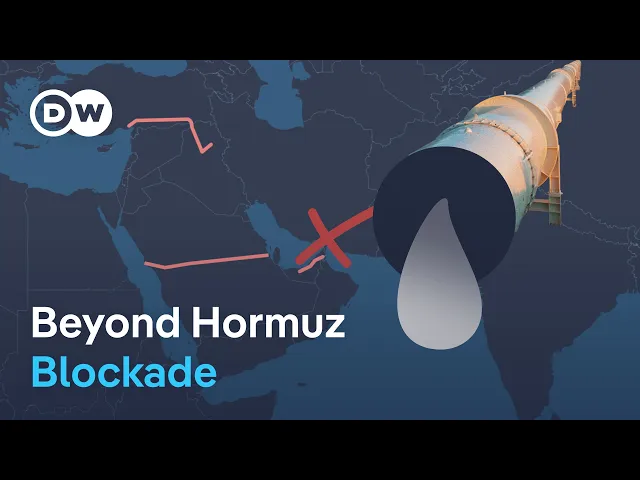
2:48 There are three main routes that are being
2:49 used to transport oil from the Gulf countries.
2:52 Since early April, Saudi Arabia has substantially
2:54 increased flows through its East West pipeline.
2:57 They're claiming exports of 7 million barrels a day.
3:00 The International Energy Agency oil report says
3:02 that Red Sea exports almost doubled month on month.
3:05 The UAE's Abu Dhabi crude oil pipeline also bypasses the straight of Hormuz.
3:10 It stretches around 400 km from onshore oil facilities at Habshan to Fujara.
3:14 The pipeline is estimated to handle between 1.5
3:17 million and 1.8 million of barrels a day.
3:19 And the Siruk Seahan pipeline, which runs from Iraq to Turkey,
3:23 can transport 300,000 barrels of oil every day.
3:26 Since the war broke out in February 2026,
3:28 Middle East oil exports have dropped by at least 60%.
3:32 New pipelines take years to build and cost an enormous amount of money.
3:36 And if you believe, as we do,
3:38 that fossil fuel demand is going to stabilize over the next decade or so.
3:43 It is a difficult investment case to make.
3:46 Now, we think expanding capacity on existing pipelines is
3:52 um a much easier sell than building new ones.
3:54 In a lot of cases, you could also see some structural change on storage
3:59 capacity as a cheaper alternative to keep
4:02 oil production going if new disruptions arise.
4:06 So if the lesson of this crisis is we need to build
4:09 more resilience which I'm sure it is now expanding existing pipeline capacity
4:15 finding alternative routes like the for example the green corridor between Dubai
4:19 and Oman and investing in storage is where I think money could flow.
4:24 Now permanent rerouting through entirely new pipelines,
4:28 the costbenefit analysis there is probably harder to justify.
4:36 Over the longer term, say 10 to 20 years,
4:38 the focus shifts to a more resilient network.
4:41 A network of corridors for oil to pass through, something bigger.
4:44 Multiple routes, multiple exits across different sea basins,
4:48 all connected by stable crossber frameworks,
4:50 a web of corridors for energy security.
4:53 This is harder to build and harder to fund,
4:55 but it's the only model that delivers
4:57 genuine resilience and not just temporary fixes.
5:00 The problem with these pipelines, of which we will see many more in the future,
5:04 is that they are not safe either because a they go overland and are
5:08 easily attacked and the East West pipeline which we currently use in Saudi
5:12 Arabia is in range of huge missiles and b uh this pipeline goes
5:17 to the Red Sea which itself has another bottleneck at the end of it.
5:21 So in some there is no 100% safety
5:25 but the only safety which we have in this region
5:28 would be by increasing the diversity of export
5:31 rules and I'm certain that this will happen.
5:36 The former British Prime Minister Winston Churchill famously held
5:39 that the key to energy security was diversity in sources of supply.
5:43 Safety and certainty and oil lie in variety and variety alone.
5:47 He told the UK Parliament in 1913.
5:50 Not much has changed.
5:51 Fossil fuels offer easy transport and storage.
5:54 But there are risks of supply distribution as we are seeing right now in Hormuz.
5:57 Renewable energy while clean is hard to store and move.
6:00 If we can't transport it or store it,
6:02 the lights go out when the sun isn't shining or the wind isn't blowing.
6:06 On a bigger scale, it's time that we spend
6:08 step back and draw the lessons from these wars,
6:11 from these disruptions to global energy and say
6:14 the result should not be more economic warfare.
6:17 Then the result needs to be a sound mix using
6:20 all of the above and not relying only on one.
6:26 China is the world's largest importer by the straight of Hormuz,
6:29 historically relying on it for nearly half of its crude.
6:32 The Iran crisis has accelerated a strategic pivot that was already underway.
6:37 Beijing's long-standing energy security fears have
6:39 been transformed into an immediate operational reality.
6:43 China moving to increase the share of oil transported through
6:46 overland pipelines by 45% by 2030 um is alone an indicator
6:53 of that right expanding corridors in multiple strategic directions
6:56 and and and and again um I think of the geoeconomic implications
7:01 of this model um and and what that looks like
7:04 for the broader Middle East the strategic and commercial oil stockpile is
7:08 estimated between I think 1.2 to 1.4 four billion barrels is
7:14 um over a 100 days of net import cover for China.
7:18 Um just again reinforces the case
7:21 for this alternative uh routes and network diversification.
7:30 Europe is facing a crisis regarding LNG supply.
7:33 Every European energy crisis since 2021 has produced the same prescription.
7:37 more renewables, more nuclear, reduce fossil fuel dependency.
7:41 European countries are often criticized for not implementing structural reforms.
7:45 Is this a fair assessment?
7:46 I would actually push back um a little bit on that premise
7:50 because Europe has done more than it's been given credit for.
7:55 Gas demand is around is down around 20% since 2022.
8:00 And actually 2025 was the first year renewables generated more
8:05 fossil fuel more energy than fossil fuels in the EU.
8:10 So I think that reduced gas dependency is part of the reason
8:14 electricity prices haven't spiked nearly as sharply this time around.
8:20 Um you can see it in the numbers.
8:21 TTF gas is up around 33% on pre-conlict pre-conlict
8:27 levels while in 2022 um it was around 400%.
8:34 Um oil is a bit of a harder story because it remains the dominant fuel
8:40 for transport and very few European countries
8:43 can insulate themselves from a serious oil shock.
8:47 Um the electrification of transport is underway
8:50 and the dependency should fall over time.
8:53 Future energy supply involves diversification both for producers and consumers.
8:57 This can include geographical diversification looking to other oil
9:01 producing areas like the North Sea, the US and Africa.
9:04 Also better energy mix with oil, gas, nuclear and renewables.
9:08 And then broadening the infrastructure,
9:10 adding a variety of pipelines, LNG terminals and electricity interconnections.
9:15 Diversification does mean higher short-term costs,
9:18 the need for investment in infrastructure,
9:19 and dealing with possible inefficiencies compared
9:22 to relying on the cheapest source, but these are weighed against the benefit
9:25 of being better prepared to resist shocks.
9:28 So the lesson isn't just diversify away from Russia,
9:32 which we thought it was after 2022, but is that this depending heavily on any
9:37 single supply route carries a big risk.
9:40 So all this um these alternatives uh through central Asia, Eurasia,
9:48 this is the probably the the conversation
9:50 reform conversation that will likely happen
9:53 to diversify from a single uh transport
9:56 route um that gets these kind of problems.
10:03 If the straight of Hormuz does not reopen soon,
10:05 then the world will almost certainly face a major oil supply crisis,
10:09 forcing painful sustained reductions in demand.
10:13 What's the damage if Hormuz remains shut for a longer period?
10:17 A prolonged closure wouldn't just be a price spike that disappears quickly, uh,
10:22 but it would mean stickier inflation, weaker investment,
10:26 and central banks having to hold rates or even increase them.
10:30 um uh long for longer than what they'd like, right?
10:34 Or or even increase them.
10:35 And that's the channel through which we think this conflict becomes um
10:42 a global economic problem more than a regional and contained uh problem.
10:52 Ultimately, a redesign to avert another crisis
10:54 in the straight of Hormuz doesn't seem like an option.
10:56 The Gulf's post-conlict energy system would likely look
11:00 much like it does today simply because there
11:02 are no viable alternatives to the straight
11:04 or existing pipelines in the short to medium term.
11:07 Instead, the focus will shift towards strengthening current infrastructure
11:10 and diversifying supply routes for both producers and consumers.
11:14 The real question is whether that will be
11:16 enough to prevent the next global economic shock.