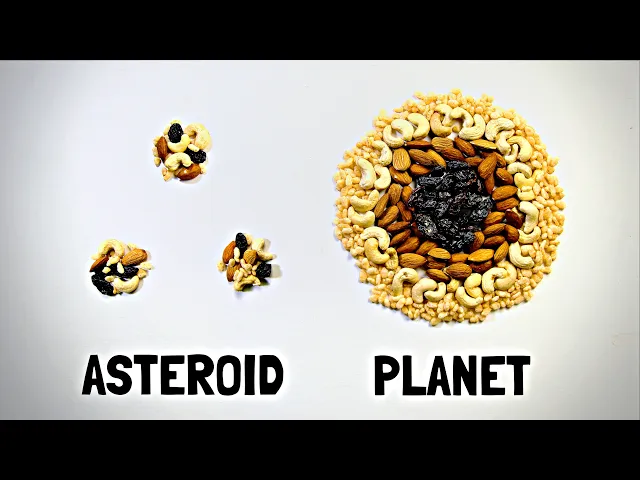
The REAL Reason Asteroids Aren't Planets
minutephysics
0:04 When the first asteroids were discovered over 200 years ago,
0:07 they were celebrated as new planets, and the story goes that the rapid
0:10 and overwhelming discovery of hundreds and then
0:12 thousands more quickly convinced scientists that asteroids
0:14 shouldn't be planets- but that’s totally wrong:
0:16 the real reason asteroids were demoted from “planet” status came nearly 100
0:20 years after the hundredth asteroid was
0:22 discovered and decades after the thousandth,
0:23 and had nothing to do with their quantity, but in fact, their quality.
0:27 Of course, up until 1800,
0:29 only seven primary planets– objects that directly orbit
0:31 the Sun– only seven primary planets had been discovered:
0:34 Mercury, Venus, Earth, Mars, Jupiter, Saturn and Uranus.
0:36 But telescopes got better and we found more: a small 8th primary planet,
0:40 Ceres, was discovered in 1801 between Jupiter and Mars,
0:43 and then there was a surge of new
0:44 planets discovered with almost identical orbits to Ceres:
0:46 Pallas, Juno, Vesta, and more, and more, and more!
0:49 It soon became clear that there was a band of small
0:52 planets orbiting the Sun between Mars and Jupiter, and so,
0:54 when describing the solar system, astronomers found it useful to group them
0:57 together as “the small planets”,“ the minor planets”,
0:59 “the planetoids”, “the asteroids” or “the numbered planets”,
1:02 because eventually so many were being discovered
1:03 so quickly it was easier to keep track of them all right away with numbers
1:06 rather than coming up with fancy names.
1:07 But there wasn’t yet any scientific reason
1:09 to stop thinking of the asteroids as planets.
1:11 I mean, “having too many” isn’t by itself a good
1:14 scientific criteria (think about all the thousands of known
1:16 planets we’ve now discovered orbiting other stars– their sheer
1:20 number isn’t a reason not to call them planets!).
1:24 So despite some embarrassment over the rapidly growing list of planets 19th
1:28 and early 20th century astronomers still
1:30 considered all the asteroids to be planets.
1:31 Well, except one astronomer,
1:32 who argued that the asteroids should be their own category,
1:35 but his reasoning was based on incorrect data and theoretical
1:37 misunderstandings and was ultimately rejected
1:38 by the wider astronomical communidy.
1:40 Even today, the International Astronomical Union’s commission on asteroids
1:43 is STILL technically named the “Minor Planet Center” (even though,
1:46 as we are about to discover, it’s a poor name for them).
1:49 So why don’t we include the asteroids in our list of planets today?
1:52 Look at this analysis of scientific papers in the last 200 years:
1:55 the terms “small” and “minor” planets had consistent use
1:58 relative to “asteroid” right up until 1953, when, boom!
2:01 their use plummeted.
2:02 This change wasn’t because of a fear of a huge list of planets,
2:05 nor from a vote by a bureaucracy,
2:06 but instead from a scientific discovery: Asteroids, it turns out,
2:09 are not just miniature version of the larger planets,
2:12 but are in fact the fragments from the collisions
2:14 and disintegration of fully formed planets (or protoplanets),
2:15 rather than miniature versions of the larger planets.
2:15 This distinction matters because when planets form,
2:17 the release of gravitational potential energy partially melts their interiors,
2:20 causing heavy elements to sink to the core
2:22 and lighter materials to float upwards, sorting into layers.
2:25 If asteroids were formed like planets, but smaller,
2:27 they would each be made of a mix of materials,
2:29 and would be too small to have enough energy to sort the materials into layers.
2:32 If instead asteroids were relics from collisions between planets,
2:35 each one would be a mostly homogenous chunk of material from a single layer.
2:38 And what astronomers figured out was that asteroids
2:40 are definitely broken planet pieces- in fact,
2:43 asteroids are literally classified into groups
2:44 based on what materials they’re made of.
2:46 Out of the ridiculous number of objects in the asteroid belt,
2:48 there are only three or four that we think formed
2:50 on their own as a planet rather than being broken planet fragments:
2:53 these three or four are the biggest: Ceres, Vesta, Pallas, and maybe Hygia.
2:58 So.
2:58 The asteroids were demoted to non-planet status, not by a vote,
3:02 nor from a dislike of a long list of planets,
3:04 but due to a scientific discovery that asteroids are,
3:06 in fact, physically different from everything else that we call planets.
3:09 The discovery meant they were split off
3:10 (in the minds of scientists) into their own group,
3:12 and those scientists organically stopped calling them planets.
3:15 In principle, the taxonomic split could have gone
3:17 the other way– researchers could have kept calling asteroids planets,
3:19 and come up with a new name for the remaining non-fragmented objects- but given
3:23 the fact that asteroids were already previously
3:25 considered a subcategory of planet (minor planets),
3:27 it makes much more taxonomic sense to split them off
3:30 and keep all the rest of the planets, as planets.
3:32 By this logic, we should also probably stop calling Ceres,
3:35 Vesta and Pallas asteroids since they formed like planets do.
3:38 So, even though there are lots of asteroids,
3:40 for the question of whether or not asteroids count as planets,
3:43 it turns out that quality matters more than quantity.
3:47 Seeing the innumerable fascinating- but completely inhospitable- worlds
3:50 in our solar system is a reminder of just how diverse,
3:53 unique and delicate our home planet is.
3:54 But to keep planet Earth as our home, we have to look after it.
3:57 That’s why we working with the nature-protection community called Planet Wild,
4:00 our sponser for this video.
4:01 Every month, the planet wild community funds a mission to restore the oceans,
4:05 forests and life here on planet Earth.
4:06 All of this is documented through videos here on YouTube,
4:09 just like this mission restoring lost peatland ecosystems.
4:11 You can join in supporting solution-oriented missions
4:14 globally by giving whatever amount you want.
4:16 The first 100 people to sign up using
4:17 our code MINUTEPHYICS1 will get their first month covered.
4:19 Just scan this QR code or click the link in the description.