Will AI robots on the frontline mark the end of human soldiers? - BBC World Service
BBC World Service
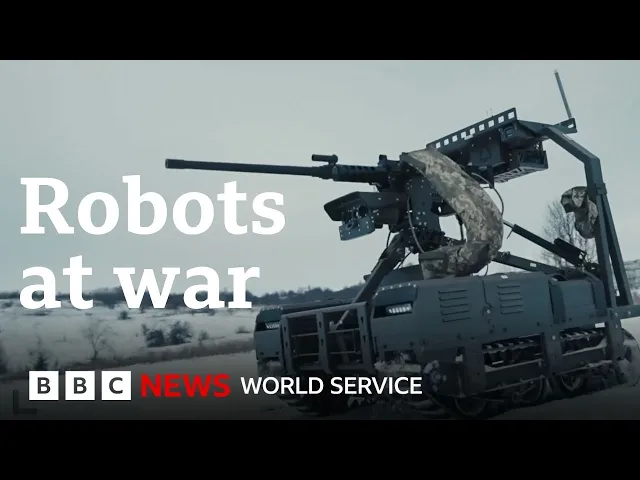
0:02 In February, Ukraine's military made an incredible claim about this robot.
0:07 For 45 days the drone rotated into combat duty and repelled enemy assaults.
0:12 According to soldiers, the bot was able to hold off attacking Russians
0:15 on the front line at some point last year.
0:18 Then, in March, an even more incredible claim from Ukraine's president.
0:22 For the first time in the history of this war,
0:25 the enemy position was taken exclusively
0:27 by unmanned platforms ground robots and drones.
0:31 The new deadly robots designed and deployed in Ukraine were lined up on display.
0:36 The message from the president was...
0:38 The future is here.
0:40 Zelensky's military also claims to have
0:42 forced Russians to surrender using robots.
0:45 Ukraine has become a testing ground for robotic warfare.
0:49 This conflict, and others like Iran are propelling us towards a world
0:52 where increasingly sophisticated robots designed to kill
0:56 will become common on front lines.
0:59 As the company commander says robots don't bleed.
1:02 Is this really the future of warfare?
1:04 And if so, what does it mean
1:07 for human soldiers and the civilians impacted by conflicts?
1:12 Uforce is a new Ukrainian weapons maker that's grown fast.
1:16 It recently became a unicorn a company worth a billion dollars.
1:19 Some of its land and air drones were used in the operations Zelensky revealed.
1:24 Although they're not saying much about it.
1:26 We met the firm at its London location,
1:28 which is secretive and unbranded to protect it from potential Russian sabotage.
1:34 So I can't go into specifics on the operation
1:37 or how Uforce were involved but we've
1:41 done over 150,000 successful combat missions since
1:45 the full-scale Russian invasion of Ukraine in 2022.
1:49 Do you foresee a future where you've got
1:51 more robots in a fighting squadron than humans?
1:55 That could potentially happen so with the system you see here
1:59 a control centre could have up to ten robots going into it
2:03 at one time so it is potential where you could have
2:08 more of these systems working together with one person overseeing them.
2:13 The company says this drone has been
2:15 used to destroy more than 150 Russian tanks.
2:19 Russia too is deploying its own robots,
2:21 for example to carry explosives into Ukrainian positions.
2:25 And for years now it's matched Ukraine in the air with drones.
2:29 I really consider Ukraine to be a major
2:31 teacher in the future of national defence and armaments.
2:36 It's a really impressive case study of how necessity breeds invention.
2:45 In the US, another weapons startup Anduril caused a stir in February when it
2:49 completed a test flight of its new fighter jet that has no fighter pilot.
2:54 Like Uforce, Andurill Industries is part of a new
2:57 wave of disruptive startups looking to reshape modern warfare.
3:01 It's raised billions of dollars in funding and US military contracts.
3:05 More established and larger defence giants like BAE Systems,
3:08 Boeing and Qinetiq are also working
3:10 on increasingly powerful unmanned robotic weapons.
3:14 You've seen Ukrainian and Russian drones fight each other.
3:18 So there is already a kind of robot-on-robot aspect of the battlefield.
3:24 Seeing that play out increasingly on the land and maritime domain,
3:27 I think, is extremely likely if not inevitable.
3:31 At the moment, most military robots across
3:33 all domains are being controlled by humans, but autonomy is accelerating.
3:38 Uforce's land drones use aim-assisting software for shooting.
3:41 And Anduril's drones can carry out the final stage of strikes on their own.
3:49 I saw that it has a function where
3:51 it can sort of kamikaze attack a target autonomously.
3:56 Is that right?
3:57 Yeah, that's correct.
3:57 I was wondering about this though because that kind of the last 200,
4:01 300 feet, what if a kid runs out or something?
4:03 These things have a wave-off feature.
4:06 Now, of course, at one point or other it's all too late,
4:09 but the speed they go, they're going pretty fast when they get down there.
4:14 So, you know, unless you're Linford Christie running out there,
4:15 you're not gonna be in the way.
4:17 You're not concerned about something like this, you know,
4:19 accidentally killing a civilian because it takes
4:21 a decision and can't get out of that decision.
4:25 This is where we keep the human in the loop.
4:29 So that last thing they do will make the last check and press.
4:32 The use of AI and robotics I believe,
4:35 will reduce the amount of mistakes made in the battlefield.
4:38 Humans need to eat.
4:38 They need to sleep.
4:39 And progressively, in a wartime situation,
4:41 they get less sleep and they eat less, and they tend to make more mistakes.
4:46 By using computing we avoid the ability to make mistakes
4:51 through more of that, what we call the kill chain.
4:54 The US administration is openly urging its military to embrace AI in all areas.
5:00 We will win this race by becoming
5:02 an AI-first warfighting force across all domains.
5:06 In the Iran strikes, AI tools from companies like Palantir
5:10 and Anthropic have reportedly played a major role.
5:14 Aside from occasional military parades,
5:16 Chinese weaponry developments are less well known.
5:19 But a US Department of Defense
5:21 assessment last year claimed that China's military
5:23 is rapidly developing in emerging tech
5:26 like drones and increasingly relying on AI.
5:30 The whole reasoning behind militaries using AI
5:34 systems is to increase the pace and accelerate,
5:38 for instance, identification of It poses huge
5:42 ethical and human rights risks and issues.
5:47 We should never really be wanting
5:49 to delegate life or death decisions to machines.
5:53 There's another concern too.
5:55 With killer robots able to think for themselves,
5:57 what happens to safety if their handlers lose control
6:00 of these deadly devices in, for example, a cyber attack?
6:05 Well, anything can happen when you're hacked.
6:07 What's important is how well you protect yourself from hacking.
6:11 The cybersecurity around what we do is hugely important, as you might imagine.
6:16 And to do that, we adhere to whatever government we work with.
6:20 I work with the MOD.
6:21 The MOD have a series of cybersecurity policies
6:24 and rules that we must follow, and we follow them.
6:27 Most experts say we are many years
6:29 away from these autonomous robots becoming commonplace.
6:32 Humans will always be needed on the battlefield, in some form,
6:35 due to a key limitation that seems hard to change.
6:39 You need a command link between the operator and the robot itself.
6:44 That command link can be severed either by electronic warfare,
6:47 by jamming, or if the robot has a physical connector,
6:50 we're starting to see fibre optic cable being used to connect ground robots,
6:55 as well as uncrewed aerial vehicles to their control stations,
6:59 which is unjammable but can be severed by explosions by shrapnel,
7:03 or even just by a pointy rock.
7:05 There's another area of war that robots and AI will likely never replace us.
7:11 While I really do expect these systems
7:12 to become more and more integrated into combat,
7:14 we have to keep in mind that robots destroying robots won't end wars.
7:20 All wars ultimately end through some kind of political
7:23 settlement when one side has suffered more cost and loss
7:26 than it can tolerate and that will remain true whether
7:30 the fighting ultimately is done by humans or by machines.