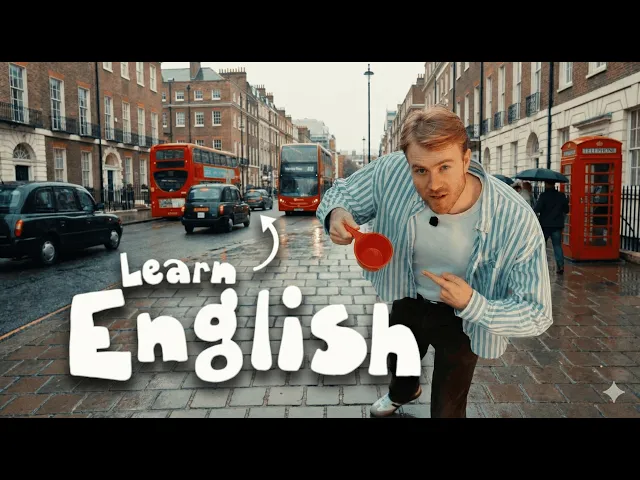
Become fluent in English using the Immersion method
English by Jay - Sprout
0:00 3 years ago when I met Chang, her English wasn't that good.
0:09 Hey,
0:08 but now she's fluent.
0:11 Her English is topnotch.
0:15 A
0:14 So, how did she go from not [music] that good to very, very good?
0:23 You might think the answer [music] is
0:24 because she's been dating me, but it's not.
0:28 Today I'll share with you the three tips I shared
0:32 with Chang which helped her reach full fluency in English.
0:37 But first [music] coffee.
0:53 This is a water tank and this is a water dispenser.
0:58 I am filling up the water tank from the water dispenser.
1:08 I am attaching the water tank to the coffee machine.
1:12 I am taking the coffee [music] pod and putting it in the coffee machine.
1:21 I am pressing the button and the coffee is
1:26 coming out of [music] the machine into the mug.
1:35 I have just made a coffee and that is the first tip to reach full fluency.
1:43 What coffee?
1:46 No, your home is your English zone.
1:51 What do I mean by that?
1:53 Well, everything in your home has a name.
1:57 Like this mug.
2:00 This is the mug.
2:02 And this is the handle.
2:05 Can you repeat?
2:06 Mug.
2:09 Handle.
2:12 Good.
2:14 The idea behind this game is that you
2:18 learn the name for everything in your house.
2:22 Treat your house like a dictionary.
2:24 Treat it like an English playground.
2:27 And it's very important to speak out loud to speak out loud
2:34 the name of things like this is a carton of oat milk.
2:40 There might be some new words that surprise you,
2:44 like door handle versus door knob.
2:51 I bet you didn't know the difference between these two.
2:53 And if you did, you're a genius.
2:57 A door knob is circular.
3:00 It's round.
3:02 And you twist it to open the door.
3:08 A door handle is rectangular and you push it down
3:14 to open the door and pull it up to lock the door.
3:21 I'm locking the door with the key.
3:26 Wait, we need to be inside.
3:29 So, let's unlock this door and go back inside.
3:38 But what if you don't know the name for something?
3:43 Either you watch my videos or you can simply use a tool like chat GPT or Gemini.
3:53 You take a picture of that thing and ask what is this called in English?
4:00 What is this called in English?
4:03 H cushion.
4:07 This is a cushion.
4:09 So now you have the name of it.
4:10 You can make simple sentences.
4:13 And these questions might help.
4:15 What color is it?
4:17 What shape is it?
4:18 What material is it?
4:20 What is the function of it?
4:22 And what does it feel like?
4:24 For example,
4:25 okay, let's see.
4:26 The cushion is red.
4:28 It's in the shape of a love heart.
4:31 It has long arms, so it looks like a real creature.
4:35 Is made of cotton, and it's very comfy and soft.
4:41 I like to use this cushion to support my head
4:44 when I take [music] a nap on the sofa.
4:47 It's really comfy.
4:50 You can do this exercise anytime at home.
4:53 When you cook, I am frying an egg in the frying pan.
4:59 when you take a shower.
5:00 I'm standing under the shower head about to take
5:04 a shower or when you do the chores.
5:09 I am vacuuming the floor.
5:11 Or in the UK we say hoovering.
5:13 I'm hoovering.
5:15 And even when you listen to music,
5:17 you can ask yourself, what instruments can I hear?
5:20 How does this music make me feel?
5:31 This is a beautiful piano piece by the composer [music] Austin Farwell.
5:37 When I listen to music like this, it makes me feel relaxed,
5:43 at ease, and peaceful.
5:48 Can you see what I did there?
5:50 I I'm using my home as my English zone.
5:54 I'm learning new vocabulary from the things around me
5:58 and then I'm making simple sentences with those words.
6:02 The key is to speak out loud.
6:06 If you have the problem that you can understand but you can't speak,
6:12 then the likelihood is it's because
6:14 you haven't practiced speaking out loud enough.
6:18 Now, speaking is just muscle memory, like going to the gym.
6:23 The more you do it, the more your muscles remember the actions.
6:28 So the more you move your mouth and tongue to form the words,
6:33 the faster those words come out.
6:36 By the way, this is a soft toy.
6:42 This is an electric piano.
6:44 [music] And this is a plant in a plant pot.
6:54 You can also practice speaking out loud with a fun and simple game.
6:58 It's called the word association game.
7:01 Let's take this bell as our starting word.
7:04 I'm going to make associations.
7:06 So, bell, ring, wedding, celebration, champagne, wine, bubbles, water,
7:15 puddle, rain, mountain, sky, blue, blah, blah, blah, blah, blah.
7:22 You get the idea.
7:23 I'm making associations in a chain.
7:27 This game is going to really build your spontaneous speaking
7:31 and help you feel less anxious and more confident when you speak.
7:36 Plus, it's fun.
7:37 I'll dive deeper into this game in a future episode, but for now,
7:42 let's go downstairs and I'm going to show you my favorite British shows.
7:49 For anyone wondering, that is a swinging chair.
7:53 This is a remote.
7:56 It has buttons on it.
7:59 When I press the power button, it turns on the TV, which links to my second tip.
8:09 Watch what you love, but slightly above your level and without subtitles.
8:14 When learning any language, input is really important.
8:19 As you all know in my videos, I teach English using visuals and context.
8:26 This is called the comprehensible input method where you understand
8:31 not all of the language but you get the gist,
8:35 you get the idea because of the visuals and the context.
8:40 So, it's less based on forced memorization,
8:44 but more on getting the overall picture through natural context.
8:52 I would recommend you to watch English videos
8:56 without the subtitles while still understanding 70 to 80%.
9:02 Why?
9:03 Well, when you watch a video with the subtitles,
9:06 you tend to fixate on the subtitles.
9:10 you read the subtitles and you don't watch
9:14 the video and listen to the English being used.
9:17 So without the subtitles, you're training your brain to link the sounds
9:24 that you hear with the visual meaning, the context.
9:28 Now this is a much stronger hook
9:31 in your brain because our visual memory is very strong.
9:34 So watching without subtitles, understanding about 70 to 80%.
9:39 Now, I'm going to share with you some of my favorite
9:41 British TV shows so you can practice this at home.
9:45 If you're a beginner, I would recommend three different things.
9:50 First, Peppa Pig.
9:52 [music] Second, Bluey.
9:59 Blue.
9:58 And third, the movie Finding Nemo.
10:02 Nemo.
10:03 Nemo.
10:05 All of these are children's shows and children's movies.
10:09 However, they are fantastic for improving your English from beginner
10:14 to intermediate because the stories are simple and the episodes are short.
10:19 If you're intermediate, try sitcoms like Friends.
10:24 I used Friends in the past to learn French and it worked.
10:28 Blue blah flu flank.
10:30 [laughter] You can also try TED ed TED videos are shorter than the TED
10:38 talks and they have more visuals so it's easier for you to understand.
10:43 If you love documentaries then I would recommend David Atenburgh.
10:49 So David Atenburgh is loved by English people and by British people.
10:54 He is a national treasure and his documentaries
10:58 are all about the earth, animals, humans and they are wonderful for practicing
11:04 English because he speaks very slowly,
11:08 very clearly and you hear the same words repeating again and again.
11:13 The two Atomra documentaries I would recommend for you are Planet Earth
11:18 which I think is on Netflix [music] and the new one Kingdom.
11:23 Other than that, just search David Atenburgh documentaries
11:27 and you'll find a lot of good content there.
11:30 And if you're advanced, the world is your oyster, my friend.
11:34 The TV is your oyster.
11:35 You can watch literally anything.
11:37 My favorite comedy show is a show called Peep Show.
11:42 And this is a British comedy.
11:45 Classic British humor.
11:47 It's British humor at its peak.
11:49 Peep Show is hilarious.
11:50 And if you're advanced,
11:51 it's going to be wonderful to understand more about British culture,
11:55 the way that British people think.
11:57 On top of Peep Show,
11:58 you can also watch other comedies like The Office or The Inbetweeners.
12:04 The Inbetweeners has a lot of slang words that you could learn from.
12:08 Again, if you're advanced, any input is good input.
12:11 So, the more you watch, the more you listen, the more you improve.
12:16 Just repeat, repeat, repeat.
12:18 After watching these films or videos,
12:21 you can ask yourself these three questions which will help your speaking.
12:26 What did I just watch?
12:28 What was it about?
12:29 And did I like it or not?
12:31 If you want to watch English videos which
12:34 show you how English is used in everyday life,
12:38 like feeding animals at the farm, shopping in the supermarket,
12:44 and exercising in the gym, then you can go to sproutlanguage.com.
12:52 On sprout language.com, the videos are categorized by your level,
12:56 so you can always progress in English.
12:59 Let's put this in action.
13:00 I want to show you an example with Chang.
13:04 Hello.
13:05 So Chang is gonna watch a video on Sprout
13:08 and then she's gonna practice speaking about it after with Ji.
13:12 Want to show you guys how it works in action.
13:16 Feeling good.
13:17 Feeling like my legs are going to ache tomorrow.
13:22 It's great to chat with you.
13:23 In the video, I was so excited to go skiing for my birthday.
13:27 Have you ever been skiing before?
13:31 Yes.
13:31 I skied with you.
13:33 That's right.
13:34 I'm so glad you could join me.
13:36 It was your first time seeing snow, too, wasn't it?
13:38 How did you like that?
13:40 Honestly, seeing snow for the first time was so magical.
13:44 It sounds like you had a truly magical time.
13:46 It's wonderful that you learned how to ski so quickly.
13:50 You picked it up really fast.
13:52 A few moments later.
13:54 See you later.
13:55 Thank you.
13:55 It was great chatting with you, Chang.
13:57 Your English is excellent.
13:58 Keep practicing and I'll see you next time.
14:01 Thank you.
14:03 Nice.
14:03 Now, we still have a 50% off Luna New Year deal.
14:07 So, head on over to sproutlanguage.com where
14:09 you get access to group classes with me,
14:11 speaking practice with JI, and all the exclusive content perfect for your level.
14:16 Right now, on to the third and final tip.
14:21 So, we have trained our eyes to watch.
14:25 We've trained our ears to listen.
14:28 And we trained our mouths to speak.
14:32 Now it's time to train our brains to think in English.
14:39 Most of you at home, I imagine,
14:42 think in the language that you use the most, your mother tongue.
14:46 But we want to train our brains to think in English.
14:51 Now, what's a practical and simple way to do this?
14:54 Well, maybe when you're on your way to work
14:57 or in a public space where you can't speak,
15:00 you can think, what if I think my thoughts in English?
15:05 What if I think about the world around me in English?
15:10 What would that sound like?
15:11 Now, in the beginning, this will take some conscious efforts.
15:15 It will be a little bit difficult.
15:17 Just like any habit, it requires you to be conscious about doing it.
15:22 be aware and just do it.
15:25 Very soon it will become subconscious.
15:28 It will become natural.
15:31 I'm going to show you an example.
15:33 H I should probably wash the dishes right now.
15:37 I can't really be bothered, but might as well.
15:40 Right.
15:40 I'm going to take the scourer.
15:43 Yep.
15:43 Pump some washing up liquid on that scourer.
15:46 Turn on the tap.
15:49 Not really sure how I feel about washing dishes.
15:52 I mean, on the one hand,
15:53 it's quite it's quite satisfying seeing those soapy suds.
15:57 M lovely soapy suds.
16:00 But on the other hand, it's a bit like slave labor.
16:05 Yes.
16:06 Rinsing off those soapy suds.
16:09 Yes.
16:11 Chopsticks or drumsticks?
16:15 Do I want to wash the rest of those things up?
16:18 Nah, leave that to Chang.
16:21 So, to recap the entire video, one, your home is your English zone.
16:28 Use your house and objects around you to practice speaking out loud.
16:34 Two, watch what you love without subtitles and make sure
16:38 you understand most of the content, around 70 to 80%.
16:44 And three, train your brain to think in English.
16:48 Now, the key take-home message is that immersion is
16:53 the number one way to become fluent in any language.
16:57 You need to immerse yourself.
16:58 You need to consume as much as possible and speak as much as possible.
17:04 Now, if you want a proven immersion system,
17:06 you can head on over to sproutlanguage.com.
17:09 The link is in the description for 50% off your first month.
17:15 Try the immersion system.
17:16 Practice speaking with JI.
17:18 Join group classes with me and you will get better.
17:23 Thank you so much for watching.
17:24 I hope you learned a lot in this [music] video and I will see you next week.
17:32 Times [music] and places [singing] are all
17:37 in who you share [singing and music] them with.