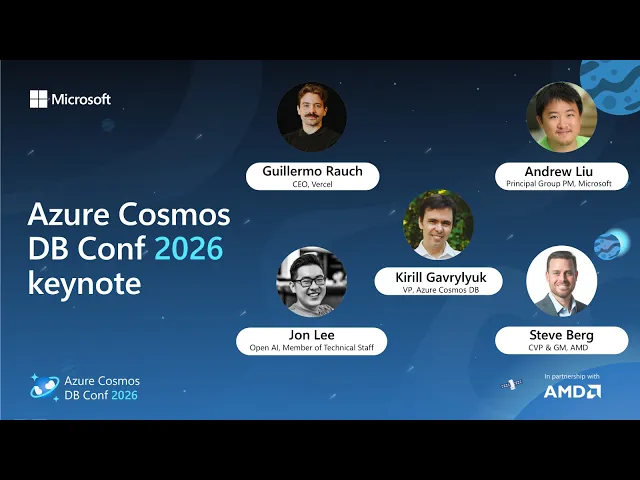
Azure Cosmos DB Conf 2026 Keynote
Microsoft Developer
0:07 Well, you know what?
0:08 I think we've set you all up and it's now to get you to our opening keynote.
0:12 Yeah, that's right.
0:13 Here's Kirill Gavrylyuk, Vice President of Azure Cosmos DB at Microsoft.
0:18 Welcome to Azure Cosmos DB Conference 2026.
0:25 We're really grateful to have you here and let's take a look back
0:30 at the year since the last conference and what a world year has it been.
0:35 Of course.
0:36 We're all building AI apps at amazing pace, right?
0:40 And for Cosmos DB perspective, we invested heavily in semantic search.
0:44 That is core part of any AI app.
0:47 You have now full-text search, hybrid search, vector search,
0:51 semantic ranker, plethora of capabilities with confidence, we can say.
0:55 If you're using Cosmos DB, you do not need a separate search system.
0:58 Just use built-in capabilities and take advantage of cost efficiency,
1:03 performance, scale, reliability, and precision.
1:07 And of course, more than half of our customers
1:10 are using coding agents today to build apps on Cosmos.
1:14 And for that, we offered great agent kits
1:17 with skills to make your coding agent world-class expert.
1:21 We added MCP servers and other capabilities to make this possible.
1:26 Now, AI does not remove the need for reliability, security, performance.
1:32 And that is our priority number one.
1:34 This is where we invest the most of our energy.
1:37 We've provided throughput management,
1:39 fleet management for customers with large fleets of Cosmos DB.
1:43 We've invested with simplified partitioning,
1:46 with global security indexes, hierarchical partition keys.
1:49 We've invested in per-partition auto failover,
1:52 and now Cosmos DB is the only database
1:55 that offers you five-nines reliability for any consistency mode.
1:58 And of course, security is number one priority.
2:02 and a number of improvements in security space.
2:05 Last year, we've added second NoSQL database to Azure, DocumentDB.
2:11 Unlike Cosmos, DocumentDB is fully open source.
2:14 It's based on an open source project at Linux Foundation where Microsoft,
2:19 Amazon, Google, and 12 other vendors are collaborating.
2:23 DocumentDB has a number of advantages over other document databases and notably,
2:29 more than 40% cheaper than any other document database,
2:33 including MongoDB Atlas on AWS.
2:35 So please come over to Azure, use DocumentDB,
2:38 take advantage of performance and low cost.
2:42 Now, AI transformation is on top of everyone's mind, right?
2:45 And for databases really means, in my opinion, three things.
2:49 One is AI increase the importance of flexible data.
2:55 The data AI processes and emits is all semi-structured, right?
3:00 It's prompts, it's memory, context.
3:02 That's what AI is focused on.
3:04 And Cosmos DB provides the first-class support for semi-structured data.
3:11 It proudly presents flexible data model.
3:14 Now, AI accelerated the pace at which we develop applications.
3:19 And flexible data is paramount for you to enable this pace.
3:23 Developers cannot be locked down by strict schemas.
3:27 They need schema flexibility, which is again,
3:29 number one capability of Cosmos DB.
3:31 That's why we build the database is
3:34 to provide you schema-less flexibility in data modeling.
3:37 Now, AI brought Semantic Search as a first-class operator into queries.
3:43 And it's true for any database that matters.
3:47 And of course, in Cosmos DB, we invested far beyond of that.
3:51 We added Semantic Search.
3:53 full-text search, vectors, hybrid, semantic ranker.
3:56 We invested in GraphRack, and we're about to announce Agentic Retrieval,
4:00 which takes the GraphRack to the next level,
4:03 where the graph, knowledge graph, can be inferred by LLM for you,
4:07 without you having to manually construct it.
4:09 Now, the third important thing about AI transformation is
4:13 we all now are accompanied by our coding agents.
4:17 That's our favorite friends now, right?
4:20 Coding agents.
4:21 speed up development, and for coding agents to be efficient,
4:25 world-class experts in databases, they need skills.
4:28 And that's why we invested in Cosmos DB Agent Kit.
4:30 We'll talk about it later.
4:32 As it provides skills to your coding agent,
4:35 no matter which coding agent you use, along with MCP servers,
4:40 plugins for any favorite coding agents that you may choose.
4:44 Now, let me introduce our guest speaker, Guillermo Rauch.
4:51 founder and CEO of Versel, a popular AI app development cloud.
4:57 And Guillermo knows a thing or two about what AI apps need from databases.
5:04 It's an honor to have with us CEO and founder of Versel, Guillermo Rauch.
5:10 Guillermo, you have built libraries like Socket.io and HGS
5:14 that form the modern web as we know it today.
5:19 On top of it, you've built a highly successful company, Versel,
5:24 that has seen a really good growth
5:27 of developers ah that provides developer cloud.
5:31 What do you credit Versel's success?
5:34 I think if I look back on the principles that we created for SellOn,
5:38 it was really about the ease of use.
5:41 At the time it was ease of use for humans.
5:43 Now, lately I've been calling it agent ergonomics or ease of use for agents.
5:48 It's about, you know,
5:49 you have an idea and you need to bring it online and you actually
5:54 want it to scale and work really well and be a really high quality product.
5:59 if it could be summarized as something simple,
6:02 would be the focus of ease of use, but in the service of quality,
6:06 not just getting slop, as we call it,
6:09 this taste online that crashes and pages you at midnight.
6:13 Makes sense.
6:15 As you transition to agents as your customers,
6:18 ah what surprised you is what's happening in the industry?
6:23 It's really the scale.
6:27 As an entrepreneur, as a founder, you start doing like...
6:30 market sizing estimates when you're preparing your early
6:33 decks for your investors and would be investors.
6:36 And the common wisdom was that, you know, even being generous,
6:41 maybe there were 30 million people that could deploy applications because
6:46 we targeted the easiest programming language that we could think of JavaScript,
6:51 TypeScript, trying to make the cloud super accessible,
6:53 but it was still tens of millions of people.
6:57 And Next.js also lowered the barrier to entry, to React into this universe.
7:02 But when you think about agents,
7:05 they're empowering everyone on the planet to create software.
7:09 They might not even be realizing that they're creating software.
7:11 They may just ask for a solution to a problem.
7:14 And in the process, the agent writes up
7:17 an application and deploys it on our cloud.
7:20 So a lot of the growth that we're seeing these days is Literally,
7:23 by the way, happened yesterday.
7:24 A high school friend of mine came to visit me.
7:27 He'd never written a line of in his life.
7:29 And he's like, by the way,
7:31 I know what Vercel does now because Claude Code deployed
7:35 a Vercel and told me the application was now online.
7:38 So I could have never imagined that we would
7:42 see an increase in, let's call it a hundred times,
7:46 the addressable market of creators of software, ah maybe even higher.
7:51 ah I think will be soon in the future where software is like water.
7:57 It's just a normal thing to create, consume, sell, ah and it's everywhere.
8:03 That's amazing.
8:04 And as the platform that is uh so frequently used by the agents,
8:10 what do you expect of the modern database?
8:13 How can we help you?
8:15 Well, I'm very thankful.
8:16 I always tell the team.
8:17 because part of growing up as a company is
8:20 telling the stories and scars of the early days.
8:23 We started out using a database that was very managed by me in the early team.
8:30 And it was a horrifying experience.
8:32 And I reached out to you uh and a very thankful Kirill,
8:36 through an introduction from Nat Friedman,
8:38 because I was looking for a solution that would help
8:41 me focus on growing Vercel and not being a DBA.
8:45 We had very few people on staff.
8:46 This is literally the garage story.
8:49 And one of the convictions that I had that helped me
8:53 choose Cosmos and be savvy about this, because I'll tell you,
8:57 some of the less familiar developers look at query languages
9:00 and like they might have a little bit of culture shock sometimes.
9:03 But one of the things that convinced me is that compute was becoming serverless.
9:09 The value of Vercel was you deploy,
9:12 it scales to zero, It scales to billions of people.
9:16 I literally am supporting applications these days that were vibe
9:19 coded and go viral all over the Internet and have traffic
9:22 that even teams of engineers would have never dreamed off and can
9:26 now be sustained by someone that barely knows how to prompt.
9:30 And the magic there is that it was that bet on serverless.
9:34 Because I also tell you,
9:35 the reality is that a lot of this software is quite ephemeral.
9:38 That's being written by the agents.
9:40 Maybe it's useful for a day.
9:42 Maybe it's useful for a presentation.
9:44 We're seeing a lot of sales engineers,
9:46 including people at Microsoft use vZero to vibe code an app for a sales pitch,
9:51 for a demo for pre and post sales to demonstrate an integration of a product.
9:56 And so if software is ephemeral,
9:58 serverless is scaled to zero and the flexibility there is extremely useful.
10:03 So I'm very thankful that we made the right bet.
10:06 The other thing that I wanted to be super mindful
10:10 of that serverless compute helps a lot with is fault isolation.
10:14 So I didn't want to get a machine hot that could create noisy neighbor problems.
10:20 Imagine if the misbehavior of one tenant could impact the reliability,
10:25 optimum availability of other customers.
10:28 But what I just described is the everyday database.
10:30 It's kind of nuts that there's so many people that kind of live in the shadows,
10:36 I think, because they put systems online because behavior they cannot predict.
10:40 They might become a wave of queries or users or whatnot.
10:44 They just ruin the day for everybody.
10:46 And people start citing slow query logs and all that junk.
10:49 And so I wanted a system that gave me an economical
10:54 thinking where the developer writes a query and they understand its cost.
10:59 We can project out its cost.
11:02 A lot of what I think has made Cosmos successful is
11:05 that it kind of makes sense in a token world, right?
11:08 Like when I use a coding agent,
11:11 I know that certain traces of reasoning costs more compute.
11:16 When I make a cross-partition query in Cosmos,
11:18 I get back an RU count of how much I spent on that query.
11:22 And so it allowed me to scale Vercel from a few developers that didn't
11:27 want to have a DBA on staff and to actually hundreds of engineers
11:33 that are supporting a growth in usage that we would have never imagined
11:39 with deployments which is one of the key collections that we host on Cosmos,
11:43 having grown our weekly deployment counts as three X'd in a few months.
11:48 And I think there's probably no database system
11:51 in the world that I could have homegrown,
11:54 for example, that could have absorbed that kind
11:56 of growth that agents have gotten us.
12:00 Thank you.
12:01 We're very grateful for you to be our customer.
12:04 We have many uh developers online right
12:07 now watching this that are early in career.
12:10 What would be your advice to them?
12:14 Well, one of the things is that the agent is like the new computer.
12:19 And this is advice that I give myself every day
12:22 is that I really have to update my priors every day.
12:26 I give a presentation to the whole company saying, look,
12:29 these are the things that I used to believe AI couldn't do.
12:32 And I was wrong.
12:34 I'm coming out and saying it like I thought AI couldn't,
12:38 you know, contribute to large code basis.
12:41 I was wrong.
12:42 I thought AI couldn't do good designs.
12:45 I was wrong.
12:45 And so it's very important to realize
12:48 that the things that you've learned, have to hold on.
12:53 Of course you have to appreciate the skills that you've developed and be proud,
12:57 but also you just be very light on your feet is my advice.
13:02 I like to think of the engineer of the future as someone
13:06 that is very full stack in their understanding of the business.
13:11 When I hire an engineer,
13:12 I don't expect them to just be typing code or even prompts for that matter.
13:17 I want to understand the full problem.
13:20 ah Again, it's a little bit like I mentioned that economy system that Cosmos
13:24 has given us where I was able to shift the burden of understanding,
13:29 you know, what our database performance and cost
13:32 is going to be to the everyday developer.
13:34 They didn't toss the problem out to, oh,
13:36 some other team will worry about scaling my database.
13:39 Right.
13:39 No, you are participating in that process.
13:41 I think the original ethos of DevOps is very much in that direction.
13:45 I think the difference now is that everyone is super full stack.
13:50 I do design, I generate videos, I generate SVGs,
13:54 I create front-end code bases, I create backend code bases, I write CLIs.
14:01 During the holiday break, I vibe coded my own Swift menu bar app.
14:06 And so I think the antidote here, like the way to really stay relevant is
14:13 to be super open-minded and uh super full stack.
14:18 Thank you, Guillermo.
14:19 Really grateful for us to have you here.
14:23 Appreciate everything what you're doing.
14:24 Love your posts.
14:26 Love you everything that Vercel companies.
14:28 Likewise.
14:29 It's been a great journey and excited to continue collaborating
14:32 with you all and uh do more with Vercel in the future.
14:45 Thank you, Guillermo.
14:46 Now, Guillermo just covered a few of the reasons why they chose Azure Cosmos DB.
14:51 But these are the same reasons why thousands of other
14:54 companies choose Cosmos as a database for their agentic apps.
14:58 Its schema-free flexibility enables your team to run fast, iterate fast.
15:03 Its search built in into your query engine so that you don't have to build,
15:08 deploy different systems for search, for database, et cetera.
15:12 Its reliability, low latency,
15:15 and serverless elasticity to enable your software to spike,
15:19 to enable your app to grow with demand without you touching anything.
15:24 And of course, it's five nines reliability that makes your sleep
15:28 sound while your software runs and serves millions and billions of people.
15:34 Now, when it comes to AI use cases, we have many, but the...
15:38 Common ones with Cosmos DB, of course, include vector database, right?
15:42 That's why we invested in vectors, multimodal vectors,
15:46 uh the speed and cost effectiveness of vector search.
15:50 Semantic retrieval, billing on top of vectors,
15:53 offers you ability to do full-text search, hybrid search,
15:57 precise, increased precision of your retrieval, uh billing,
16:01 taking advantage of the knowledge graph of your system.
16:05 But a recent trend is...
16:07 A new use case that tripled in size
16:10 over the last six months is agentic memories.
16:13 We have more and more systems choosing
16:15 Cosmos DB as agentic memory for their apps.
16:18 And there is a reason for it.
16:19 Memory is semi-structured.
16:22 Memory is dynamic.
16:24 Memory needs to be reconciled over time.
16:27 And all of these capabilities are built into Cosmos so you can focus
16:31 on what app needs to do and less about the infrastructure that it runs on.
16:38 Now, let's get a couple of words about the search in Cosmos DB.
16:43 The vector search is based on this kind
16:46 of algorithm built by Microsoft Research.
16:48 And the two key things about it is one, it's extremely cost efficient compared
16:53 to the traditional uh separate standalone search systems.
16:56 It's up to 50 times cheaper, as you can see on the charts.
17:01 It is also low latency and scales, no matter the scale of your app.
17:06 It provides you the same millisecond latency
17:09 for your vector search and full-text search queries.
17:13 And it scales well from few vectors to billions of vectors in your data set.
17:18 Now, when you think about an AI app built on Cosmos,
17:22 of course, OpenAI Charge GPT comes to mind.
17:24 That is well known.
17:26 It's a tremendous one-of-a-kind application.
17:31 It executes more than 1.4 trillion transactions daily against Cosmos DB.
17:35 It stores more than 45 petabytes in Cosmos by now.
17:39 And at this scale, it's the fastest growing app on the planet.
17:42 It still grows tenfold every year.
17:45 And to dive deeper into what enables OpenAI to scale
17:51 that fast and maintain the rapid pace of innovation, let me invite John Lee,
17:58 Staff Engineer from OpenAI to share a few thoughts with us.
18:03 Well, hi, John.
18:04 It's really great to have you here.
18:06 um Would you mind introducing yourself?
18:09 Yeah, of course.
18:10 It's good to be here.
18:12 My name is John.
18:12 I'm on the online storage team at OpenAI.
18:16 Awesome.
18:17 Well, OpenAI is a unique company in many ways, right?
18:20 But one of the things that everyone knows
18:23 about it is that, and it's really visible, is that it moves really fast.
18:27 You guys are doing many things concurrently and very fast.
18:32 What is OpenAI?
18:34 look for from databases to enable users' fast pace of innovation?
18:39 That's a great question.
18:41 I think there are lots of standard database
18:43 things that we care about uh at scale.
18:46 So predictability, being able to scale to per-byte sizes,
18:50 uh being very flexible with how our use cases can be built.
18:55 And then, of course, observability is very important.
18:57 But I think from the scale perspective and being able to move really fast,
19:03 uh The most important thing here is being
19:06 able to scale from zero to millions of QPS,
19:10 being able to scale from zero bytes to petabytes.
19:13 Features are launched on the regular,
19:15 and they go immediately from no usage to being used by hundreds
19:20 of millions of people on a daily basis kind of thing.
19:24 So the way that you might design a normal database
19:27 and then scale it out as your use case grows,
19:30 that just doesn't work at this kind of velocity.
19:34 And I think we have thousands of developers that are actively building products.
19:39 So with Codex, now things are iterating even faster.
19:42 It's really important to make it easy to onboard to databases really fast.
19:47 we have thousands of tables ah that ah we have to back by Cosmos DB.
19:54 And we have a system in front of Cosmos
19:57 that helps you be able to do schema-less design.
20:00 uh allow these product developers to onboard very quickly.
20:07 Amazing.
20:07 um Could you share any of the interesting patterns
20:10 that you guys have done on top of Cosmos DB?
20:14 Yeah, you know, think predictability is really key for how we use Cosmos DB.
20:19 ah We have a very well-defined API that we have and expose.
20:26 And all of these clients, they build on top of this, right?
20:30 And that allows us to keep the system stable.
20:33 em We don't want every client to be writing their own Cosmos DB queries,
20:37 creating their own Cosmos DB accounts, creating their own tables.
20:41 So we try to build a multi-tenant system on top of Cosmos.
20:44 uh Interestingly, at this global scale where we have
20:47 a lot of Cosmos accounts in a lot of regions, region failure is a big problem.
20:54 It doesn't happen often, but with dozens of regions, it will happen.
21:00 And so we definitely use Cosmos DB multi-region write.
21:04 We replicate our accounts.
21:06 so that we can always shift reads
21:08 and writes to other regions in case of outages.
21:10 ah But generally also for good performance,
21:13 you need to be able to allocate your data
21:16 in Cosmos DB accounts that are close by.
21:20 One particularly interesting feature that we use
21:22 for Cosmos DB ah is that we have tiers
21:24 of Cosmos DB accounts where some of these accounts
21:27 that are being used to store globally accessed metadata,
21:31 things like account information and user settings,
21:35 We actually replicate that to dozens of regions
21:38 as opposed to just a single region.
21:42 That's fascinating.
21:43 What is the...
21:44 You've done a lot of innovations on top of Cosmos DB.
21:47 What's your favorite?
21:52 I would say that uh being able to move data across Cosmos DB.
21:57 So we have a lot of products that will start
22:02 on a single Cosmos DB account and in a single container.
22:09 But as they grow or as their needs change,
22:12 iteration is very important at OpenAI.
22:15 As needs develop, maybe we realize
22:17 that they have much higher performance constraints.
22:21 And so being able to transparently migrate their data from one Cosmos
22:25 DB account to a different Cosmos DB account that is globally replicated,
22:29 is something that we've spent a lot of time trying to build around.
22:33 And the Cosmos DB team has uh given us a lot
22:36 of the building blocks that we need to build to do that.
22:40 That's awesome.
22:41 I wish at some point you joined the publishers,
22:43 because a lot of viewers would love to see this as well.
22:47 Well, we have many...
22:49 app developers that are early in career or potentially are still in college,
22:53 ah what would be your advice to them?
22:57 Yeah, I think this is evident also in the way
23:01 that our system has been built to accelerate product teams.
23:05 There's a big culture at OpenAI
23:07 about shipping things and shipping things quickly.
23:10 I think it's important to have a vision of what you're working towards.
23:14 But don't overbuild solutions to problems.
23:17 Try and get something working into the hands of your users.
23:20 And then you can evolve and iterate on it.
23:23 Almost.
23:24 Never you will get the first iteration correct,
23:26 but you'll learn from that experience.
23:30 Thank you so much, John.
23:31 And thank you so much for being our customer.
23:34 And thank you for joining us at this conference.
23:38 Thanks for inviting me.
23:43 Thank you, John.
23:44 Now, you noticed, John mentioned codex use in OpenAI.
23:49 Everyone uses coding agents, right?
23:51 As I said, based on telemetry,
23:52 more than half of our customers are now using coding agents.
23:57 And for you to get started, let's say you don't know about Cosmos DB yet, right?
24:04 The best thing is to install our agent kit.
24:07 This is a set of the skills.
24:09 that gets your agent up and running
24:11 and becoming the world-class expert in Cosmos DB.
24:14 It has 80 plus skills and growing and convincing
24:17 best practices with Cosmos DB across the entire app lifecycle,
24:21 from data modeling to partitioning, to queries,
24:24 indexing, throughput management, high availability, and monitoring.
24:29 Now, to see it in action, let me invite our fearless product leader,
24:34 Andrew Liu, to show AgentKit in a demo.
24:38 Hi, Kirill.
24:41 So to set the stage, ah I am building an app here.
24:45 It's a travel planner.
24:46 It's a multi-agent Cosmos DB application, and it's going to help me plan a trip.
24:52 So here I'm planning a five-day family
24:55 trip to LA that includes my 3-year-old daughter.
24:58 Now, what's important about this is that it's not just helping me plan a trip.
25:01 It remembers where uh I left off.
25:05 And this is done through by storing memory in Cosmos DB.
25:08 This includes short-term memory, long-term memory, and vector.
25:12 Now, here's the thing.
25:13 It's not about the application, but rather, ah I'm new to building AI apps.
25:17 And the thing I constantly question myself is, did I build it right?
25:20 Because at scale, getting it not right gets expensive.
25:26 What if I picked the wrong partition key?
25:28 What if I have the wrong data model, the wrong index?
25:30 I mean, that's burning RUs in production.
25:33 That's the kind of thing that you don't
25:35 want to surprise you when you launch and scale.
25:38 So, let's jump over into what this looks like in VS Code.
25:43 And first thing I want to show you is
25:45 actually our new VS Code extension or relatively new.
25:48 Many of you guys have seen the portal and we get it.
25:51 We've also gotten a lot of the feedback on, we
25:53 really want to go and improve the desktop tooling.
25:55 And so, we've been putting a lot of effort into the VS Code extension.
25:58 And what you'll find here is you'll get a lot of the same operations,
26:01 but you can do it now in line with your code without having to contact switch.
26:05 So, here I have my Cosmos DB account.
26:07 ah and it works just the same way.
26:10 I can go and query the database right behind this application,
26:13 and what you'll see is I'm storing a bunch of data in Cosmos DB.
26:17 I have my short-term memory in the form of messages,
26:20 I have my long-term memory in the form in this memories container
26:24 where I have things like my declarative memory which is uh durable facts,
26:28 procedural memory where I have behavioral preferences,
26:31 and episodic memory which is going to be
26:34 things that are a bit more trip specific.
26:37 Let's go into the magic on uh agent kits.
26:41 Did I even get this right?
26:43 So installing this is actually very easy.
26:46 Just one uh CLI command away,
26:48 you can use MPX skills add and go and add the Cosmos DB agent kit.
26:54 It's going to go through a few different uh questions like setting it
26:59 up uh for the project scope or doing it uh globally on your computer.
27:05 When it sets it up, what it's going to do is
27:08 it's going to go and create this on the project scope,
27:11 a .agents container or rather a directory
27:13 and it'll load all of my skills in here.
27:17 Now that I have my agent skills set up,
27:21 let's go and go check out the quick application.
27:26 I am going to go take a look here and I'm going
27:29 to have it just go review my Cosmos DB data model for performance issues.
27:35 Now, this isn't just a generic LLM looking at the code.
27:38 ah The agent skills is a package set of specialized expertise modules, right?
27:42 We're taking a lot of context about Cosmos DB
27:46 and bringing that into uh modules uh just for this.
27:51 Now, there's no services, no accounts, it's a repo of skills.
27:54 So, the agent gets smarter about Cosmos.
27:56 It's teaching the agent how Cosmos DB actually works.
27:59 It'll include data modeling,
28:01 best practices, partitioning, indexing, RU economics.
28:04 and make sure that that actually matches up with my data access patterns.
28:07 These are things that it took us decades
28:11 to learn over building real-world Cosmos DB applications.
28:14 Now you can get that directly in the form of agent skills.
28:21 Now, ah this is what's really cool about this.
28:23 It's not just doing some generic pattern
28:26 matching and giving me generic NoSQL advice.
28:28 It's reading my actual code.
28:31 It's taking a look at my code, infrastructure as code bicep templates,
28:35 correlating my partition key, my index policy,
28:38 my document shapes to the different data access patterns.
28:42 And it knows what quote unquote good looks like specifically for Cosmos TP.
28:47 This is expertise that used to live in one senior architect's head on my team.
28:53 But it was hard to get a hold of those individuals.
28:56 I had to book them a week out.
28:58 And now it's just in my editor here on demand.
29:03 So let's take a look at that summary here.
29:05 ah It was able to go and find an order of priority in highest ROI.
29:11 Oh, shoot, I missed some composite indexes for my order by query.
29:15 That can shave off a bunch of RUs for each of my different queries.
29:20 And when I'm running at scale with high QPS, that's really going to add up.
29:23 It's also going to go and uh prioritize additional things like,
29:27 hey, I should go and fix my memory's partition key.
29:30 Once again, hey, if.
29:32 I get the wrong partition key uh as this application scales to many partitions.
29:37 If I have a lot of cross partition queries, that's going to go add up.
29:41 So, what I'm really happy about this is,
29:44 it's catching this uh before I hit live application or live production.
29:49 So, there's two key takeaways I'd like to uh for everyone here in the audience.
29:55 Number one, if you're a new developer,
29:58 uh Cosmos DB doesn't have to feel foreign or scary
30:02 like all the cognitive load of partitioning, data modeling.
30:06 Right here, I can go and interact here
30:09 with my Cosmos DB agent kit and go and get
30:12 a live code review of my system and make
30:15 sure that what I'm doing is well architected by default.
30:18 Also, if you're an existing Cosmos DB uh developer, well,
30:22 this also lets you go and scan your code,
30:25 scan your past projects and go look for opportunities for.
30:28 optimizing the performance as well as cost characteristics of that application.
30:32 Now back to you, Kirill.
30:40 Wow, thank you, Andrew.
30:42 I think the last point resonated with me so much.
30:45 This is not just allows you to increase your productivity and build apps faster.
30:50 It's actually a world-class expert in Cosmos DB as your code reviewer.
30:54 You can plug it in into your CICD processes in your code review flows.
30:59 And it's right there catching any bugs that you may
31:03 introduce or helping you tune your code to be more efficient.
31:08 Now we have.
31:09 Great coding agents, skilled on Cosmos DB, we have fantastic AI apps.
31:14 But with all of that, we need systems to continue to be reliable,
31:19 secure, and performant.
31:20 And Cosmos DB is built for that.
31:23 That is the number one priority for Cosmos DB as a database.
31:26 Cosmos DB is a database that can
31:29 take your applications anytime from gigabytes to petabytes,
31:31 from hundreds of transactions per day to trillions of transactions per day.
31:35 You don't need to worry about it if you hit on overnight success at some point.
31:41 Cosmos DB is the only database in the cloud that offers
31:46 you guarantees not only five nines uptime across any consistency modes,
31:51 including the strong consistency.
31:53 It also provides you money back guarantees for zero data loss,
31:58 thanks to the consistency SLAs financially backed.
32:02 And finally, it's the only database that gives you full autonomous resiliency,
32:07 zero touch for your system.
32:10 This scale and the reliability is made
32:12 available to you not only just by software, but also by an awesome hardware.
32:17 And to discuss how we run the fleet of Cosmos DB,
32:21 I would like to invite Steve Berg,
32:23 Corporate Vice President and General Manager of the Service
32:26 CPU Cloud Business Group at AMD on stage.
32:30 Welcome, Steve.
32:31 Thanks for having me.
32:32 Good to be here.
32:33 Great to have you.
32:36 Now, Steve, from your perspective,
32:38 how does AMD and Microsoft partnership impact how customers experience Azure?
32:42 That's a great question.
32:44 Before I answer the partnership piece, let me give you a little bit
32:47 of history about our working together with Microsoft.
32:50 Back in 2017, we launched our first EPYC processor, Naples.
32:54 And Microsoft was actually the first cloud provider
32:56 to offer it to make it available in the cloud.
33:00 That created a really unique bond between us and Microsoft.
33:03 And over the past decade,
33:05 we've worked together to launch five more generations of EPYC instances
33:08 that are available in about 60 different compute families across the globe,
33:12 with our most recent one being Turin, which is an excellent product.
33:17 So we're constantly working to optimize our hardware, along with your software,
33:21 to be more performant, more efficient,
33:23 and provide new capabilities with each generation.
33:26 We do this with a deep
33:29 engineer-to-engineer collaboration on making roadmap changes.
33:31 that improve our products and help them
33:34 get tuned better for Microsoft Azure needs.
33:36 So some of these examples include things like confidential computing,
33:40 uh 3D vCache and high performance bandwidth that's used on some of your VMs.
33:47 This partnership has led to more Azure uh first parties adopting our hardware
33:52 and that is what the partnership provides is Cosmos DB and users
33:57 on Cosmos DB get all the benefits of decades of work that we
34:02 do together and all the hard work that happens within our collaboration.
34:06 I could agree more.
34:07 We actually use AMD quite heavily in our Cosmos DB fleet and that's what
34:12 enables us to scale with demands like
34:14 OpenAI and other super fast growing applications.
34:17 Yeah, exactly.
34:17 OpenAI and all those just get all the benefits
34:20 of us working together with everything under the hood.
34:22 So it's really, that's what the partnership really brings.
34:26 That's awesome.
34:27 Now in today's world with global situation, energy efficiency is top of mind.
34:32 How should builders think about balancing
34:35 the performance needs and sustainability and energy efficiency?
34:39 Yeah, we absolutely focus on that.
34:40 Our product teams and our engineers are
34:43 always looking at what's energy efficiency and sustainability.
34:47 And fortunately, builders who choose to run on Azure get all
34:49 of this benefit without even really having to think much about it at all,
34:53 because we do all of the work for them.
34:55 We work to deliver generation after generation EPYC CPUs with more performance.
35:00 better efficiency per watt, and improved TCO,
35:03 which directly translates into users and builders being able to get
35:08 benefits of cost and maximizing their performance per watt per dollar.
35:13 That's the critical metric.
35:15 So when you consider the global reach
35:17 of Azure with over 70 regions and counting,
35:20 it's absolutely imperative that we maximize performance
35:22 for those users in a sustainable way.
35:24 So focusing on that performance per watt per dollar is where we concentrate on.
35:30 And when Cosmos DB team rolls out new improvements to your SaaS offerings,
35:35 builders implicitly get all those benefits
35:37 just by using the modern infrastructure.
35:40 And when end users roll their own infrastructure as a service,
35:44 if they gravitate towards AMD EPYC VMs, they also receive those benefits.
35:49 That's amazing.
35:50 That's exactly what we all need to do, right?
35:52 We don't want to think about problems that we can't solve.
35:55 We want you to solve them for us.
35:57 We want to make it easy for you, yes.
35:59 Semiconductor has always fascinated me as a really
36:02 tough industry because you have to plan ahead,
36:05 five years ahead for what CPUs customers might need.
36:08 How do you do that?
36:10 Yeah, it's interesting you asked that because I don't think anyone could
36:14 have predicted what was happening with AI in the past year or so.
36:18 And it's really fascinating to see what you're doing with agentic AI today.
36:22 I think the rapid pace of AI took everyone, many by surprise and...
36:27 No one would have guessed the importance
36:29 that CPU provides the role in this market, right?
36:31 CPUs are becoming what I like to refer to as the new bacon.
36:34 uh Inference workloads, orchestration, pre and post processing, agentic AI,
36:40 general purpose all continue to use CPUs in a very greater detail.
36:47 so cloud infrastructure will continue to move from general
36:52 purpose commodity type machines
36:54 to increasingly customized and differentiated platforms.
36:57 And we're gonna focus on what's important, that dollar,
37:00 performance per dollar per watt that is so critical in our infrastructure.
37:04 So we already do a lot of this custom work today.
37:06 provided some of the, with Microsoft,
37:08 I presented some of those examples earlier.
37:10 It will continue to expand in this space in the coming years.
37:14 So if I leave you with a prediction
37:16 of what's gonna happen in the five year span,
37:19 I can tell you that we're gonna launch more and more VMs with Azure.
37:23 And Cosmos DB and user developers in the planet will
37:28 be able to get benefits from AMD and our collaboration together.
37:32 That's exciting.
37:33 So Cosmos DB customers can look forward to more transactions per dollar,
37:37 thanks to the work that we have.
37:39 At a better cost efficiency, absolutely.
37:42 Awesome.
37:42 Well, thank you so much, Steve.
37:43 Thank you for our partnership.
37:45 Thank you for sponsoring this conference
37:48 and made these wonderful sessions available.
37:50 Appreciate you having me and thank you all the time.
38:00 That's amazing.
38:01 ah Now, Cosmos DB is not the only NoSQL database we have on Azure, right?
38:07 Last year, we launched our second NoSQL database, Azure DocumentDB.
38:11 And unlike Cosmos, DocumentDB started from an open source project.
38:15 This is a DocumentDB project that Linux foundations at Microsoft,
38:20 Amazon, Google, Yugabyte, and 12 other partners are collaborating on.
38:26 And both Amazon and us are offering fully managed services,
38:30 Amazon DocumentDB and Azure DocumentDB on top of this open source project.
38:36 This is a fully managed document database that has
38:39 a number of advantages over other document databases.
38:42 It's faster, it has faster AI search, for example.
38:45 You can deploy it anywhere in any cloud or on premises.
38:50 And it's more than 40% cheaper than any
38:54 other document database on the cloud, including AWS.
38:58 MongoDB Atlas, for example.
39:01 Let's take a look at an example of this.
39:03 Let's say I want to send 1 million writes per second to my database.
39:09 On Azure DocumentDB, a single instance, single chart,
39:12 uh MAT allows me to do that, no sweat.
39:18 An equivalent scenario,
39:20 equivalent setup on AWS with MongoDB Atlas with the same skew, MAT.
39:27 would only give me 800K transactions per second according to AWS documentation.
39:32 We have the codes if you want to run it and see for yourself what it does.
39:36 But according to docs, it's only 800K and it cost me 60% more.
39:42 So all in all, I can get twice
39:46 as many transactions per dollar with Azure DocumentDB.
39:50 For every SKU, it's at least 40% cheaper, the SKU per SKU basis.
39:57 And overall, as you scale your application and load more data,
40:01 you get more than 85 reduction in TCO for your application.
40:04 So DocumentDB is really cost effective.
40:08 Take it for a spin and get the cost efficiency.
40:12 Now, when should I use which?
40:17 If you are having a lot of simple queries,
40:21 if you want to have a mission critical application,
40:25 If you want to scale limitlessly, if you like serverless form factor,
40:29 you like global distribution, Cosmos DB is for you.
40:32 This is the only database in the cloud that can do all that.
40:35 But if you prefer open source, if you like MongoDB API compatibility,
40:40 if you want to potentially port your application to other clouds or on-prem,
40:44 and you like the core architecture, then DocumentDB is a good choice for you.
40:53 multi-clouds, open source, complex queries, DocumentDB.
40:57 Lots of scale, serverless, 5.9 reliability, Cosmos DB.
41:04 Now, what if I want both?
41:05 What if I want 5.9 resilience and I want cross-cloud portability?
41:12 As of today, you can do it both.
41:16 We created an open source project.
41:18 We launched it today called MultiCloudDB.
41:21 It's fully open source MIT licensed and it
41:26 provides you cross cloud portability across Azure,
41:30 AWS and GCP by providing one data access layer on top of Cosmos DB,
41:38 AWS, DynamoDB and Google Spanner.
41:43 We provide you cross cloud disaster recovery.
41:47 We will provide you cross cloud replication with Sync.
41:50 as part of this project, you don't have to choose.
41:53 You can have 5.9th availability and cross-cloud portability
41:57 at the same time using this project and with Cosmos,
42:02 Dynamo, and Spanner from each of the hyperscalers.
42:07 Now, these are just some of the topics we will cover in the next few hours.
42:12 And while we have your attention, join us for skill challenge to win free Cosmos
42:17 DB certification and stay tuned for more exciting sessions today.
42:23 Install Cosmos DB Agent Kit, look at more sessions, build an app,
42:27 and maybe you can talk about it at our next Cosmos DB Conference 2027.
42:33 Enjoy the rest of the event.