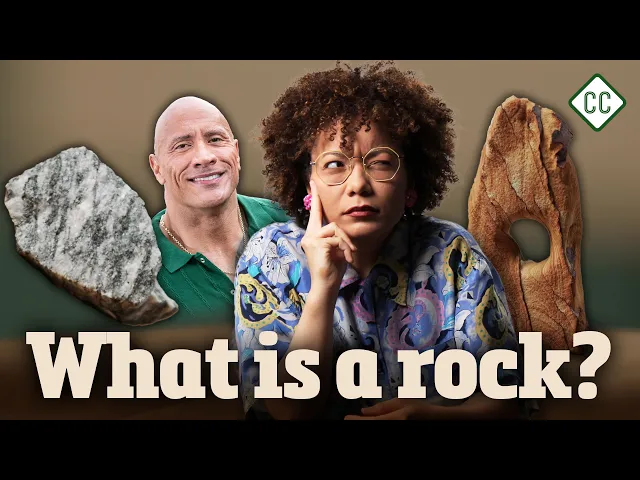
The Rock Episode: Crash Course Geology #6
CrashCourse
0:00 In the wilds of Chile, there are mountains that look like Oreos?
0:03 [music] These are Los Cuernos del Paine.
0:06 Their unusual appearance draws thousands of visitors every year.
0:09 With a thick light stripe between [music] two dark layers,
0:11 they out here looking like a snack.
0:13 But besides looking cool,
0:14 they actually have a lot to teach us about geology, star subject.
0:17 That's right.
0:18 It's the rock episode.
0:20 Hit it, Dwayne.
0:22 Hi, I'm Sage and this is Crash Course Geology.
0:27 [music] Los Cuernos are amazing not just for their unique visual features,
0:32 but because they showcase every part of the rock cycle.
0:36 Listen, Dwayne, if you do that every time I say rock in this episode,
0:39 we'll be here a while.
0:40 Just turn it Just turn it down a little bit, pal.
0:42 The rock cycle is a process that recycles Earth's raw materials over time.
0:47 The rock cycle makes it possible for any kind
0:49 of rock to transform into another kind of rock.
0:52 It's one of the forces that continuously freshen up Earth's surface.
0:56 It's the reason why when you hold a rock in your hand,
0:58 you're not holding something that's frozen in time forever.
1:01 A rock's current identity isn't what it once was or what it'll be in the future.
1:06 But first, what really is a rock?
1:11 Stonehenge, the Blarney Stone, Emma Stone.
1:15 Since the dawn of time, rocks have held many meanings for many peo- What?
1:21 We don't have that much time.
1:24 What am I supposed to do with these?
1:28 [music] As I was saying, in geology, the word rock has a specific meaning,
1:32 a solid cluster of one or more minerals.
1:34 Minerals, by the way, are solid crystals with a specific
1:37 chemical composition formed by geological processes.
1:41 Dwayne, one of us is going to have to change.
1:45 Uh, stubborn as a rock.
1:49 I think a rock's kind of like dogs.
1:50 You have your purebreds, like quartzite,
1:53 which is mostly just the mineral quartz.
1:55 Then you got your mutts, which are a mix of different minerals.
1:58 Like Dwayne is granite, which is mostly quartz, feldspar, and mica,
2:01 but can also have a lot of other minerals like hornblende,
2:04 zircon, and magnetite.
2:06 But even the rock mutts still fall into three basic types,
2:09 classified by how they formed within the rock cycle.
2:11 Sedimentary, like this super sandstone, igneous, like this beautiful basalt,
2:16 and metamorphic, like this nice, well, nice.
2:20 All three of these rock types were involved in the formation of Los Cuernos.
2:25 Let's start at the bottom.
2:26 Rock bottom, am I right?
2:28 I think I just have to accept the puns at this point.
2:30 This is sedimentary rock, which is created when bits of rock and minerals,
2:33 called sediment, pile up and solidify into a solid mass.
2:37 About 90 million years ago, before these mountains were mountains,
2:40 the oldest rocks formed from tiny grains of mud
2:43 and sand at the bottom of an ancient sea.
2:45 Over time, this sediment was buried and squeezed like
2:48 a geological panini until it formed a solid mass.
2:51 Like, imagine if all the stuff at the bottom
2:53 of your lockers slowly fused together over the school year.
2:56 Paper clips, clarinet reeds, emo sweaters,
2:59 all combining into a single locker rock.
3:02 It's sort of like that, but on a much longer time scale.
3:05 The sedimentary rocks at Los Cuernos are clastic.
3:07 They formed from bits of other rocks that broke off,
3:10 drifted away, and got compacted deep underground over time.
3:15 If you wanted to get fancy, and I always do,
3:17 you've got to know that there's more than one way to make a sedimentary rock.
3:21 And I've got examples of all of them in my pockets.
3:23 It's cool rock time.
3:26 All right, Dwayne, it's your time to shine.
3:30 This is limestone.
3:31 Get a load of that puppy.
3:33 It's a sedimentary rock that forms biochemically,
3:36 meaning from the shells and bones of once living organisms.
3:40 Cool, right?
3:40 This one, you know it, you love it, you eat it.
3:43 It's rock salt.
3:44 It's a sedimentary rock that forms chemically
3:46 from dissolved minerals that separate from water.
3:49 Finally, this lump of coal is a sedimentary rock
3:52 that forms organically from the compressed tissues of once living things.
3:56 Can you believe this rock is made of leaf goo?
4:00 Like, how is our planet a real place?
4:02 Let's turn it over to igneous rock,
4:04 by far the most common rock type on Earth's surface.
4:07 What's that, Edwin?
4:09 Sure, I guess classic rock is pretty common, too.
4:11 What?
4:12 No, Blink-182 is not classic rock.
4:15 I'm not going through this again with you.
4:16 Sorry about that.
4:17 Anyway, igneous rock forms when molten rock
4:20 cools down and crystallizes into a solid.
4:22 Geologists give molten rock different names depending on where it's hanging out.
4:26 Magma is when it's underground, and lava is when it's above ground.
4:30 Remember that thick light stripe on Los Cuernos?
4:33 We can thank igneous rock for that.
4:34 Around 12.5 million years ago,
4:36 three pulses of magma pumped out of Earth's depths and slid in between
4:40 the sedimentary rock layers that now make up much of the mountain.
4:43 As the magma cooled over time,
4:45 it formed a special type of igneous formation called a laccolith.
4:48 It's giving belt of lava volcano.
4:50 Look at those spicy lava eyes.
4:52 The igneous rock at Los Cuernos is intrusive.
4:55 That means it formed from magma that rose up
4:58 and cooled very slowly inside other rocks below Earth's surface.
5:03 It intruded, if you will.
5:06 But some igneous rocks, like basalt and this pumice here,
5:11 form in a way that's extrusive.
5:13 They're created when magma exits up to the Earth's surface,
5:17 becoming lava, where it cools and hardens into rock.
5:20 Our last stop on the tour of Los Cuernos is metamorphic rock,
5:23 which forms when intense temperature, pressure,
5:26 hot fluids, or a combo of these causes one kind
5:29 of rock to transform into a different kind of rock.
5:33 In other words, a metamorphosis happens.
5:36 Like a beautiful rock butterfly.
5:38 A rock-a-fly.
5:39 A butter-rock.
5:39 You get it.
5:40 At Los Cuernos, when the magma intruded into the mountain,
5:43 it oozed between layers of sedimentary rock.
5:46 As it did so, the magma's heat baked the rock it touched,
5:49 causing it to change identity.
5:52 Those rocks became metamorphic.
5:55 Sometimes metamorphic rock takes on a foliated or stripy appearance.
5:58 Nice, like the one I have here.
6:01 Has visible streaks because intense pressure flattened
6:04 and rearranged its mineral crystals into even bands.
6:08 But in Los Cuernos, the metamorphic rocks are non-foliated.
6:11 That's because the rocks weren't squished by extreme pressure,
6:14 only warped by intense heat.
6:16 So, the crystals never got pushed into stripes.
6:19 Los Cuernos is so cool,
6:20 but these mountains show us just one of the ways the rock cycle can play out.
6:24 Many different factors can cause rocks to bop back and forth in the rock cycle,
6:28 changing identities over time.
6:29 Igneous rock can become sedimentary, then metamorphic,
6:32 then back to igneous, or sedimentary again.
6:34 Rocks go through more phases than me in middle school.
6:37 Just look at Dwayne.
6:38 His journey started underground millions of years ago
6:41 when magma collected in a bleb under Earth's surface,
6:44 slowly cooling to form our igneous buddy.
6:47 Over many years, tectonic shifts pushed the land and Dwayne upward.
6:52 As the land rose, other slow but mighty
6:55 forces freed Dwayne from his rocky prison, weathering and erosion.
6:59 You see, elements like water, wind, and ice act as hammers,
7:04 sculpting rocks by breaking them down in a process called weathering.
7:07 This can also happen through chemical processes.
7:09 Like, rain is slightly acidic,
7:11 so raindrops can spark chemical reactions as they land on rocks,
7:14 transforming the minerals within them.
7:16 And even living things can cause weathering.
7:19 Trees weather rocks by creating cracks with their roots.
7:22 People cause weathering by walking all over the same patch of rocks for years.
7:26 Even tiny, unassuming lichen weather rocks
7:29 by oozing acids from their root-like structures.
7:32 We have got to change the game to rock, paper, scissors, wind, water, lichen.
7:37 Weathering creates sediment, the stuff that eventually forms sedimentary rock.
7:40 And then comes erosion,
7:42 the process that washes away sediment and moves it somewhere else.
7:45 Those two processes explain how Dwayne broke off from his home cliff
7:48 and tumbled down to where I was hiking when I was like,
7:51 "Hey, cool rock." And the rest is history.
7:54 So, yeah.
7:55 Nothing stays the same forever.
7:56 The rock cycle is happening all around us all the time.
7:59 When you pick up a rock, you're touching something that's part of the same
8:02 cycle that formed the Rainbow Mountains in China,
8:05 the Giant's Causeway in Northern Ireland, and The Wave in Arizona.
8:08 Which, honestly, looks like something out of a Dr.
8:10 Seuss book.
8:11 No matter where you live, the rock cycle shapes the land around [music] you.
8:14 Understanding how rocks form and transform can give you
8:18 a whole new perspective on the planet we all call home.
8:21 Next time, we're taking a magnifying glass to gems.
8:24 See you then.
8:25 All right, Dwayne, let's go.
8:27 Rock, paper, scissors, wind, water, lichen.
8:30 Oh, wait, you don't have hands.
8:31 Thanks for watching this episode of Crash Course Geology,
8:34 which was filmed at our studio in Indianapolis,
8:36 Indiana, made with the help of all these super cool people.
8:40 If you want to help keep Crash Course free for everyone forever,
8:43 you can join our community on Patreon.