Sawing a Dam in Half (on Purpose)
Practical Engineering
0:01 Concrete is the second-most-consumed substance on our planet.
0:04 Only water beats it,
0:06 and actually water is a major ingredient of concrete anyway.
0:11 Every year, humanity mines, mixes,
0:13 and places roughly three metric tons for every person on Earth.
0:18 It’s ubiquitous.
0:19 Most of us hardly even think about all the concrete around us.
0:23 We’ve all seen the grey lumpy mixture flowing
0:26 down chutes into formwork to become a road,
0:29 sidewalk, footing, pile, patio, or foundation.
0:32 It’s easy to think of concrete as a single,
0:35 uniform substance used around the world.
0:37 But it’s not.
0:38 The only reason we are able to use
0:40 so much concrete in construction is that it’s cheap.
0:43 Of the four main ingredients- sand, gravel, cement,
0:46 and water- two of them come directly
0:48 from the ground with little need for processing or refinement.
0:53 One is water.
0:54 Cement is the only ingredient that requires a significant manufacturing process,
0:59 but the raw materials for it are fairly widespread across the globe.
1:04 Many building materials are constrained by geography.
1:07 They only grow, occur mineralologically,
1:09 or are manufactured in specific locations.
1:12 Then they have to be transported, often at great cost, to where they’re needed.
1:18 It’s not true for concrete.
1:19 No matter where you are on earth,
1:22 there’s a pretty decent chance that somewhere nearby exists a ready source
1:25 for at least most of the raw ingredients you need to make it.
1:29 That simple fact has significantly contributed to its widespread use,
1:33 but it’s done something else too.
1:36 Take a look at any geologic map.
1:38 If you’re like me, you do this in your spare time anyway.
1:41 You realize pretty quickly that there is tremendous variability in the different
1:46 kinds of materials that make up the surface of Earth’s crust.
1:49 And the practical result of that, at least for the purposes of this discussion,
1:54 is that every batch of concrete is just
1:56 a little bit different depending on where you go.
1:59 In a way, that’s kind of special, right?
2:01 In most cases, the concrete you see
2:04 around you represents a particular place on Earth.
2:07 Its strength, durability, appearance,
2:09 and essence are highly local characteristics.
2:12 It’s literally made from materials that were sourced not too far away.
2:16 But, in some cases, we’ve learned too late that local
2:20 materials had some hidden problems when used in concrete,
2:23 and the ways we’ve worked to fix those problems
2:26 have created some of the most interesting stories.
2:29 I’m Grady, and this is Practical Engineering.
2:40 This is Fontana Dam on the Little Tennessee River in North Carolina.
2:45 At 150 meters (or nearly 500 feet) in height,
2:48 it’s the tallest dam east of the Mississippi River.
2:51 The north shore of Fontana Reservoir forms
2:54 the border of the Great Smoky Mountains National Park.
2:57 And if you’re through-hiking the Appalachian Trail,
3:00 the famed 2200-mile path through the wildest parts of the eastern United States,
3:05 you have to walk right over the top of it.
3:08 Built by the Tennessee Valley Authority (or TVA), Fontana was completed in 1944,
3:14 just in time to provide hydropower to the Alcoa
3:17 aluminum smelting plant at the end of World War II.
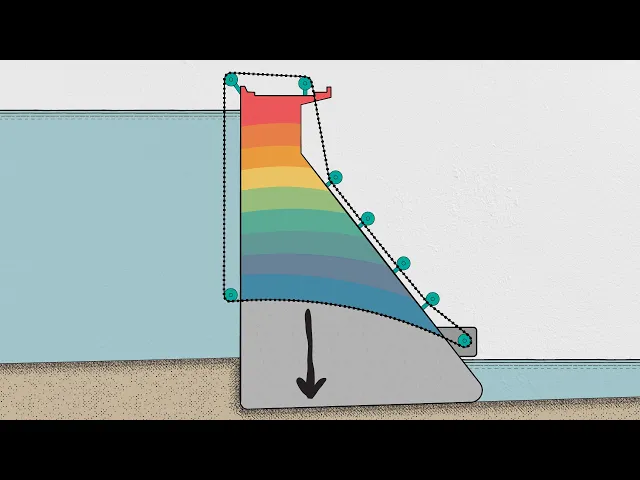
3:21 It’s a concrete gravity dam, meaning that it derives its stability to hold
3:26 back Fontana Reservoir entirely from its own weight.
3:28 And boy does it have a lot of weight.
3:31 More than 2.1 million cubic meters of concrete
3:34 went into the structure before it was finished.
3:37 That’s well over half the volume of Hoover Dam,
3:40 and if you watch the same kinds of videos I do,
3:43 you know that putting all that concrete in Hoover Dam was a major challenge.
3:49 Concrete heats up as it hardens, which can negatively affect the curing process,
3:53 but more importantly, it causes the concrete to expand.
3:57 For a structure like a dam sandwiched between two rocky abutments,
4:01 that expansion can lead compressive stress to build up in the concrete.
4:06 Then, after curing, when the concrete starts to cool back down, it shrinks.
4:11 That shrinking can lead to cracks,
4:13 especially in mass concrete structures that heat up and cool down unevenly.
4:17 And cracks are not ideal for dams.
4:20 To mitigate this issue, pipes were installed within the concrete at Hoover Dam,
4:26 and chilled water was continuously circulated during
4:29 construction to pull heat out of the concrete.
4:31 The same thing was done when they were building Fontana Dam.
4:35 In fact, in addition to the cooling lines,
4:37 the dam was built with deliberate expansion joints that would
4:41 allow each separate concrete block to cool off and shrink.
4:44 Once the concrete cured,
4:46 those joints were grouted to add strength and make the dam watertight.
4:49 It was a pretty robust and thoughtful plan to avoid
4:53 the buildup of stress in the structure, or so they thought.
4:56 In 1972, engineers inspecting the drainage gallery,
4:59 a tunnel through the concrete dam used to collect and redirect drainage,
5:05 noticed unexpected cracks right where the dam curves.
5:08 Later investigation revealed that the cracks extended
5:11 through a large part of the structure.
5:13 At this point, the dam was still less than 30 years old.
5:17 It shouldn’t be deteriorating this quickly.
5:19 But the cracks were serious enough that something needed to be done.
5:23 Engineers initially blamed the Tennessee sun.
5:26 Fontana Dam runs almost perfectly east to west,
5:29 with its broad downstream facing directly south.
5:32 That means a huge area of concrete is exposed to sunlight for most of the day.
5:38 The sun heats the concrete, causing it to expand,
5:41 and over thousands of cycles, cracks are inevitable.
5:44 The curved section of the dam was most vulnerable.
5:47 Reaction forces from the abutments align with the axes of the dam.
5:51 Instead of pure compressive stress,
5:53 the expansion of the concrete created bending stress
5:56 (a combination of expansion and contraction) at the corner.
6:00 In addition to the cracks,
6:02 the movement was also causing the spillway gates to bind up.
6:05 After instruments were installed on the dam,
6:08 the scope of the problem became clear.
6:10 Thermal movement is cyclical with the seasons.
6:12 Concrete may expand in the summer,
6:14 but it returns to its original size in the winter as temperatures cool.
6:19 Fontana had some of that, but underneath
6:22 the cyclical changes was a continuous one.
6:25 The concrete was permanently growing.
6:28 TVA took some cores of the concrete to start planning a repair,
6:31 and sent them out for testing.
6:33 When the results came back, the reason for the unexpected growth was discovered.
6:37 The laboratory that examined the concrete under the microscope noticed
6:41 that some of the aggregates inside had dark rims around them.
6:45 That is a classic sign of alkali-silica reaction,
6:49 or ASR, sometimes known as concrete cancer.
6:53 The fundamental components of concrete are aggregates, large and small,
6:56 bound together by a paste of cement and water.
6:59 As the cement paste hydrates,
7:01 potassium and sodium hydroxides dissolve into the water
7:04 within the tiny pore spaces of the concrete, creating an alkaline solution.
7:09 In some cases, this is a good thing.
7:11 The alkaline environment is great for steel reinforcement,
7:14 helping to prevent rust.
7:16 But for some types of aggregates, it causes a serious problem.
7:21 Specifically, if reactive forms of silica are present,
7:25 they can more readily dissolve in the high-pH water,
7:28 combining with the alkalis to form a kind of gel.
7:31 As that gel absorbs moisture,
7:34 it swells and expands, causing internal stress and cracking.
7:38 This is an extremely widespread problem that has caused structural damage
7:42 in every state in the US and many countries around the world.
7:46 You usually don’t have to search far for an example of a cracked up bridge,
7:51 broken sidewalk, or ruined building foundation that resulted
7:54 from an alkali-silica reaction in the concrete.
7:57 Fortunately, the reaction requires three conditions,
7:59 so there are quite a few ways to deal with it.
8:03 For one, an alkali-silica reaction requires
8:06 the aggregates to actually contain silica, also known as silicon dioxide.
8:10 Well, 90 percent of the Earth’s crust is made up of silicate minerals,
8:15 so this might not seem possible to avoid.
8:18 Luckily, only certain forms of silica are significantly reactive in concrete.
8:22 We have tests we can perform ahead of time
8:25 to identify quarries or sources of rock that react with cement,
8:29 allowing us to just avoid the issue altogether.
8:32 But like I mentioned before,
8:34 the cost of concrete is really sensitive to transportation costs.
8:37 The farther you have to go to get suitable aggregates,
8:40 the higher the project’s costs rise,
8:43 so avoiding local materials is not always ideal.
8:46 The second condition required for an alkali-silica
8:49 reaction is highly alkaline cement.
8:52 So, we have ways to control for that too.
8:55 Cement can be manufactured to have lower alkali content, and we can use what are
9:00 called “Supplementary Cementitious Materials,” like fly ash,
9:03 to replace some of the cement in concrete.
9:06 Those solutions only work if the concrete isn’t already in place, though.
9:10 The third factor of an alkali-silica reaction is excess moisture.
9:14 You can just keep the concrete dry with waterproof coatings or membranes.
9:18 Without moisture, the gel can’t expand, so the problem is solved.
9:22 But there are some structures where waterproofing is a pretty big challenge.
9:28 So TVA was in a bind, literally.
9:30 They were facing the possibility of just having to perpetually
9:34 repair cracks and equipment as Fontana continued to expand.
9:38 Then they decided to get creative.
9:40 Kristen Smith is the Senior Program Manager for Dam Safety at TVA,
9:45 and she explained the thought process: Kristen: You know,
9:48 the impacts on the spillway and powerhouse equipment.
9:50 That led to major maintenance and repairs[...] Need to move from the reactive
9:57 approach- that's not a long-term solution- to a more proactive approach.
10:04 The proactive approach they landed on was a fourth option for dealing with ASR:
10:10 Rather than trying to stop the reaction,
10:12 TVA decided to just give the concrete more room to grow.
10:16 The solid rock abutments at each end of the dam had no room to give,
10:20 so that space would have to be found in the dam itself.
10:24 In 1976, they embarked on a fairly novel
10:27 operation to cut a relief slot all the way
10:31 through Fontana Dam and do it without draining
10:34 the reservoir or causing any disruptions to the hydropower plant.
10:38 The idea was pretty simple:
10:40 instead of building up axial stress as the concrete expands,
10:44 the dam can expand into the newly cut slot.
10:47 Simple in theory; pretty challenging in practice.
10:50 How do you saw a dam in half?
10:52 Luckily, TVA has done this at two of its other dams in addition to Fontana,
10:57 and shared some footage of that so you could see it happen.
11:01 These are big dams, so this isn’t
11:04 sawing with blades you find at ahardware store.
11:06 The tool used for cutting through the concrete
11:08 looks more like a rope than a saw blade.
11:11 Kristen: It is diamond wire, and it's really neat.
11:16 It's, if you touch it, you know, it's 15 millimeters,
11:21 which is a little over half an inch.
11:25 It's abrasive.
11:26 I mean, you know, it would rub your skin if you drug it across your skin,
11:31 but you can touch it.
11:32 You can run your hand along it and it's not going to cut you.
11:35 It can cut through concrete.
11:36 It can cut through steel.
11:39 It looks like a big necklace.
11:42 That big diamond necklace runs along pulleys strategically
11:45 installed on the dam to advance the slot downward.
11:48 The saw pulls the wire in a loop,
11:51 managing the slack and keeping constant tension against the bottom of the slot.
11:55 There are a lot of advantages
11:57 to this, in addition to the practically unlimited depth.
12:00 It causes very little vibration or dust,
12:03 and provides a clean cut without breaking the edges.
12:06 But, there’s a pretty obvious challenge of cutting a slot in a dam:
12:10 how do you deal with the water?
12:12 Turns out, it depends on the dam.
12:15 At Fontana, crews installed a cofferdam on the upstream face
12:18 of the dam to hold back the reservoir during the operations.
12:21 It’s basically half of a steel pipe that seals
12:24 against the concrete face on the sides and bottom,
12:27 just big enough for access to adjust the pulleys.
12:30 At Chickamauga Dam, the geometry made a cofferdam less feasible.
12:33 So instead, they broke the process up into three
12:37 sections separated by boreholes drilled downward into the structure.
12:41 One section could be cut by the diamond
12:43 wire while the other borehole was sealed,
12:45 preventing water from moving through the slot.
12:47 That’s easier said than done, but you can look to your feet for inspiration.
12:51 The seals installed in the boreholes are long rubber tubes called sock seals.
12:57 Kristen: Well, it's like a sock you put on your foot,
12:59 but a half-inch thick rubber and a hundred feet long.” [Grady laughing] Kristen:
13:04 And I've heard it described as kind of like an inside-out fire hose.
13:11 Very strong and waterproof, but to some degree flexible.
13:19 The mess is another problem.
13:21 The dust from the fresh cut concrete mixes with lubricating
13:25 water to form a slurry that runs out of the slot.
13:28 Concrete slurry isn’t good for the environment.
13:31 It mucks up the water and changes the chemistry.
13:34 So the slurry generated by the cutting process
13:36 has to be captured and pumped to holding tanks.
13:39 After the concrete particles have settled out,
13:42 the water can be recirculated to control
13:44 the dust and lubricate the wire as it cuts.
13:47 And this whole process happens essentially non-stop.
13:50 Time is of the essence so that the internal stress
13:54 doesn’t close the slot while the wire is still inside it.
13:57 Slot cutting is relatively low impact on the dam operations,
14:00 but parts of the dam have to be shut down to avoid an accident
14:05 like a broken wire being pulled into a hydro unit or spillway gate.
14:09 One of the reasons this is possible at all is
14:12 that TVA’s concrete dams experiencing ASR are all gravity dams.
14:16 In essence, that means that any vertical slice of the dam
14:20 is theoretically stable on its own without lateral support.
14:23 Cutting a slot in an arch dam wouldn’t work,
14:26 because they depend on axial thrust forces for stability.
14:30 Before, during, and after the slot cutting operation,
14:33 there’s an intensive monitoring program to keep an eye
14:36 on how the dam is behaving and methodically
14:39 measure the movement and strains to make sure
14:41 the dam responds in the way the engineers predict.
14:44 Kristen: We have hundreds and hundreds of instruments
14:48 on the concrete portion of the dam.
14:52 We measure the slot that we've cut.
14:55 Is it closing?
14:57 Is it opening?
14:59 At what rate is it closing or opening?
15:02 We measure our spillway piers.
15:04 Are they moving?
15:06 We measure expansion joints.
15:09 Everything in every direction we measure.
15:13 And those measurements are important because
15:15 the slot cutting isn’t a one-time permanent solution.
15:19 This doesn’t slow down the alkali-silica reaction in the concrete at all.
15:23 It just mitigates the stress building up
15:25 in the structure as the concrete expands, which is basically a non-stop process.
15:30 Over time, the slots close.
15:33 That means that TVA has to go through the operation regularly.
15:37 Kristen: Every approximately five years, we update,
15:41 we use finite element analysis models on our concrete growth projects.
15:47 So they take all of those years
15:51 of new information data from the instruments and they
15:55 recalibrate and they rerun these models and they
15:59 can tell us how effective the slot cut is.
16:02 They can tell us when we need to do it again.
16:05 Whatever we need to do to ensure that we are maintaining
16:09 the integrity of our dams and the adjacent equipment, that's what we do.
16:15 I was curious why they don’t just cut a big slot
16:18 to get a longer period of relief before having to do it again.
16:22 In hindsight, it was kind of a dumb question: Kristen:
16:25 The simple answer is so we don’t leave a big hole in the dam.
16:28 The slot cut at Chickamauga is approximately a half and inch.
16:33 It's a lot easier to stop water from flowing through a half an inch
16:37 slot in a dam than it would be maybe a six inch wide slot.
16:43 In addition, slot cutting is expensive.
16:46 In other words, TVA wants to disturb their structures as little as possible,
16:50 while still mitigating the problems AAR causes.
16:54 It’s a back-and-forth thing.
16:55 You cut, observe, wait, and only cut again when it’s necessary.
17:00 It’s good stewardship of the resources available
17:03 to take care of the structures we’ve already built.
17:06 Alkali-silica reaction in concrete is a huge problem.
17:09 It’s something engineers have to consider
17:12 when designing basically any concrete structure,
17:14 which means it’s something that quarries, batch plants,
17:17 testing labs, and contractors have to think about as well.
17:21 Since the 1970s, we’ve gotten pretty good at avoiding it in our structures.
17:25 But since it’s often a slow-growing issue,
17:27 we’re still figuring out how to deal with the problems it’s causing
17:31 on the stuff we built before we really had a handle on it.
17:36 On mass concrete structures, like TVA’s dams, it could have been a death blow,
17:41 significantly shortening the lifespans of these massive projects.
17:44 But they figured out a creative solution to live with it.
17:48 Kristen: “I mean, it's cool.
17:50 And when you think about a dam, it's a water barrier.
17:54 It is designed to hold back water.
17:56 So the last thing you expect to do is to cut a piece out of it.
18:00 But we do.
18:02 We do.
18:04 Reactive aggregates are a hyper-local phenomenon.
18:07 Go a few miles in any direction,
18:10 and the composition of rocks can completely change.
18:12 That’s true for a lot of parts of life,
18:15 but one thing I never considered was how specific
18:18 a sports stadium is to the city it's based in.
18:21 There are huge differences in how they’re built,
18:23 where they’re located within a city, and how it feels to watch a game.
18:28 One of my favorite channels, Maapify, produced a 3-part video series called
18:32 Beyond the Bleachers that explores the people,
18:34 policies, and priorities that shape the differences
18:37 in stadiums between the US and Europe.
18:40 And if you want to check it out, it’s only available on Nebula.
18:44 You probably know about Nebula now, even if you’re not subscribed.
18:47 It’s a streaming service built by and for independent creators.
18:50 No studio executives deciding what gets the green light,
18:54 no advertisements driving the content into a single style.
18:58 It’s just independent creators making stuff they’re excited about
19:02 with as few barriers and distractions as possible between you and us.
19:06 My videos go live on Nebula before they come out here,
19:10 and my Practical Construction series was specifically produced for Nebula
19:13 viewers who want to see deeper dives into specific topics.
19:16 I know there are a lot of streaming platforms out there right now,
19:20 and no one wants another monthly cost to keep track of, but I
19:23 also know that if you’re watching a show like this to end,
19:25 there is a ton of other stuff on Nebula that you’re going to enjoy as well.
19:30 So we’ve made it dead simple: click the link below and sign up for a free trial.
19:34 Watch whatever you want for 3 days totally free.
19:37 If you love it, pay just one
19:39 time for an entire year’s access at go.nebula.tv/practical-engineering.
19:42 We also have gift cards if you want to get a subscription for someone you love.
19:49 Or you can get a lifetime membership for 200 dollar off right now.
19:53 Pay once and have access for as long as you and Nebula last.
19:57 Hopefully that’s a long time!
19:58 If you’re with me that independent creators are the future of great video,
20:03 I hope you’ll consider subscribing.
20:04 Thank you for watching, and let me know what you think!