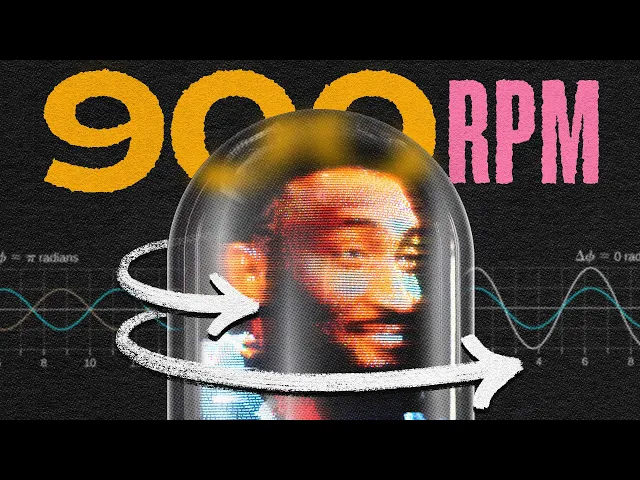
How This Hologram* Breaks Physics
The Studio
0:02 This is a fully 3D hologram complete with video games,
0:06 3D models, and this really freaky Marquez.
0:10 Except it's not a hologram.
0:12 And in order to understand why it isn't, we have to start by understanding.
0:16 Yo, what even is a hologram?
0:19 Okay, look.
0:20 Holograms are tricky.
0:21 There's like the dictionary technical definition of what a hologram is,
0:25 and then there's the idea of a hologram that we all have in our head.
0:28 And I mean, look at this thing.
0:30 Just look at it.
0:30 That is a hologram.
0:33 But technically, it's not a hologram.
0:36 Everything that you think is a hologram actually isn't a hologram.
0:42 Miku at Meikufest, that was just rear projection on a transparent screen.
0:45 Pac at Coachella, that's Pepper Ghost transparent screen.
0:48 That Razer Waifu thing at CES, I don't exactly know how that works.
0:52 I'm pretty sure it's like a transparent OLED or miniLEDD screen inside a tube.
0:55 Not only are none of these actually holograms, they're all not even 3D.
1:00 Those are all 2D images just on transparency.
1:03 If you looked at it from the side, it would be flat as a board.
1:06 Yeah, but I I've been to CES.
1:08 Like, I feel like I must have seen a hologram.
1:11 I wish that were true.
1:12 Marquez, none of the things you've seen
1:14 so far in this video are actually holograms.
1:17 And that's because a hologram is less of a specific device
1:20 and much more of a technique we can use to record 3D information.
1:24 If you were to ask a trad holographer,
1:27 they would say that something like this is your breadandbut hologram.
1:31 There's no screen.
1:32 There's no projectors.
1:33 It's just a way you can make a flat surface look kind of like a window.
1:37 You'll get some perspective shift as you move side to side,
1:40 but you're not going to see any Japanese singing,
1:42 dancing, vocaloid sensations on it.
1:44 The way real holograms work is actually really interesting.
1:48 And it all comes down to capturing depth information
1:51 and then recording it using these things called interference patterns.
1:55 So when you take a normal photograph,
1:57 effectively what you're doing is recording brightness information.
2:01 But to take a 3D photograph, you also need to capture depth information.
2:05 Well, how do you do that?
2:07 Lucky for us, light moves at a really constant speed.
2:11 Which means in order to find out how far away something is,
2:14 all we have to do is time how long it takes for the light to reach us.
2:18 But what do you do since light moves really really fast,
2:21 if you don't have a clock fast enough to time that light?
2:25 Well, the holographic answer is to take a laser
2:28 and to split it into two identical beams.
2:31 One of those beams is going to bounce off the object you're making
2:34 a hologram of, and the other is going to go straight to your holographic film.
2:38 where those two beams kiss, they mess with each other.
2:42 And the exact timing of that return beam,
2:44 the one that's bouncing off the object you're scanning,
2:47 that's going to dictate what that mess looks like.
2:49 And that mess is the interference pattern.
2:53 So then we take that interference pattern and we stamp it into a piece of metal.
2:57 And all of a sudden,
2:58 we have a flat piece of metal with these little ridges poking up.
3:01 Those ridges are going to reflect ambient light in the exact
3:05 same pattern that the original object reflected light off of it.
3:08 That means when you shine light onto your little
3:10 card and you tilt it side to side,
3:12 you're going to get the same parallax light 3D effect
3:15 you would as if you were running around that object.
3:18 I just smoothbrained the heck out of a really complicated scientific thing.
3:22 If you want to get like the full physics explanation,
3:25 go watch this video by three blue one brown.
3:28 But the point is that real holograms are actually kind of underwhelming.
3:32 They're just these flat things that sort of create this fake window effect.
3:36 But what if what if that Princess Leia digital campfire 3D apparation was real?
3:44 It's just not a hologram.
3:47 I'm supposed to be talking about holograms.
3:49 What am I doing here?
3:50 Miles, what is that?
3:52 What do you mean what is this?
3:53 We're here today to talk about the real
3:54 tech marvel and the sponsor of today's video, Narwhal.
3:58 That's right, Narwhal.
3:59 The Narwhal Flow 2.
4:00 The greatest robot vacuum ever made.
4:04 Normal robot vacuums, what do they do?
4:05 They run around your house just bumping into stuff like a big little idiot.
4:08 Okay, Narwhal Flow 2.
4:10 Two full color cameras.
4:12 Okay, paired with a VLM.
4:14 That's a vision language model.
4:16 That means it can quickly recognize a room.
4:18 Okay, it can find your valuables.
4:20 It can recognize cables.
4:21 It knows everything it sees.
4:23 Marwal Full 2 has an extremely powerful mop.
4:26 It can heat up to 140° F.
4:29 And using artificial intelligence,
4:31 it can detect whether they go into dry mode or wet mode.
4:35 Now, while most mops get dirty over time,
4:37 the Narwhal Flow 2 has a built-in dual tank system right inside
4:40 the vacuum to make sure you're only using fresh water to clean your floors.
4:44 And once the mop has picked up all that waste water,
4:46 there's actually a stirer inside of the robot to make sure
4:48 you're not leaving any nasty residues or odors on the inside.
4:52 So Miles and I own these at home.
4:54 We love our NW wallflow tubes.
4:55 So click that link in the description and check it out for yourself.
4:59 But now back to the video at hand.
5:01 What if we had a hologram that wasn't technically a hologram,
5:05 but really felt like a hologram?
5:09 Ah, that makes sense.
5:10 A display with volume.
5:12 Exactly.
5:12 volume, depth, the big Z.
5:15 Technically, this is a swept volume display,
5:18 which uses a trick called persistence of vision
5:21 to create this sort of 3D effect.
5:24 Now, what is persistence of vision, you may say?
5:26 Yeah.
5:27 Look at this picture of a horse.
5:29 Now look at this picture of a horse.
5:31 Now look at this picture of a horse.
5:32 Now look at this picture of a horse.
5:33 Now look at this picture.
5:34 Now look at this picture of a horse.
5:36 Look at this picture of a horse.
5:37 Now look at this picture of a horse.
5:39 Now look at this picture.
5:40 Do this picture of a horse.
5:41 If I make the horse picks fly by fast enough,
5:44 you stop perceiving individual horse pickicss and start perceiving moving horse.
5:50 Your brain is piecing all of these images
5:52 together into one sort of continuous visual experience.
5:55 Look at this spinning LED fan display we got on Amazon for $30.
6:00 You take a bunch of LEDs,
6:01 you spin them around real fast where they're lit up, you get a circle.
6:04 But if you pulse those LEDs so they're on in the exact same place each rotation,
6:08 you'll get a dot floating in space.
6:10 sort of like a pixel.
6:13 Okay.
6:13 So, I mean then that's kind of like what that is,
6:16 but maybe they stack a bunch of those spinning fans
6:18 on top of each other and you get some depth.
6:21 That was pretty easy to pull off.
6:25 The VX2 is the perfect example of a piece of tech that is so simple in theory,
6:31 but as soon as you want to turn it into a functional consumer product,
6:34 it gets astronomically difficult.
6:35 This thing spins at 900 RPM.
6:39 That's like 15 times a second.
6:41 That's That's as fast as your car's wheel on the freeway.
6:44 Yeah.
6:44 See, the way this thing works is it takes a 3D object
6:47 and it turns it into a bunch of these vertical slices, right?
6:50 And then as the LED panels spin around,
6:53 it displays each one of those 2D slices at exactly the right point.
6:58 Let's do some quick napkin math here.
7:00 If it rotates at 15 times a second and loads about 480 slices into a rotation,
7:07 that means in order to play a 3D
7:08 video at 30 frames per second, God's frame rate.
7:12 You need to update the panels on this thing over 7,200 times per second.
7:17 And moving that fast complicates things even more, right?
7:20 Because if a single one of those slices is shown at the wrong time,
7:24 your image starts to flicker and get jumbled
7:26 and it just becomes really hard to look at.
7:28 And on top of all this, you still need enough processing power to do
7:32 error correction because the motor is never going to spin it at exactly 900 RPM.
7:36 This thing is only connected to the PC with a single USB 3.0 cable.
7:41 There's there's no Thunderbolt.
7:42 There's no HDMI.
7:43 It's USB 3.0 delivering all of this data,
7:46 which means you need one hell of an efficient graphics engine.
7:50 in order to get a graphics engine so
7:53 efficient that you could pull all of this off.
7:55 The guy who wrote it wrote a lot of like Duke
7:57 the Duke Nukem graphics engine from the '90s which was like
8:01 a really ahead of its time first person shooter graphics engine
8:04 that let you run 3D graphics on a old '90s computer.
8:08 Here's another thing you didn't consider, right?
8:10 How do you get data and power to something that is spinning that fast?
8:15 If you just ran a normal cable to those panels in there,
8:19 you'd get instant cable tangle.
8:21 The whole it would just turn into wire
8:22 spaghetti inside that little dome, you know.
8:25 And so Voxon actually developed a wireless technology.
8:28 They're getting power to their to the panels via induction.
8:31 They're getting all the data transferred wirelessly, too.
8:34 So on top of all the crazy hardware and software
8:36 Foxcon had to develop to make this thing exist,
8:39 they also then had to beat the literal laws of physics.
8:43 Because when you spin an LED panel at 900 RPM, it really wants to flex.
8:48 And what happens when it flexes?
8:50 Those individual LEDs will be at a slightly
8:52 different place than they're supposed to be,
8:53 and your image gets warped and jumbled again.
8:56 So to defeat this flexing, they came up with two clever solutions.
9:00 The first is an aluminum frame between those two
9:03 LED panels that keeps everything nice and rigid.
9:06 And the second they build a super elegant solution where the air
9:09 in there actually moves in laminer flow with the display spinning.
9:14 There is no turbulence in there.
9:16 It's smooth.
9:17 It's smooth.
9:18 Marquez, it's so much work.
9:20 But Ellis, what does it actually do?
9:25 Okay.
9:25 What does it actually do?
9:29 You would never ask a car manufacturer what
9:32 a car could do in a world with no roads.
9:36 I believe Confucious said that.
9:38 Is it the highest resolution display that's ever existed?
9:41 No.
9:41 Does it have the most color accuracy of any display in the studio?
9:45 No.
9:45 Does it flicker a little bit when you're in front of it in person?
9:48 Yes.
9:49 However, this thing is simultaneously the future because
9:53 this is really the invention of the digital campfire.
9:56 the first narrative experiential display that people can stand around
10:01 and see each other and see the content from 360 degrees.
10:05 It's a blast from the past because it's made
10:08 by a group of tinkerers who started in a garage.
10:10 It's like Apple or Compact.
10:12 It's it's something you don't see that often in tech anymore.
10:16 Yeah, having Having the display before the content is an interesting conundrum.
10:20 As a reviewer, it's funny.
10:21 It's like if someone invented mechanically
10:23 complex McLaren P1 before we had roads,
10:27 it would be a bad take to say that the car is useless.
10:32 But you know, you are totally wrong though.
10:34 No, exactly.
10:34 Like if you were trying to explain it to a technologist, you'd be like,
10:37 "This is great." If you were trying
10:38 to convince someone to buy it, you'd be like, "Yeah." Yeah.
10:42 So, what does it actually do?
10:45 Skibby toilet.
10:47 can click right here to hear me talk about speakers,
10:50 other weird experimental new consumer tech stuff.
10:53 Um, but I got to go.
10:54 I got a hot date tonight.
10:56 So, uh, make sure to subscribe to the studio channel.
11:00 Peace.