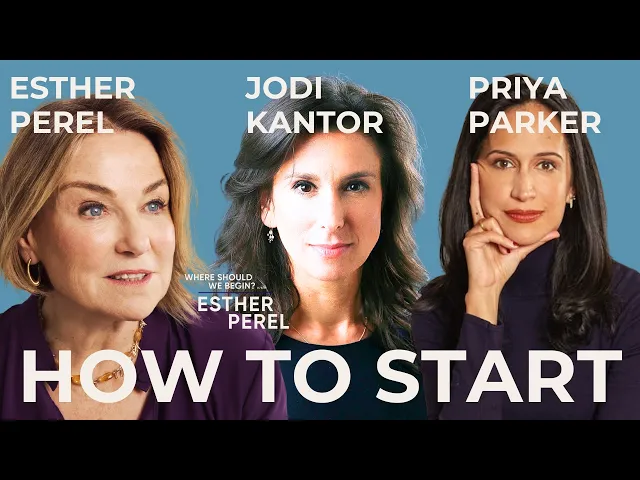
How To Start: Esther Perel in Conversation with Jodi Kantor and Priya Parker Where Should We Begin?
Esther Perel
0:00 I'm often asked how I started my career.
0:04 So, of course, when Jodi Kantor, author of How to Start,
0:09 investigative journalist for the New York Times,
0:11 asked me to join her and Priya Parker, author of The Art of Gathering,
0:17 in a conversation about how to start our work life,
0:21 our careers, I was instantly intrigued.
0:25 There's so much to tell about how to start.
0:28 I actually really like the the focus on the starting
0:31 rather than I even anything that follows afterwards.
0:35 So, we showed up on stage and basically asked questions about the book to Jodi,
0:42 like what made you want to write a book for young
0:46 people finishing college or school and wanting to know how to start.
0:52 What was special about the audience was how intergenerational it
0:55 was because everyone is concerned by the question of work today.
1:00 Whether you have just paid for the college of your child,
1:03 whether you are yourself in transition in your mid-40s,
1:07 or whether you are just starting,
1:09 it is actually a collective question at every age level.
1:14 So, my friend Priya Parker, who is a consummate group facilitator,
1:20 set the intention for the evening and facilitated the conversation.
1:29 We are gathered here tonight as a temporary community with a shared question.
1:36 And we are gathering around one of the things
1:39 that people have done for as old as time,
1:41 which is to sit together and ask something that is relevant to our young people,
1:48 but is actually relevant to all, which is how in this moment of uncertainty,
1:54 in this one could even say mess, does one find one's life's work?
2:01 And a year ago, our friend Jody was asked
2:04 by the Columbia students to be their commencement speaker.
2:08 Now, I don't know if you all remember
2:10 what was happening at Columbia at the time,
2:12 but uh most people would probably say,
2:15 "You know, I need to wash my hair." And Jody being Jody accepted,
2:20 but she also didn't go and pontificate in a corner.
2:24 She did what she always does, which is she went to the people most affected,
2:29 and she spoke to Columbia students graduating,
2:32 and said, "What are your questions?" And I
2:35 want to read just the opening paragraph,
2:37 one of the paragraphs from How to Start.
2:41 I reached out to students to ask how they were navigating their sad,
2:46 strange senior spring.
2:49 They didn't want to talk about Israel and Gaza
2:53 or President Trump or even the university administration.
2:56 Many of them had grown to distrust.
2:59 Instead, all of them, regardless of demographics or political views,
3:05 were united in worry over one question.
3:09 How, in this environment,
3:11 were they supposed to find and start their life's work?
3:16 And that speech went on to become this beautiful, beautiful book, How to Start.
3:23 And the question that has most kept her up at night
3:26 over the last year is how do young people begin?
3:31 So, that is why we are here, and we wanted to also find out why you are here.
3:37 Esther?
3:38 Yes.
3:39 Yes, hello everyone.
3:41 So, um you know, one of the questions we all had in the back
3:47 room here is if you have ever
3:51 received career advice that was spectacularly wrong.
3:58 Please, if you have received that kind of advice, stand.
4:03 Or indicate in the best way you can.
4:08 We shall quickly realize how much similarity we have.
4:11 May I just ask you for a moment,
4:13 how many of that spectacularly wrong advice was from a parent?
4:19 Thank you.
4:23 My son just raised his hand.
4:32 And please, would you stand up if the job that you have today
4:39 is a job that you knew existed when you were 10 years old?
4:49 Took a moment to remember.
4:52 Right.
4:53 Okay.
4:54 Thank you.
4:56 And may I ask you, who here is doing work today
5:00 that they absolutely didn't plan to do when they started their careers?
5:08 Since Hold on this moment because I see the the generation that is standing.
5:14 So, for all of the young people in the room, and you, too, and me as well,
5:19 just take a look because between what people thought they were going to do
5:23 and where they ended up is a bit of a journey of life.
5:27 Yes, thank you.
5:31 And who is actually doing what they thought they would be doing?
5:34 Are there such people in the room?
5:38 Yes, we can clap.
5:44 Some people had some linearity in their life, you know.
5:49 And may I ask you, who remembers the first
5:53 time that they walked into a professional room and thought,
5:57 "Somebody is about to realize that I know shit." Stand up.
6:10 Yes.
6:10 Yes.
6:11 Yes.
6:11 Yes.
6:13 How many of you have had job interviews with chatbots?
6:17 And may I ask you, raise your hand if the chatbot never told you any
6:21 feedback about your interview and you never even
6:23 got a rejection letter either for that matter.
6:27 And how many of you it was your first job interview?
6:31 So that you had no guidance.
6:33 Anyone?
6:35 Yes.
6:36 Tell us.
6:36 Tell us.
6:37 What's your name?
6:38 My name is Leila.
6:40 Hi, Leila.
6:40 Hi.
6:42 So, I did an interview a few weeks ago and I had to talk
6:47 directly to an AI which was very strange because there's no real conversation.
6:53 There's not really a connection that you're having.
6:55 You can't, you know, be like, "Oh,
6:57 how's your day?" You know, have that little banter in the beginning.
7:00 So, you're just really talking to yourself and then they are like, "Okay, great.
7:05 So, there's the next question." There's not really There's no connection.
7:09 There's no connection.
7:10 There's no reciprocity.
7:12 There's no contingency.
7:13 There's no sense that you You say something,
7:16 it engages another person to say something else and when they do,
7:19 so do you and a rapport is created.
7:22 So, there's nothing before and there's not much after.
7:25 Yes, absolutely.
7:26 Good.
7:27 Yes.
7:28 Um Would you please stand up if you
7:32 feel that your career choices have been too risky?
7:38 Yes.
7:39 Yes.
7:39 I see you rise slowly but surely.
7:43 And you too.
7:45 Yes.
7:47 Would you like to say something?
7:50 I'm trying to pursue journalism.
7:55 There was somebody else who stood up here.
7:58 Mhm?
7:59 This one?
8:01 I've left some big companies to join some
8:03 small startups um where there's a lot more risk.
8:06 Mhm.
8:08 Anybody else?
8:09 Yes.
8:10 I started a startup digital agency the day my premature
8:14 twins were born from the hospital with my husband, both of us in, no net.
8:19 It lasted eight years.
8:27 There's one more here.
8:28 Oh.
8:29 Hi.
8:30 Yeah.
8:31 Thanks.
8:31 I write musicals.
8:42 I'm going to ask you one last one.
8:44 Stand up if you've ever looked at something that is broken
8:49 in the world and then you thought someone should fix it.
8:55 And then you realized that that someone should be you.
9:02 Wow.
9:04 Wow.
9:07 At some point when you leave here tonight,
9:10 I will invite you to speak with each other about exactly that.
9:15 What did you notice was broken?
9:18 What did you think needed fixing?
9:20 And in what way did you engage with the project?
9:24 Thank you so much.
9:33 I want to start Jody by asking you a simple question,
9:37 which is why did you write this book?
9:41 Well, thank you.
9:42 Thank you, Priya.
9:44 So, as you said, you know, I get this email a year ago and says,
9:48 "Will you please give the undergraduate commencement address at Columbia,
9:51 where I went?" And it was a huge honor and kind of a bad offer,
9:57 um, because of what was going on at the school.
10:00 Like, it was just chaos and my I may not name you,
10:04 but I see a Columbia friend right there,
10:06 a very wise Columbia friend, who was like, "Don't do it." The colon's sick.
10:13 Um, but I felt like,
10:17 "Give me those kids for 15 minutes." because I was just so upset.
10:21 Not really from anyone political point of view,
10:24 but I was so upset at seeing what had happened there.
10:28 And then what happened is that I got
10:31 on a Zoom with the leadership of the Columbia College class.
10:36 Some of the students are here.
10:37 Will you guys stand up?
10:40 Woo!
10:42 So, so we get on the Zoom and I I think you mentioned this, they were like,
10:48 "We don't want to talk about Israel.
10:50 We don't want to talk about Gaza.
10:51 We don't want to talk about President Trump.
10:52 We don't want to talk about university administration.
10:55 We chose you because of your career and here's your assignment.
10:59 Every member of this class, no matter what their political perspective,
11:04 is united in anxiety over this question about in this crazy time,
11:11 how do you find and start your life's work?" And Priya, their question hit me.
11:17 I mean, I love good questions.
11:19 I I love hard questions.
11:21 What's the point of easy questions right now?
11:24 And what I understood, because I had covered employment for many years,
11:31 and also because Megan and I had been speaking
11:34 on college campuses ever since we broke the Weinstein story,
11:38 that this was a generational question.
11:41 The students are saying,
11:44 "Housing prices are so high that I'm worried that even if I get a good job,
11:51 it's not going to be enough to rent
11:53 or buy something decent." I'm hearing students say,
11:59 "Enjoyable jobs are only for rich kids." I'm hearing, um,
12:04 there's a thing of not typing the word job, j o b, in your text chains.
12:12 People are writing it j asterisk b because the real word is too scary.
12:20 And year over year visiting these campuses,
12:24 I was seeing this feeling of disillusionment and cynicism rising about work,
12:31 which is a rational response in so many ways, including to like the AI chatbots.
12:37 I mean, Astera is completely right.
12:40 You know, I don't think we know what AI will do to entry-level work yet.
12:45 It's too early to say, but I can say this now.
12:48 It is making the process of looking for a job so sterile, so digital, so lonely.
12:57 I'm talking to students who are telling me, "Jodi,
12:59 I applied for 150 jobs, and not only did I not get a bite,
13:04 but I did not meet anybody in the process." So anyway, I gave the speech.
13:09 It's on I I think people need to take a breath when you say something like this.
13:14 I know because for people our age, it's it's like it's inconceivable.
13:19 So I'm seeing this, and I'm seeing that into this very scary situation,
13:24 I'm meeting too many students who are either getting bad advice or no advice.
13:30 So, essentially what that does to me is that it makes me unable to stop writing.
13:36 I And I'm like like I give the speech,
13:38 it goes great, it's on YouTube if you're curious.
13:40 And then Ron and my family will tell you I spent
13:43 the rest of the summer getting up at 6:00 in the morning,
13:46 being at my laptop, writing more and more, saying like, am I writing a book?
13:50 What am I doing?
13:51 I'm not an advice columnist, I'm an investigative journalist.
13:54 Is this weird?
13:56 And And And the question I was gripped by was
14:03 what does a productive response look like to these circumstances?
14:09 Like in the book and at this event all night,
14:12 like, okay, we laid the groundwork, it's a very tough environment,
14:16 but we're not we're not going
14:17 to do the equivalent of doomscrolling tonight, right?
14:20 Because it's not helpful.
14:22 The question is, what are young people
14:25 supposed to actually do in this situation?
14:30 And I wanted to give them something that felt real and true.
14:35 And listen, I want all of my journalism to help people,
14:38 but this was like taking the subtext of my journalism,
14:42 which is I want to live in a better world, and this was like making it text.
14:46 This was being like, sit down on my couch, we are we're going to work together.
14:52 I don't want you to give up.
14:53 I don't want you to give up before you start,
14:56 because then you're going to put satisfaction further out of reach,
15:00 and we have to do it because the stakes are too high.
15:03 You can't give up on work individually,
15:06 but also we can't give up on work collectively.
15:09 It is our source of collective progress, right?
15:15 Total cynicism about the workplace is tempting,
15:18 but at the end of the day we cannot afford it.
15:22 So, here's what we Here's the first thing we're going to do on our way
15:25 to sort of working this to this answer of how do you start?
15:29 I wanted to ask Esther and Priya and I will
15:32 contribute myself to tell you a story of how we started.
15:38 I started my first job working in my parents clothing store.
15:43 I lived above the store and I was basically from the moment I could talk,
15:47 I was asked to come and help.
15:49 And that meant talking to people of all walks of life
15:53 and being shy and not being shy and um selling clothes.
15:59 And that is very personal when you sell clothes.
16:01 It's actually a very particular form of intimacy that you develop early on.
16:06 So, that was my first job.
16:08 Then I was in Israel and I
16:11 basically studied in Jerusalem at the Hebrew University
16:14 and I was part of the theater company
16:18 of the Israel Museum and I worked in puppetry.
16:22 Puppet theater for 4 years.
16:25 And I taught dance and movement and theater and I
16:28 performed and I created plays and I worked with puppetry.
16:32 Um it was fantastic and that same puppetry is what the gave me access
16:38 to my first job in Boston when I came to graduate school because I wanted to do
16:45 family therapy and the only way I could get into the offices of the big teachers
16:50 was to say I could do puppetry
16:52 with the children while you work with the parents.
16:55 And then I became basically I would work with the parents with the puppet, too.
16:59 And I became a disciple of three teachers who allowed
17:02 me to be in every session just because I could
17:05 do something that they could not do but that made
17:08 perfect sense if you work with families and young children.
17:13 I was living in Brooklyn and I was taking
17:15 the subway all the way to Brighton Beach to do workshops
17:18 that took me about an hour and more to get
17:20 to to then have one person show up at the workshop.
17:24 And I just thought, why am I doing this hustle?
17:27 And then somebody said, come back another week.
17:29 They will come.
17:30 They will come.
17:31 And I just thought, okay, I'll do it again.
17:34 And I iterated and I came back and I I basically hustled and lied.
17:43 What did you lie about?
17:44 Oh, I lied I didn't have I needed a visa to be in America first of all.
17:49 I had already had every other student visa and all of that.
17:52 I needed In order to open an account, you needed a job.
17:54 In order to have a job, you needed an account.
17:56 You needed a house.
17:57 And in order to have a house, you needed an account.
17:59 It was one of these things you couldn't So,
18:01 I I had I knew five people in New York.
18:04 Everyone became my previous employer, my previous my previous landlord.
18:11 I mean, whatever I needed to say, you just managed.
18:14 So, I I didn't big They were lies that are nice.
18:18 They're fun.
18:19 But they you know, so that's the that's really that.
18:22 It's was taking everything I could find.
18:26 And then Okay, I'll give you one more because So,
18:29 I I knew I speak French and Spanish.
18:31 And with that, I could go work in the Bronx.
18:35 And I went to neighborhoods in the Bronx where I just can't believe I walked.
18:40 I walked sometimes in places I I didn't know where I was.
18:44 And I would go to the clinics,
18:46 but I didn't have the right degrees to get into these clinics.
18:49 So, in the end, I didn't go and work to any of these places,
18:53 but I knew that with Spanish and with French, I can find a job in a hospital.
18:58 And so, I began working in the psychiatric hospitals where
19:02 in the units where people came that spoke primarily French primarily from Haiti.
19:07 And and in Spanish primarily from Dominican Republic,
19:11 Puerto Rico, and places like that.
19:13 And I just thought I am so lucky to speak languages.
19:17 I was like, "What do I have that other people don't?" It's very simple.
19:21 So, that's the beginning of Esther Perel.
19:31 And, Priya.
19:33 I um I'm biracial.
19:36 And I went to the University of Virginia.
19:39 And the first question I would be asked over and over and over again was,
19:44 "What are you?" And I didn't understand what the question meant.
19:49 And I quickly I thought, "Oh,
19:50 a first-year or woman." And I quickly was educated.
19:53 No, no, no, they mean racially.
19:54 Oh, okay.
19:55 So, I I I I answered the question
19:58 in the ways that were I was supposed to answer them.
20:00 Biracial, I'm half Indian, half white American.
20:03 And I the first I remember an orientation,
20:07 I went to the orientation party and it was at the athletic center,
20:10 and it was at a swimming pool.
20:11 So, we walk in and there's a swimming pool, and I look to the left and there's
20:16 a lot of black students dancing and hanging out.
20:18 And I look to the right and it's all white students.
20:21 And I literally in that moment, unless I jumped into the pool,
20:25 had to decide which direction I was going in.
20:27 And it was such a strange experience for me.
20:30 I was like many of you, I was I was born in Zimbabwe.
20:34 Any Zimbabweans in here?
20:37 And I I my mother's an anthropologist, and we moved a lot.
20:40 And so, this was the first time I
20:41 was in a sort of highly racialized environment.
20:45 And I was very lucky that UVA has a strong sense of student self-governance,
20:50 and two older students basically said, "Do something about it." I was like,
20:54 "What do you mean?" And they said,
20:56 "Do something about it." And that was the first time it was kind
21:00 of a shocking idea that I could I I could I'm a freshman.
21:04 Like, I could do something about this thing.
21:07 And so I just started asking questions.
21:09 Like, well, what is the history of race here?
21:11 And what has been done so far?
21:13 I took courses on race.
21:15 I put my foot in my mouth over and over and over again.
21:18 I would say things and there was no social media.
21:20 So, fortunately, you could just kind of make mistakes.
21:23 And I learned about a process
21:24 through my mother actually called Sustained Dialogue.
21:27 And I emailed the guy, his name was Hal Saunders,
21:30 and I was very lucky that he helped write the Camp David Accords.
21:34 He had retired, he was a senior diplomat.
21:36 He was very interested in young people.
21:39 And he said, "I will come and teach train you and your your peers
21:43 in this process called Sustained Dialogue." And we launched this process,
21:47 the student club, September 10th, 2001.
21:53 And 9/11 happened the next day.
21:56 And part of what happened was we launched,
21:59 meaning we wrote a letter to the community saying this thing's happening.
22:02 And all of a sudden, there was a deep and necessary demand for dialogue.
22:08 And we didn't know what we were doing,
22:10 but we had a practice, we had a need, we had trainers.
22:13 And over the next 7 years,
22:15 I learned how to facilitate a dialogue group with people not like me.
22:20 I learned how to help people have conversations
22:23 safely that usually only happen behind closed doors.
22:26 And so I I started with this question that was like,
22:29 why is everyone asking me, "What are you?" Wow.
22:35 Um I was fired from my job as a columnist at the Columbia Daily Spectator.
22:49 But it made me hate journalism.
22:51 It made me say journalism is this messy,
22:56 chaotic, non-rigorous, non-trustworthy thing I want no part of.
23:06 And I thought, I admire what lawyers do.
23:09 I did an internship at DOJ.
23:11 I was a Nazi hunting intern.
23:14 And that mean?
23:16 It so DOJ used to have an office that rooted out former
23:23 Nazis that had lied on their immigration papers to get into the US.
23:29 I didn't lie about that.
23:33 And DOJ found these people and sometimes
23:39 denaturalized them and sometimes deported them.
23:42 But anyway, I went to law school.
23:45 And then in my first semester of law school one night
23:49 at 3:00 in the morning I had an epiphany that was half horrifying,
23:56 half thrilling which is that I really, really, really,
24:01 really, really, really did want to be a journalist.
24:04 And I had no evidence that I could succeed.
24:09 In fact, as you now know, I had evidence to the contrary.
24:15 And then, you know, I scrambled and thanks to generous friends,
24:19 thanks to Frank Four, to whom this book is dedicated,
24:22 I was able to get my first job
24:24 in journalism and within a week, I said, I'm home.
24:28 I want to get into the text um to how to start.
24:31 And I think Jodi has two really core ideas in this book,
24:36 which I think deeply resonates with both of us,
24:39 which is focus on a craft and focus on a need.
24:44 And I want to actually just read you a paragraph.
24:50 Most successful, fulfilled people are practicing
24:53 a combination of expertise and skill.
24:56 The special thing they know how to do that other people do not.
25:01 This is craft.
25:03 Craft guides the hand of the surgeon restoring an accident victim's body.
25:08 It's how a writer, composer,
25:10 or director holds an audience's attention for hours at a time.
25:14 It's why restaurant meals cooked by experts taste so good and also
25:18 why the best written home recipes turn out beautifully in amateur hands.
25:22 Craft is why an AI summary, even an accurate one,
25:25 feels blank because it's missing an author's voice and intelligence.
25:30 Now, listen to this paragraph.
25:31 It's one of my favorites in the book.
25:32 When contracts, science experiments, and brand campaigns are well crafted,
25:39 investment becomes more secure and likely to pay off.
25:42 Craft protects us in the face of disaster.
25:46 Firefighters and psychologists rely on strict rules and knowledge passed through
25:51 generations to protect us and lead us from devastation to repair.
25:56 When we hone our craft,
25:58 we build up protection against being regarded as disposable or interchangeable.
26:04 What is craft and how did you find yours?
26:07 Craft is a special expertise or skill that you have that other people don't.
26:16 You know, part of what the Columbia students were asking me was,
26:19 "How do I gain agency, right?
26:21 How do I empower myself?" And when you have a craft,
26:28 it's protection against being regarded as disposable or interchangeable.
26:35 Craft is something you learn over a long time, right?
26:39 Like it it's In so many ways, it's not really rewarded on social media.
26:45 Like the kinds of slow stumbles and repetitions and experimentation
26:51 and exploration that are required to really build a great craft,
26:56 like they're not going to look good on social media, right?
27:00 They're not going to look sharp on LinkedIn.
27:03 The online world is telling 20-year-olds
27:05 that they should become crypto billionaires.
27:09 Uh I'm arguing the opposite.
27:11 I'm arguing have something that's yours.
27:15 You can be fired from any job.
27:17 The employment world is cruel, but your craft can never be taken away from you.
27:22 Craft is also incredibly rewarding and pleasurable in a way that's really
27:29 hard to see when you're 22-years-old because you don't have it yet, right?
27:33 And it's only when you get There are rewards along the way,
27:38 but it's really when you get to like that highest
27:41 level of mastery that the feeling is completely different.
27:47 Young people are being told, "You're not needed." That's false.
27:52 It's degrading.
27:53 It's wrong.
27:55 And so, I want you to come back to the world
27:59 with a craft that's going to pull and guide you and say,
28:03 "This is my offering." I mean, I'm listening to you and I'm thinking we need
28:08 to make one distinction because in the last years,
28:12 instead of talking about craft, people have been talking about passion.
28:16 What's your passion?
28:18 And you know, passion doesn't need doesn't have an on-ramp.
28:23 Passion is not something that you learn.
28:25 Craft is a different story.
28:26 It's practice.
28:27 It's iteration.
28:29 Um and and that's why it takes place over time.
28:33 And every time you think you know, you realize how much more there is to know,
28:38 but you're less uncomfortable with the fact that you don't know.
28:41 Because I think that there is a pressure these days
28:44 for people who begin to to think that they should already know.
28:49 They're just starting.
28:50 You know no nothing.
28:51 Don't be afraid of being of of being caught not knowing because you don't.
28:57 I think for as a therapist which is really one of the professions
29:02 that you can continue to learn till the day you drop dead.
29:06 Um there's there's a relatively little ageism in it in that sense.
29:11 It's was finding teachers.
29:13 I've always said to my students,
29:15 don't just think about which approach and which theory.
29:18 Find the teacher.
29:19 A good teacher will make any approach and any theoretical model fascinating.
29:25 A bad teacher can destroy the most fascinating subject.
29:29 So, get good training.
29:32 Then um together with training it's it's get supervision groups.
29:38 Stay with other clinicians.
29:40 But this is true for journalists who come
29:42 together as an in the profession of psychology it's
29:45 actually a fantastic thing that people continue to meet
29:48 on a weekly basis with colleagues to discuss cases,
29:52 to not feel alone with the weight of so much challenges that people bring to us,
29:58 but to feel that we are supported.
30:01 I have had supervision till today.
30:03 People are very surprised that I A I practice.
30:06 That's another thing.
30:07 The craft is something you stay connected to.
30:10 Doesn't matter what else is happening to you
30:12 because it's the thing you can come back to.
30:15 And it's the thing that gives you
30:16 authenticity and it's the thing where nobody claps.
30:19 The door closes, you sit with a patient, and you do the work,
30:23 and you make mistakes, you try, but it is humble.
30:28 To me it's very important the notion of staying close to the craft,
30:31 not just knowing your craft and developing it, but staying close to it.
30:36 And sometimes you're good at your craft and sometimes you're not.
30:41 That's another thing.
30:41 Well, especially at the beginning.
30:43 Like I feel like when I talk to a lot of young people now,
30:46 they feel like the entry there's so much pressure
30:49 that they feel like the entry into the career world has
30:53 to be like one of those perfect Olympic dives where there's
30:57 like technical excellence and no splash and if there's a splash,
31:00 you know, like you you get dinged or you
31:03 don't win and that's not the way craft worked.
31:05 I mean I you have described to me with real vividness
31:10 when you first became a facilitator
31:13 like feeling awkward and uncomfortable, right?
31:16 terrified.
31:16 I we would we would get trained and then
31:18 you basically in the ways that we did it we had 12 students in front of me for 3
31:22 hours and we were supposed to talk about race.
31:25 That all sounded good, you know,
31:27 theoretically and then I was sitting there and everyone's around me,
31:30 my palms are sweating, my heart's beating, I'm my hands are shaking
31:33 and I was like how do you begin this conversation?
31:39 What do I actually say?
31:41 How do you create connection across difference?
31:44 And so much I mean I think the writer David Brooks I heard him say
31:47 this at a conference years ago and he said
31:49 no question worthy of pursuit is answerable in a lifetime.
31:54 And and so as a facilitator and I know
31:56 Jodie is like this and Esther is like this.
31:58 Esther still sees clients every week.
32:01 Jerry Seinfeld still writes jokes every day.
32:05 And and these are people who are driven forward
32:07 in part because there's a craft that is interesting and curious.
32:10 I mean when I when one of my first jobs as a facilitator
32:13 after I graduated was to work with Hal Saunders and my job
32:17 was I was the baby facilitator in the room and my job
32:20 was to sit for we'd go for 3 days at a time.
32:23 There would be a room of a table
32:25 of 18 um senior officials across the Arab world,
32:29 Arab, European and American leaders.
32:31 It was off the record.
32:32 It wasn't allowed to be recorded but it was allowed
32:34 to have have And guess who got to write the transcript?
32:40 And so what that meant was for 8 hours a day on the laptop,
32:43 I would sit there with headphones through simultaneous translation and write
32:47 as fast as I possibly could the notes of the meeting.
32:51 And I did that for years and years and years.
32:54 And if I missed a word, people would be livid.
32:57 That is not what he said.
32:58 That is not what the There was risk and stakes.
33:01 And my my hands would cramp and I and I
33:04 and I was so terrified that I wouldn't get it right.
33:06 And I took typing in high school and I had no idea
33:09 that that would have been That was why I got the job.
33:12 I knew how to type.
33:13 And so so much And yet And today,
33:15 25 years later, if you It's a really weird trick,
33:18 but if you want to If we're ever in a room together and you want to like say,
33:22 "Priya, can you just play back the last 120 minutes
33:24 of dialogue?" I can literally just tell you exactly what happened.
33:28 And as one of the elements that is my one
33:30 of my edges as a facilitator is specifically around dialogue.
33:34 It's dial-ogic facilitation.
33:36 I understand communication.
33:37 I understand craft, but not theoretically.
33:39 But because I've listened to thousands and thousands and thousands
33:43 of hours of where and when does something change in a group?
33:48 And how does this one moment of vulnerability or a word
33:50 choice shift everything that we think is actually possible between these people?
33:56 And so whether it's a therapist or whether it's
33:58 a journalist or whether it's a painter or whether it One
34:00 of the things I love about this book is you're
34:02 so imaginative about all of the jobs that people can be.
34:06 A chef, right?
34:07 A firefighter, a policeman.
34:09 If you are a person.
34:10 And so much of of what I think we can sometimes think about is,
34:13 "Oh, everyone needs to be a consultant." It's like, "What?
34:17 Like, what does that mean?
34:19 Find a craft." And And then I think what you want
34:23 to do is you want to pair your craft with with a need.
34:26 Yeah.
34:26 Like in the sea of bad advice and no advice and intimidation,
34:30 I wanted to give young people two really solid building materials, right?
34:37 That would be powerful in combination.
34:39 So, if the first is craft, the second is need.
34:42 Craft is authority, need is propulsion.
34:47 Need is you looking around the world and saying,
34:51 "What is going to be needed in my lifetime,
34:54 in my working years, 40 or 50 years of working?
34:58 What kind of goods, what kinds of services,
35:03 what kinds of new things that haven't even been invented
35:05 yet?" And the thing about need is that I want
35:10 it to be a counter to the roller coaster
35:15 of like hollow conventional wisdom about what you're supposed to study.
35:21 I can tell my entire life story since I was 16 years old,
35:25 like I can diagnose every era by remembering what
35:30 the conventional wisdom was about the thing you had to study.
35:34 Like when I was in high school, it was learn Japanese.
35:37 The Japanese were going to take over the world economy,
35:40 and if you didn't speak Japanese, you were like a loser.
35:44 Japanese is an incredible thing to study, but it didn't turn out to be right.
35:48 The Japanese stock market slumped and didn't recover for 30 years.
35:53 Then it was genetics.
35:57 Then it was Mandarin.
35:59 Then of course it was computer science, right?
36:02 And listen, these are all great things to study,
36:06 but the idea that any one of them is going to be a golden ticket,
36:13 I think is completely wrong.
36:15 And so, what I want to force you to do, what I want to ask you to do,
36:19 is make a more independent need assessment on your own,
36:26 because I think with your own ideas, sometimes using tragedy,
36:30 sometimes using the hardest things you have faced in life,
36:35 you are going to find that propulsive force.
36:38 It could be altruistic, it could have to do with business,
36:43 but that is part of what is going to give your career velocity.
36:50 I'm thinking about romantic relationships.
36:54 Yeah.
36:54 This is to you.
36:56 And how often we find ourselves kind of waiting to be discovered,
37:01 waiting to be found,
37:03 to be met, for something to just land or someone to just land in our life.
37:08 And sometimes a similar approach is happening around work.
37:13 I want somebody who knows my potential without my even knowing it exists.
37:22 And I wonder what's your thought about, you know,
37:26 how um how we switch from being a passenger to a pilot,
37:32 from waiting to becoming the author of our own life.
37:35 I mean, the it is interesting that you chose two people here,
37:40 and I think neither of us have ever worked for anybody.
37:43 That's not except ourselves.
37:47 Um we have worked with a ton of people, though.
37:50 It's different.
37:51 But we haven't been part of large structures.
37:54 You are actually part of a large structure.
37:56 And um and in that sense, we have been pilots for long time.
38:03 Um but I think a lot of people need help to transition from waiting to acting.
38:10 Well, especially now.
38:12 I mean, this very unfriendly employment environment
38:16 is making young people feel like supplicants.
38:20 You know, there's like that anxiety of not knowing whether you're wanted,
38:26 of not feeling like you have a lot of control.
38:29 So, I'm going to tell you one
38:30 of my favorite um stories about making yourself the pilot.
38:35 Um So, about 20 years ago, there was a group of young writers in New York.
38:42 And they were outsiders, you know, publishing,
38:45 especially at that time, could be a very clubby industry.
38:50 These were all women, a lot of them were freelancers,
38:54 they didn't feel that connected.
38:57 And so, they formed a group, and they started meeting,
39:01 and most writers groups are about what's on the page, right?
39:06 They're looking at text together.
39:08 This was different.
39:09 They wanted to write books,
39:10 and they decided that they were going to figure out publishing together.
39:15 So, every meeting was devoted to a different topic,
39:19 like how do you get an agent,
39:21 or what's effective book publicity, do you really need a book trailer,
39:26 what makes for a good blurb?
39:28 And they studied these things together,
39:31 and they called themselves the Invisible Institute.
39:36 And they And, you know, they initially considered themselves kind of nobodies.
39:41 You know the way this story ends.
39:45 The members of the group were Rebecca Skloot,
39:48 who wrote The Immortal Life of Henrietta Lacks, Gretchen Rubin,
39:54 who wrote The Happiness Project books, Sheri Fink,
39:58 who wrote Five Days at Memorial, Susan Cain, who wrote Quiet.
40:07 Pamela Paul had to leave the group because she
40:09 became the editor of The New York Times Book Review.
40:13 So, these women went from feeling like outsiders to banding
40:20 together in a collective to sort of climb together.
40:27 And so, you know, I don't want to be like
40:29 overly prescriptive because different scenarios are right for different people.
40:34 But, you know, I'm I and a lot of people are tortured right now by this question
40:42 of it like if you're a young person who's
40:45 applying for job after job and not getting any traction,
40:50 what can you do to both improve the outcome
40:54 and and give yourself some agency during the process?
40:59 And I think forming something like
41:01 the Invisible Institute is a really good idea.
41:04 Um Esther, you said something amazing to me the other day.
41:09 We were talking in your kitchen and you said, "You know, Jody,
41:13 this career thing is very parallel to what I say
41:18 about relationships because your famous formulation in Mating in Captivity is
41:23 that to thrive romantic relationships need
41:26 a balance between security and stability
41:29 on the one hand and freedom and exploration on the other.
41:34 You said really, you know, career relationships uh work the same way." So,
41:43 I thought we could talk for a second about how to think about risk at this time.
41:49 It's a big dilemma.
41:51 Everybody's aching for stability.
41:53 It's a chaotic world we live in right now.
41:57 And yet, you don't really get anywhere in a career without taking on some risk.
42:05 So, how do you think through that problem?
42:08 I remember always saying,
42:11 "We all need security and we all need freedom." When it comes to work,
42:17 I can tolerate the lack of security better
42:20 than I can tolerate the lack of freedom.
42:24 That's why I'm self-employed.
42:27 But I think that it's not which one do I need more, it's we need both.
42:32 But some of us really need the security
42:34 for a host of very important reasons that that work provides.
42:39 And then risk comes second.
42:41 And some of us can tolerate the lack of security
42:46 better than they can tolerate the lack of freedom.
42:48 I couldn't tolerate somebody telling me all the time what to do
42:51 because I had a lot of things I wanted to do.
42:54 So, first of all, I think this question applies beyond work.
42:59 There is a risk aversion at this moment and the need
43:02 to want to expe- to have predictability, you know,
43:06 in one's life like you have when you open your phone
43:08 and the app tells you how to get some place.
43:11 Um so, in that sense, it's not limited to work.
43:15 And I think the word risk at this point
43:18 is not linked enough to the word exploration,
43:21 serendipity, spontaneity, improvisation, surprise, curiosity.
43:27 All of that has to do with risk.
43:29 The word risk at this point is about danger,
43:32 uncertainty, and therefore lack of safety.
43:37 And I think if you redefine it as a major aspect of life,
43:41 that it has to do with growth, that it has to do with friction,
43:45 then you begin to think about doing things for which you need the craft,
43:50 for which you need time,
43:52 and you're not just there to deal with anxiety management.
43:56 So much of work at this moment is about managing anxiety.
44:00 It's actually not even about thinking about work.
44:02 Work becomes a symptom of the uncertainty that is in the world.
44:06 And I would add to that that one of the most important things that has
44:10 happened to work is that because it is the place where most young people
44:15 are going to spend 10 years before they deal with any of the other
44:20 aspects of their lives since people date
44:22 less sex have sex sex and everything else.
44:25 Work becomes this hub for belonging,
44:28 for identity, for fulfillment, for continuity.
44:32 I mean, it's like work has become a central
44:35 place for those kinds of needs beyond just the job, j o b fully spelled.
44:42 If you define risk as the the thing that you that will make you fall,
44:48 the thing that will make every parent feel like I invested so much,
44:52 I spent my my I I worked so hard to be able to have you go to school,
44:57 to pay for it, or to at least pay a portion of it, or all of that.
45:01 And this risk is the devaluing of this entire enterprise.
45:06 Rather than you're young, you have plenty of time to find the thing.
45:12 And how many of you people here uh thinking that you chose
45:17 what you do versus a bit of choice and a lot of life?
45:22 Kind of life brought things to you.
45:24 And and and things began to develop
45:26 and that's where you ended up doing the thing.
45:28 Life may be a mentor, life may be an opportunity.
45:32 It's life.
45:33 There's except for people with vocations, artists, musicians, you know,
45:39 who people who know from the beginning that that's what they're going to do,
45:42 then life doesn't really I mean, life has a lot of influence too,
45:46 but you you have at least a sense I want to be X.
45:50 But many of us didn't we we didn't have a career that is based on I want to be.
45:56 Wonderful.
45:57 Okay.
45:58 So, Priya is going to close us out tonight,
46:01 but I just want to say that if there's one thing you take
46:04 it especially for like the under 30 crowd here that's still sorting it out,
46:09 if there's one thing I want you to take
46:11 from this evening is a feeling of encouragement and warmth,
46:15 and a feeling like Esther, Priya, and I have confidence in you that there are
46:19 other older people in this room who do, too.
46:23 That there are people you can ask questions of because I think your experience
46:28 of entry into the work world has been too cold and too lonely,
46:33 and I think people our age need to counteract that.
46:43 So, we began with a text, we're going to end with a text,
46:46 and we're going to close with Jody's words.
46:49 Here are her tips at the end of the book.
46:52 Exit the library.
46:55 Do not let your parents decide your career.
46:59 Look to your friends instead.
47:03 Observe the obvious.
47:07 Drop the assumption that your college
47:08 experiences will dictate what becomes of you.
47:13 Consult your demons.
47:15 Relax about coherence.
47:19 Find by starting.
47:23 Listen to your positive emotions.
47:26 Find alternate doors.
47:29 Make your pursuit a group exercise.
47:33 You should not have to do any of this grappling alone.
47:43 We wanted to pass on the experience of three women who each had a story of how
47:52 they started that was very far from where
47:55 they had arrived or where they are currently,
47:57 which may not be the end point for that matter.
48:00 The intergenerational conversation around work isn't just between parents
48:06 and children or bosses and people who work for them.
48:11 Mentorship actually starts the moment you have 1 year
48:17 longer experience than the person who comes after you.
48:21 And mentorship is not just what to do the other person should do,
48:26 but it is also the sharing of your own experience,
48:29 which is really what I thought we were
48:30 doing as well was to basically share a portion
48:35 of the story of our career to give
48:38 a sense that where people arrive is often very,
48:43 very far and different from where they started
48:45 and where they imagined they would get to.
48:48 And to introduce a little bit more flexibility
48:51 in the thinking about work or what Jody Kantor called coherence,
48:57 kind of linearity, that it's not just one straight line.
49:01 When you mentor, when you pass on the experience,
49:04 when you share names of people,
49:07 when you introduce relationships, when you introduce need with craft,
49:13 resources with aspirations, all these encounters actually highlight something
49:20 that is ultra dear to my own work, which is the importance of relationships.
49:26 Work is rooted in relationships.
49:30 And relationships travel to work.
49:37 Where should we begin with Esther Perel is produced by Magnificent Noise.
49:41 We're part of the Vox Media Podcast Network
49:43 in partnership with New York Magazine and The Cut.
49:46 Our production staff includes Eric Newsom, Destry Sibley,
49:50 Sabrina Farhi, Kristen Muller, and Julie Nat.
49:53 Original music and additional production by Paul Schneider.
49:57 And the executive producers of Where Should We Begin?
50:00 are Esther Perel and Jesse Baker.
50:02 We'd also like to thank Courtney Hamilton, Mary Alice Miller, and Jack Saul.