Energy, Inflation, War – how bad could it get? | DW News
DW News
0:00 inflation, recession,
0:01 energy shock, a very large shock for the European economy,
0:05 a very bad piece of news for Europe.
0:07 The European economy is in a pretty bad state,
0:09 and now comes the next energy shock on top of the previous one.
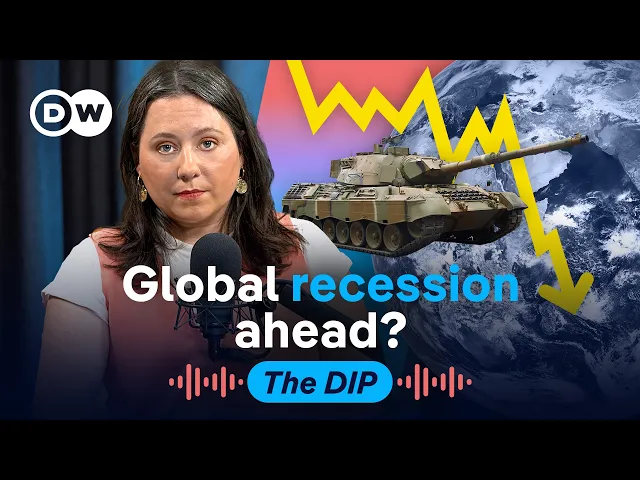
0:12 Today, we're going to talk about recession.
0:14 Are we already in one?
0:15 Is one coming?
0:16 Europe remains uniquely vulnerable to any potential recessionary situation,
0:22 especially if what we're thinking is coming is actually a perfect storm.
0:26 For one, European economies are more exposed
0:29 to energy prices than say the US or China.
0:31 And European governments have been trying to stave
0:34 off the big bad inflation for a while,
0:37 but we've kind of moved into this stagflation era.
0:40 Well, right now the economy in the US where I'm sitting is booming
0:46 essentially because of the AI investment boom
0:50 and the AI implications for the rest
0:53 of the economy and because of a very expansionary fiscal policy that government
0:59 is expanding its its spending in the middle of um of a boom.
1:05 So it's kind of like adding fire to the fire
1:09 and those things are keeping the economy on a on on a stronghold.
1:14 Both are kind of missing an action in Europe that on the one
1:19 hand you have um less of dynamism associated directly with AI investments.
1:25 There might be some dynamism associated with AI absorption,
1:30 adoption, adaptation, diffusion, and that might help the economy.
1:35 But the energy shock is a very large shock for the European economy.
1:40 the the economist today is coming out with a report
1:44 with no a headline saying you have yet to see more because
1:50 the energy situation is much more fragile than the markets think
1:55 and so that's a very bad piece of news for Europe
2:00 very bad news for you um grammar what kind
2:02 of vibes are you getting from the European side
2:07 yeah I mean the European economy is indeed in in a pretty bad state.
2:11 Um I mean we um uh have the since the since the Russian invasion into Ukraine,
2:18 we have significant energy price shock and energy scarcity
2:22 shock that was largely uh resolved um in the last
2:27 in the last year and now comes the next
2:29 energy shock um on top of the previous one.
2:32 So, so the combination of these two successive energy shocks is
2:37 a burden on the relatively energyintensive
2:40 um industry in particular in countries
2:43 like like Germany which are very sort of industry um cheap
2:47 industry cheap energy based industry um for for a very long time.
2:51 And so um part of the story we we are observing is
2:55 actually a transformation of of an economy
2:58 away from a relatively heavy industry,
3:02 relatively uh energy intensive industry towards a different
3:06 type of industry and the they are there are basically these two um obstacles um
3:13 that the German and the European industry face.
3:17 One is a major China shock.
3:19 China really roaring ahead on ma major technologies that are now at the core
3:25 of what typically um the the European econom econom industry was was able to do
3:33 um and on the at the same time the artificial intellig intelligence shock
3:38 I want to get into some of the headlines
3:40 as well because that's playing into the broader story
3:43 here right so Gundam at the time of recording
3:46 there was a brief uh hit for Brent crude oil
3:50 prices over $120 a barrel and in the last
3:54 two months it's been really a roller coaster for oil
3:56 prices and then we had the exit at the beginning of May uh of the UAE from OPEC.
4:03 How high could oil prices get?
4:09 Well, the the main uh question for that the main answer to that is
4:14 it depends on um how long the straight of Hormus will be will be closed.
4:18 I mean we are at the moment in a situation that for um
4:22 two months now almost two months um the straight of Homos
4:25 has been has been closed and that means roughly 20% of the global
4:29 oil supply does not reach um the final customers and um
4:35 that of course means that prices go up go up go up
4:39 um and um prices have had the roller coaster because um expectations about
4:44 how long it would be closed uh changed uh depending on various
4:49 tweets and statements by both the Iranians as well as the US president.
4:54 And so I think at this point um the uncertainty um has again gone up.
4:59 That's why oil prices have gone up
5:01 and and I think the uh many market participants
5:04 now worry that this might might remain uh
5:07 uh closed for for longer than than foreseen.
5:10 And so so I think the for me the really the question is what can we do about it?
5:14 Um, and I think unless you you think there's a military solution to it,
5:18 which I don't think even the US government thinks is feasible,
5:22 um, there we will have to find some sort of a compromise.
5:26 Um, and that's very unhappy.
5:28 I'm saying this very unhappily because we don't
5:30 want to make a deal with this Iranian regime.
5:33 But then I prefer to do an ugly deal with the Iranian regime
5:37 rather than uh keep having very high oil prices that benefit just Russia.
5:42 So let's say you know we have a peace deal, we have an agreement of some sort.
5:46 How how long would it take the straight offes open again?
5:49 How long would it take to you know prices going back to normal?
5:52 Is that like a couple of months situation or does that happen quicker?
5:58 I would say that depends on on two things.
6:01 One is the damage already done to the infrastructure.
6:05 There apparently two trains of uh LNG and Qatar that were
6:10 destroyed and will take between three and five years to repair.
6:15 It depends on what's happening to the oil
6:18 capacity because now that the inventories
6:21 are all full and they don't have where to put the oil,
6:24 they have to start shutting down wells.
6:26 And when you shut down wells, you damage wells.
6:29 You you lower the pressure on the wells.
6:31 And so uh putting them back into production may
6:35 take some time and you need some equipment and some
6:39 countries maybe Saudi and UAE are more prepared
6:43 for that because they've been shutting and opening as OPEC members.
6:49 Iraq probably less so and Iran probably less so.
6:53 So the idea is that you know even if you opened it tomorrow you know if
6:58 you opened it tomorrow it's not obvious that all
7:00 all the insurance companies and all the chip
7:04 companies are going to immediately say okay go
7:07 ahead use it because they'll want others to test
7:09 it first and then we'll find out how much how much damage has has been done.
7:15 So I think that we're playing a game of chicken.
7:19 The Iranians are trying to survive.
7:22 So they're fighting for regime survival.
7:26 Trump is fighting for you know the next
7:29 November elections which are not existential for him
7:32 etc.
7:33 So the question is who chickens out first?
7:36 And you know some people would say that you know when you
7:40 have a a pre predator prey dynamic one is running for their lives
7:46 and the other one is running for their lunch and that that means
7:50 that one has more higher toleration for pain than the other.
7:54 But we shall see.
7:55 You know, I can't help but think
7:57 about when we're thinking about this energy shock,
8:00 the last energy shock we had here in Europe, right?
8:03 And it all has to do with fossil fuels.
8:06 Uh, Gundam, why aren't governments doing everything
8:10 in their power to ramp up renewables?
8:13 Because, you know, the sun doesn't always shine,
8:15 but it shines everywhere, right?
8:16 You're then not dependent on on a on a pipeline or something like that.
8:24 Well, I mean I think the first answer is
8:27 uh many countries have invested a lot in renewables
8:30 and among them China certainly stands out as the country
8:34 that has really really invested very strongly in renewables also
8:40 um because it realizes that um it is dependent
8:44 on um the fossil fuel from geopolitically difficult actors and so
8:50 so China has really prioritized energy security based on renewables
8:56 plus coal and nuclear and coal is domestically produced.
8:59 Um now this is uh a situation that we have not replicated in Europe.
9:06 In Europe the dependence on fossil fuels is still very big.
9:11 Um at the same time there has been an attempt to um increase and build um
9:17 the renewables infrastructure but um it has basically
9:21 happened too slowly uh to really compensate for that.
9:25 But there actually significant differences across European countries.
9:29 If you look for example at Spain,
9:31 Spain has a much higher share of renewables in the electricity grid than than
9:37 Germany does and um has so far weathered this shock um uh this fossil
9:43 fuel shock much better than Germany in the sense that um electricity prices
9:48 have increased much less in Spain than they have on average in in Germany.
9:52 And so in that sense um I would say yes the structural long-term answer is
9:58 um a sensible and reasonable buildup of renewable
10:01 energy and the entire energy systems behind it.
10:06 Rick oil has also been the talks about the recession but we've also had I live
10:11 through like a couple recessions now like 2008
10:14 even I I'm young but I I've experienced recessions
10:16 a lot of historical events in both of our lives.
10:18 So uh like 2008 of course like COVID hit that was that was a big hit.
10:23 Um what are usually like the shock
10:26 absorbers for stuff like this for a recession?
10:29 What can states or you know European Union do
10:32 to have like a safety net against a recession happening?
10:38 Well I mean the typical thing is that governments just
10:41 uh stimulate the economy through
10:43 fiscal spending through lowering interest rates.
10:47 The complication here is that it's happening
10:49 in the context of what economists call a supply shock.
10:53 It's some of the inputs are in shorter supply and higher price.
10:56 So that tends to generate inflation.
10:59 And there's a bigger tradeoff between
11:01 containing inflation and stimulating the economy.
11:05 But you know there's this old line saying don't let a good crisis go to waste.
11:09 And I think that that um Europe has
11:14 an important serious strategic situation to deal with.
11:19 I wish it wasn't the case, but it is what it is.
11:23 I think Europe has to think that the security umbrella,
11:27 the US security umbrella is not as solid, as trustworthy as as it thought.
11:35 that that security umbrella was built into many of the European institutions.
11:41 For example, in the European Union,
11:44 the Akoair the European common law or or shared law says that security is
11:53 the responsibility of the ind of of the states of each 27 of the members.
11:59 And you know if you were to design the European Union from scratch,
12:05 you know, it would be a military union.
12:08 But right now you have you know 27 armies,
12:11 27 procurement processes, 27 everything.
12:14 And um you know Germany is now
12:20 independently you know accelerating its its buildup.
12:24 Poland is you know strong in its buildup etc.
12:28 each one with its own kind of separate army that makes it in part
12:33 of the investments are there to substitute for the US not to complement the US.
12:37 So it's not making the old NATO alliance necessarily stronger.
12:41 It's just you know you're replicating capabilities that the US already had.
12:47 So if you see that it means that you know it will
12:50 take Germany maybe 10 years to become a really strong military power.
12:55 If you're sitting in Moscow, you say,
12:57 "Should I wait 10 years to take the Baltics or should I take them now?" So,
13:03 I think that Europe is in a very serious strategic situation.
13:07 So, maybe if you need to have some
13:09 fiscal space to do more to stimulate the economy,
13:13 you know, you might use that space to consolidate the security of Europe, right?
13:18 And to advance a little bit in the union.
13:20 We were talking about Winram was talking before about the fact
13:24 that in Spain they use more renewable energy than in Germany
13:30 and and Germany could buy energy from Spain but they have
13:34 to get through France and France doesn't open up its electricity market.
13:38 So it's again a problem of not of insufficient
13:42 integration within Europe that maybe we can use
13:45 this crisis to make progress in making Europe a more
13:49 viable and more sustainable and more vibrant vibrant place.
13:52 I was really happy to see uh Ricardo that you are
13:56 a true European federalist just as I am and and really
14:00 and really arguing the case for um a European army
14:04 which by the way at the foundation of the European
14:07 Union um was uh a big part of the conversation
14:11 and was stopped in the end in the in the French
14:13 Parliament and Conrad Adnau at the time was saying
14:16 this is the bad the worst day of my political life.
14:19 um because he realized that this is of course a huge huge
14:23 blow to European integration and exactly that's the kind of thing we need.
14:28 I want to bring in a comment that we actually got recently from one
14:32 of our faithful listeners page and this was
14:35 received at uh via email at the dipdw.com.
14:39 She had a lot of really good things to say,
14:40 but I want to bring part of this specifically to you, Kai.
14:43 And she wrote um because this was about our story about how the US
14:46 and Germany specifically compare in terms of technology
14:50 and innovation and that kind of a thing.
14:52 And she wrote, "Instead of trying to copy and paste the US economic model,
14:56 I would argue Germany should take lessons on the US business culture
14:59 that makes the market so successful instead
15:02 of creating products like the European Zoom, as discussed on your podcast.
15:06 In these times of economic uncertainty,
15:08 which we've discussed a lot in this episode,
15:10 German businesses should shift more towards a hiring and promotional
15:13 model that rewards new ideas in order to encourage innovation.
15:17 Yeah, I guess Germany's always a bit slower to move in general, I say.
15:22 But I guess if you would like tell
15:24 anybody from Zmen's also show them this comment, they'll be, "Yeah, that's us.
15:27 That's we we're doing this.
15:29 We're innovative.
15:30 We're flexible.
15:31 We're investing.
15:32 We're doing all of these things." Um, yeah.
15:36 It's I mean it's really for me it's really tough
15:37 to say because I always also feel like that companies here
15:41 struggle a lot and do a lot and try to work
15:43 with the you know political frameworks that they are given
15:46 and they just need to accustomed to so many norms
15:48 that Germans like but you know so that's also something that we
15:53 maybe as Germany could cut down a bit not just you
15:55 know our business mindset but the red tape around it basically
15:59 I think that like that was such a cultural shock to me coming here because I
16:02 think coming from the US right there was
16:04 this idea that like Germany like really has its
16:07 like you know beep together right that things
16:10 like run on time and that a German product
16:12 like has like a certain standard that it that levels up to but then just you get
16:16 here and just really basic parts of living
16:19 much less when you're running multi-million multi-billion dollar companies
16:23 like the hoops you have to jump through
16:25 sometimes can be really wild I have to say
16:27 as someone who who has come here recently
16:30 so these companies these big companies they really
16:34 do they they They they turn the ship
16:36 ship quite slowly when it comes to addressing innovation,
16:39 at least from my vantage point.
16:41 Yeah, totally agree.
16:42 Totally.
16:44 Hi YouTube.
16:44 This has been a sneak preview of our podcast, The Div.
16:47 And if you like what you saw,
16:48 you can of course check out more episodes in our playlist
16:51 or you can check the description link in the description, of course,
16:54 or you can scan the QR code that's somewhere around here
16:57 to listen to the podcast wherever you listen to podcast usually.
16:59 But until next time, thanks so much for checking out the dip.