16th-Century Italian Dress Dagger With Hidden Byknife Surprises Expert | Antiques Roadshow UK
BBC Antiques Roadshow
0:00 Well, we've had a lot of people
0:02 in from the locality with their treasures for valuation,
0:05 but this piece has come from much further away.
0:08 And in a sense, it's coming home for the day.
0:13 Because, Lord Newton, this is your ancestral home.
0:16 That's right, yes.
0:17 My family lived here for 550 years, till 1946,
0:22 when my grandfather gave Lyme to the National Trust.
0:26 So what are your personal memories of this piece?
0:29 How has it survived in the family?
0:32 Well, some of the contents were removed
0:34 by my grandfather when he gave Lyme away.
0:37 And it passed to my father and then it has come down to me now,
0:42 so…- Well, when I saw it, obviously,
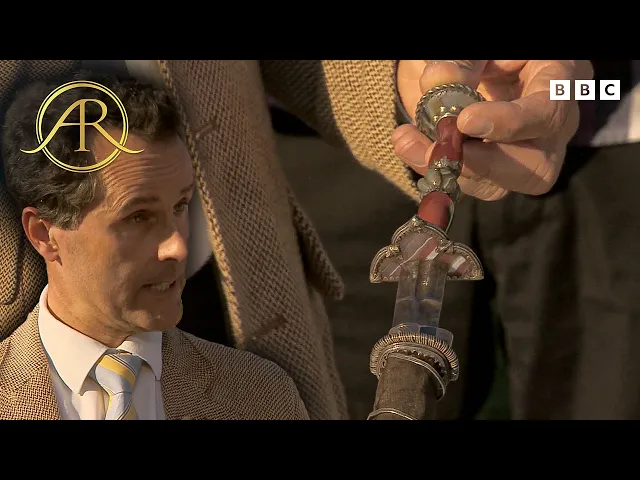
0:45 the first thing that attracted me was the use of minerals,
0:49 hard stones, in conjunction with silver…-
0:52 Right- ..to form this delicious handle.
0:56 Because we have two minerals.
0:58 We've banded agate and then we've got the use of carnelian.
1:02 These two inverted balusters conjoined by a fluted knop, mounted with silver.
1:09 But you know, this is a dagger.
1:13 But it's terribly elegant.
1:14 It's actually so finely made that it couldn't really be used in anger.
1:21 Right.
1:22 This is very much sort of a dress dagger.
1:26 And how old do you think it is?
1:30 I mean, is there any family tradition…?
1:31 Well, the family tradition is that it belonged to King Charles I.
1:36 Although we believe that it was about a century earlier that it was created.
1:43 OK.
1:43 But maybe that's wrong.
1:45 Yeah, well, there's elements of truth.
1:48 If I actually slide the sheath back… ..indeed there is the name,
1:54 in Latin, Carolus, which is Charles, on the blade.
1:59 But I have to ask myself, is it Charles I?
2:02 Because Charles was a very common name in the 16th century.
2:07 But indeed, I've conferred with colleagues as well.
2:10 We think this is a 16th-century piece that would have been used by a noble.
2:17 Quite where, specifically, I'm not sure,
2:21 because it's manufacture is almost certainly Italy.
2:24 So it could have been made in Italy,
2:28 found its way here and was something of a sort of presentation piece,
2:32 something that will become a family treasure.
2:36 But, of course, we don't really know, do we?
2:37 The true history is lost in the mists of time.
2:41 Indeed.
2:41 Absolutely.
2:42 So we're looking at a piece that's a symbol,
2:45 really, of a man's wealth, his elegance and his refinement.
2:50 You think of the clothes they wore at court in the 16th century.
2:54 Well, this would just go a bomb with that.
2:57 Let's have a look at the whole thing.
3:00 There we go.
3:01 The blade's just had its tip knocked off,
3:03 but shows lovely wear and tear commensurate with its age.
3:09 But it holds a little secret, doesn't it?
3:10 The little byknife.
3:13 Just pull that out.
3:16 And before the regular use of cutlery provided for you,
3:20 you would carry your own little byknife.
3:24 What a great thing to own.
3:25 Yes, I'm very fortunate.
3:27 Yes.
3:28 So the link to Charles I, we're going to have to accept, a little bit tenuous.
3:32 But, you know– look at it.
3:33 It's a serious European work of art.
3:38 The lapidary work is absolutely fabulous.
3:41 And in the sunshine,
3:42 the colours of the natural mineral and the banding is just gorgeous.
3:49 So what about value?
3:50 Have you got it well insured?
3:51 Sounds a bit of a clichéd question, but…- It is insured, yes.
3:56 It is insured.
3:57 Right, well… I think an auction estimate would have to be,
4:01 considering its provenance, between £15,000 and £25,000.
4:06 Really?
4:06 Yes.
4:07 It's very, very rare.
4:09 Perhaps I need to insure it more.
4:14 Thank you very much indeed.
4:16 And a very interesting account.
4:18 Thank you.