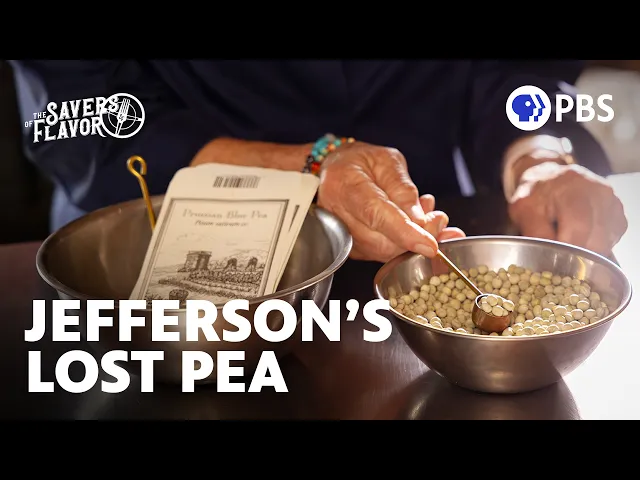
The Pea That Almost Vanished Forever | The Savers of Flavor | Full Episode
PBS Food
0:05 Thomas Jefferson here.
0:06 Do you know what my favorite variety of vegetable is?
0:10 It's the one that ripens first in my garden each spring.
0:15 David> In every heirloom seed lies a story of survival,
0:20 of resilience, a flavor forgotten by the modern world.
0:25 Join Charleston chef Kevin Mitchell and me,
0:28 food historian David Shields on our mission
0:30 to preserve the long lost flavors of the South.
0:35 We are "The Savers of Flavor."♪ David> Here it is,
0:46 the garden book of Thomas Jefferson.
0:49 I remember reading this years ago.
0:52 Thomas Jefferson and his neighbors every spring would hold a contest
0:56 to see who could supply the first plate of fresh garden peas.
1:01 Despite the fact that Thomas Jefferson grew 15 varieties of peas,
1:06 his neighbor George Divers usually won.
1:10 Mr.
1:11 Divers planted an earlier variety of pea.
1:16 Thomas Jefferson> It is the beginning of spring and the peas have come to table.
1:20 They arrived first from my neighbor, Mr.
1:23 Divers.
1:23 Per usual.
1:25 He confided that he planted the early
1:27 frame pea in February underneath a cold frame.
1:31 He won again, and we celebrated with a delicious plate.
1:35 Mr.
1:35 Cocke and I will try again next year.
1:37 Savor the flavor of Madeira.
1:39 Mr.
1:39 Divers, you have triumphed again.
1:51 David> Well, Kevin, we're off on another adventure.
1:54 I got a call from a magazine editor who's doing a special
1:59 issue on the 250th anniversary
2:01 of the signing of the Declaration of Independence.
2:04 The editor wanted to know whether there were
2:06 any foods that the signers would have eaten.
2:10 Back in 1776 that are still available and taste the same in 2026.
2:16 Kevin> Okay.
2:17 And I said, we can do better than that.
2:19 Thomas Jefferson was the chief author
2:22 of the Declaration of Independence, kept a garden book,
2:26 and we know from its pages his favorite vegetable were early spring garden peas.
2:33 Kevin> You know, what's really interesting to me is that through time,
2:36 we've lost a sense of flavor for fresh vegetables.
2:41 We're so used to this convenience of popping peas out of a can
2:47 into a pot and cooking them until their putrid gray green.
2:52 I think back, the cafeteria lady would just
2:55 plop these canned peas and carrots on my tray.
3:00 With instant mashed potatoes.
3:01 Wouldn't it be great?
3:03 We can just go back to when we can eat peas fresh in May,
3:08 in butter, in tarragon, in salt, pepper, and they're beautiful, bright green.
3:13 And they have some texture to them.
3:15 They're not mushy and disgusting, just putrid.
3:19 You know.
3:24 David> There is a pea that has surfaced in the Dutch Fork of South Carolina,
3:31 and I think that it was the pea that Jefferson loved.
3:37 Jefferson wanted the first pea that ripened and that first.
3:41 He was called the early frame pea.
3:45 Kevin> Okay.
3:46 David> Some people call it the old timey English pea.
3:50 Some people call it the May pea.
3:52 Some people call it the Dutch Fork autumn planted pea.
3:56 If you take a look at its characteristics,
3:59 I'm convinced they're one and the same.
4:03 Kevin> This address you've giving me a little mountain,
4:05 this is the house of Rodger Winn.
4:08 So I'm assuming he has this pea?
4:11 David> Yes.
4:11 He's a famous seed saver.
4:14 And he has got a little white pea, and he calls it the Dutch Fork.
4:21 Autumn planted pea.
4:30 Rodger, I see that you've, prepared a welcome for us in the form of a forest
4:37 of, tree jars here and chock full of seed.
4:41 And I'm sure that this is only a fragment of your trove of treasure.
4:46 Rodger> A very small fragment.
4:48 I actually had four freezers that were full
4:50 of stock seed that I've collected over my lifetime.
4:55 These are some of my my favorites.
4:58 Some South Carolina heirlooms,
4:59 plus some others that have sentimental value to them.
5:02 David> Talking about, your lifetime of collecting.
5:06 One of the things that I'm sort of curious
5:08 about is how and when you began collecting seeds.
5:15 Rodger> Probably before I was even in elementary school.
5:18 Like collecting maple seedlings in the spring.
5:21 Planted them and then sold the little trees for a dollar apiece.
5:24 So there's maple trees out there that are 55 years old, 60 years old.
5:29 [laughs] David> The saving of seeds is very much a family enterprise.
5:36 Passing down from grandparents, and when you marry into a family,
5:41 those family seeds get connected to your seeds.
5:46 Is that how it is around here?
5:48 Rodger> I guess it is.
5:49 That was one of the fascinations I had with my wife
5:52 when I first met her, and then went to meet her family.
5:56 They saved seeds.
5:57 They had a big vegetable garden.
5:59 I knew right then and there.
6:01 She was the person I wanted to marry.
6:04 [laughs] David> That's great.
6:06 Kevin> This here, I'm very curious about.
6:08 Which one is this?
6:10 Rodger> This is an okra.
6:13 I spent 20 years in the Navy, in submarines,
6:15 and when I would go out to sea, I brought seeds with me.
6:20 Typically beans, because of the multiple patterns.
6:23 And, it just gave me something to look at.
6:24 I also brought seed catalogs.
6:26 I had a good friend, early 90s, when we were home.
6:31 He was from Mamou, Louisiana,
6:33 and he went back home and was telling his grandmother
6:36 about this guy that grows all these unique vegetables.
6:39 He came back from Christmas vacation with a sandwich
6:42 bag with this okra seed in it.
6:45 Said it was from his grandmother.
6:46 And she said that if, I since I was into the old timey seeds,
6:50 I needed a good old timey gumbo okra.
6:53 Good flavors.
6:54 Definitely not like you would find an okra
6:57 in the farmer's market or the grocery store or whatever.
7:02 It's hard to, some flavors, it's hard to describe, but, definitely a nice okra.
7:09 And especially like the, sentimental attachment to it.
7:13 David> While Hurricane Helene inflicted some damage on his farm,
7:17 it's always a pleasure catching up with Rodger and touring the farm,
7:21 but we came to see if he has seeds
7:24 that are a direct descendant of the Jefferson frame pea.
7:29 I think that this jar here is, perhaps the reason why we've come here.
7:35 Rodger> The star of the show.
7:36 <Yes> A lot of people call it the Thanksgiving Day pea,
7:39 because it was always planted at Thanksgiving.
7:42 My great aunt over in Saluda County always
7:45 planted this and had it in her garden.
7:47 When I met my wife, her family grew this pea, planted it on Thanksgiving Day.
7:51 David> And this would overwinter, right?
7:53 Rodger> Right.
7:54 It would come up, usually get 2 or 3 inches tall.
7:57 I had asked people, you know,
7:58 why plant it in the fall when most people associate
8:01 planting sugar peas or English peas in early spring, February.
8:05 Actually late winter.
8:06 And nobody had a good answer.
8:08 They were like, I don't know.
8:09 We always plant it on Thanksgiving.
8:11 David> And how many peas do you get in a pod?
8:15 Rodger> There's a good many.
8:16 It could be 6 or 8 or down to four, but it's a lot.
8:20 And it takes a lot of peas to make a meal.
8:24 You'll you'll sit there for a while shelling them out.
8:26 Kevin> Well, let me ask.
8:27 Did you eat them fresh?
8:29 Were they in a can or milk or cream?
8:34 ...little salt or pepper?
8:35 Rodger> Salt and pepper.
8:36 You know butter.
8:37 Most people around here just cooked it with with noodles,
8:40 salt, pepper and butter.
8:42 Nothing.
8:42 Nothing fancy.
8:43 And it was something to look forward to for about 4 to 6 weeks in the spring.
8:47 Rodger, thanks for having us here at your farm
8:51 in the Dutch Fork in Little Mountain.
8:55 Rodger> I appreciate ya'll coming out.
8:58 David> We now follow the path
8:59 of the pea to just outside Charlottesville, Virginia,
9:02 where perhaps the most famous of all gardeners,
9:05 Founding Father Thomas Jefferson, cultivated his beloved seeds at Monticello.
9:12 You know, Monticello means, little mountain in Italian.
9:17 So we're going from Little Mountain,
9:19 South Carolina, to Little Mountain, Virginia.
9:21 Kevin> Fantastic.
9:25 David> Kevin, here she is.
9:27 My friend, Peggy Cornett.
9:29 Peggy> Hi, Kevin.
9:31 So nice to see you.
9:32 How are you?
9:32 David> This is Kevin Mitchell, chef scholar.
9:35 Peggy> I see you that, Yes.
9:36 Kevin> Thank you for having us.
9:37 Peggy> Yeah, well, thank you for being here.
9:40 David> So, Peggy, what is the mission here?
9:43 Peggy> Well, Monticello, it's a historic site,
9:46 and we're preserving and educating the public
9:49 about Thomas Jefferson and his gardens at Monticello,
9:52 collecting seed and growing crops that Jefferson
9:55 grew that he documented in his garden book, his letters and memoranda.
9:59 David> We're talking a period around 1760 to Jefferson's death in 1826.
10:06 Peggy> That's right.
10:07 Yeah.
10:07 And he kept remarkable records.
10:09 We think he grew over 330 different varieties
10:12 of vegetables and herbs just in this garden,
10:15 not all at one time, but throughout his lifetime we, were counting.
10:18 Yeah.
10:19 The garden itself was really a laboratory.
10:21 He was growing vegetables from all parts of the world,
10:24 tomatoes and potatoes from South America,
10:26 and cold crops from Europe and and of course,
10:29 peas were very important to Jefferson.
10:31 That was one of the first crops he would plant in the garden every spring.
10:35 I mean, it was sort of a rite of spring to go out and plant peas in the garden.
10:39 Kevin> About how many varieties of peas did he grew?
10:41 Peggy> Well, we believe he grew about 15 varieties at last count.
10:44 So we should go and look at some.
10:46 Kevin> Yeah, let's do that.
10:48 <Okay> Peggy> So this is a Prince Albert.
10:50 David> So this is the famous pea that supplanted
10:53 the early frame in the grand scheme of things.
10:56 Why do you think that it prevailed in the 1840s?
11:00 Peggy> Well, I think it was the more vigorous pea that would, you know,
11:04 repeat bloom so you could continually harvest from it after the first picking.
11:08 I think the taste was probably similar.
11:11 David> The problem with the early frame is
11:13 that once it's ripened and you pick the pods, Peggy> The whole thing just goes.
11:17 David> It wilts.
11:18 It dies.
11:19 It turns yellow.
11:21 Peggy> So the Prussian blue pea,
11:23 notice the bluish cast to the foliage, which gives it that name.
11:26 And also the pea itself is definitely a historic variety,
11:30 so it's not one you're going to find very often.
11:32 But it's very important for us to preserve this in our collections.
11:36 Some of these things we let go to seed
11:38 so much that I don't really get to taste them.
11:41 Kevin> Yeah, this is really good.
11:44 Peggy> We'll just eat them all.
11:45 <Yeah> I don't think we're going to save any.
11:48 Kevin> While Jefferson may be known
11:50 for his meticulous record keeping in the garden,
11:52 he was also very influential in the culinary world.
11:57 James Hemings, whose story I'm very fascinated with, he was a slave.
12:01 And, you know, Thomas Jefferson sent them to France to really
12:04 try to understand and learn the beauty of French cuisine,
12:07 because, you know, we know that Jefferson was this huge Francophile.
12:11 He loved everything French, food, wine, so on and so forth.
12:15 So having an enslaved person go to France
12:19 to learn that cuisine is really fascinating to me.
12:23 His influences have lasted hundreds and hundreds of years and influences
12:28 chefs today from what he did then to where we are now.
12:37 Peggy> So I want to introduce you to my colleague Michael Tricomi.
12:41 He's a curator of historic gardens at Monticello,
12:44 <Hello> and he's been working on this special project to grow
12:47 the, David> We've been in email contact over the years.
12:50 So, it's, great to see you, face to face.
12:53 Michael> Nice to meet you in person.
12:54 Yes.
12:55 So here we have the early frame tea,
12:56 and we're experimenting with growing it here and trying to get as much
12:59 seed from it as possible so we can propagate it in Jefferson's garden.
13:03 David> I've encountered descriptions of people planting in England,
13:09 this in November, having it overwinter, and the plant reactivate.
13:14 Have you heard about this sort of method of propagation of peas around here?
13:19 We haven't done that here on the mountaintop.
13:22 Michael> We've definitely been successful in overwintering quite
13:25 a bit of lettuces and greens and brassicas, cabbages and things like that.
13:29 We haven't done it with peas.
13:30 If we had a cold frame with a lid, we probably could do that.
13:33 <Sure> In the garden, which is what they do a lot of times
13:37 in Colonial Williamsburg there been doing that sort of thing.
13:40 David> I guess that's where the name of the pea comes from.
13:42 <Early frame> The early frame pea that had a cold frame.
13:47 I noticed that there is a double blossom here,
13:51 and there was a distinction made among some early
13:56 frame peas in terms of single blossom versus double blossom.
14:00 So there were two varieties grown.
14:03 I wonder if this is a double blossom.
14:06 Peggy> Sure looks like it.
14:08 <Yeah> David> Well, you know why the people
14:10 would love that you double the pods, too.
14:13 Peggy> When you were growing this specifically here
14:16 so you could surround it with chicken wire.
14:17 Michael> Yes.
14:18 We wanted to make extra sure that we,
14:21 are protecting these because it's such an important variety
14:24 and we have such little seed, like you said.
14:26 So making sure that these, are able
14:29 to fruit and we can harvest is very important.
14:31 Kevin> There's another one behind you, too.
14:33 Peggy> Yeah.
14:33 They're all double.
14:35 David> That nails it down.
14:36 It's got to be the early frame double blossom pea.
14:40 Kevin and I are headed over to Tufton Farm,
14:42 the site of the Thomas Jefferson Center of Historic Plants,
14:46 where Peggy archives plants and seeds at Monticello.
14:50 Peggy> Well, I want to introduce everybody to Roger Gettig,
14:53 director of horticulture at Monticello.
14:54 And he's here with me at the center for Historic Plants.
14:58 Where we propagate and grow a lot of the plants.
15:00 Roger> Nice to meet you.
15:02 Welcome.
15:02 David> I see we have.
15:03 Peggy> Well, I wanted to show you the peas we were enjoying in the garden.
15:07 The blue Prussian pea.
15:09 <Yes> Kevin> This is my new favorite pea.
15:10 Peggy> That's right.
15:11 We're going to be growing this pea.
15:13 So basically, we just kind of open it up and, there's
15:16 about what we decided about 20 seeds in a packet or more.
15:20 Roger> There's different size scoops for different seeds.
15:22 Peggy> The largest scoop the number 17 and we'll show you the others.
15:26 Actually you don't have to lick it.
15:27 <I don't?> It's self Sealing.
15:28 Yeah.
15:29 You just bend it over and press.
15:31 Kevin> This work you're doing with seeds.
15:33 Why is that important?
15:34 Peggy> There's a great movement to preserve, native plants.
15:38 But in some ways, these cultivated plants are just as much,
15:41 if not more endangered because you have
15:43 to keep them growing in order to preserve them.
15:45 Roger> You tasted this and you love it,
15:48 but it was replaced over time with other peas,
15:52 by Prince Albert and things like that.
15:54 So, whenever we grow peas and we don't want them to mix,
15:58 we grow them in different years or different
16:01 ends of the gardens or different gardens,
16:02 so we can make sure that the bee is not
16:06 mixing them because we want to keep the strains pure.
16:08 Peggy> The main thing about saving seed, just keep it dry.
16:12 You don't have to put it in the freezer.
16:14 Roger> Don't put it in the freezer.
16:15 Peggy> In fact don't do that.
16:16 And, you don't have to refrigerate it.
16:17 I mean, we keep them cool for, you know, the ones that we preserve here.
16:21 It's the humidity that won't lose the viability of seeds.
16:25 Roger> Right?
16:26 So if you want to save something, it's the opposite of growing it.
16:28 So, cool, dark and dry.
16:30 <Yep> It'll stay fine.
16:32 Warm, moist and sunny.
16:33 It'll start to germinate.
16:34 So you want, you can be in a cellar in a sealed jar.
16:38 You don't want it in your refrigerator in case there's a leak,
16:40 the ethylene from your ripening fruit
16:42 in the refrigerator might impact the seeds.
16:44 David> Could we actually see your seeds storage?
16:48 Peggy> I think we could take you out there.
16:52 So we're in, what we call the cool bot.
16:55 And so here we have the Monticello seeds.
16:57 These are seeds collected from the gardens.
16:59 These packets were painted from live plants
17:01 that were grown in the gardens at Monticello.
17:03 So it's a local artist named Tim
17:06 O'Kane who made these beautiful paintings for us.
17:08 This is another flower that's named after Meriwether Lewis.
17:12 It's Lewis' Prairie Flax.
17:15 And again, this is painted from plants in the garden at Monticello.
17:19 [sound of truck engine] David> Now that we found
17:24 and actually picked some of the rarest peas in the world,
17:27 it's time for chef to get to work.
17:31 Kevin, you have a wonderful array of ingredients here.
17:34 Tell us what you are going to prepare for us.
17:37 Kevin> I got a couple surprises for you,
17:39 so we're going to do two dishes featuring peas, Of course.
17:42 One will be more historical and one is
17:44 going to be a little bit more contemporary.
17:47 So the first thing we're going to do is a cup of this Moruga Hill rice.
17:51 We have one cup of rice.
17:53 David> Jefferson brought Hill rice over from West Africa in 1787.
17:58 Kevin> Two cups of water, we throw in some bacon,
18:03 a little bit of butter and then I like to do a little bit of pepper.
18:08 David> That idea of boiled bacon is a very 18th century cooking idea.
18:12 You know, that's old school cooking.
18:16 Kevin> I like it nice and crispy, fried.
18:18 So, we'll cover this up a little bit, and we'll let that go.
18:21 Now on to the second more contemporary dish.
18:24 We've got bacon.
18:25 [sizzling sound] You hear that?
18:28 That's what you want to hear.
18:30 All right.
18:31 Nice sizzle.
18:32 I want to add just a little bit of butter.
18:35 That's going to add a little bit more additional fat to this.
18:40 But this is going to be kind of fried but still a little bit of boiled,
18:44 too when we add the the add the water to it.
18:47 Now for this I like to add some shallots to it.
18:49 As soon as you get that aroma it's good to go.
18:52 And so now I'm going to add my rice.
18:56 Beautiful Carolina Gold rice.
18:58 This will go in.
19:00 And then what we're going to do here is
19:02 we're going to do a process called toasting the rice,
19:06 where basically what we're doing is we're covering each grain of rice in fat.
19:15 Because the key to this rice is once it's cooked that the rice is separate.
19:20 It's not like sticky rice or sushi rice.
19:23 And when you can kind of start to smell the rice browning,
19:28 that's when you can add in your water.
19:33 Just enough to cover.
19:36 This will come to a boil and then we'll
19:38 cover it and we'll cook this for about 12 minutes.
19:41 But halfway through I'm going to throw in the peas.
19:44 Now these peas, just regular English peas blanched in boiling salted water.
19:49 Bring the water to a boil.
19:51 Drop your peas in.
19:52 It comes to another boil instantly out of that hot water into some ice water.
19:58 I'll just throw these peas in there.
20:04 And then I'll check on the others.
20:06 So we do about three tablespoons of benne in here.
20:11 Toast the benne here.
20:14 What I can do now is add the early frame peas here.
20:19 <All right> And we have some.
20:22 <Beautiful> So about a half a cup.
20:26 But, these are really good.
20:28 We definitely do more than that.
20:30 Just leave them in here long enough so they kind
20:32 of warm through and they soak up some of that moisture here.
20:37 Time to check on the benne seeds.
20:39 David> That's lovely looking.
20:41 Kevin> So now we're just going to pour them in this mortar and pestle.<Wow>
20:45 Then I will add the chili or what we're using here are jalapenos.
20:51 Just small dice.
20:52 Got a little bit of the seeds in there because you want,
20:54 you do want a little bit of spice.
20:56 And that's where the spice is.
20:58 <Yep> A little bit of salt.
21:00 Little chopped cilantro.
21:03 And then just.
21:05 David> Grind it up.
21:06 Peggy> Wow.
21:07 Look at that.
21:09 That looks so good.
21:10 Kevin> All right.
21:11 Clean as you go.
21:13 So we're going to, I'm going to dish this up for you guys.
21:20 That's enough.
21:21 Yes.
21:21 Peggy> Oh yeah.
21:23 Kevin> All right, all right <That is amazing> like I said
21:27 we're going to, <the difference> going to leave that bacon on there.
21:34 Peggy> Thank you very much.
21:35 David> Put a lot of that on for mine.
21:36 Kevin> Yes, sir.
21:39 David> That'll be okay.
21:41 Kevin> Here you go.
21:42 Bon appetit.
21:43 Bon appetit.
21:45 Enjoy.
21:46 Yes.
21:48 David> There's a smoky quality to this red rice dish.
21:51 <Yeah> And the benne provides this little crunchy topping.
21:56 It's wonderful.
21:58 And the undercurrent of bacon is, it gives it a little slipperiness.
22:04 And the peas, well they're wonderful.
22:08 Peggy> They're cooked just perfectly I think.
22:11 David> Well chef, I think it's time to award you the Madeira bottle here.
22:34 With the rise of globalization and the dominance of the supermarket,
22:38 we've lost sight of why heirlooms like the early frame pea matter,
22:43 their ability to thrive in cold weather and their exceptional flavor
22:48 truly go hand in hand like two peas in a pod.
22:59 Gardeners are known for having a poetic streak and, I found
23:05 a wonderful pea poem by a gardener named Peter Burn, written in 1885.
23:12 It's called "Sow Afresh." Two Cottagers in gardening, skilled in early spring.
23:22 There are acres tilled, and raising fruit was known full well.
23:29 Each sought the other to excel.
23:33 Yet there existed twixt the two a friendship, honest, firm and true.
23:39 Green peas, a favorite dish was then, and so it was now among most men.
23:46 And he who first this dainty raised was loudly by his neighbors, praised.
23:55 The time by these men was set on which
24:00 they should their seed peas get and got they were,
24:05 and it was said the same day, saw them duly led.
24:11 Not many weeks had they been sown one low an inch or more had grown,
24:19 each viewed with pride his little plot.
24:23 Each boasted of a noble lot.
24:26 But came a frost and morning found both growths of peas struck to the ground.
24:36 Friends, if these fellows had had a cold tolerant pea like
24:42 the early frame pea that contest would have continued to the end.
24:47 But as the poem's title says, so again.