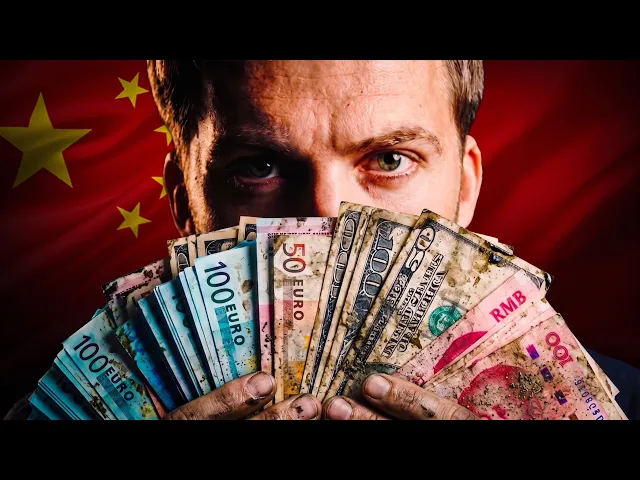
China’s Dirty Money Problem, Explained
Johnny Harris
0:00 (upbeat music) (background chatters)- These people are ghost,
0:04 authorities don't see absolutely anything.
0:10 (bright music) Inside of this bag is a hundred thousand dollars.
0:15 What should I spend it on?
0:16 I could buy a fancy orange jacket, I could buy a new drone.
0:20 I could buy like really nice antique maps,
0:22 but actually I can't spend this money 'cause I have a big problem,
0:25 this money is dirty.
0:29 (bright music) No, not like germs,
0:32 I mean I'm sure there's plenty of those, but it's a different kind of dirty.
0:34 This money is dirty because I got it from selling drugs.
0:38 (bright music) And in fact,
0:40 I can't spend it because I need to get it back to my bosses in another country.
0:44 (Johnny sighs) I could take it to a bank and deposit it,
0:47 but they'll end up asking questions and report it to the government.
0:50 (siren shrieking) I could try to ship it,
0:53 bring it with me on a flight, but that also can get pretty risky.
0:58 (bright music) Ultimately, I need to clean this money, to launder it.
1:07 It's not gonna be easy though.
1:08 (air whooshing) Okay, no, I did not sell drugs to get this money and know
1:16 it is not dirty and in fact it's not even real.
1:19 (bright music) But we'll leave it here to remind us what money looks like,
1:24 because a lot of money that moves around our world is dirty.
1:28 (bright music)- More than $50 million in drug cash vanish from U.S.
1:36 streets without tripping a single bank alarm, and this was just one city.
1:43 Multiply this around the world and you can see how much money is flowing around.
1:49 I mean, we're talking, you know, trillions and trillions of dollars.
1:53 Roughly three to 5% of world GDP is the proceeds of crime.
1:57 That equates to roughly $4 trillion.
2:01 Drugs, human trafficking, weapons, illegal wildlife parts,
2:05 it all needs money to work.
2:08 Criminals, criminal organizations commit crime for what?
2:11 For money.
2:12 Money.
2:13 (bright music)- And if I were in this hypothetical scenario,
2:17 I actually have another option, an option that will allow me to move
2:21 my money without any government or law enforcement knowing.
2:25 It is called flying money.
2:27 (bright music) It's a mostly invisible system.
2:32 It secretly connects the whole world of organized crime and helps to fund it.
2:36 Connecting illegal gold mines in Congo, to the cocaine trade,
2:39 to weapons, to the illegal trade of Oregon,
2:41 which is connected to illegal timber and tusk
2:44 poaching and shark fins and jaguar bone wine.
2:47 All of this somehow linked to unassuming places,
2:50 like a restaurant in Lima, Peru, or a clothing store in Rome.
2:54 It's all connected, but it's almost impossible to see.
2:57 (bright music)- [Sean] The money doesn't move.
3:00 It flies, right?
3:01 It's kind of a ghost, so you can't trace it.
3:04 These people are ghosts flying 30,000 foot around us.
3:07 That's Andrea Crosta.
3:08 He actually came to us and pitched me on this story,
3:12 because he's spent years infiltrating this system.
3:15 He and his team have been risking their lives
3:17 to see how this actually works to try to find solutions.
3:20 So thanks Andrea and his team and many others.
3:24 We have this story and we're starting to understand it,
3:27 and I wanna show it to you,
3:28 how it works, what it enables, and what we might do about it.
3:32 (bright music) (upbeat music) I'm in Taiwan right now, working on my next story,
3:39 but I want to quickly tell you about the sponsor of today's video,
3:42 which is something I've actually used quite a bit.
3:44 We are currently engaged in a very crazy time where your data,
3:48 your name, your address, your birthday, your viewing habits,
3:52 this stuff is bought and sold on an open market.
3:54 It's valuable stuff and there's sort of a shadowy,
3:58 invisible market that no one wants you to know about,
4:00 that takes this information and sells it to people who wanna sell you
4:04 stuff or put you on people's search sites or jack up your insurance premiums.
4:09 Incogni is the answer to this.
4:11 Incogni is a service that you give the permission to go
4:15 off and start making requests to take you off these lists.
4:18 You don't really have to do anything, you just get to sit in the background
4:21 and on their fancy dashboard you can just track the progress.
4:25 How many lists have been requested that you're
4:27 maybe taken off of, which have been successful?
4:30 A feature I really like is this custom removal feature,
4:32 which allows you to send a specific site or register that your name is on.
4:38 Someone at Incogni actually then handles this for you.
4:40 They go after this site and make sure that your name is taken off.
4:43 I've been tracking over the years,
4:45 they've taken my name off over a thousand of these data broker lists,
4:49 which is a very satisfying thing.
4:51 I sleep better at night knowing that I have a little bit more privacy.
4:54 Incogni is giving a big discount to people who use my link.
4:56 It's incog.com/johnnyharris.
4:58 You get 60% off the unlimited plan.
5:00 The unlimited plan ensures that every month Incogni is searching for my name
5:05 and my information and making requests to get me off these lists.
5:09 It's made a big difference in my life.
5:10 I am a big fan.
5:12 Grateful that they sponsor this channel, again, it's incog.com/johnnyharris.
5:16 Go get 60% off and reclaim your privacy today.
5:20 I'm working on this incredible video from Taiwan.
5:23 There's claw machines and arcades everywhere.
5:27 This is an amazing country.
5:29 Let's get back to this story about flying money.
5:31 So it goes back to the Tang Dynasty.
5:33 (bright music)- This is one of the golden ages of China's history.
5:36 The capital is huge.
5:37 It's one of the most populous cities in the world and it's thriving.
5:40 People are using money in the form of copper coins.
5:43 (bright music) Let's say I'm a businessman who sells tea.
5:48 I live up here.
5:49 And I routinely go to the capital to sell my harvest.
5:52 I sell it off to the nobles and the elites and the tea
5:55 drinkers of the capital and I get paid in copper coins.
5:58 Uh, oh, these coins are not light.
6:00 This is gonna be hard to bring all these coins back up to my home region,
6:04 and I'm gonna be vulnerable to robbers as I go along my journey.
6:08 (bright music) So let's do this.
6:11 I'll take my bag of coins to a merchant and he'll give me
6:14 a little piece of paper and he'll tell me that once I'm back home,
6:17 I should go see his merchant friend and give him this piece of paper,
6:21 this light, easy to carry piece of paper.
6:25 Nice.
6:26 Once I'm home, I take that paper
6:28 to the merchant that the guy from the capitol knows.
6:30 And because these two are trusted partners,
6:33 the merchant in my hometown honors it, and gives me a bag of copper coins,
6:38 that's the exact same amount as what I gave his friend back in the capital.
6:43 The relationship between these two, I don't totally know.
6:45 They'll settle up later.
6:46 All I care about is I got paid my copper
6:49 coins and I didn't have to carry them from the capital.
6:51 This is magic, built on trust.
6:54 In fact, this was flying money.
6:56 (bright music)- Flying money is actually thought
7:01 to be the first form of paper money.
7:03 Now China and the Tang Dynasty were not the only people to come up with this.
7:07 They were one of the earlier and one of the more widespread,
7:09 but other cultures settled on these mirror transactions as a way to transfer
7:15 value without having to carry a bunch of money or gold a long distance.
7:20 (bright music) We're talking about the Chinese version here because this would
7:24 go on to inform a global network that we see today.
7:28 As tens of millions of Chinese immigrants spread throughout the world,
7:33 they were often persecuted, segregated,
7:35 and excluded, and they stayed tight knit.
7:37 China towns became not only a cultural refuge,
7:39 but also commercial hubs that were anchored by family association,
7:43 clan networks with strong cultural ties maintained with the homeland.
7:48 With mainland China, these communities are built off of some strong core values,
7:53 self-reliance, mutually beneficial relationships that are based on trust,
7:56 reciprocity and personal bonds,
7:59 and often a very strong work ethic and business sense,
8:03 making money with often cash based businesses,
8:06 sending a lot of that money to family around the world.
8:09 But soon this global diaspora network of trust and connection
8:13 would be abused by criminals who would use it to wash
8:18 dirty money using this to create a shadow banking system
8:22 that was near impossible for outsiders to understand or infiltrate.
8:27 (bright music) So let me show you how this works today.
8:34 How those same concepts that we saw in the Tang
8:37 Dynasty play out in a real world scenario today.
8:40 Wealthy Chinese individuals are using flying money
8:44 to get their money out of China.
8:46 Any change in the Politburo, or any change in the kind of rulings or legal
8:50 system could have your money taken off you at any time.
8:52 (bright music)- So let's say there's man in China named Mr.
8:56 Chen.
8:57 He's very rich, he's got a lot of extra
8:59 money and he wants to invest his money elsewhere.
9:01 Got 2 million extra dollars that maybe he
9:04 wants to buy a luxury apartment in Miami with.
9:06 He has a cousin in the U.S.
9:07 who could help him, but he's got a problem.
9:10 In 2017, the Chinese government implemented a 50,000 U.S.
9:14 dollars limit on the amount of money that you could get out of China.
9:17 This is the way for the Chinese government to stop
9:19 tons of money from flowing out of the country.
9:22 Now that's not gonna stop anyone.
9:23 So they turn to the underground banks.
9:25 (bright music)- So Mr.
9:27 Chen goes to a broker in China and he pays him the $2 million.
9:31 He does this from one Chinese bank account to another,
9:33 maybe in a series of small transactions.
9:35 So he doesn't draw too much attention and reminder, this is dirty money.
9:38 Mr.
9:39 Chen just makes a lot of money in his job and wants to invest it elsewhere.
9:43 He didn't get it from like drugs or anything, okay?
9:45 So anyway, the broker tells Mr.
9:47 Chen to tell his cousin in the U.S.
9:50 to go to a shop in Chicago and ask for the broker's trusted contact
9:55 who's another broker in the United States and to give him a special code.
9:59 Meanwhile, here in the United States, there's something else going on.
10:03 There's a drug dealer from a Mexican drug cartel.
10:05 He has his own financial puzzle to solve and it has nothing to do with Mr.
10:09 Chen yet.
10:10 He's been selling drugs on the street of Chicago
10:12 and now he has $2 million in cash.
10:15 Now this cash is definitely dirty.
10:16 It's the definition of dirty money, has no paper trail from where it came from.
10:20 Just a huge amount of cash from drugs.
10:22 He needs to somehow make this money look legitimate
10:26 and get it back to his cartel bosses in Mexico.
10:29 And these days it's not easy to do that.
10:31 So he goes to this same Chinese broker in the United States,
10:35 the same guy that Mr.
10:36 Chen told his cousin to go to, and he gives him this $2 million saying,
10:40 I need this to get to my bosses back in Mexico.
10:44 So this broker now owes the cartel $2 million.
10:47 And this maybe goes without saying,
10:49 these are all simplified numbers and examples to show the concept.
10:52 (bright music) Okay, this is where these two start communicating.
10:58 These two brokers.
10:59 They know each other.
11:00 They're probably a member of the same extended family, clan, tribe.
11:04 They're not gonna take advantage of each other.
11:07 (bright music)- They're talking over an encrypted communication app.
11:11 And the broker in China tells the broker in the United States that Mr.
11:15 Chen's cousin is coming and that he will give him a special code,
11:18 and when he does give him $2 million.
11:22 The cousin arrives at the shop, gives him the code,
11:25 and in exchange he gives the cousin $2 million.
11:28 The $2 million in fact that he got from the drug dealer.
11:32 That cousin then deposits into a variety of family
11:36 business accounts under a bunch of different names.
11:38 So he doesn't raise any flags and eventually he uses
11:41 that money to buy a luxury apartment in Miami for his cousin.
11:46 So look, Mr.
11:47 Chen now has a $2 million asset and he didn't have
11:50 to send any money across any borders or through financial system.
11:54 His $2 million stayed in China and the $2
11:57 million used for his apartment stayed in the United States.
12:00 (bright music) Okay, but look, there's still some imbalance here.
12:04 There's still people who owe each other money.
12:05 The broker in China still has that $2 million that Mr.
12:09 Chen gave him and the cartel in Mexico still
12:11 needs to get their $2 million of drug money.
12:14 And this is when they turn to the global economy,
12:16 (upbeat music)- When they wanna settle up accounts,
12:22 oftentimes they go back and settle accounts through trade.
12:27 Traditional, historically and culturally, that's what they did.
12:30 We always talk about following the money.
12:33 Sometimes it's more important to follow the value.
12:36 By the way, that's John Cassara, who is a former U.S.
12:40 intelligence officer.
12:41 He was a special agent for the treasury
12:42 where he spent decades investigating these types of crimes.
12:45 He now writes books.
12:47 He's very helpful for this story.
12:48 Okay, so it turns out that the broker in China has a company,
12:52 a legal legitimate looking company.
12:54 He sells kitchen appliances that are made in China,
12:58 and this is a perfect cover for what he's about to do next because the cartel
13:02 in Mexico also has a front company where they
13:06 sell kitchen appliances in a retail store in Mexico.
13:10 Okay, now watch this clever move between these two.
13:12 (bright music) The cartel purchases $10 million of refrigerators,
13:18 from the Chinese broker's appliance company,
13:20 but instead of charging $10 million, the broker only charges $8 million.
13:27 And on the invoices they just put, these are $8 million worth of refrigerators.
13:31 $2 million is secretly transferred illegally in this legal
13:37 looking trade transaction that flows through the global economy.
13:41 These appliances roll into port,
13:43 they're transferred to the retail floor, they're sold.
13:47 And look, everyone in this little transaction
13:51 is settled and the authorities have no idea.
13:54 How could they?
13:55 Because most of this transaction left no paper trail.
13:57 [Andrea] The ledger is only trust.
13:59 (bright music)- And let me just reemphasize
14:03 that this is not just a Chinese diaspora thing.
14:05 This kind of informal trust-based value transfer has been
14:10 used by many different groups and networks around the world.
14:14 [Andrea] Hawala is, in effect, the defacto banking system of Afghanistan.
14:19 All eyes are on Hawala and the Middle East
14:21 and terrorism coming out of that part of the world.
14:24 From terrorists using it to fund attacks,
14:26 to allowing the Italian mafia to have a global footprint.
14:29 This is a very common way of transferring laundering money.
14:32 But flying money specifically this Chinese diaspora network in many
14:36 different countries is much bigger than all of those other networks.
14:41 (upbeat music) (background chatters) Hey, real quick,
14:51 a little behind the scenes thing that I wanna tell you about.
14:53 This video that you're watching right now has been available for people
14:58 to watch early and ad free over our new platform, New Press.
15:02 New Press is the place where anyone for free
15:04 can come contribute toward journalism, make it better.
15:06 It's also a place where you can support the work that we're doing here.
15:09 And for those who do support you get access to our videos early and ad free.
15:13 So if you wanna support us or just contribute to our journalism for free,
15:17 head to New Press to sign up to check it out.
15:19 We're building a community of curious people over there.
15:22 And if you like this video, you might like what's going on over there?
15:25 Okay, let's keep going.
15:27 So if this is so hard to track and infiltrate
15:30 and see how do we even know any of this?
15:34 And the answer is the hard work and risk
15:37 taking of investigators like the ones we've been talking to.
15:40 It's very hard to break into for law enforcement.
15:42 Any investigator in financial crimes,
15:45 investigator worth their salt will tell you that it's
15:49 human source information that makes the best cases.
15:52 AI by itself is not gonna make it the case.
15:55 To infiltrate this network you need time, you need to get their trust,
16:00 you need to use certain kind of undercover operatives.
16:04 Andrea told me that when he got into this 13 years ago,
16:06 he had no idea that he would
16:08 end up investigating money laundering and shadow banking.
16:11 In Kenya, working as a security and geopolitical consultant.
16:15 And it was right in the middle
16:16 of the elephant poaching crisis when we were losing 40,
16:19 50,000 elephants per year for the ivory trade.
16:22 We definitely needed a change of strategy, new ideas.
16:27 So I resigned to create the first intelligence agency for Earth.
16:33 It's sort of CIA for the environment.
16:36 And so I started a recruiting former FBI,
16:39 former CIA crime analyst, undercover specialist.
16:44 Andrea quickly realized that environmental crimes like
16:47 poaching are not just their own thing,
16:49 they operate in the same networks and systems as seemingly unrelated crimes.
16:56 Trafficking wildlife, illegal fishing, illegal logging,
16:59 illegal gold mining, money laundering,
17:01 human smuggling, human trafficking, drug trafficking,
17:04 weapons trafficking and so forth.
17:05 And even though we live in a world of electronic money and surveillance and AI,
17:10 the reality is this system, it's built off of old school methods.
17:15 And so the only way to infiltrate it is through human intelligence.
17:20 You have to physically meet and befriend with the very guy who is doing that.
17:26 That's classic human intelligence.
17:29 from the old generations of spies and intelligence officers.
17:33 You need the Chinese speaking undercover operatives.
17:36 These are rare commodity, I'm telling you, it's really,
17:39 really difficult to find them and train them and trust them.
17:42 Undercover missions in all continents infiltrating dozens
17:46 and dozens of organized crime groups and trafficking groups.
17:50 We are usually able to film and record every meeting we have with these people.
17:55 So we have tons of intelligence coming from this recordings.
17:58 Sending some people to jail, putting together an incredible amount
18:02 of intelligence about how these groups operate.
18:05 We regularly produce intelligence reports for law enforcement agency.
18:10 They receive a lot of information from us about
18:13 the most important members of this network with profiles and everything.
18:17 (bright music)- [Johnny Harris] Andrea gave us some of his undercover footage,
18:24 showing these flying money networks in action.
18:26 Truly the most important and revealing undercover operation
18:30 in over 10 years of work in the field.
18:33 [Johnny Harris] This is shot by two of his undercover
18:35 operators who have spent months getting close to this one guy.
18:39 He's a trafficker from China,
18:40 he's living in Mexico and he's a big player in the illegal seafood trade.
18:44 And this undercover operators are posing as businessmen
18:47 interested in putting money into the illegal seafood trade.
18:50 With time these undercover operators successfully earn his trust and he
18:54 agrees to introduce them to other people in his network.
18:57 Trusted partners in the trafficking ring.
18:59 Two days later, the same two undercover operators meet
19:02 one of these contacts in a Starbucks in Mexico City.
19:05 This guy's also from China,
19:07 and focuses on trafficking product and money between Mexico and the U.S,
19:11 but not just for seafood.
19:13 It's also revealed that he traffics people and uses mirror transaction
19:16 to clean huge amounts of money for the cartels in Mexico.
19:20 (speaking in foreign language)- [Johnny Harris] The undercover
19:25 operators are getting deeper and deeper into this ring,
19:27 and soon they're being offered an introduction to a corrupt
19:30 customs and immigration officer at the Mexico City Airport.
19:33 Someone who helps clear illegal products coming in and out of the country.
19:36 They go to dinner for this meeting and the customs officer shows them his badge.
19:40 During the dinner, the corrupt customs officer
19:42 leaves the table and they start speaking Chinese.
19:45 This original trafficker telling the undercover operatives
19:48 just how valuable this customs contact is.
19:52 (speaking in foreign language)- While the customs officer is gone,
20:07 the undercover operators try to get a glimpse of his notebook.
20:11 He returns and the conversation turns to cash,
20:13 what techniques they use to hide huge amounts of cash
20:16 when it's going in and out of the airport.
20:19 (speaking in foreign language)- [Johnny Harris] This special dye
20:24 makes the cache completely invisible to airport scanning equipment.
20:28 (speaking in foreign language)- [Johnny Harris] You can see
20:40 how difficult but useful this kind of human intelligence is.
20:43 The level of insight and understanding
20:45 of how these networks operate is unprecedented.
20:50 [Johnny Harris] But what this also reveals is how what
20:52 originally looked like someone trafficking seafood is something much bigger.
20:57 (speaking in foreign language)- There's Chinese traffickers and money
21:20 launderers were at the center of all sorts of crimes.
21:25 But this was confusing to me.
21:26 When Andrea originally approached me,
21:28 I didn't understand this concept how wildlife poaching
21:32 could be deeply interconnected with the drug trade.
21:37 (bright music) Okay, another example, let's start here.
21:47 The Sinaloa cartel is in northern Mexico
21:50 and they've gotten into the fishing business,
21:52 hiring local fishermen to go after valuable products like shark fins,
21:57 which can sell for up to $630 a piece.
21:59 Sea horses, which end up in jars like this to make wine,
22:03 sea cucumbers, abalone, but most valuable of all are these.
22:10 They call this the cocaine of the sea.
22:12 The swim bladder of a fish called totoaba.
22:15 Now this is a highly endangered fish
22:17 whose bladder despite having no proven health benefits,
22:21 is highly valued in traditional Chinese medicine.
22:25 But more importantly, they are a modern status symbol in China.
22:28 And the reason this is called the cocaine of the sea
22:30 is because it sells for tens of thousands of dollars a kilogram.
22:34 (bright music) So the cartel is going after this stuff
22:40 and let's say they harvest $6 million worth of illegal seafood products,
22:45 including these very expensive fish bladders.
22:48 This is not dirty cash, it's dirty product though.
22:52 And in order to get across the borders,
22:54 they go also to a broker, a Chinese broker in Mexico.
22:58 So they coordinate the smuggling of let's say half of this product,
23:02 $3 million worth to China.
23:04 Maybe this would be bribing a shipping company not to inspect the shipment.
23:07 Or maybe they'll just carry these fish bladders
23:10 in their luggage on a flight back to China.
23:12 Maybe they'll hide them in legal products
23:14 like roof tiles or other fish products.
23:17 One way or another they get to China.
23:18 (bright music) (dramatic music) Once there,
23:25 the Chinese mafia takes it and sells it in their own market to the rich.
23:29 They make their money back, probably get some profit.
23:31 But again, for our simple math, let's just keep this at $3 million,
23:35 they have 3 million extra dollars, but they haven't paid for the product yet.
23:38 They haven't paid the cartel.
23:40 To pay the cartel back they're once again gonna turn to the global economy.
23:43 This time they're gonna sell a chemical Phenylethyl bromide,
23:47 which is actually a legitimate pharmaceutical for like farming chemicals,
23:50 but it's also a key ingredient to make fentanyl.
23:53 They'll doctor the invoices once again
23:55 and value has been exchanged and these two
23:58 are now settled with no money being exchanged for the illegal marine products.
24:03 (dramatic music) Okay, but remember there's a second half to this.
24:05 The other $3 million gets smuggled into the United States where a Chinese
24:10 broker receives the products and sells them to rich Chinese consumers there.
24:14 This U.S.
24:15 broker in the United States is now in possession of $3 million of dirty money.
24:20 And the only thing that has crossed any borders
24:21 into the United States are these illegal seafood products.
24:24 At the same time, let's say that the cartel in the United States,
24:28 has also amassed another $10 million in drug money,
24:32 drug sales, and they need to clean that money and get it back to Mexico.
24:35 So they bring that cash to the same Chinese
24:38 broker who now has $13 million of dirty money,
24:41 three from the sea products, 10 from the drug cash,
24:45 and all of that is owed to the cartel in Mexico.
24:47 And here comes the trust that makes flying money work.
24:50 These two Chinese brokers know each other, they do business together.
24:54 They're constantly in communication on a encrypted platform like WeChat,
24:58 and they want to keep the cartel happy.
25:00 So the Chinese broker in the U.S.,
25:02 asks the Chinese broker in Mexico to just quickly pay
25:06 $13 million of their own to the cartel in pesos.
25:09 The cartel is now made whole for all
25:11 of the fish bladder and the $10 million of dirty cash.
25:14 And yet the Chinese broker up in the United States is still
25:17 sitting on $13 million of dirty money that they need to clean.
25:21 They also need to somehow repay their trusted broker in Mexico.
25:24 So how will they do this?
25:25 (bright music) Well, as we're seeing, they've got a couple options here,
25:30 but one that is becoming more and more
25:31 common is to just cheat the global economy.
25:35 (bright music) This broker in the U.S.
25:38 runs an electronics store.
25:40 This is their front for their real business.
25:43 And to make this all work, this broker puts in an order for $14 million worth
25:48 of electronics from a company in China that you guessed it,
25:52 is actually a front for the Chinese mafia.
25:54 The mafia sources and ships off these electronics to the U.S.,
25:59 in an official legal looking $14 million transaction for electronics.
26:04 It's on its way to the United States, but actually if anyone were to look
26:09 and evaluate what is inside of these shipping containers,
26:12 they would see a bunch of cheap electronics worth probably only $1 million,
26:17 a bunch of knockoff watches and cameras and tablets.
26:20 The broker receives those electronics and puts them for sale in their store.
26:26 You've maybe been into a store where stuff like this is being sold.
26:28 All of this helps drive the perception that this is a legitimate business.
26:32 But really this whole transaction was purely meant to transfer $13
26:36 million to the Chinese mafia in this complex deal involving marine wildlife,
26:42 drugs and a bunch of money that is now
26:45 clean because it flowed through a legitimate looking transaction.
26:48 (bright music) And there are so many
26:53 more forms that this can take value transfer.
26:55 Maybe the mafia in China will hire the cartel to smuggle Chinese
26:59 immigrants into Mexico and then across the border into the United States.
27:03 That's a lucrative human trafficking effort that both
27:05 groups make a lot of money off of.
27:07 The cartel could extract even more value from the transaction by enlisting
27:11 these migrants to carry drugs for them into the United States.
27:16 (bright music) So these are simplified examples,
27:23 but they're based off of real world
27:27 cases that have been revealed by these investigations,
27:30 from people like Andrea and his team.
27:32 Within these transactions, there's a lot more nuance.
27:35 All the brokers are taking commission.
27:37 There are bribes usually for officials to look the other way.
27:40 The complexity of the ledgers, much more than what we've laid out here.
27:45 And when you start to go into these investigations,
27:47 you see the attempt of the investigators
27:49 to like piece together some of these networks,
27:52 all the different nodes in just one country or one community.
27:57 And they very quickly become too complex to follow.
28:00 They get dizzying really fast.
28:02 (bright music) And by the way, we've been focusing on this triangle,
28:08 China, United States, Mexico, it's a very common one here.
28:11 But this system is global.
28:13 (bright music) It moves money all around the world.
28:17 It allows the Italian mafia to offload their ill-gotten cash to a Chinese
28:22 broker in Rome who then might buy luxury cars for a Russian oligarch,
28:27 helping them evade taxes or sanctions and being
28:31 part of other mirror transactions in China and elsewhere.
28:34 Transactions that deal in rubles and euros and Chinese yuan,
28:38 all evading official transactions or taxes.
28:41 That same broker might be approached again by the mafia
28:44 who just received a cocaine shipment from Columbia.
28:48 They need to pay the cartel $5 million in drug money.
28:51 So they give them a duffle bag full of $5 million in the form of Euros.
28:55 And this broker gets on WeChat and messages
28:58 a longtime friend running a restaurant in Columbia,
29:01 telling them to release that same amount in local currency to the cartel.
29:06 The money is transferred and these two will
29:09 settle up in some transaction in the future.
29:11 Maybe a series of WeChat transactions
29:13 or messing with trade invoices as we've seen.
29:16 So you can see this network touches everything,
29:20 and it links casinos in Myanmar to struggling fishermen
29:24 in Peru and Jaguar fangs to illegal gold mining,
29:28 crypto scams and unassuming electronic stores in New York City.
29:32 Illegal timber and human trafficking and shark fins,
29:35 gold bars into Dubai and meth labs and seahorses and rhino horns,
29:40 cocaine and ivory and luxury apartments in Vancouver and border tunnels.
29:46 Flying money is one shadow banking network that could touch all of it.
29:51 (bright music) As I've made abundantly clear, fighting this is hard,
29:59 and in part because of how low tech it is.
30:02 Back in the day, it was much easier for law
30:04 enforcement to tap into people and listen to people.
30:06 They know that the more they stay
30:09 away from anything digital or computer related,
30:14 the better it is and the safer it is.
30:16 And yet we're entering an era of encryption and decentralized currency,
30:21 which are two very powerful technologies
30:25 to enable and improve a system like this.
30:28 You have flying money pair with crypto, pair with the encrypted communication.
30:33 The system is almost unbreakable from the outside.
30:38 If there's one thing I feel in looking at this, is
30:40 that like there are people who are taking this seriously,
30:43 working on this, trying to infiltrate these systems.
30:45 And in fact, governments are getting on board and getting
30:48 savvy to how serious of an issue this is.
30:52 U.S Congress and even the EU parliaments now
30:56 treat Chinese money loaned organization as priority threats.
31:01 Chinese government itself is recognizing that this is a big
31:03 problem in assessing ways to crack down on it.
31:05 (bright music) But, these are small dense in a very huge problem.
31:14 $4 trillion of illicit proceeds every year.
31:17 That impacts everybody.
31:19 Honestly we have the laws, the rules and regulations we need now.
31:23 What these experts stress is that the real key
31:26 to enforcement is actually dedicating enough actual humans and funding,
31:31 most importantly enough patients to investigate and infiltrate these networks.
31:37 If I was a government agency, I would put together a task force and start
31:41 laundering and moving money around the world with them.
31:44 That's what I call the last mile.
31:46 What we as an NGO cannot do.
31:49 Law enforcement is rated and rewarded because of statistics,
31:53 but in order to make this work,
31:56 we have to change the incentives for law enforcement.
32:00 We have ICE, immigration and customs enforcement.
32:04 They'll go after the quick border stats.
32:07 All the resources are going into immigration
32:10 instead of going after these long-term,
32:13 complex, meaningful money laundering cases, criminals are motivated by money.
32:20 And once they have the money they have to launder it.
32:23 Whether it be the fentanyl, whether it be human trafficking that occurs
32:27 in the strip malls across this country, a romance scam, an investment scam,
32:33 somebody trying to fleece you out
32:35 of your hard earned money that affects everybody.
32:39 (bright music)