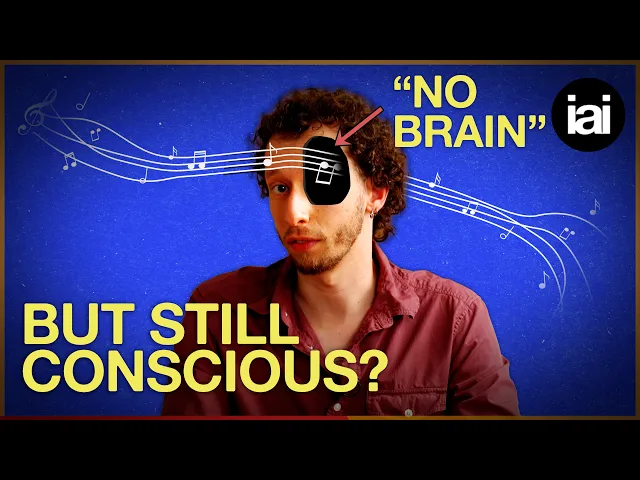
What "no brain" patients teach us about consciousness | Ideas For Our Time
The Institute of Art and Ideas
0:00 In 2007, a strange headline shocked the world.
0:03 The mysterious case of the white-collar worker without [music] a brain.
0:06 On the outside, a normal 44-year-old man, employed,
0:10 married with two children, and an [music] IQ of 75.
0:13 And on the inside, a gaping fluid-filled cavity where a brain would normally be.
0:18 And he's not the only one.
0:19 Stories like this keep making headlines.
0:22 [music]
0:21 People living otherwise regular lives, but underneath the surface, nothing.
0:26 How do these stories challenge our understanding of how the mind works?
0:30 [music] And how would you feel if you found out you had no brain?
0:32 Today, we explore the mystery of how
0:34 consciousness can exist [music] without the brain,
0:36 and how the structures of music might offer a radical new perspective.
0:40 Welcome to Ideas for Our Time.
0:45 [music] We choose to go to the moon.
0:46 There are things we thought we knew and still [music] don't know.
0:49 And it's one of the things we're hoping to discover.
0:51 I have a dream today.
0:58 Today's idea comes from Michael Gazzaniga and Bridget Quinnan,
1:01 two distinguished neuroscientists.
1:04 This video is based on an article that they wrote for our website,
1:06 which [music] you can find the link for in the description below.
1:09 Michael and Bridget propose a new way of thinking about consciousness,
1:12 [music] not as a physical phenomenon, but as the music of the mind.
1:16 Along the way, we'll hear directly from Bridget,
1:18 who was kind enough to let me interview her about this idea of theirs,
1:20 [music] and how it could shed light on the matter of artificial consciousness.
1:24 I sort of trust that if anyone is going
1:26 to figure out how life works and nervous systems and brains,
1:30 it would probably be musicians.
1:31 Like, my money is on them.
1:33 But first, the missing brain.
1:37 The case of the missing brain is rare, but not unique.
1:40 Outside of the headlines, there have been many studies examining these instances
1:44 of people missing most of their brains.
1:46 Often, these people go into hospital for other reasons,
1:48 and only then does a scan reveal that they just have a thin layer of cortex,
1:53 the rest of their skull filled with fluid.
1:55 In these cases, it's a surprise that these people
1:57 have been going about their lives fairly normally,
1:59 all while lacking so much brain matter.
2:02 Even rats with hollowed-out brains have been
2:04 shown to perform well in various tasks.
2:07 Importantly, if you're born with no cortex, things look pretty bleak.
2:10 Infants born with hydranencephaly rarely survive longer than a year.
2:14 But these cases of having barely any brain reveal something quite extraordinary.
2:18 If you were born with just a tenth of your liver, you'd have a serious issue.
2:23 [music] But somehow, the brain can handle it?
2:24 We know what brains are supposed to look like,
2:25 and these brains just don't look right.
2:27 Our nervous system, the brain, the spinal cord,
2:29 and the brainstem, float around in cerebrospinal fluid.
2:32 [music] Our brain should have a few ventricles, but not ventricles that big.
2:37 A normal adult skull has a bit of fluid in the center and around the edges.
2:40 The rest is brain matter.
2:42 But the skulls of these individuals are mostly filled with fluid,
2:45 with just a little bit of brain matter at the outskirts.
2:48 It's like the central ventricles have overflown completely,
2:50 which is actually something that can happen in adulthood,
2:53 a condition known as hydrocephalus, and it's bad news.
2:56 The [music] skull fills with excess fluid,
2:58 which impairs behavioral, cognitive, and motor functions, [music]
3:01 and to prevent serious damage,
3:03 shunts have to be installed to drain the excess fluid.
3:06 [music] But in these cases, if the initial brain-to-fluid ratio is different,
3:09 somehow it works just fine.
3:11 It's just a different arrangement.
3:15 [music]
3:19 The big question here, of course,
3:20 is how does consciousness work if you have so little brain?
3:23 Neuroscience has been trying to solve
3:24 the problem of consciousness for a long time.
3:26 According to Michael and Bridget,
3:28 it might be time to look at the problem in a whole new way.
3:31 In a field that has been stuck for a minute, if you're stuck,
3:36 you might as well just like start playing around with ideas,
3:39 and then you'll get there faster.
3:41 And you know, you have different waves
3:43 of like a technological revolution where you're like,
3:45 okay, now we're going to crack this thing right [music] wide open, right?
3:48 And so, you know, when you couldn't look inside a human brain,
3:52 people did phrenology, right?
3:54 So, you're like, what information is available on a skull?
3:58 Uh you know, like that's If that's the best you can do,
4:01 then that's the best you can do.
4:02 So, might as well start with that.
4:03 Certainly, when all the you know, structural brain imaging came into play,
4:08 then obviously you could do CT and X-ray and MRI.
4:11 And then it's like, okay, now that we can look inside brains,
4:15 you know, can we do this voxel-based morphometry?
4:18 Can we see if like this brain area is larger or smaller?
4:21 But then once the functional imaging came into play where you're like,
4:24 we can have PET scans and we can have, you know,
4:26 bold signals of where the oxygen is and various things,
4:30 there was the sense of like, okay, you know,
4:32 we can see inside a living human brain,
4:34 [music] so like this will be wrapped up in, you know, a couple weeks.
4:40 So, you get these sort of surges of like,
4:42 all right, we're going to figure this all out,
4:44 and then you know, it's just how science works is everyone does their homework,
4:48 and then at a certain point,
4:50 you sort of you exclude all of the reasonable things,
4:53 and then you're like, well, those didn't work,
4:55 so like [laughter] what's the next idea, right?
4:58 Let's begin by comparing music to brain activity.
5:01 Both of them could be described in terms of volume,
5:03 [music] the amount of sound happening at once,
5:05 or the amount of brain happening at once.
5:08 But the volume of music is not the sole determiner of what makes a good song.
5:12 Unless we're talking about the loudness war,
5:14 but that's a story for another time.
5:16 There's also other components like the rhythm, the harmonies, the melody.
5:20 Music is the elaborate interplay of these different frequencies,
5:23 which in combination creates something beautiful.
5:26 Now, consider the brain.
5:27 Once again, the volume might not be
5:29 the sole determiner of what makes a brain good.
5:31 There's also the circadian rhythm, the central pattern generators,
5:34 [music] and the real-time brain activity.
5:36 The conscious mind is the elaborate interplay of these different frequencies,
5:40 which in combination produces something beautiful.
5:43 In both cases, volume is the easiest thing to measure.
5:46 [music]
5:46 In music, it's hard to quantify rhythm,
5:47 and very difficult to quantify the melodies and harmonies.
5:50 Same in brains.
5:52 [music]
5:51 For years, neuroscience has found better and better tools for measuring volume,
5:55 but it's hard to quantify the circadian rhythms,
5:58 and [music] very difficult to quantify activity from firing neurons.
6:02 In both cases, volume only tells you part of the story.
6:05 Now, how does this musical analogy help us think about these brainless patients?
6:08 You know, there's a lot of people who've been put in scanners where like,
6:11 yeah, there there is clearly a certain shared layout.
6:15 The same thing as an orchestra where you're like, yeah,
6:17 we put like it's not random that the big
6:19 instruments are at the back, [music] right?
6:21 Someone thought this through.
6:22 And so, you're like, yeah, you sort of expect timpani to be in a certain place.
6:26 And so, there are reasons why it's set up this way,
6:30 there's reasons why it works this way.
6:32 And so, [music] if you go to hear a symphony, yes,
6:34 you should reasonably expect that the cellos
6:37 are going to be where the cellos are.
6:38 And so, I think that's a healthy way to be thinking about
6:43 [music] brain structure.
6:43 What Bridget means here is that we can
6:45 kind of think of the brain like an orchestra.
6:46 [music] The brainstem is the conductor,
6:49 and in vague semicircles around the conductor,
6:51 you have the hypothalamus, the thalamus, the basal ganglia,
6:54 like [music] the different sections of the orchestra.
6:56 And then the largest arc at the back is the cortex,
6:59 like the choir at the back of the hall.
7:01 That's what Bridget means about a shared layout.
7:04 [music] Neuroscientists have used modern brain imaging
7:05 to figure out the brain's orchestral layout.
7:08 Language is here, vision is over there, [music] memory over in that section.
7:13 But our friends without a brain are like orchestras without instruments.
7:17 Just a conductor in the middle, and a small choir at the back.
7:20 So, I think it's just like a healthier way of being like,
7:22 yeah, of course, you have a genetic [music]
7:25 program that unfolds, and if everything goes well,
7:27 you sort of use the thing that worked before, and that's great.
7:29 [music] Um but that's not It's not deterministic.
7:32 It doesn't have to be that way, right?
7:34 If you only have five people up on stage,
7:40 then you're going to play the song with those five people.
7:42 You know, I went to see like a [music]
7:43 a chamber group do Beethoven's fifth and seventh.
7:47 It was great, you know?
7:49 They know what they're doing.
7:50 Obviously, someone had to put some effort in into distributing [music]
7:54 a symphony for, you know, 80 people onto four or five.
7:58 So, it's not to say it doesn't work.
8:00 But But you can't tell me like that's not That's not Beethoven's fifth symphony.
8:04 It's recognizably Beethoven's fifth symphony.
8:07 And And so, the thing that made it recognizably
8:09 his symphony wasn't the number of people playing it.
8:18 We've now seen how using music as a metaphor can
8:20 provide new ways of exploring the mysteries [music] of the brain.
8:23 But can music be more than a metaphor?
8:25 And is there something that musicians know that we don't?
8:28 I sort of trust that if anyone is going
8:30 to figure out how life works and nervous systems and brains,
8:33 it would probably be musicians.
8:35 Like, my money is on them.
8:37 You know, it's like if they figured out how
8:38 to mathematically interrogate a world that's entirely invisible to us,
8:43 and like make these insane calculations on the fly,
8:45 you're like, I would put them in charge of wave physics.
8:48 I'd put them in charge of a lot of stuff, you know?
8:50 Like, they seem to know what they're doing.
8:51 Michael and Bridget push this idea further,
8:53 and explore what it would mean to define a basic layered hierarchy
8:57 of consciousness based on the rhythms of the body that we observe in others.
9:00 Instead of consciousness being a thing that you have or don't [music] have,
9:03 they define it using a musical hierarchy,
9:05 starting with the minimum requirement for life, that the brainstem keeps time.
9:09 we already know that it's like if your brainstem is not involved,
9:13 that's the end of everything.
9:15 So, I think building from the brainstem back up is a a healthier way
9:19 of doing it than starting from our highest-order
9:22 cognitive processes and working back down.
9:25 Without this tempo, you are brain dead.
9:28 No music, the lowest level of the hierarchy.
9:31 One step up, you get asleep.
9:33 With a tempo set by the brainstem,
9:35 you get a simple polyrhythm consisting of the heartbeat and the breath.
9:42 Now, we have awake, a complex polyrhythm [music]
9:45 where we add in blinking and limbs in motion.
9:52 The body now has a whole rhythm section, [music] and the pace has increased.
9:55 Finally, we have awake and aware,
9:58 a complex polyrhythm that changes and evolves [music] in response to stimuli.
10:03 In musical terms, a band that can improvise.
10:05 [music] [music] Now, building up a hierarchy from the minimum requirements like
10:26 this is interesting and a very different way of thinking about consciousness.
10:30 Crucially, it's a very broad definition,
10:33 one that admits more than just humans into the consciousness club.
10:36 If you're just talking about basic theory of mind of like do you understand
10:39 that this other creature has a mind that is not yours that you could anticipate.
10:46 You're like, I know plenty of dogs who have higher theory of mind than you know,
10:52 colleagues [laughter] of mine, right?
10:55 I was like, they clearly understand that you're like, yeah,
10:58 you're you and I'm me and like I want
10:59 that thing that you have and if I do this thing, it will be more likely.
11:03 So, to me, it's just like it's pretty clear.
11:07 There were some crows that I used to feed at UCSB in the parking lot
11:11 and they wouldn't eat the food unless I first ate it and then they would eat it.
11:16 And so, you're like, they're in the club.
11:17 That's theory of mind.
11:18 Clearly in the [laughter] club, like like not I mean, I was like,
11:21 that's more sophisticated than a lot of people to just be like,
11:24 we are not falling for this one.
11:25 We are not getting poisoned again.
11:27 At the physical level as well, you mentioned phrenology.
11:30 Throughout history, people have tried to find ways that the human brain is is
11:34 more impressive than every other animal to to [music] show what sets us apart.
11:39 For me, one of the things about certain there's like an alarm bell
11:43 that goes off in my head with certain people how they talk about consciousness.
11:46 You're like, this is just a eugenics kind of thing that we're doing here, right?
11:51 And you're [music]
11:52 you're coming in determined to find evidence that certain people are in the club
11:59 and certain people are out of the club and I already know how this goes.
12:02 We have already done this simulation.
12:05 Like you did it with women, you did it with black people,
12:07 you did it you like you're doing it with animals.
12:08 So, just this is yeah, that is not science.
12:11 If you're building it from the ground up to just say,
12:14 okay, what is the minimum requirement?
12:16 Everyone who meets this requirement is on level one.
12:19 Okay, now what is the next one?
12:21 Level two.
12:21 And so, that is a if you're doing it as a bottom-up approach,
12:25 then you're actually in you know,
12:28 what are the features that are shared and then that helps you figure out,
12:32 okay, now what are the features which differ?
12:34 There is a stunning history [music] of humans trying
12:36 to find ways of scientifically defining our superiority over other species,
12:39 especially when it comes to consciousness.
12:41 Yet, again and again,
12:42 the physical characteristics of our brains do not seem to set us apart.
12:45 [music] Not brain mass, not brain density,
12:48 not the number of neurons or the number of folds.
12:50 According to all of these metrics, humans [music] are not remarkable.
12:53 So, to fulfill this agenda of ours,
12:55 we turn to things like language to set us [music] apart.
12:58 This thing that only humans can really excel at.
13:01 Right?
13:06 The arrival [music] of artificial intelligence Artificial intelligence
13:09 Artificial intelligence
13:10 Artificial intelligence [music] Michael and Bridget's definition
13:13 of consciousness has nothing to do with language.
13:15 In the musical metaphor, lyrics are not the same as music.
13:18 And so, language is not the same as consciousness.
13:21 You weigh down very heavily in the article on kind of admitting
13:24 animals into the the consciousness club and kind of turning down language,
13:29 which some people argue is very much what sets humans apart
13:33 and then maybe is what makes us conscious rather than animals.
13:36 So, do you think it came from this idea that if we want to exclude AI,
13:40 which is this thing that is very good
13:42 at language but doesn't have those physical characteristics?
13:46 Is it is this an idea of how we can redefine consciousness?
13:49 Yeah, and I guess probably in my musical definition,
13:53 none of those systems are going
13:54 to meet the requirement for consciousness because yeah,
13:56 it's going to be much more based on sort of physiological rhythms and variants
14:01 and and also like what are the minimum
14:03 resources you need to produce the maximum [music] thing.
14:07 Originally, I was a biochemist.
14:09 So, biochemists are like the economists of the science world, right?
14:12 It's like how much can you do for how little energy?
14:14 And so, you're like, living things are so interesting to me where you're like,
14:17 a handful of Skittles and I can
14:18 like solve all these math problems, [laughter] right?
14:21 Like I just need coffee.
14:22 Yeah.
14:22 And like whereas you're just like, yeah, sure,
14:25 if you need to like drain the entire Colorado
14:27 River and like has start a nuclear power plant,
14:30 I don't actually think that's impressive.
14:32 I think it's really cool that you can do this on the fly.
14:35 Well, I guess that's part of what's so
14:36 interesting about those those folks' [music] brains, right?
14:38 Is it's like if you could get all of that cognitive
14:40 performance out of just this, like good job, you.
14:46 I don't think we should be making fun of these folks, like Yeah.
14:49 Well, how how amazing a structure that with a like
14:54 tiny amount of brain mass that you can achieve all that.
14:57 Perhaps this alternative definition of consciousness built up
15:00 from physiological rhythms can help separate man from machine.
15:04 Or maybe consciousness shouldn't be our main
15:06 concern [music] when it comes to AI.
15:09 Are you worried about the effect that these systems will have on our brains
15:13 and and the brains of people who develop while using all this technology?
15:17 Yeah, yeah, absolutely because I think that one
15:20 of the things that people have forgotten and a lot
15:23 of my neuroscientific colleagues would [music] this would also be
15:25 true is the nervous system is also neck down, [laughter] right?
15:31 Like this part is great.
15:32 Don't get me wrong.
15:33 I love it.
15:34 But like this part also is involved.
15:37 Your [music] conscious mind is for problems that you haven't solved yet.
15:46 But every time you solve a problem neurologically you move
15:53 the solution to a different part of your nervous system, right?
15:56 [music] So, like once you know how to ride a bike you don't
16:00 have to think about it because the knowledge lives in the basal ganglia, right?
16:04 You know, the knowledge of how to breathe and beat your heart [music]
16:08 is not conscious.
16:09 And so, I think that that that's also like if you spend all of your time,
16:14 you know, kind of in your conscious mind [music]
16:17 you're spending all of your time with your failures.
16:20 Right?
16:20 By definition.
16:21 Mhm.
16:22 Like this is all of the stuff on your to-do list that you haven't done.
16:27 And so, the you have to spend time with the activities where you're like,
16:32 you did already like learn to walk and learn to ride a bike.
16:35 And if you're only consuming music or you're only consuming art then
16:40 your nervous system has no opportunity to do what it likes to do,
16:46 [music] which is to experiment with, you know, with music,
16:50 with sports, with painting, with you have to physically implement it.
16:55 And and you're just walking around,
16:57 you're testing your hypothesis of where the ground is.
16:59 And every time you step, you're like good job, me.
17:02 Like [laughter] uh and like I got that.
17:05 Like you do it your thousand steps and every
17:08 single time you got that math problem [music] correct.
17:11 So, yeah, so I think that the more you're divorcing
17:14 people from their kind of physical interactions with their environment,
17:19 the more crazy you will drive people just because [music]
17:23 your your nervous system is that's I mean,
17:25 that's what it's interested in doing is kind of confirming these physical
17:29 hypotheses about the world and if you're starving it for things to do,
17:34 then you know, yeah, it's you put it in like solitary confinement.
17:38 So, of course it's going to go a little little crazy.
17:42 So, yeah, I do think that it is a recipe
17:44 for insanity if you don't let yourself do these things.
17:48 And I mean, I guess that's why I'm sort of naively
17:49 hopeful that one of the things that that, you know,
17:52 is emerging and could emerge more with the AI conversation is like I
17:58 understand that we're outsourcing the creation of music and art to these things.
18:03 [music] But that's assuming that art and music are just things to be consumed.
18:10 Right?
18:10 And that the whole point of some of these activities are like,
18:14 no, they are actually things that you do, right?
18:18 Because [music] the process of doing them is the thing, right?
18:22 Not the product at the end.
18:24 And so, of necessity,
18:26 you have to make a product that you can sell [music] because
18:28 you live in a capitalist system that has required it of you.
18:32 But that wasn't the point of it.
18:35 Right?
18:35 Like if money was no object you would do it because it creates [music] meaning.
18:41 To end my conversation with Bridget, I wanted to ask her more broadly about how
18:44 music should be treated within [music] the scientific community.
18:47 I do sort of think that you know, modern scientists don't realize that obviously
18:53 there are certain things that we have
18:55 that are so amazing and we are in sort of a golden age,
18:58 but there are other things where you're like, no,
19:00 this really is a dark age of science because
19:03 you've kicked all of the arts and humanities out.
19:07 [music] And that's a fairly recent development where you really ripped you
19:11 just ripped the heart and soul out of the scientific [music] enterprise.
19:15 Um and so, like A, it's going to lead to evil
19:20 but also just like it's not going to be fun.
19:22 You know, just [laughter] like it can't be fun.
19:25 It has to be like it's not a human enterprise.
19:28 It's [music] a creative profession, right?
19:31 It's just like wondering about the world and experimenting with the world
19:35 and drawing pictures of the world and describing it in numbers.
19:37 I mean, [music] it's supposed to be an art form.
19:41 And that's why I like kind of using [music]
19:44 Plank or Newton to just be like, okay,
19:46 these are people that you respect and like
19:50 they didn't look down on arts and humanities.
19:56 You know.
19:57 Today we've explored the mysteries of consciousness
19:59 [music] through the lens of music.
20:00 We've seen how thinking about consciousness
20:02 as the music of the mind not only helps
20:04 us understand these cases [music] where the brain
20:06 structure is radically different from the norm,
20:08 but also helps inspire new definitions of consciousness that bring
20:12 us closer to our animal friends and [music] further from AI.
20:15 The beauty of music is an emergent property
20:17 that cannot be easily explained by its components.
20:20 Maybe consciousness [music] is the same.
20:22 A beautiful emergent property that can't be explained by physical measurements.
20:26 Perhaps there is still a lot we could learn from musicians.
20:29 People with dementia,
20:31 like [music] they they've forgotten everything else, right?
20:35 Like they've forgotten their partner, they forgot their kids,
20:37 they forgotten their names, but you know,
20:39 when you see the footage of pianists [music] kind
20:42 of coming back to life and performing or ballet dancers,
20:46 I mean that to me is just [music] like if that's the last thing to go,
20:52 then it's probably the first thing that you built.
20:54 Thank you for watching [music] Ideas for Our Time and stay tuned.