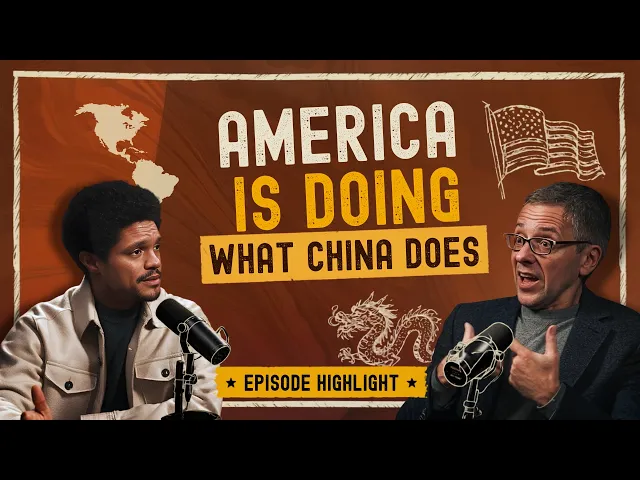
Thought It Was China" — The America Story Nobody Is Covering
Trevor Noah
0:00 Think about where China was 35 years ago.
0:02 What I mean, you know, you go there and everyone was riding a bicycle and now
0:05 they're building better tech than we have in the United States.
0:08 Like so they it's not just this idea of oh,
0:10 countries are static and I need to help you
0:13 understand that when you go to Japan it's different.
0:15 It's also that your your own place is changing and how
0:19 you're perceived as being is different than it used to be.
0:22 How far do you think America is from how
0:25 many Americans think about it currently in the world?
0:29 Oh, I I think it's Like like take us take us through a little journey.
0:32 So let's talk about that period.
0:33 There's the period where America comes out
0:35 of these these wars physical and otherwise, right?
0:38 The Cold War is a war World War Vietnam War but there's this moment like
0:43 America has this idea of itself and the world has an idea of America, you know?
0:50 And I think some people are still sort of set in that and stuck in it.
0:56 But it's clearly changed.
0:57 What do you think has been the biggest shift?
0:59 There've been a few.
1:00 Yeah.
1:01 Uh one, a big one, is that America used
1:05 to be the place that wanted to trade with everybody.
1:09 Free trade.
1:10 Now tariffs are the principal tool that the Americans
1:15 are using economically and and it's not just about Trump.
1:18 I mean, most people in the US, Democrats, Republicans are saying,
1:21 "No, no, no, no, we don't want free trade.
1:23 We want like, you know, stuff that's built much more here and we
1:26 want more manufacturing here." And you know,
1:29 you think as well about immigration.
1:31 And my grandma came through Ellis Island and the Statue of Liberty.
1:35 Where did she come from?
1:36 Uh originally they are Syrian Armenians.
1:39 Oh, wow.
1:39 Okay.
1:40 Yeah.
1:40 So they came over and she's even on a little bench on a little
1:43 Oh, wow.
1:44 That's amazing.
1:44 kind of cool to see.
1:45 Still there now?
1:46 Yeah.
1:47 I mean, I haven't been today but I think so.
1:49 Unless someone ripped it out.
1:51 I mean, you know.
1:51 two cold days.
1:53 Yeah.
1:53 [laughter] She's out there in that bench.
1:54 Still there.
1:57 My old grandma.
2:01 [laughter] knitting cashmere and wool.
2:03 You and your textures.
2:05 Eugene loves textures.
2:06 God.
2:07 [laughter] So uh you know, and and I I think of the Statue of Liberty
2:12 as a pretty iconic thing for the United States.
2:15 But I mean, clearly that doesn't reflect who the United States is today.
2:22 Right?
2:22 I mean, like welcoming immigrants from all over the world.
2:24 Give me your tired, your huddled masses.
2:26 That that is nowhere close.
2:28 Yeah, now it's give me your people who have a million
2:30 dollars to invest or 5 million dollars to spend on citizenship.
2:33 Yeah.
2:33 Yes.
2:34 That's the new thing now.
2:34 Yes.
2:35 Sell me your golden visa.
2:36 Sell me your golden visa.
2:38 Right.
2:39 Yeah.
2:39 And and and also let me see your social media history,
2:42 by the way, the last 5 years.
2:45 You know, I when I first saw that I didn't see the context.
2:47 Of course, you'd immediately think, "Oh,
2:49 that's China." You would think that from around the world, right?
2:53 You know, or you think it was Russia
2:54 or some other authoritarian state that controls information.
2:57 Turns out it's the United States.
2:59 Most other people around the world would not have thought.
3:01 That's not That's not comport with their view of the United States.
3:07 I'm just thinking about how how powerful the idea of a place is [snorts]
3:16 in that it can be so powerful that people don't notice when
3:20 it is doing things that it said it did not stand for.
3:25 It cuz what you just said,
3:27 I don't know why that that that that it's
3:29 just like jammed something in my brain.
3:30 I saw the reaction immediately.
3:32 literally it literally jammed something in my brain where I
3:34 went if you put out a news headline tomorrow and said,
3:39 "China is going to be scrubbing people's social
3:41 media for anyone who comes into the country,
3:43 they're going to look through their social media for 5 years and they
3:45 they're going to get access to your phone." How would most people react?
3:49 They would go, "I'm never going to China." Yeah,
3:51 but they'll be like, "Of course, I expected it." Yeah.
3:53 And they'll be like, "What kind of country does this?"
3:55 Got to bring a burner, all that stuff, you know, it's a communist country.
3:58 Don't trust them.
3:59 Authoritarian.
4:00 You know, the United States is These these things are fluid.
4:03 Nations are fluid.
4:05 Governments, these all things, our identity, what do we stand for, who are we?
4:09 I mean, maybe the most consistent thing since I was growing up is money.
4:14 In terms of what the United States stands for.
4:17 Yeah, the dollar.
4:17 The almighty dollar.
4:19 Yes.
4:19 Um but but I you know, when I grew up the US didn't only stand for the dollar.
4:24 It stood for other things, too.
4:26 And uh I think that's becoming a challenge.
4:29 You're always writing books about moments in time.
4:33 forget tweets.
4:33 I'll never forget the tweets.
4:34 Okay, good.
4:35 Where you guys first met.
4:37 [laughter] Our meet cute.
4:39 You were you were always writing books about moments
4:41 and ideas that speak to those moments, you know, a power crisis, um you know,
4:47 how the world is moving at a certain moment in time.
4:50 I I always wonder, you know,
4:52 especially from authors who tap into these these moments in the zeitgeist,
4:55 I always wonder what they're seeing that we're
4:57 not seeing that leads to them writing that book.
5:00 And and I'd love to know like what you're seeing now
5:02 that would inspire a book that you would be writing for the future.
5:05 What what's what's what's capturing your attention and your imagination?
5:09 Uh As someone who studies the world.
5:11 Maybe the So the the book that I wrote
5:14 that probably was most prescient was back in 2011.
5:19 And I'm going to answer your question.
5:20 I just wanted to give you a thought about it.
5:22 And um about the G-Zero world.
5:25 And this idea, not that I had some crystal ball,
5:28 but that it seemed so over determined by big structural factors in the world.
5:32 By the fact that the Russians, when the Soviet Union collapsed,
5:36 we said that we wanted to bring them
5:38 in, the NATO-Russia Council, the G7 plus one.
5:40 We never really wanted to bring them in.
5:42 They were angry about it.
5:43 They blamed us.
5:44 And we said we wanted to bring China in.
5:46 We did, but only if they were going to become Americans.
5:49 Only if they actually accepted our economic system.
5:53 They became free marketeers.
5:54 Only if they accepted Right.
5:57 If they if they adapted their system
5:58 and they became much much much more powerful, but they were still Chinese.
6:01 So we weren't happy about that.
6:03 And then the United States increasingly had
6:05 a whole bunch of people saying, "Well,
6:06 that stuff that we used to do, like, you know,
6:10 sheriff of the world and architect of trade and promoting democracy,
6:15 we don't really buy that stuff." So you put all those things together with it
6:19 seemed to me wildly over determined
6:21 that the world wasn't going to be Pax Americana.
6:24 It wasn't going to be G7 or G2 or G20.
6:27 It was going to be an absence of global leadership.
6:30 That the US wasn't going to play the role it used to, but no
6:33 other country or group of countries could come together and replace it,
6:37 at least not for a period of time.
6:39 And so it's it seemed to me wildly over determined,
6:42 even if some of these things were going to change,
6:44 that the train had so had so much momentum pulling out
6:47 of the station and going downhill that that the G-Zero was going to come.
6:51 So I wrote that.
6:52 Because, you know, a book should be something that stands up for a while.
6:57 And the thing that I see now Before you move on from that.
7:01 Before you move on from that, I'd I'd love
7:02 to know how people responded to it at the time.
7:05 Because I find a lot of these books
7:08 and these ideas are welcomed when they meet their moments.
7:13 Or in hindsight.
7:14 Yeah, but when you when you release them,
7:16 I'd love to know how people responded to you writing a book
7:18 basically saying not only would America not be the de facto,
7:23 you know, respected and loved power in the world,
7:25 but power itself would diffuse,
7:28 it you know, would find itself diffusing in in in this kind of way.
7:31 What How did people respond to that?
7:33 Um I think they thought it was interesting.
7:35 Yeah.
7:35 They thought it was intriguing.
7:36 I think it it played with a lot of different
7:38 strands that that people were picking up and looking at.
7:41 There were a whole bunch of people that were
7:43 looking at one or two pieces of that puzzle,
7:45 but most people at the time thought I was taking it too far.
7:48 Yeah, I can imagine.
7:49 Most people thought, "No, no, no.
7:50 Maybe it'll go that way, but actually we see a G2.
7:54 It's going to be US-China.
7:55 Actually, it's still Pax Americana and the US isn't in decline." I'm like,
7:59 "No, the US doesn't have to be in decline,
8:00 but if it doesn't want to do these things, you know,
8:03 then it it it is it is personally removing itself from that role.
8:07 It doesn't mean that the dollar suddenly is no longer the reserve currency.
8:10 It doesn't mean the US doesn't have,
8:12 you know, [music] all of this military capacity,
8:14 but it still has to be willing to play that role." [music]