Wild knots
Henry Segerman
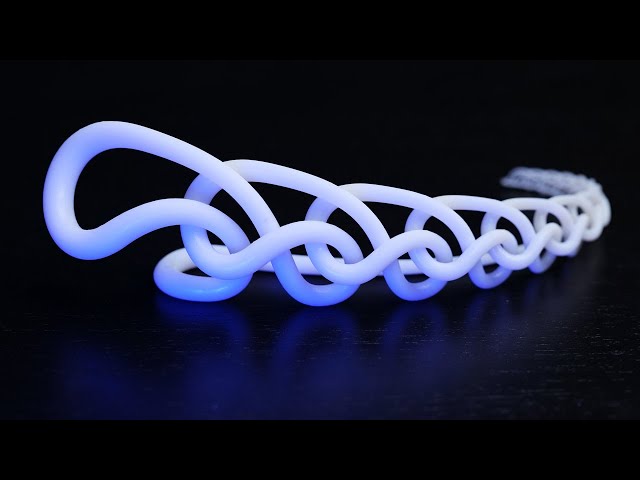
0:00 This knot is wild.
0:03 No, really, that's the technical term for it.
0:05 It's like an ordinary knot, except that it's infinitely complicated.
0:09 Okay, well, this 3D print is not itself infinitely complicated.
0:13 I had to stop at some point, but you get the idea.
0:15 This looping pattern should keep repeating, getting smaller and smaller forever.
0:21 But does this really count as a knot?
0:23 Are we allowed to tie infinitely many tangles in a piece of string?
0:28 Mathematical knots are like knots you would tie in real life,
0:30 except that we join the ends of the string
0:32 together to make a loop so it can't come undone.
0:34 Okay, there are some other differences as well.
0:37 Mathematical knots don't usually have any thickness,
0:39 unlike a real piece of string or a 3D print, it should be infinitely thin.
0:43 More precisely, a mathematical knot is a "simple closed curve" in space.
0:48 So what's a curve?
0:49 A curve is the image of a continuous map of a line segment into space.
0:53 For example, this knot, the "trefoil",
0:55 is the image of the interval from 0 to 2 pi under this continuous map.
1:01 A curve is "closed" if it closes up into a loop like this one does.
1:05 And it's "simple" if it doesn't pass directly through itself.
1:08 In other words, the map never sends two different
1:10 points on the interval to the same point in space.
1:12 So here I've collapsed the trefoil down,
1:15 and now it's no longer a simple closed curve.
1:18 Now, there's nothing in that definition that means
1:20 you cannot have an infinitely tangled knot.
1:23 You might worry that there's some
1:24 problem with an infinitely complicated continuous map,
1:26 but this turns out not to be a big deal.
1:29 Here's a wonderful example of an infinitely
1:31 wiggly curve called the "topologist's sine wave".
1:34 It's just the graph of the function y equals sine of one over x,
1:38 for x greater than zero.
1:40 As x gets nearer to zero, one over x gets bigger and bigger, faster and faster.
1:45 And we zoom through the wiggles of the sine wave faster and faster.
1:48 All the waves kind of bunch up as we get towards x is zero.
1:52 Okay, maybe there's a problem with closing this curve up to make a loop,
1:56 because it's not so clear where the left hand end
1:58 of this curve is when we get to x is zero.
2:01 So instead we can just scale the function by multiplying by x
2:04 to get y is x times sine of one over x.
2:08 And now the function goes to zero as x goes to zero.
2:11 And so we can join it up like this to make a closed curve.
2:14 And we still have an infinite amount
2:16 of wiggling happening in this finite amount of space.
2:20 Okay, back to knots.
2:21 So a knot is a simple closed curve.
2:23 But there's another thing,
2:24 which is that we don't care about the exact shape of the curve.
2:27 If you deform it a bit, it still counts as the same knot.
2:30 And then you might ask, is this really knotted?
2:33 Or could you somehow deform it so much that you would untie it,
2:37 turning it into the unknot, which is just a circle.
2:40 And it doesn't seem likely for this knot, and yeah,
2:43 it turns out that this knot really is knotted,
2:45 although it's not so easy to prove that.
2:48 In fact, there are infinitely many knots that are all really different.
2:51 Meaning that you cannot deform one into another.
2:53 Although again, showing that they're really
2:55 different from each other isn't so easy.
2:58 All of these knots are "tame",
3:00 which means that they can be deformed into polygonal loops.
3:03 That is, you can make a version of the knot,
3:05 which is made from a finite collection of line segments connected end to end.
3:09 For example, this is a polygonal version
3:10 of the trefoil knot made from nine line segments.
3:14 And the idea is that if you can make a polygonal version of the knot,
3:17 then it cannot be infinitely complicated.
3:20 It cannot be wild.
3:21 So instead it's tame.
3:23 Here's that knot from the start of the video.
3:25 Now these tangles go on forever with smaller and smaller loops,
3:28 so it seems like there should be no way to draw
3:30 this as a polygon with a finite number of line segments.
3:33 But it's not that easy to show that this is wild.
3:36 You know, maybe there's some big,
3:37 complicated way to deform it and somehow get rid of the infinite
3:40 complexity before you try to make it out of line segments.
3:44 Our scaled topologist's sine wave from before
3:46 also has infinite complexity in a sense,
3:49 even though you can just squish that down into a circle and a circle
3:53 is just the unknot which of course can be deformed into a polygon.
3:56 So even though this knot is infinitely wiggly,
3:59 it's tame because it's just the unknot.
4:03 Here's a really interesting example due to a mathematician called Ralph Fox.
4:06 You could call it a "wild slipknot".
4:09 Just like the other wild knot, it looks like it has infinitely many tangles,
4:12 but, well, we can just start undoing each tangle from the end.
4:16 If you pull this loop through here, I mean,
4:19 it just goes away and the knot looks the same as when we started,
4:22 except that it's one loop shorter.
4:23 So surely we should be able to just keep doing this, untangle everything,
4:27 and this is just the unknot.
4:29 Well "hold on", you might be saying,
4:30 "this is one of those cases where infinity does strange things".
4:33 It has infinitely many loops and if you remove one,
4:36 it still has infinitely many loops.
4:38 So to untie this wild slipknot,
4:40 you'd have to do infinitely many "unlooping" moves.
4:43 But is that a problem?
4:45 In Zeno's paradox of Achilles and the tortoise,
4:48 Achilles and the tortoise are in a race, but the tortoise gets a head start.
4:52 Achilles is faster.
4:53 But by the time he gets to where the tortoise was,
4:55 the tortoise has moved forward a bit.
4:57 And by the time Achilles gets to that second point where the tortoise was,
5:00 the tortoise has moved on to a third point and so on.
5:03 So Achilles has to do infinitely many
5:06 things before he can actually overtake the tortoise.
5:08 but of course, he can overtake- each step of getting
5:11 to where the tortoise was happens faster and faster,
5:13 and he overtakes in a finite amount of time,
5:15 even though he does infinitely many of these "catching up" moves.
5:19 So can we untie the wild slipknot?
5:21 We would have to do infinitely many unlooping moves,
5:23 but if Achilles can do it, why can't we?
5:27 This gets very subtle,
5:28 and now we have to be really careful about what it means to deform a knot.
5:32 It turns out that with the precise mathematical sense of "deform",
5:35 you cannot untie this wild slipknot.
5:38 I won't go into the full details,
5:40 but I can at least wave in the general direction of a proof
5:42 that this is not the unknot- that this isn't the same as a circle.
5:47 One of the ways you can show that a knot
5:49 is not the unknot is to show that it is "tricolourable".
5:52 A knot is tricolourable if you can colour the strands
5:54 of a diagram of the knot in three colours,
5:57 with the rule that at every crossing you
5:59 either see all three colours or only one.
6:02 And of course, you're not allowed to use only one colour for the whole diagram.
6:05 You have to use at least two.
6:07 This diagram of the trefoil knot is tricolourable,
6:10 and if you start moving the knot around to change the diagram,
6:14 doing "Reidemeister moves" as they're called, it stays tricolourable.
6:18 But this diagram of the unknot is not tricolourable.
6:21 There's only one strand to colour in, and we have to use at least two colours.
6:24 So the unknot is not tricolourable, the trefoil is tricolourable,
6:28 so they must actually be different knots.
6:31 And it turns out that our wild slipknot can be tricoloured.
6:35 Here's how you do it.
6:37 Well, maybe this is not such a satisfying
6:40 argument for why the wild slipknot cannot be untied.
6:43 The usual justification for why tricolourability is an invariant of the knot
6:48 is that if you do any finite sequence of these Reidemeister moves,
6:51 you either stay tricolourable or you stay not tricolourable.
6:55 But no finite number of moves is going to undo the wild slipknot anyway.
6:59 And it isn't so clear how to keep track
7:02 of tricolourability when you do some infinite sequence of moves.
7:05 But there's another, more technical way to think about tricolourability.
7:08 Rather than colouring the strands, you think about the loops that go around
7:12 the strands back to some fixed base point.
7:14 You can "multiply" loops together just by doing them one after another.
7:18 And it turns out that these loops form a group
7:20 called the "fundamental group of the complement of the knot".
7:24 The fundamental group is calculated in terms of the topology of the complement,
7:27 which means that it doesn't depend on the diagram.
7:29 So there's no argument involving finitely many Reidemeister moves.
7:34 To show that this, wild slipknot is not the unknot,
7:36 all we have to do is show that its
7:38 fundamental group is not the fundamental group of the unknot.
7:41 That is, we have to show that it is not the group of the integers.
7:44 You can do this by showing that there
7:47 is a non-trivial homomorphism to a noncommutative group,
7:49 because the integers form a commutative group.
7:52 For us, that group will be the simplest possible noncommutative group:
7:55 the group of symmetries of an equilateral triangle.
7:59 The relations among the loops in the fundamental
8:00 group come from the crossings of the knot.
8:02 If you go around the over strand, then one of the strands,
8:05 then the over strand in the other direction,
8:07 and then the other under strand, then you really didn't go around anything.
8:12 This is one of the relations of the so-called "Wirtinger presentation".
8:16 So let's do that same relation with the symmetries of the triangle.
8:20 Let's send the three colours of our tricolouring
8:23 to the three reflection axes like this.
8:26 First we flip across the green axis,
8:28 then the blue axis, then green again, and then finally red.
8:33 And we end up back where we started.
8:35 So the relations of the fundamental group also
8:37 hold when mapped to the symmetries of the triangle.
8:40 And we have a non-trivial homomorphism to those symmetries.
8:43 So that means that the group we started with could not have been commutative,
8:46 So it could not have been the integers,
8:48 and so the wild slipknot could not have been the unknot.
8:51 It isn't the unknot.
8:53 Okay.
8:54 That's it.
8:55 Thanks to my collaborator Saul Schleimer for working this out with me.
8:58 And thanks to you for watching.