This Egg Leather is About Dinosaurs
Reactions
0:00 I was reading about dinosaur bones and now I've made
0:02 leather out of eggshells and this rabbit hole gets very weird,
0:04 but I promise I will bring it all together at the end.
0:07 And and then there's the moldy fish tank with a bone in it.
0:10 I was reading some papers that scientists
0:11 have been finding collagen in dinosaur bones.
0:14 And this is very surprising because collagen is a protein and the peptide
0:18 bonds that hold together the protein typically
0:20 have a halflife of about 500 years.
0:22 But dinosaur bones are millions of years old.
0:25 So all these papers got me thinking about whether
0:27 or not you could stabilize collagen for millions of years.
0:29 And then I started wondering if I could stabilize collagen.
0:31 And that is how I found myself dumping a bunch
0:34 of collagen supplements into a bowl and thinking about cross-linking them.
0:37 But the problem with collagen supplements is that they really
0:40 often are not fulllength collagen and they're also kind of expensive.
0:43 But do you know where they get that collagen?
0:47 Eggshells or fishkins.
0:48 But that is for another video.
0:50 So that is how I found myself blowing the insides out of a bunch of eggs.
0:54 Blowing out the insides is an art technique.
0:56 Dissolving the hard outer shell layer in vinegar so
0:59 that I'm left with just the membranes is a me technique.
1:02 But I am left with thin sheets of collagen.
1:04 Also, I hate eggs.
1:05 And one of the most common ways
1:07 to stabilize collagen is by making it into leather.
1:09 Because that is really what leather is,
1:12 is it is just stabilized sheets of collagen.
1:14 It's just normally animal skin and hides, not eggshells.
1:17 Now, I hadn't made leather before,
1:20 so I bought this very generic high tanning formula on the internet.
1:23 I'm not actually 100% sure what this stuff is.
1:25 The bottle says how many bear and deer hides it can tan,
1:28 but it does not specify how many eggs it can tan.
1:31 Is it because no one has ever done this before?
1:33 I don't know who would ever do this other than me.
1:36 And that kind of worked, but dinosaur collagen definitely was not stabilized
1:40 with like an orange bottle of goo.
1:42 So, I wanted to try some other DIY methods.
1:44 So, how about tanning with metals?
1:46 Now, chrome tanning is super common,
1:47 but the internet made it seem really scary and dangerous.
1:50 So, instead, I decided to try alum tanning.
1:53 And really, what can't alum do?
1:55 It can help keep pickles crisp.
1:57 It can purify water via fauculation.
1:59 And it can apparently tan leather if I mix them up into a gloopy
2:02 paste with some baking soda and then
2:04 sort of shove my eggshell membranes into it.
2:06 Checking in on it a few days later.
2:08 It definitely did something, but it did not smell good.
2:10 I washed it in borax to neutralize the solution and then checked back
2:13 in on it again and it kind of folded up on itself in a weird thing,
2:17 but you know, it was a stable piece of leather that wasn't just disintegrating.
2:20 Look, it's not the most exciting,
2:21 but like this has been sitting out in my studio for months now, and it's fine.
2:27 Can you see it?
2:29 It's not disintegrating, so that's good.
2:31 The problem is that it just didn't look like leather, right?
2:34 Imagine leather in your head.
2:35 It does not look like my little alum egg.
2:38 We got bark in the mail.
2:40 Bark tanning feels like how you're supposed to make leather, you know?
2:43 I steeped oak bark.
2:44 I gently simmered it to make a tea, and then I let my membrane sit in it.
2:49 It feels very woodsy.
2:51 Probably because it's made of trees.
2:53 That's probably why it felt woodsy.
2:54 And because this is a video about dinosaurs while these were soaking,
2:57 I actually went to go look up a diagram of how tanning works.
3:01 And I I actually think this diagram helped me get it.
3:04 So this is the peptide chain backbone.
3:06 And these are the tannin molecules.
3:08 They are reacting with the carboxyl groups
3:11 of the peptide bonds via hydrogen bonds.
3:13 And they're sort of holding them together a little
3:16 bit like the suspension cables on a bridge.
3:18 This is also similar to how alum and other
3:20 metal salts stabilize collagen in those kinds of tanning.
3:22 So that's what's happening in tanning.
3:23 And while it's definitely not the same
3:25 thing that's happening in the dinosaur bones,
3:27 it might be sort of related to stabilizing the collagen molecularly.
3:32 It's maybe somewhat closely related.
3:33 Now, these membranes looked so beautiful.
3:35 They looked so much like leather.
3:37 But the problem was that when I did let them sit out,
3:40 the tanning solution was kind of astringent and it really pulled
3:42 a lot of the like oil and moisture out of them.
3:45 So they got a little crunchy.
3:46 So to get them to be nice and supple,
3:48 I have to put some of that hydration back in.
3:51 I did that first by soaking them in egg yolks.
3:53 And while that did feel very wast in this situation,
3:56 and it did make them feel nice and supple, the process was kind of disgusting.
4:01 Remember, I don't like eggs.
4:03 So I also bought some neatsfoot oil.
4:05 This is what you're actually supposed to use to soften,
4:08 lubricate, and moisturize leather.
4:09 So I rubbed that in.
4:11 And then these came out kind of truly beautiful to me.
4:15 Look at these.
4:16 And because this video is about dinosaurs,
4:19 I have this beautiful oak tanned egg leather that I will make something out of.
4:24 So, this 2024 paper talks about how collagen in dinosaur bones might
4:28 be stabilized in a way that keeps it around for millions of years.
4:31 This peptide bond right here is prone to being attacked by water
4:35 because this carbonial carbon really wants to bind with an oxygen.
4:38 But collagen backbones have a lot of twists in them,
4:41 which means that there's actually another oxygen hanging around nearby
4:44 with some lone pairs of electrons that they can share.
4:47 It's this one.
4:48 It can share some of its electron density
4:50 with that original carbon and prevent it from being hydrayed.
4:53 This could help it last for millions
4:55 of years rather than just being broken apart.
4:57 Now, look, the dinosaur collagen that scientists have
5:00 found was most likely not tanned like leather.
5:02 I'm not trying to suggest that.
5:04 I'm just saying that it was also stabilized at the molecular level.
5:08 And that's how I justified these two wildly
5:10 divergent science experiments being in the same video.
5:12 But what do you make with super thin egg tanned
5:15 leather that could potentially be around for millions of years?
5:24 This is egg project runway.
5:28 Huh?
5:28 This is like a geometry problem.
5:30 I'm making this too difficult.
5:31 I'm trying to make a a round thing flat just to make it round again.
5:35 Are we seeing the vision?
5:37 Oh, come on.
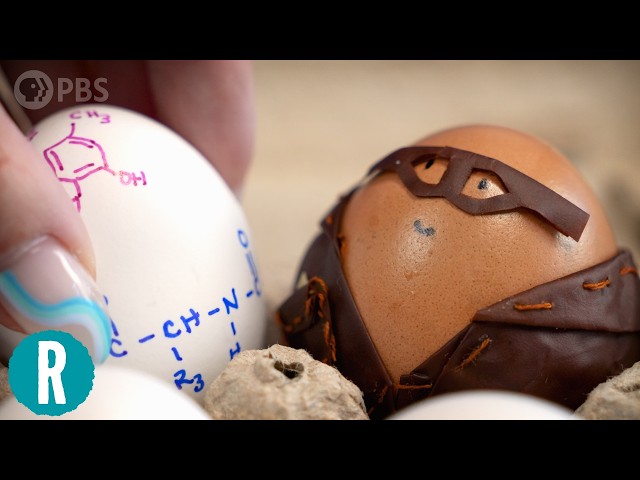
5:38 I mean, tell me that's not the cutest egg leather jacket you've ever seen.
5:42 Originally, there was a point where I thought I was going to make myself
5:46 a dress out of this, and then for a lot of reasons, that didn't happen.
5:50 Look, I am unreasonably proud of this.
5:54 It might simultaneously be the cutest and weirdest thing I've ever crafted.
5:58 I still haven't named it.
6:00 Needs a name.
6:00 Do you have a name suggestion for my tenn?
6:04 Now, these membranes are still very thin.
6:06 They're between 0.01 and 0.7 mm thick.
6:09 So even though this leather is tanned, it is oiled.
6:13 It is well cared for.
6:15 It's still super thin and so it's easy to tear.
6:18 This is much more of an art piece than it is a functional piece.
6:22 I actually don't know that I could make thinner leather.
6:28 But what about thicker?
6:30 It's an ostrich bone.
6:31 It's a dinosaur.
6:32 What if a dinosaur died right next to an oak tree and then bam,
6:37 dino collagen leather?
6:38 Can you see all the air bubbling out of this?
6:43 Could this preserve this bone for millions of years?
6:46 I will literally never find out because I'm not going to be around that long.
6:50 But I will check back in in a month.
6:53 Okay, real talk.
6:53 It's like that's not actually the test.
6:55 I got this piece of marrow bone at the pet store.
6:58 This is what we're actually going to test.
7:00 I'm I'm going to see if it actually preserves this.
7:03 And this doesn't go bad.
7:04 It's not a real dinosaur, but it was an easy to obtain and replicable sample.
7:08 We're just gonna scoot scoot that right in there.
7:14 Okay, we'll check back on this in a month.
7:20 God, it's so gross.
7:22 So, it's been about 5 weeks that these have been sitting in here.
7:27 I mean, it's kind of like a kombucha scobby.
7:29 Oh my god.
7:30 Did it tan?
7:31 No way.
7:32 No way.
7:32 Did it t Oh no, it's tearing.
7:34 But look at that.
7:36 It almost looks like leather.
7:37 But gosh, is it gross.
7:39 So, this is my marrow bone.
7:42 This is not tanning how I hoped it would.
7:46 It turned brown, but it's just gross.
7:49 I think I assumed the bone marrow would tan, but it did not really.
7:54 Oh, is this too gross for the internet?
7:57 Can I go back to my adorable egg?
7:59 Where's my emotional support egg in a leather jacket?
8:02 Actually, final thoughts on that bone purse.
8:05 Oak tanning does apparently take weeks if you're tanning like a sheet of skin,
8:09 and so I do anticipate that's going to take longer.
8:12 So, I will continue to keep that from getting
8:15 too gross and refilling it with oak tea.
8:18 I guess just strangest experiment I've done in a long time.
8:21 But after all of that, I actually feel pretty good about
8:24 this oak tanned leather in all of its different states and forms.
8:29 I figured out how to make oak tanned leather in different colors,
8:34 in different sort of sizes and shapes and softnesses,
8:38 and I finally figured out how to make it in a method
8:42 that allowed me to create the tiniest little leather jacket for an egg.
8:47 I am open to suggestions for other things to make out of this.
8:50 I think I learned enough through this process that I could make bigger batches.
8:54 I don't think that this is going to be a structural leather.
8:57 I think this is something that will be much more art forward.
9:00 I love a good science craft project.
9:02 And I'm sure there are some other talented science crafters
9:05 out there who can take this even farther than I could.
9:08 My tiny little aviator egg will always be my favorite, though.
9:11 I love this kind of rabbit hole that we were talking about dinosaur
9:14 bones and then suddenly I was making a leather jacket for an egg.
9:17 This is what science is all about for me is asking questions.
9:19 And I got to ask some real weird ones here.
9:22 Happy Earth Month.
9:22 By the way, if you want to see
9:24 another video about what to do with waste products,
9:25 you can check out PBS North Carolina's new video
9:29 on Charlotte's Crush Truck over on their YouTube channel.