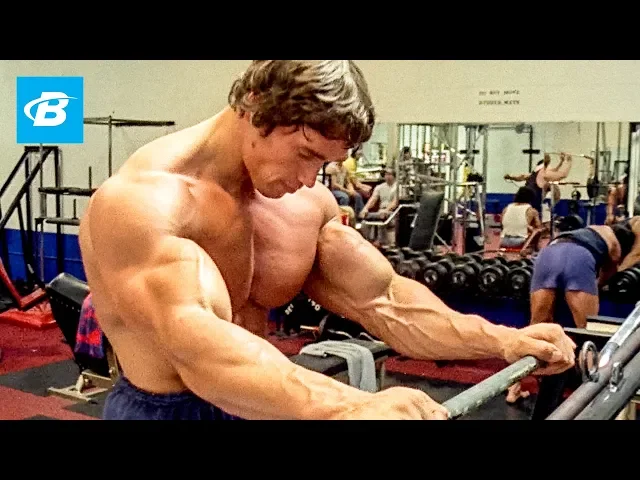
How To Train For Mass | Arnold Schwarzenegger's Blueprint Training Program
Bodybuilding.com
0:00 (film reel rattling) (piano music)- [Arnold] Not every legend is a myth.
0:10 Some are flesh and blood.
0:13 Some legends walk among us.
0:15 But, they aren't born, they are built.
0:20 Legends are made from iron and sweat,
0:23 mind and muscle, blood and vision, and victory.
0:30 Legends and champions, they grow, they win, they conquer.
0:39 There's a legend behind every legacy.
0:43 There's a blueprint behind every legend.
0:48 I'm Arnold Schwarzenegger.
0:50 This is my blueprint.
0:52 (piano music) (film reel rattling)- [Narrator] Arnold Schwarzenegger,
0:58 28 years old, six foot two, two hundred and 40 pounds.
1:03 Mr.
1:03 Olympia for the past five years.
1:05 He is preparing to defend his title this year for the last time.
1:09 All Mr.
1:10 Universes from the past five years or so come and get together
1:13 in one contest and we find out who's the best of all the Mr.
1:17 Universes.
1:18 So they created the Mr.
1:19 Olympia contest, which is then the top contest,
1:21 and then whoever wins that is the top bodybuilder.
1:24 And you are the top bodybuilder.
1:25 Right, yeah.
1:26 I think that everyone knows when they get into training that you're not
1:29 going to go and become a champion from one day to the next.
1:32 But the question is, how can I speed up the process?
1:34 (inspirational piano music) And then the important thing is,
1:44 did you train the proper way, which is to train the basics,
1:47 if it is the squats, if the two arm curl, if it's the bend over rowing,
1:51 if it's the clean and the press,
1:53 the bench press, the incline press, the dumbbell press,
1:56 all of those basic exercises, and that's what you need to do,
1:59 especially the last three months before a competition.
2:02 You've got to shock the muscle, shock the muscle and shock the muscle
2:06 with different kind of training principles.
2:09 Expose your weak points.
2:12 You're gonna go and hit those marks, and then you move the bar higher.
2:16 Then you move the bar higher, and you feel that with hard work,
2:20 you can achieve the goals and you can become successful.
2:24 (inspirational orchestra music) (film reel rattling)-
2:37 [Arnold] The important thing for people
2:38 to recognize is that not everyone wants to be a champion.
2:43 Not everyone has the desire to stand on stage,
2:47 to stay up there on stage and win Mr.
2:49 Universe or Mr.
2:49 America or the World's Best Built Man and Mr.
2:52 Olympia and all of those kind of titles.
2:55 No.
2:56 But they can apply the same principles.
3:00 One thing I can tell you.
3:01 There's major mistakes that are being made today
3:04 in bodybuilding by not covering those basic exercises.
3:08 Because today men are going to the gymnasium,
3:10 I don't see anymore the kids learning about the cleaning and pressing or they
3:14 to the two arm snatch and they do the upward rowing from the floor up,
3:18 and all of those kind of exercises that are so
3:20 important to create the traps and to create the lower back.
3:25 (film rattling) I think that the three
3:30 exercises for chest today I have always done.
3:33 The first year when I started training and the last 10 when I was training,
3:37 is bench press, incline press in different levels,
3:42 so to start low, medium and high, and then flys.
3:47 I mean, to me the flys was an exercise
3:50 that gave me the full pectoral muscle development,
3:56 because I went all the way out and almost hitting the ground and I was
4:00 a big believer in expanding the chest
4:02 as much as possible and giving that stretch,
4:04 because remember with muscles the important thing always is
4:07 to get the stretch and to get the flex.
4:10 And so, to me, that going all the way out
4:12 with the dumbbells as far as you can to get that stretch,
4:16 and then to come in and then to have the dumbbells
4:18 touch and then flex like you're doing the most muscular on top,
4:22 and then going out again, those are the kind of exercises to me that were like,
4:27 you could not replace them with any machine.
4:30 This was it.
4:35 One of the main things, of course,
4:37 in order to create size and to create muscle growth,
4:42 which sometimes the body will hit a wall.
4:46 What that basically means is that the body is saying,
4:48 "Look, I know all your tricks,
4:51 "I know you're gonna start first with bench press,
4:54 "and then I know you're gonna walk over to the "chin-up bar and do chin-ups,
4:58 "and then I know you're coming back "to the bench press and then
5:00 you "go to the chin-up bar and come back to the bench press.
5:02 "I know that routine.
5:04 "I know exactly everything you do "and I am prepared
5:07 for that." So you have to go and use the shocking principle.
5:12 (intense orchestra music) The body, and if this chest knows that I'm gonna start
5:20 with 135 and then I go to 225 and do 275,
5:23 I'm gonna go and start now with 315, and I'm gonna do 20 reps with 315.
5:31 And then I'm gonna go and have the guys pull off plates and then have 225 left,
5:36 and then I'm gonna do another 10 reps.
5:39 And then I'm gonna have them take off another
5:41 45 pound plate and then I have 135 left,
5:43 and then I'm gonna go to do another 10 reps.
5:46 Or maybe if I can, do 15 or 20 reps,
5:49 and let's see if the pectoral muscle is used to that.
5:53 Then always you will find that your pectoral muscle is shaking after that.
5:57 It did not know what to do because it's cramping
5:59 and it is being tortured and it is in pain,
6:04 because you've now shocked the muscle.
6:07 (film rattling) Bend over rowing with a barbell and the t-bar rowing.
6:13 I mean, any kind of a rowing exercise that uses the thickness,
6:16 those are the exercises I always relied to, again,
6:19 from the beginning to the end.
6:20 There's a lot of bodybuilders that have a kind of a deficiency when
6:23 it comes to the lower back and to the striation of the lower back,
6:27 which you only get from stiff legged deadlift and from regular deadlift,
6:30 and from bend over rowing and all the stuff without supporting your chest.
6:34 You've got to let your body free and let the lower
6:39 back hold you up while you're doing the bend over rowing.
6:42 We did off the bench balancing on the bench up to 315 pounds bend over rowing,
6:49 because that's what gave you that strength in the back
6:52 and gave you the thickness of the back,
6:54 because remember when you train the back you
6:57 need the width and you need the thickness,
7:00 but you need the thickness in the lower part of the back,
7:02 you need the thickness in the top of the back
7:04 and the outer back and in the center back,
7:06 so you've got to train and to find exercises for all of these different things.
7:13 Curls, barbell curls.
7:15 I was up doing reps with 275 in the barbell curl.
7:20 Many times we would start out with the weight,
7:23 with a heavy weight and do just one rep.
7:26 Then I have them pull off plates and do curl,
7:28 but just enough that I can now do two reps.
7:30 Then pull off plates and do the three reps,
7:32 then pull off more plates and do four reps after that.
7:35 And so this is how I would go up until, without ever putting the bar down,
7:39 to really let the bicep know, "you don't know what's coming,
7:43 "you're not gonna get used "to my training method.
7:45 "I'm gonna have all kinds "of tricks up my sleeve." I mean,
7:48 it was absolutely essential to do the barbell
7:51 curl to create the thickness of the bicep,
7:53 to do the dumbbell curl on the incline bench, and to do the concentration curl.
7:58 Because the concentration curl isolated the biceps with the heavy weights,
8:02 not with light weight, but do heavy weight,
8:04 but to isolate it and to really concentrate and to create that peak
8:08 on the outside of the bicep that they need when you do your back shots.
8:19 The tricep was a lot of narrow bench press in the early days,
8:24 then triceps extensions down and then overhead tricep extension with one
8:28 arm and with both arms and then also tricep extension
8:32 out of bar where you let the head go under
8:35 the bar and press out and use your own body weight.
8:42 Shoulders.
8:43 Dumbbell presses, barbell presses in the front and in the back.
8:49 I mean, we always did the rear press behind the neck kind of presses.
8:53 The military presses, the dumbbell press, which is now called the Arnold Press,
8:58 because there was a certain way that it was done
9:00 in order to really create the stretch of the front deltoid.
9:03 We come down with the elbow here, not just to here,
9:05 but they come all the way down and then to rotate
9:07 out and go up and to get the full flex.
9:10 And then lateral raises,
9:12 and especially bent over lateral raises on the bench, that's a 45-degree bench.
9:18 This is a specialty that I've learned at Vince Gironda's gym.
9:23 He had this cutout on the face where you could still breathe,
9:25 where you don't have to look sideways but you can breathe.
9:28 But it is 45 degrees and to turn your wrist
9:32 outward like this and it is a fantastic rear deltoid exercise.
9:39 We many times went into the gym just one day a week where
9:44 we went to 110-pound dumbbells and we did dumbbell presses, we did six reps.
9:52 That's all we could do, six reps.
9:53 So we picked up the hundred and did another six reps.
9:56 Put them down and took the 90s and did another six reps.
9:58 Then picked up the 80s and we went all the way down
10:02 to the 40s and barely could to six reps then with the 40s.
10:06 But I can tell you that I did not know where to put my arm,
10:10 because my deltoids were screaming.
10:13 They were in pain.
10:14 Why?
10:15 Because I shocked the muscle.
10:18 (film rattling) Squats is I think the most
10:23 important exercise to create thighs, big thighs.
10:27 Squats, rear squats, front squats,
10:30 leg extensions, lunges, stiff legged deadlifts,
10:35 or good morning exercise with stiff legs, and a lot of leg curls.
10:41 Then sometimes in order to shock the body and the muscle,
10:45 we would switch from squats to leg press,
10:47 so just load up the leg press machine and do
10:49 a lot of leg press and stuff like that.
10:51 (film rattling) There will be regular ab training that we did for abs,
10:57 which is just leg raises.
10:59 We did straight legs, leg raises with bent knees, sit-ups, roman chair sit-ups,
11:05 which gives you the 500 reps, which was an absolute necessity,
11:08 and we all believe in, and then crunches.
11:12 Everything fits together now,
11:14 and all I have to do now is get my posing routine down more perfect,
11:18 which is almost impossible to do, you know.
11:21 It's perfect already.
11:23 Oh yeah.
11:24 It's down to a point.
11:26 Wait when you see it.
11:28 (laughing) I think the important thing is that you always go all out
11:32 in every set and that you really don't save yourself for the next set,
11:37 because there's another big mistake that a lot of people make.
11:40 They say, okay I'm gonna do 20 sets,
11:41 so I better take it easy on the third and fourth set,
11:44 and then the fifth set and then the 10th set,
11:46 because I still have 10 sets to go.
11:48 But that's the wrong approach.
11:49 Each set ought to be going all out.
11:54 I think the most important thing is that you eat the right way
11:58 and that you get in the amount of protein that your body needs,
12:02 and there's always, of course, a debate how much protein does the body need.
12:05 I always lived off the formula that for every pound
12:08 of body weight I want to get one gram of protein.
12:12 The challenge, of course,
12:12 is that how do you get this 250 grams into the body and have
12:16 the body take it all in, rather than just letting it go through?
12:20 I felt like that for me it worked best when I had five meals a day.
12:29 There's some people that can work with three meals.
12:32 For me, five meals was the answer.
12:34 And the reason is because I never was a big eater.
12:37 I always felt comfortable with a regular-sized steak.
12:41 If you give me a 10 ounce steak, even in my hey day, I was happy.
12:46 And to have a bit of vegetable, so to have some sliced tomatoes on it,
12:49 and then some salad or something like that, I'm fine.
12:53 In the morning, if you gave me just three scrambled eggs with a little
12:56 bit of bacon or sausage with some cut in tomatoes and onions,
13:00 I was fine with that.
13:02 The only thing is that two hours later, after that breakfast, I was hungry.
13:08 And so when I was sitting at Santa Monica City College,
13:12 or I was in the workplace doing construction work, or wherever I was,
13:17 I would pull out of my bag a little plastic container that had a cup
13:23 on it that you usually use at the bar to mix things at the bar.
13:29 And I would have my milk in there and I would have my protein powder in there
13:33 and everything like this, and I would just close
13:35 it up and then put it in my bag.
13:37 And then I'd be sitting in the classroom,
13:39 and I would just pull it out, shake it up like that.
13:41 Everyone would be looking,
13:42 kind of, "what the hell is he doing now?" And I would be shaking my protein,
13:46 (mimicking shaker) Just like a bartender doing all the little tricks,
13:50 and then I would drink it, close it up and put it away.
13:55 That, to me, was the additional 30 grams of protein that I needed at that time,
13:59 and then I would be an hour later going to the gym.
14:03 Then we'd be working out for two and a half hours,
14:04 and then we would go for lunch.
14:06 There would be a late lunch,
14:07 and then I would have again a regular steak and then two
14:10 hours later after that I would have another one of those protein drinks.
14:13 So I would have two times a day protein
14:17 drinks in order to get the 250 grams of protein,
14:21 because as I said, it is absolutely essential that you have
14:25 enough protein so that you can really experience the muscle growth.
14:31 We have to recognize that we would not get all of the nutrients, the vitamins,
14:36 the minerals and the proteins and all of this stuff
14:39 that the body needs just with regular meals.
14:42 This is why we have supplements.
14:45 And that's why they are called supplements, because we are supplementing,
14:50 because we don't get enough from regular meals
14:53 no matter how healthy and how good you eat.
14:56 [Announcer] All three contestants, Lou Ferrigno,
14:58 Serge Nubret and Arnold Schwarzenegger for a pose
15:00 down for the final decision for the judges.
15:04 [Arnold] So now I've built a certain amount of mass during the year,
15:08 and I've worked now on certain weak points throughout the year,
15:13 and now with the combination of the diet
15:16 and of high repetitions and more exercises and more sets,
15:22 take that mass and chisel it down and work on the details.
15:27 And that's why I called the period before competition the most exciting period,
15:32 because that where you really have to concentrate,
15:35 pay close attention to it every day,
15:37 look at yourself in the mirror in an honest way, and expose your weak points.
15:43 That motivates you then.
15:45 That's what makes you train harder, So you've got to expose those weak points.
15:49 But the key thing is to set the course, to do the training every day,
15:52 to eat the right way, and you're gonna go and hit those marks.
15:58 Then you move the bar higher, then you move the bar higher.
16:01 It is really exciting to do that, and you feel that with hard work,
16:06 you can achieve the goals and you can become successful.
16:14 The training principles and the nutritional principles,
16:17 the kind of protein that you need and vitamins you need
16:19 and minerals you need and all of these kind of supplements,
16:22 it all still stays exactly the same.
16:24 That is the important thing.
16:27 (cheering)- [Announcer] And the winner, the one and only Arnold Schwarzenegger!
16:36 (crowd cheering) (dramatic music)- Bodybuilding has
16:54 been a beautiful experience for me,
16:55 and I will continue it for the rest of my life.
16:58 I only stopped competing, but I am not stopping bodybuilding.
17:01 It's the greatest sport (crowd cheering) Thank you.
17:06 (film rattling)