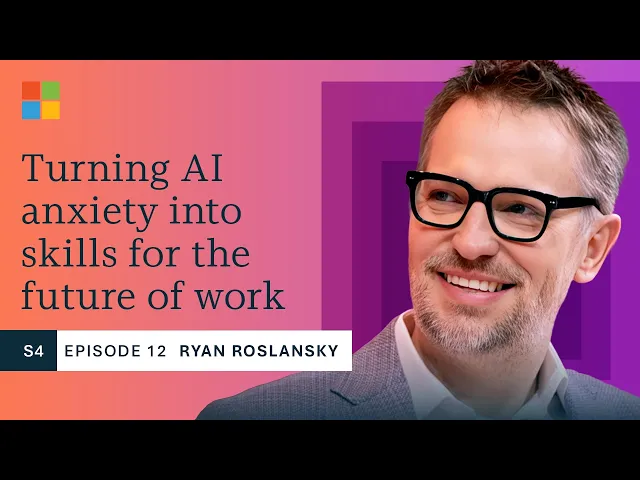
Ryan Roslansky: Turning AI anxiety into skills for the future of work
Microsoft
0:00 It's an uncertain time right now in the world of work.
0:02 There's a lot of anxiety.
0:04 It feels like the old playbooks, you know, aren't relevant anymore.
0:08 Maybe the new playbooks haven't even been written yet.
0:10 And sometimes when you're mired in the technology, and especially with AI,
0:14 and you kind of draw out where you know,
0:16 where this could potentially going to go,
0:18 it leads you to, you know, some dark places and some uncertain places.
0:21 And Aneesh and I wanted to take this moment to write the book
0:25 not as a crystal ball of what's going to happen in the world,
0:28 but more, I think, as a framework to help people
0:31 start to think through how you can turn uncertainty into opportunity.
0:34 how you can turn uncertainty into opportunity.
0:35 The future isn't written on this.
0:37 It's in our hands.
0:39 That's Ryan Roslanksy, CEO of LinkedIn and a Microsoft executive vice president.
0:44 Ryan leads the LinkedIn platform that connects
0:46 more than a billion professionals worldwide.
0:49 Ryan and his colleague, Aneesh Raman, have written a new book.
0:52 It's called “Open to Work.” A practical guide
0:55 to navigating your career in the age of AI.
0:58 We talk about AI’s potential impact on all our jobs and careers.
1:02 It's both a challenge and an opportunity.
1:05 After all, the human brain predates the Industrial Age by millennia,
1:09 and human beings have shown an extraordinary
1:11 ability to adapt to each technological advance.
1:15 But to make the most of this opportunity, we each need to combine a sense
1:18 of where technology is going with practical advice.
1:21 And Ryan has a lot of good practical advice to share.
1:25 Including how to think about your current job not as a title,
1:29 but a collection of tasks, and then use this understanding to build
1:34 on your strengths and add to your skills.
1:36 The future may be a lot more promising than you think, if we get this right.
1:41 My conversation with Ryan Roslansky, up next on Tools and Weapons.
1:48 Ryan, it's great to sit down.
1:50 I have been looking forward to this conversation for a long time.
1:53 Because you and your colleague, Aneesh Raman at LinkedIn,
1:57 have been working on a book that has now reached the shelf.
2:02 “Open to Work– How to Get Ahead in the Age of AI.” I love the title,
2:07 because a lot of times people are asking hard questions like,
2:12 “Is there a way for me to get ahead?” “Will I be left behind?” You and Aneesh
2:17 offer so many insights about where the world
2:19 and where the world of AI are going.
2:21 Thanks for having me, Brad.
2:22 Thank you for, you know, the inspiration that you,
2:25 kind of gave to write- to write the book as well.
2:27 And so my colleague, Aneesh Raman and I, from LinkedIn,
2:32 had the idea basically to evolve what we've
2:35 been doing for decades on the LinkedIn platform.
2:38 A platform that exists to create economic
2:40 opportunity for every member of the global workforce.
2:42 And right now, there's a lot of uncertainty,
2:44 a lot of anxiety with the world of work through AI.
2:47 And while this is by no means a crystal ball to what the future of work holds,
2:53 it is a starting point to start a discussion,
2:56 and to start giving people a framework for how
2:58 they can think through what's happening around them right now.
3:01 How they can, you know, connect some of the dots that, you know,
3:04 maybe creating some of the anxiety or the uncertainty,
3:07 and hopefully then turn that uncertainty into opportunity.
3:11 And, you know, I think one of the most important things that I've
3:14 thought about in writing this book and talking to people about it,
3:17 is the future isn't written on this.
3:20 It's in our hands as workers,
3:22 as employees, as companies, as economies, as societies,
3:26 to, to figure this out together, to find the opportunity,
3:31 and to create a better, world of work moving forward.
3:33 So, it's exciting to get this book out there
3:37 and I look forward to talk to you about it.
3:38 Well, I mean, one of the things I think your comments reflect is you,
3:43 or you and Aneesh, really have in many ways,
3:46 some unique perspectives, I will say uniquely broad perspectives,
3:50 because of all of the data that you get from LinkedIn,
3:55 from the LinkedIn Economic Graph, and not just the data about where the world
3:59 is and where the world of work is today,
4:02 but I think the perspective gained over time.
4:04 Because, as you say, for two decades,
4:06 the world has been changing, jobs have been changing.
4:09 You all have been seeing those changes.
4:12 So now, as you put it, we look ahead.
4:16 Let me start with where you started in the book, the introduction.
4:22 And I think you've already alluded to a little bit of this, but I even love
4:25 the title “Failure is Not an Option.” And what
4:30 you start with is really the Apollo 13 story.
4:34 Many people know it,
4:35 either having read about it or watched the movie and other things.
4:40 This extraordinary story of human ingenuity,
4:43 people doing things that I don't think they thought were necessarily possible,
4:47 having to do them in a few days to keep three astronauts alive.
4:52 And it really was about human ingenuity.
4:55 Why did you choose that as the story with which to begin?
4:59 Yeah, it's a great question.
5:00 As you said, I mean, it's this beautiful day in 1970.
5:04 You have a set of astronauts that are taking the fifth trip to the moon.
5:07 Things are going well, and out of nowhere,
5:11 you know, in a quick stir of the oxygen tank,
5:14 “Boom!” And the astronauts start to realize that they are spewing oxygen
5:18 out into space and send that now famous message back to Mission Control,
5:23 “Houston, we have a problem.” And, you know,
5:25 it was the the flight director, Gene Kranz, who sat there in Mission Control,
5:30 started to understand what was going on, and came
5:33 to the conclusion that “Everyone, stay calm.
5:36 And let's remember failure is not an option.” And I
5:40 think it just resonates so well at this moment in time,
5:43 which is that when you're hit with this uncertainty,
5:45 we have to come together to figure this out,
5:47 to use human ingenuity to think creatively
5:51 is the right mental framework to be in.
5:54 This is a great example of, technology wasn't going to solve this problem.
5:59 This is a set of astronauts that had
6:01 to make do with what was literally, you know,
6:05 what would right now would look at like super
6:07 antiquated technology that exists on this, on this spacecraft.
6:11 You know, literally in certain cases, you know,
6:14 fit a square peg into a round hole and figure out a way to save themselves.
6:19 And, you know, it's a bunch of people working together, across different,
6:23 you know, departments and agencies, and in space and on the ground.
6:26 And they succeeded and they, you know, they, they brought it together.
6:30 They brought themselves home.
6:31 And it's just, it's just a great, in my view,
6:36 a great story for what happens when, you know,
6:39 you realize failure's not an option, you bring human ingenuity to the forefront,
6:43 and you're able to do great things.
6:54 One of the interesting threads that you pull on is
6:58 this notion that we don't know entirely where things are going,
7:02 but that doesn't mean it’s predetermined and that we don't have agency.
7:06 I have to admit, I love this because, to be honest,
7:10 I feel like it's sometimes missing in our industry.
7:14 In the world of technology people can be a futurist and make a lot
7:18 of predictions about what is going to happen in five or ten years.
7:23 I don't know that there's a lot of accountability or even review.
7:27 I will admit, a few weekends ago I was thinking
7:30 about this and I used the Researcher agent in Copilot,
7:34 and I put in a lot of the names that everybody would recognize.
7:37 And I asked for an assessment and a grade
7:41 of all of the, I'll just say, luminaries,
7:46 and how well they did with their predictions
7:48 about what would happen in defined periods of time.
7:52 And almost everybody got between 20 and 30%.
7:56 So, you know, nobody got a passing grade.
7:59 But rather than have people make fewer predictions,
8:03 people just keep making them.
8:05 But this is not what you guys do.
8:08 You and Aneesh.
8:09 In fact, what you say is,
8:11 “...we won't get a lot of these answers for some time, in some cases decades.
8:16 We don't need these answers, however, to know what to do right now.
8:21 The most important part of all
8:23 of this is that these answers are not predetermined.
8:27 Nothing about this moment is.
8:30 Where we go next comes down to one thing and one thing only:
8:34 the choices we make right now as individuals, organizations, economies,
8:40 societies...” You use that to frame the mission and what you
8:45 think the mission is for the two of you as authors,
8:47 really, in my view, the view of LinkedIn and Microsoft, about human innovation.
8:55 Can you say a little bit about how you think about human innovation?
8:59 What is it, and what is it that makes it most special?
9:02 What makes so many of the, you know, the greatest technology thinkers great is
9:07 this idea of what the future can become.
9:10 And sometimes when you're mired in the technology,
9:13 and especially with AI, and you kind of draw out where,
9:16 you know, where this could potentially go, it leads you to, you know,
9:20 some dark places and some uncertain places sometimes.
9:23 But oftentimes that that assumes that nothing else changes around it.
9:28 That if we were to all to stay
9:29 in one place and not change and let the technology,
9:32 you know, run wild, we could end up
9:34 in a place that seems uncertain or scary to us.
9:37 I don't believe in that.
9:38 I believe that, you know, that humans play such an integral role
9:43 in shaping where that technology should go, and understanding not only,
9:48 you know, what technology can bring to bear on the upside,
9:52 but how people can adapt and evolve with that along the way as well.
9:57 So much of what's exciting about AI, the AI that we use every day right now,
10:01 is its ability to take certain tasks that, you know,
10:03 have somehow felt mundane to us in the past, maybe we didn't want to do them,
10:06 and help us do them better, give us actually more agency.
10:10 But more importantly, I think we're all starting to realize that the set
10:13 of what we historically maybe called “soft skills”,
10:15 which didn't seem as important, these are really important, by the way.
10:18 You know, curiosity, courage, communication, compassion.
10:22 Wow.
10:22 These turn out to be some really,
10:24 really important skills to, you know, do your job well.
10:27 And the focus and emphasis on those, along with AI,
10:30 is what I think gives us the opportunity to dream big and paint
10:32 a much more positive picture that exists
10:35 with humans and technology together moving forward.
10:38 And as you say, you don't have to know every step.
10:43 No one knows every step they're going to need to take.
10:47 The most important thing is to take the first step.
10:49 That’s right.
10:50 You know, if you're early in your career, if you're later in your career,
10:54 if you're a parent wanting to think about what a career
10:58 for your son or daughter might mean in the future,
11:00 I think this book has very practical, helpful advice.
11:05 You have a title for a chapter, “Jobs Are Tasks,
11:09 Not Titles.” But you do put tasks into different buckets.
11:13 Can you say a little bit about the three buckets that you define?
11:16 It was maybe two and a half or three years ago when, you know,
11:20 you and I were first exposed as part of, you know,
11:23 this great company to some of the, groundbreaking AI moves.
11:28 And someone in a meeting said something like, “Well,
11:30 where does this all go?” And off the cuff, you turned and said, “You know what?
11:34 Everybody's job is a set of tasks.
11:36 And we need to look at it like that.
11:38 And if your job is just a set of tasks that can be automated,
11:41 you may need to start looking for a new job.” And I mean,
11:44 I remember writing that down really quickly when you said it,
11:47 Brad, because- I have no recollection.
11:49 That's what I assume.
11:51 I'm glad you took notes.
11:52 But it's a really important framing.
11:54 And it does start to give people something practical to think about,
11:56 which is that, historically, we've talked about what we do as a title.
12:00 “I'm a product manager.” “I'm a marketer.” “I'm a salesperson.”
12:04 And it's a great shorthand to basically bundle up what, at the end of the day,
12:08 is a set of tasks to be done and how you communicate what you do.
12:11 It's important for us to actually think about our jobs not as a title,
12:15 but as that set of tasks, because the more that you think about it like
12:19 that, the more you can start to realize that, “Wow,
12:21 there are certain tasks that AI can do really well, and that's a great thing.
12:27 But if my job is only a set of those tasks,
12:30 I need to start thinking about what that means
12:31 for me.” We bucket those tasks into three buckets.
12:34 One, tasks that we, you know, feel pretty,
12:37 pretty good that AI is going to automate those and can do a great job with them.
12:42 You know, “Summarize this document.” “Translate this piece of text.” You know,
12:47 AI is going to be great at that.
12:49 The second bucket are those tasks that we feel like
12:52 can really help augment what you do as a human being.
12:57 So, you know, AI can't go all the way there,
12:59 but they can really give you a superpower as you realize how to use them.
13:04 The last set of tasks, the third bucket,
13:07 are those things that are, so innately human or messy sometimes,
13:12 that we don't believe that AI is going to be able to do those.
13:16 When you're in a meeting and people aren't agreeing
13:18 on something and you have to get them to agree.
13:21 Or people who are on different pages about the direction to go
13:23 when you got to bring people together talk about a strategy.
13:26 The ability to really communicate and galvanize
13:29 a group of people around going a certain direction.
13:31 We bucket those into those tasks and then it's a really easy exercise,
13:35 you can start to think about in your job.
13:36 “My goodness, like what do I do on a daily basis?
13:39 And you know, if I really boil that down,
13:41 what percentage of my job fixing fits into each of these buckets?” Again,
13:45 it's not a crystal ball.
13:47 It's not the answer,
13:48 but it's a way to start thinking about “Am I in a role right now that I
13:52 need to be thinking about making a quick change?”
13:54 Or, “Am I in a role right now where,
13:56 wow, I feel really, insulated into the future?” Or, “Am I in a role where,
14:02 you know what, like most people are,
14:04 some of my tasks are in this bucket one, some of them are bucket two,
14:07 some of them are bucket three,
14:07 and how can I be great at all of these?” But I mean,
14:21 when you think about, you know, say,
14:23 just that dividing line between what you rely on AI
14:27 to do versus what you're now using AI to do, but you're doing it with AI.
14:32 How do you find that changing your own work?
14:35 One of the greatest things that I found so far with AI is,
14:40 having Copilot built directly into Outlook,
14:43 and my ability to get this long email where people are debating something,
14:47 and just say, “Hey, can you explain this to me really quick?
14:49 Like, what's going on or what do I need to do?”
14:51 And there's so much nuance in a lot of these discussions,
14:54 and there's so much decisions that I have to make
14:59 before I can make a decision or reply to email.
15:01 But I can save a good ten to 15 minutes
15:04 on a topic when I can just come up to speed really quickly.
15:07 So, I love that.
15:08 And then the second thing that I've started to do quite frequently,
15:11 I'll be in a situation where I have
15:14 to send an important email to you or to Satya, and, and I'll ask Copilot, “Hey,
15:20 how can I make this better?” Or, “What am
15:22 I missing here?” I'm not asking to make a decision.
15:25 I'm asking it to challenge me or help me as a thought partner
15:28 to make a better end product that I'm trying to make a point on.
15:32 You know, a lot of these that I'm talking about, these are bucket two tasks.
15:35 You feel like you have this superpower all
15:37 of a sudden to kind of do more, with AI.
15:40 But it doesn't just happen and it does- You can't just, you know,
15:44 assume that you're going to type something into some random AI
15:46 and it's going to be there for you and help you.
15:48 There's a lot of work and effort that goes
15:51 into this in helping it become that thought partner for you.
15:54 And, you know, your reference to curiosity.
15:56 I mean, I felt for so long that that actually
16:00 is the fundamental fuel for growth, for learning.
16:05 But it is a bit of a craft and a bit of an art, even to learn how to use AI.
16:13 And in your work, how are you
16:16 seeing the development of that capability, that skill?
16:20 I think everyone has their own, you know, approach to working with these tools.
16:25 And I actually think that's a great thing,
16:27 because to be building this thought partner with you,
16:29 it has to become so personalized to you
16:31 and who you are and how you work and think.
16:33 The LinkedIn feed these days is flooded with people who are so excited to share
16:40 what they are doing or learning with the various AI products that they're using.
16:45 It’s symbolic of a couple of things.
16:47 Number one, people are trying a lot of different things in their flow of work.
16:53 Right.
16:54 And not all of them hit.
16:56 But when they do, when you're able to really
16:59 find like a bucket two task that makes sense,
17:03 you're so excited about it that you want to share it with the world.
17:07 You know, number two, the feedback that you see on these LinkedIn posts,
17:10 like, “Did you try this”, or, “Try it this way”, or, “Oh my goodness,
17:13 I'm going to go and try that.” It kind of goes back to this human idea of like,
17:17 we're all trying to figure this out together,
17:19 and this building of a community around these topics and how you're using it.
17:22 It's just really inspiring to watch people kind of motivating each
17:26 other on and kind of talking about it and doing it.
17:30 Anyboy who's been around computers for the last ten or 20 or longer years,
17:36 knows, hey, some people, they were like PowerPoint or Excel wizards.
17:40 They could do things, that most of us would go, “Wow, I wish I could do that.
17:44 I cannot.” And, it in part can be people get some formal courses,
17:51 it can be online, it can be in some other format.
17:54 It might be watching a video,
17:56 might be LinkedIn learning, or it might just be practice.
18:00 Yeah.
18:01 The same thing is happening here.
18:03 Even just being inside, you know, a team.
18:07 The comparisons, people say, “Wait,
18:09 how did you get it to do that?” It often- “How did you prompt it?” “How did
18:15 you use it?” You think of writing as something
18:19 that you would either do yourself or rely on.
18:22 Maybe you take a shortcut and, you know, you let your Copilot or some other,
18:28 you know, chatbot write for you, and it does a good job.
18:31 But wow, I have been so struck when people really just work with it— Yeah.
18:37 —and they keep using it.
18:39 And, one of my colleagues has a habit when she gets something,
18:43 she doesn't like, she says, “That's terrible.
18:48 You got to do that again.” And it'll come back and say, “Yeah, you're right.
18:53 It's terrible.” Takes feedback better than maybe
18:56 the some of the humans we work with.
18:59 But it it is a skill.
19:01 Yeah.
19:01 And it is a skill, in part, honed through practice.
19:04 We talk a lot in the book about this importance of a mindset
19:08 shift of really adapting AI in your workflow or pushing yourself to adapt it.
19:15 For the future of your career it's really important to be trying these tools,
19:23 and learning these tools as you would with any other skill.
19:26 We live in this technology world, and it seems like, you know,
19:29 according to you and I, everyone in the world is using AI all day long.
19:32 That's not true.
19:32 To really kind of push yourself to learn about it, read about it, try it out.
19:36 I think that's an important mindset shift that folks need to be making.
19:40 You have this notion, bucket three.
19:42 You know, the tasks that are uniquely human.
19:46 And that hence AI won't do or can't do.
19:50 For a huge number of jobs,
19:52 there are significant parts of it that are uniquely human.
19:56 If you just, you know, think about what it means to work in sales.
20:01 You know, every company that has a product has people who are in sales.
20:08 You know, to be a lawyer.
20:10 And so often success turns on relationships that build trust.
20:17 So much of the work that matters actually involves investments of time,
20:23 of building relationships, of understanding other people.
20:28 And the more people can move tasks from bucket one to bucket two,
20:33 and then free up some more time for bucket three,
20:36 which I think is frankly where we're often the most time constrained,
20:39 people are so busy, they just think, “Wow,
20:42 I think I could be a better manager of my team if I just had
20:46 some more time to ask the people I work with, you know, how are they doing?
20:52 What's up with their kids and their family?”
20:54 And that is actually an important part of what it means,
20:58 I think, to be successful.
20:59 So, I think it's just a different way
21:01 that you offer of reimagining a world of work
21:06 that can be more meaningful if people figure out how to use AI the right way.
21:12 These skills, they're important,
21:13 but they've historically been talked about as soft
21:16 skills and almost like put to the side.
21:17 Like, “Those don't matter as much.” We've always
21:21 kind of known they really matter, quite frankly.
21:23 Like, having strong EQ in your job is
21:25 is a really important thing for for many people.
21:28 The fact that, you know,
21:29 so many of these hard skills feel like they have the ability to be automated,
21:32 that now all of a sudden it's kind of, shining
21:34 the light on the true importance of some of these soft skills.
21:37 If you think about, I mean, you know,
21:40 If you think about your your day today or my day today.
21:43 My goodness.
21:43 Like the number of the number of times I've had to use,
21:46 you know, some uniquely human skill around,
21:48 you know, compassion or, you know, EQ,
21:52 or conflict mediation I mean, these are- That's what these jobs are.
21:55 And to think that those aren't important, I think makes no sense.
22:00 But to think that, wow,
22:02 what will happen in a in a professional world where people are actually
22:05 much better at these skills and have really honed in their craft on it?
22:09 I think that it makes things a lot better.
22:11 Most people in some way have jobs where at some point
22:16 in time you need people to bet on you, to trust you.
22:20 And that usually comes with time well spent
22:23 in investing in those relationships that make the difference.
22:27 I also think this connects- You go from jobs to careers.
22:30 And you have this phrase that really “a career is
22:34 not a ladder,” maybe the way we’ve often thought about it,
22:36 “but a climbing wall.” Can you say a little bit more about that?
22:39 The most requested feature by far that I've
22:42 seen in my time at LinkedIn is you know,
22:45 people say, “Hey, Ryan, LinkedIn has all this data.
22:47 Can you can you just use that data to show us exactly
22:50 what career paths are supposed to be or what they look like?
22:53 If I want to become a CFO, what am I supposed to do?
22:56 Or I want to, you know, be a marketer,
22:58 where should I go to school now?” And the truth is,
23:00 you look at the data and there is no such thing as a linear career path.
23:04 You have to realize that you need to take your career into your own hands.
23:07 We're moving from, you know, just this idea of roles into specific tasks,
23:13 and the importance of those tasks.
23:14 All of a sudden, you know,
23:15 this kind of linear thinking of a, of a career or hierarchy
23:19 inside of a company starts to look a little bit different.
23:22 And you need to be thinking about your career less about,
23:24 “I need to be climbing this ladder,
23:26 or getting this new title or promotion”, and more about,
23:30 you know, “What adjacent skills or tasks can I be picking up?
23:33 What did I think I couldn't do that now, if I really embrace AI,
23:37 I can actually do more of that?” It's a reframing on what,
23:41 you know, we've historically thought it meant to be in a career,
23:45 or what a career was made of.
23:46 We’re seeing phenomenal, you know, employees at LinkedIn, or Microsoft,
23:52 or many companies who historically may have thought that their, you know,
23:57 path to success was, “I'm a great IC and now I'm supposed to become a manager.
24:01 Like, that's what I'm supposed to do.” Yeah.
24:03 But now it's like, “Wow.
24:05 As an IC, I can, you know, leverage some of these AI tools, get a lot more done,
24:10 be more fulfilled in my life, and that's what's rewarded now.
24:14 That's what seems exciting, my ability to help my company in greater ways.”
24:18 These hierarchies are so embedded in the human psyche.
24:20 And I don't think these get changed overnight.
24:22 But, I am starting to see that trend.
24:25 I think it's important to think about, you know,
24:26 “I'm not just trying to be the next, you know,
24:29 seniority or level, but I'm trying to expand my skill
24:31 set.” That's going to be the path to success moving forward.
24:41 As you get to this part of the book,
24:43 you're basically encouraging people to think about three questions as they
24:48 think about their their own careers and where they want to go.
24:52 The first one is, Why do you work?
24:56 The why.
24:56 Say a little bit about that question and why you make that the first question?
25:00 I don't want to discount that the answer to many
25:02 people to that question is “I need I need to live,
25:05 I need money to live.” And I think that that's fair, but, and really important.
25:09 But I think it's a great place to start, which is inside of myself.
25:12 Like, “Why am I doing this?
25:14 What do I care about?
25:15 What is going to make me get out of bed every day?
25:18 What is motivating me?” And I think that then
25:21 helps you make the next decisions and what,
25:23 you know, you should be trying to do or learn in your career.
25:25 But it also connects with then your second question, which I think is even more,
25:30 perhaps beneficial for people as they're
25:32 really trying to to think about themselves, which is what do you uniquely do?
25:37 How do you think about that question?
25:39 If I want to have a fulfilling career, if I want to be able to, you know,
25:43 leverage those skills and tasks that I know how to do,
25:46 in a world where, you know,
25:48 some of these bucket one tasks may become more commoditized, like,
25:51 “What is it unique about me that helps me
25:53 stand out in this field?” What are those, you know,
25:56 human skills that you uniquely bring?
25:58 What are those other skills and tasks that you uniquely know how to do,
26:01 you know, with or without AI tools?
26:03 To paint a picture that's more at a task-based level than on a role-based level.
26:07 And again, I think it's just more of this mentality shift from roles to tasks.
26:12 And then you go to the third question,
26:14 “Where do you want to go?” How do you and Aneesh think
26:18 about that question and how people best think about it for themselves?
26:22 I think the good thing is that if you're able to answer one and two, you know,
26:25 it starts to give you a pretty good ability to feel
26:28 like you have agency over what number three looks like.
26:32 Again, to so many people, you know, careers and jobs, it feels like a black box,
26:39 you know, that “Someone else is taking, you know, care of this for me.
26:42 I get on some path and it.
26:44 And again, I might.
26:45 That's how it's supposed to work.” In reality, no,
26:48 no, you have to take it into your own hands.
26:50 You have to take that agency of what you
26:52 want to become into your own hands by again,
26:54 going back to “Why am I doing this?” You know,
26:56 “What is unique to me?” And then with those two
26:58 questions I think you're really able to answer,
27:00 you know, a variety of ways that you can go with your career that match
27:03 those two things that will then end up
27:04 with something that's fulfilling and unique to you.
27:07 So many people end up in jobs that, you know, are not what they meant to be.
27:10 They're not what they meant to be doing.
27:11 They don't enjoy doing that.
27:13 And I think if you can really foundationally,
27:16 end up principally with those first two questions,
27:18 it will lead to a much more fulfilling career,
27:20 especially in a time where it feels like, you know,
27:22 there's so much uncertainty and you don't have control of it.
27:24 You do have control of it, but you have to put in the time and the effort,
27:27 and the work, to really ground yourself in those principles
27:29 and those questions to know which way to go.
27:31 There's also this really terrific, logical flow in your book.
27:37 “Understand the impact of the technology.” The part we've just talked
27:41 about sort of that comes after that is actually the “Know yourself.
27:44 What's uniquely your strength?” Then it goes to a third part,
27:50 which is putting it in the context of the world as a whole,
27:53 where economies are going.
27:55 Which I think is helpful as well.
27:58 And you entitle the chapter, “Economies Need Innovation From All for All.”
28:04 What do you and Aneesh mean by that?
28:07 I think if you start with the mindset that, you know,
28:10 there is a very positive future of the world of work,
28:15 and you think about what some of these AI
28:18 tools can go and do and unleash for the world.
28:22 There’s some really positive outcomes to all of this.
28:27 I have a 20-year-old daughter who, you know,
28:29 for much of her life has been really focused on, you know,
28:33 “Dad, how can I make an impact on climate change?
28:36 It feels like there's nothing that can be done here.” Now,
28:40 the conversations we have are more like, “Oh,
28:42 you know, these tools are going to be so powerful
28:45 that some of these really important questions in the world,
28:48 like climate change, and health care, and poverty,
28:51 we may be able to find step change breakthroughs in solving
28:55 some of these problems.” When you look at it through that lens,
28:58 all of a sudden it becomes so inspiring what can happen.
29:02 And then you take the logical steps back to say, “Okay, well,
29:06 what needs to happen to get there?” It requires, you know,
29:11 these strong partnerships between the public sector, the private sector,
29:16 the infrastructure that needs to exist in the world
29:19 to allow some of this prosperity to flourish, the skilling that needs to exist,
29:24 to help people learn what they can do with these tools.
29:27 There's so much at the foundational level of work that needs
29:31 to be done that can't just be done by, you know,
29:34 individuals or companies, it needs to be done by, you know,
29:36 kind of, schools and governments and everyone involved.
29:39 But when you when you put yourself in that mindset,
29:41 wow, how exciting can this be?
29:43 That almost brings us back to where we began,
29:47 talking about an outlook on the future.
29:50 And this– Should we be optimistic?
29:54 Should we be pessimistic?
29:55 Should we be excited?
29:57 Should we be anxious?
29:59 The first thing I would note is, even if AI may automate or make it possible
30:06 to automate many of the tasks in your work,
30:10 what you do is more than just the sum of the tasks.
30:13 We at Microsoft see so much about how great AI tools are automating coding.
30:21 The job of a software engineer is not going away, but it is changing.
30:27 The data that we have right now on LinkedIn.
30:30 We're seeing an increase in the number
30:32 of software engineer postings that are happening right now.
30:36 And it feels like that should be ironic, but it's not necessarily, at all.
30:39 Exactly.
30:40 Exactly when you think about the power that comes through the creation,
30:44 you know, through software engineering.
30:46 Now, that ability that can be in more
30:47 people's hands is actually really, really exciting.
30:49 But to your point, the job is changing.
30:51 Take the job of a product manager, where you know,
30:54 historically what you used to spend a lot of your time on was,
30:57 you know, number one, talking to customers to understand the problem.
31:00 Most important.
31:01 Number two, writing a bunch of, you know,
31:04 specs to hand over to engineers about how the product should look,
31:08 how the features should come together, how we’re going to measure success,
31:12 etc., and then help manage the kind of project to be done.
31:16 Directionally, that job is still the same today,
31:18 except that second step is different.
31:20 You're still out talking to a lot of customers,
31:23 but the next thing you're doing is actually
31:25 you're writing a bunch of evals for the model.
31:28 It's not an antiquated product- Explain what
31:30 an eval is for people who are not familiar.
31:31 For most people it's, you know, the idea that a customer has this need.
31:37 We have to help our product,
31:39 which is an AI-enabled model-driven product to fulfill that customer need.
31:45 So, I need to help teach the AI through what we call evals.
31:49 So, a scenario, the product needs to do
31:51 this, and the AI needs to respond like this.
31:54 I need to teach it how to do that in order to fulfill that customer need.
31:58 A product manager's job is still talking to a customer.
32:01 It's still writing something that looks like a spec.
32:03 The spec now is just a set of like,
32:06 “If this scenario, here's a good or bad response.” “If this scenario,
32:10 here's a good or bad response,” and helping to train
32:12 the model to help the customer do their job, still working in the process.
32:16 So, it's not like the job is going away, but it is changing.
32:19 And the product managers who are, you know,
32:21 really succeeding in their careers right now are the ones that are embracing,
32:25 you know, that AI eval loop and really understanding it,
32:28 how it works, and in the flow.
32:29 So, I think everone’s job is changing.
32:32 In fact, it's not a new thing.
32:34 If you look over the past eight years alone on LinkedIn,
32:37 you take the average role.
32:38 This is not even an AI-related comment.
32:41 The skills required to do that job over
32:43 the past eight years have changed by 25%.
32:47 And we expect that by 2030, they will change by 70%.
32:51 So, even if you're not changing your job, your job is changing on you.
32:55 And quite frankly, that's always been the case through history.
32:58 It may just be accelerated now in the AI age.
33:03 The other point that you make in the book is that there's
33:07 probably more premium and opportunity in the future for cross-disciplinary work.
33:13 The ability to combine that, you know, what might be a specialist,
33:19 but with also, the ability to think across specialties.
33:22 Do you see that actually becoming one of the soft skills that's more necessary,
33:28 or in-demand, or valuable because of AI?
33:31 I think a couple things there.
33:33 You know, first, and we've we've tried this inside
33:35 of the LinkedIn company over the past year,
33:37 and it's been really exciting to see.
33:40 Historically, we have siloed roles in the software production process.
33:45 You know, I talked about one just a second ago of a product manager.
33:48 But in that process that you also have a product marketer, a designer,
33:52 a front-end engineer, to create, you know, part of the LinkedIn product.
33:59 What we've learned is that when you enable
34:03 people to use some of these great AI tools,
34:09 oftentimes people are able to do many more
34:11 of those tasks that are required in those siloed roles.
34:14 So we tried something recently.
34:17 We created a role at LinkedIn, which is called a builder.
34:21 And historically, you'd think of it as those four roles.
34:25 And now it's just this one role with a great set of AI
34:29 tools that enable you to build a product from start to finish,
34:33 leveraging a lot of the insight typically held siloed in those roles.
34:37 When roles are siloed, it requires a communication path,
34:41 and that takes time to do and build.
34:44 When you can enable a single builder with the ability
34:46 to do this, they can do things much more frequently.
34:49 For a company like LinkedIn, like the speed and the quality of the decisions
34:54 to make and get a product out there, are really all that matters.
34:57 We try a lot of things and we test it and we pull a lot of things back.
35:00 So, enabling this new class of builders to go and build
35:03 more things and test more things helps our company to thrive.
35:08 Quite frankly, doesn't mean anyone's role is going away.
35:10 We're making more builders.
35:12 And we've created a new program at LinkedIn for associate builders.
35:15 People who are just, you know, maybe coming out of college,
35:18 maybe not even going to college at all,
35:20 but are proficient in building things and understanding these tools
35:22 as a new way of entry-level work to come into our company.
35:25 Because it's so valuable for what we need right now at LinkedIn.
35:29 I think we'll see a lot of roles start to change like that as well.
35:32 Again, not something going away,
35:34 but adapting the way that work is done to help a company succeed.
35:38 Well, one of the things I love about that, and even
35:41 though you say a job is not a title,
35:43 and as somebody who didn't major in computer science,
35:47 if I could choose between being a coder and a builder,
35:51 I think it's pretty cool to be a builder.
35:53 Builder sounds great.
35:54 Yeah.
35:54 So, let’s conclude with what I think is maybe the, I'll
36:01 call it the emerging great debate in the tech sector.
36:05 I might even argue the emerging great debate for this century as a whole.
36:11 What are we trying to do?
36:13 Are we trying to use AI to outperform people?
36:18 Or are we trying to use AI to help
36:22 people develop the capacity to do more in work,
36:26 with their lives, in short, help people perform at a higher level?
36:31 I actually think there's a bit of a schism in the tech sector.
36:37 If you just look at what people have as their mission,
36:40 or just their great quest.
36:43 There are some who say, “No, we are in search of AGI.” What is AGI?
36:47 Well, there are differing definitions, but they say, “It is the ability,
36:51 to have some autonomous system that can outperform humans at, say,
36:57 most economically valuable work.” Or you have our mission,
37:02 which is basically to create technology that empowers people to do more,
37:07 to achieve more, or to be more that they want to be.
37:11 Those are two very different visions
37:15 of what different companies are trying to accomplish.
37:20 I still remember when LinkedIn and Microsoft came together,
37:23 and part of the conversation was Satya Nadella and Jeff Weiner,
37:28 realizing that the two companies had very similar mission statements.
37:33 So, as we look at the future.
37:34 You know, you uniquely, you've you've had this experience at LinkedIn,
37:38 you've been part of Microsoft, you look to the future.
37:41 What do you hope we will do with AI for people in the world?
37:47 One of the most important reasons that Aneesh and I felt like
37:50 we needed to write this book right now is to, more than anything,
37:54 start the discussion and help people to start understanding what's going on.
37:59 The reason that I work at LinkedIn, and the reason that I work at Microsoft
38:03 is because of the missions of these companies.
38:06 Like, LinkedIn is a platform for 1.3 billion
38:10 professionals around the world to find economic opportunity.
38:14 It has been that way for 20 years.
38:16 And, you know, through different economic changes through Covid,
38:20 we've been there as a platform to help
38:22 people navigate their careers through their community,
38:27 through how they learn new skills,
38:29 through how they, you know, adapt as human beings.
38:34 And I think now more than ever,
38:36 people need to be understanding and having these discussions again.
38:40 And it's not just unfortunately, up to, you know,
38:42 some tech companies or you and I, but it's governments,
38:45 it's economies, it's educational institutions to really paint
38:51 a positive future for what this can all mean.
38:55 AI is an enabler for us to do bigger and better things as a society.
39:04 We have to be thoughtful about the approach and how we get there.
39:08 Everyone has to have a framework so they, you know,
39:11 can deal with the uncertainty in the messy middle we're going through,
39:14 to how to navigate it right now.
39:16 But my goodness, if we are able and when we're able,
39:19 to navigate through it, to give humans these superpowers,
39:23 to enable and to do more than they ever thought possible,
39:26 I think we're going to end up in a pretty special place.
39:28 I know you share the same thought as well, and that's why you're here.
39:31 Every book is an argument.
39:34 Every book starts a conversation.
39:36 I think the book that you and Aneesh
39:38 have written really is about two conversations.
39:41 One is how can an individual or a parent coaching a kid,
39:48 or somebody who's 20 years into their career and looks ahead to another 20,
39:53 get some practical advice and think in some new and helpful ways?
39:58 In this changing time,
40:01 how can individuals use AI to be more successful in so many ways?
40:06 But there's a second argument you're making as well, that there is a path.
40:11 If we put our minds to it, we will decide the future as people.
40:16 Machines won't decide it, people will.
40:18 There is a path, where as a society,
40:21 we can use AI to fashion a broader and better future for lots of people.
40:27 And it's not about being replaced by machines,
40:29 it's by using this to achieve things that we couldn't otherwise contemplate.
40:35 I think you and Aneesh together have written
40:38 a book that creates the basis for these conversations.
40:43 I think it's the conversations that people want to have.
40:46 But more than that, I think it's the conversations that we need to have.
40:49 And I'll say it helps reinforce what all
40:53 of us who work here at Microsoft and LinkedIn.
40:56 This is why we joined these companies in the first place.
41:00 It’s why we’re still here today.
41:02 because we actually want to see technology do good for people.
41:07 And I think you show us how.
41:09 So thank you very much.
41:10 Thanks, Brad.
41:11 Appreciate it.