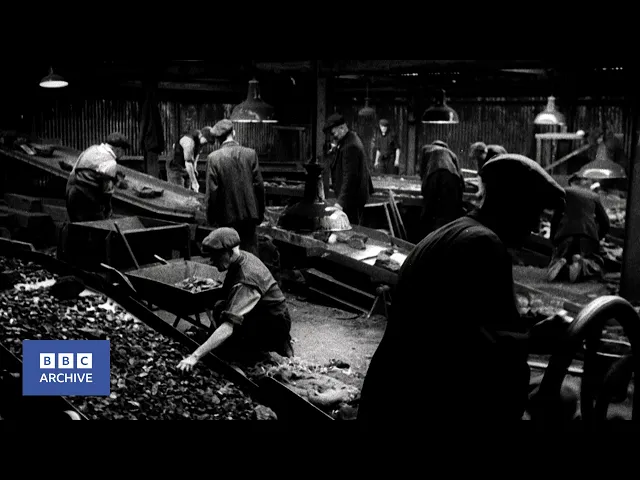
1956: The British Coal Industry | The Edge of Success | BBC Archive
BBC Archive
0:01 A chief cause of our industrial difficulties is often
0:04 said to be the bad example set by nationalized industries.
0:08 The members of our nationalized boards are
0:10 accused of being weak towards the unions,
0:13 of letting wage production rise without in increases in production,
0:17 and therefore of sending the price of everything up.
0:21 And to clinch that argument,
0:22 those who hold these views often end by saying, "Well,
0:26 just look at coal." All right, let's look at coal,
0:30 and as far as possible without political bias.
0:33 Are the miners letting this country down?
0:36 And are the millions that we're pouring
0:38 into the coal fields really bringing us a poor return?
0:44 Many of you may never have been to the coal fields.
0:47 They're not one of the most beautiful sights in this country.
0:50 These villages were built when the mines were first sunk,
0:53 and they remain much the same ever since,
0:55 as has much of the machinery in the mines themselves.
0:59 You can't really compare coal mining with other industry.
1:03 Men get coal day by day more than half a mile under the ground,
1:08 and sometimes more than 4 miles out under the sea,
1:11 in conditions which most of us wouldn't accept
1:14 otherwise than under the extreme pressure of war.
1:18 And because they work underground and work continuous shifts,
1:21 which gives them their leisure when most other people are at their business,
1:25 coal miners live a life apart.
1:28 Now, this is in a very narrow seam.
1:30 And in many collieries, exactly this is going on day by day at this moment.
1:35 And this man handling with the old tubs when the coal comes to surface likewise.
1:44 And partly because they live a life apart,
1:47 when the Great Depression hit this country in the 1920s,
1:51 coal miners were hit harder than most.
1:54 When the demand for coal fell off and collieries closed,
1:57 whole communities were out of work.
2:00 Now, thousands of people left the pits and the mines themselves fell into ruin.
2:06 But, fortunately for us, enough stayed on, literally scraping a living
2:10 from the slag heaps and from charity,
2:12 in the hope that the pits would one day reopen.
2:19 Well, they have reopened with a vengeance.
2:21 Today, the picture is exactly the opposite.
2:24 We haven't enough coal and we haven't enough coal miners.
2:27 And to meet the deficiency,
2:29 an immense program of modernization has been undertaken.
2:33 Wherever machines can do the work that men used to do,
2:36 they're being made to do it.
2:38 And for instance, these broad roadways in the mines are
2:42 being built so that instead of pit ponies and men hauling,
2:46 diesel engines and rail cars and conveyors can
2:49 carry the coal from the face to the shaft.
3:00 And here are some of the new machines.
3:09 Uh here is a a cutter in a narrow seam,
3:12 just about the size that man was cutting in you saw before.
3:21 A power loader.
3:36 You don't see many picks and shovels here.
3:43 Look at the contrast between the old and the new
3:45 in one particular pit at Rawdon in Leicestershire.
3:48 Now, here they've completely modernized the way that coal is brought up
3:51 from the bottom of the shaft to the surface and handled afterwards.
3:55 Now, here's the old method, and if you watch,
3:57 there's a great deal of man handling.
4:04 Now, those are the old tubs.
4:05 They're quite small, and a man to push them out of the shaft,
4:14 two men to put them into the tippler,
4:30 and then a great number of men to do the cleaning,
4:32 pick out the slag and the dirt from the coal by hand.
4:42 And here's the modern method.
4:43 The same shaft run from a control room.
4:47 Far bigger containers holding about double.
4:54 Automatically switched out of the shaft,
4:58 automatically unloaded or tipped onto conveyor belts,
5:03 which take the coal to the automatic cleaning plant,
5:06 where the dust and the slag is taken out.
5:09 And then the real coal is automatically weighed.
5:21 And of course, new pits are being sunk.
5:24 Now, this is not drilling for oil.
5:26 These drills are testing the value of the seams
5:30 of coal hundreds of feet below the ground in new areas.
5:34 No less than 14 new mines are being built in this country,
5:38 and the first of them will come into operation at the beginning of next year.
5:42 And when a new mine is first put into operation,
5:45 or when an old one is completely modernized,
5:48 it gives an entirely new look to the industry.
5:50 Modern coal fields look like plastic factories.
5:53 Now, I'm taking you to one of these later on, but first meet Mr.
5:56 Jim Bowman, himself a miner who might well
5:58 have been the chief of the miners' union,
6:00 but is in fact chairman of the National Coal Board.
6:02 I asked him how he was paying for all this reconstruction.
6:06 Well, by the end of 1965, internal financing should have produced about
6:12 2/3 of our total expenditure since 1950.
6:15 Well, when you say "from our own resources", you mean that you're going to pay
6:18 for a large part of this re-equipment yourselves.
6:21 Does that mean that we shall have to pay more for our coal?
6:25 Well, I'm not going to suggest that the price
6:27 of coal will remain as it is for always,
6:29 but you won't have to pay more for your coal because of our investment program.
6:35 You mean that you hope to increase efficiency so much
6:37 by mechanization that it won't automatically mean an increase in the price.
6:42 Yes, exactly.
6:43 You see, so far as our major
6:45 investment and our major development program is concerned,
6:50 most of our schemes are still in the pipeline.
6:55 Yeah.
6:53 It takes about 8 to 10 years to produce a new pit.
6:58 And out of 167 major projects, only 20 are actually in production today.
7:05 But I want to schedule, I mean,
7:06 you think that you'll get most of it done by '65?
7:09 Oh, yes.
7:10 We will we will we will do the job according to program.
7:12 But the projects come progressively into being.
7:17 And as they come into being, of course,
7:18 we produce a much higher output per man shift,
7:21 and there's a much higher standard of efficiency all round.
7:24 I think you've said publicly recently that all the increase in production
7:29 you're getting from mechanization is being
7:31 wiped out by an increase in absenteeism.
7:35 And I this has led a good many people to say
7:37 that all this money the country is spending on coal really isn't worthwhile,
7:41 it is going literally down the drain.
7:42 And do you think it's a thing that you're ever going to be able to cure?
7:46 It's a very difficult
7:47 mean I I'm meaning voluntary absenteeism, not absenteeism due to
7:50 Yes, I appreciate that.
7:52 Well, it's a very difficult thing because you
7:54 see here again it's so difficult to generalize.
7:56 I think we have a minority of our people who are not playing the game.
8:01 But taking the vast body of British mine workers,
8:04 they're working awfully hard and awfully well.
8:07 Uh six out of every seven work a full five days every week.
8:11 And we have about 200,000 to 250,000 who are working six days a week.
8:17 In other words, they're giving us a voluntary Saturday.
8:21 And you know, I I think it would be fair to say
8:23 that that's more than some people in more comfortable jobs are doing.
8:28 But I do admit that we have a minority
8:29 of our people uh who really must do better.
8:35 Now it's clear from what Mr.
8:36 Bowman said that getting coal isn't only a question of machinery.
8:40 And so I went to some collieries to talk to the men.
8:43 Now this is the West Riding Colliery,
8:45 100 years old, too old for complete modernization.
8:49 A colliery in which absenteeism is high
8:51 among the 1,200 men and production is low.
8:54 Mr.
8:54 Hopwood, how how often do you take a day off?
8:57 Very rare.
8:58 At all.
8:59 Don't bother.
9:01 Well, now some chaps on your shift must.
9:04 Why do you think the What do you think the main reason is?
9:07 Various reasons.
9:07 Some of them oversleeps.
9:10 Some of them don't intend coming.
9:12 I thought that they had alarms or somebody knocked them up or something.
9:14 Somebody knocks them up sometimes.
9:17 And sometimes they don't.
9:20 And what do you think the main reason is?
9:22 Well, I couldn't exactly tell you really.
9:24 I I don't know.
9:27 Some I don't think someone feels physically fit.
9:32 But Mr.
9:33 If they don't get a doctor's chit, they they lose all their
9:36 They lose their bonus.
9:37 Yeah.
9:37 Oh, yes, definitely.
9:38 Yes, of course they do.
9:39 They're bound to do.
9:41 I can't do no other.
9:43 But, um do you do you resent it when chaps on your shift don't turn up?
9:48 I mean, it makes a lot
9:49 Yes, it because we have to have somebody else.
9:52 And then you don't know the other chap, and it's not so easy to know.
9:54 but anyway, we don't know the other one sometimes.
9:56 Many a time we don't.
9:58 At all.
9:59 Well, now, when you read criticisms in the press
10:01 about this, what do you all feel?
10:02 I don't like it.
10:04 Definitely, I don't like it.
10:05 No.
10:06 I resent it all, that, because I don't like to see it.
10:09 But, you resent
10:10 it's unfair.
10:12 Most of it is unfair.
10:14 Because they don't understand the reason.
10:16 No, they don't.
10:17 And they don't They've never been down a pit.
10:19 Perhaps someone has only seen the pit doubles
10:20 as they've gone by in in the railway train.
10:23 Mr.
10:23 Handley, you were saying that the speed of the work is much faster now.
10:28 But, when you were tubbing, surely it was much harder work.
10:32 Well, now, yeah, you have a certain time to get it off in the coal.
10:35 You used to have coal that have a certain time.
10:38 Well, when you was tubbing,
10:39 if you hadn't time to fill another tub, you no need to bother.
10:42 But, now you can't leave the yard of coal on.
10:43 You must get it off.
10:44 So, therefore, you have to get it off in that certain 7 and 1/2 hours.
10:47 You have to go the speed of the machine.
10:48 You have to You have to keep going as long as the belt's going,
10:51 you have to keep shoveling on.
10:52 So, do you I mean, before you would take a breather,
10:54 and now it's just pretty well
10:55 Yes, you could take a breather before, but you was losing money.
10:57 If you didn't fill the tubs, you didn't get the money.
11:00 The more tubs you fill, the more money you get.
11:03 But, supposing you take a breather now,
11:04 the the van just doesn't have anything on it.
11:06 No.
11:06 No.
11:07 Well, do you lose money then or not?
11:08 No, you still have to get your stint off in the time.
11:11 Now, you're a married man.
11:12 Have you got any sons?
11:14 No.
11:14 Well, if you had a son, would you like him to go down the pit?
11:17 No.
11:17 But, any Do you find that most of your friends feel the same or not?
11:21 Yes, I think they do.
11:22 These what's working the pit.
11:24 I wouldn't come out of the pit myself.
11:26 But, I wouldn't let the lad of mine go in if I had one.
11:29 How many of Are men's sons coming down this pit or not?
11:32 I don't think so.
11:33 Don't think there's a lot.
11:34 There's more in the other trades out the pit.
11:36 Are you short of men in this pit?
11:39 No, not not particularly.
11:41 We have a certain number of men on the books
11:44 and provided those men turn up to work,
11:47 well of course there's no shortage of men.
11:49 When did you last take a day off yourself?
11:52 Uh about 3 months ago.
11:54 Well now, what do you think the most usual reason for a chap staying away is?
11:59 Well, men working hard.
12:02 Men having to stay over to get the stints off.
12:06 What do you mean by that?
12:07 Also Well, to complete the task.
12:10 Yes.
12:09 You have a certain amount of work to do.
12:14 Yeah.
12:13 And you have to do that certain amount of work
12:17 Yeah.
12:17 before somebody else can follow along with another cycle.
12:19 But now, if a chap stays away just on his own,
12:24 he'll lose not any one day, but he'll lose a day's pay and the the bonus shift.
12:29 a shift and his bonus.
12:30 That's yes.
12:30 So, it might make the difference of six or seven pounds a week to him.
12:33 Yes, possible.
12:35 Well now, how can a man afford to do that?
12:38 Well, he can't really afford,
12:39 but the point is this, if a man is tired and he's a bit off color
12:46 it is possibility that by having one day off he may save himself a week's play.
12:53 Now, do you resent it when chaps stay away?
12:56 Well, no, but if he is a absew absew absenteeism,
13:02 well of course there comes times when of course he
13:05 has to be replaced by a man that's that works regular.
13:09 Do you find that it's usually the same chaps
13:11 who stay away or is it lots of fellows?
13:14 Well, we have some that plays pretty regular,
13:17 but we have other chaps that naturally have to have a day off now and again.
13:21 Uh did you have the proposal put to you
13:23 here that you might have some Italians on the mine?
13:27 Yes.
13:27 What what did you of it?
13:28 Well, we didn't like the idea at all.
13:32 Why?
13:33 Well, we have plenty of foreigners here, Poles, Hungarians, and other Czechs,
13:38 and we didn't think the Italians would make good workmen for a start,
13:43 and we didn't think they'd go for harmony down the pit.
13:46 We thought we should have trouble with them, so we definitely turned them down.
13:51 But mightn't it be worth giving them a try?
13:52 They have a lot of them working down pits.
13:55 Right?
13:56 Well, we didn't think it'd be a success here.
13:58 We may upset our own lads by doing it.
14:01 Did you have a vote on it or or
14:03 Yes.
14:04 We had a vote at the branch meeting, and it was turned down unanimously.
14:08 But supposing in the mines as a whole, we go on being short of men,
14:13 do you think then people will change their view about that or not?
14:16 Well, if they was put on the face to the south, they'd probably be all right,
14:20 but uh to mix among our own people,
14:22 we didn't like the we didn't we wouldn't entertain it at all.
14:27 Now, one of the reasons for absenteeism,
14:29 which none of the men mentioned and which many may not
14:31 be conscious of, may be the surroundings in which they live.
14:35 When streets and houses are dilapidated and ugly,
14:38 wives don't ask for so many things.
14:40 Mrs.
14:40 Kirby is just beginning to.
14:43 Mrs.
14:43 Kirby, do you find life easier now than you did before the war?
14:47 Oh, yes, quite.
14:51 The money buys more than the money you had then, does it?
14:54 Oh, yes, it does.
14:56 Now, does that mean you've got everything in your house you want?
14:59 No, not everything.
15:01 What is there that you do want?
15:03 Well, I want the electric in now and the washer.
15:05 When's the electric coming in?
15:06 About November.
15:08 And then what will you get with it?
15:10 The washer first.
15:11 A washing machine?
15:12 First, yes.
15:13 So that you'll never have to do any more washing yourself.
15:15 No, I won't.
15:16 What what's the next thing you want?
15:18 Well, I'd like a Hoover.
15:21 Yes.
15:21 And then my husband would like a television.
15:23 So, by this time next year you might have all three.
15:26 What about an iron?
15:26 Don't you want an iron?
15:27 Oh, I got the iron.
15:28 You've got the iron?
15:29 Yes, I've got the iron.
15:30 What, without electricity?
15:31 Yes, I've got it in stock.
15:34 Well, um if your husband wasn't earning good money,
15:37 this would be difficult, wouldn't
15:38 Yes, it would.
15:40 What happens if he has to stay away?
15:43 Do you suddenly lose a lot in that week?
15:46 Well, I don't know.
15:47 It doesn't make any difference to me, you see.
15:50 I never know what he earns and I never ask.
15:53 He always gives me my wage.
15:54 He never tells me.
15:55 He just gives you enough to run the house.
15:57 Yes.
15:57 Yes.
15:58 Is that true with most people that their wives not know how much they earn?
16:01 Well, I think the biggest majority around
16:03 here don't know what the husbands earn.
16:06 That's very clever of the husbands.
16:07 I don't think I should be able to keep that secret.
16:10 West Riding Colliery is near Doncaster.
16:13 And a few miles away, still in Yorkshire,
16:16 is a modern colliery with a new housing estate belonging to the Coal Board.
16:20 And I think if you look at these children's
16:22 toys and the adults' toys and look at the gardens,
16:26 you'll feel that you might be in a seaside resort.
16:31 We tried to take this young mother without her noticing us,
16:33 but she saw us and ran away and we had to persuade her to come back again.
16:38 Now, in these houses most of the wives already have all the things that Mrs.
16:42 Kirby still wanted.
16:44 And behind each house you'll see a special
16:46 coal bunker for the miners' free coal,
16:49 which as the wives are quick to point out is much too small,
16:52 so that half the coal has to be left outside to the delight
16:55 of the children and the despair of most of the mothers.
16:58 Mrs.
16:58 Barton, when did you move into your new house?
17:01 A year, this April gone.
17:03 Well, and what sort of house were you living in before?
17:05 Oh, we lived in an old cottage, you know, just this back colliery.
17:09 It was really nice.
17:10 My husband made it nice, you know, but with no light and no water.
17:13 We had to go to the old well, you know,
17:15 and drop the bucket down and then turn the handle, you know.
17:18 It was hard work, you know.
17:20 Well, now some people as said that they don't see why miners should
17:24 have special houses and they want to wait their turn on the council list.
17:27 What do you think?
17:28 Oh, well, I think miners when the NCB build these houses they ask
17:32 for the miners and I think they want I mean they all got get baths,
17:36 you know, at the pit but I think you want the bath as well, you know.
17:40 You mean the bath in the house?
17:41 Oh, yes.
17:42 Your Is your husband earning good money?
17:44 Well, he I really don't know what he gets but my husband,
17:48 you see, is always he doesn't get a bad wage, you know, but he has to work all
17:51 the weekends he only has one Sunday off in three.
17:55 Really?
17:55 And when the other banksmen are away they have to do 12 hours, you know.
17:59 Does he ever stay away from work?
18:01 No, never.
18:02 Only he has his fortnight holiday and then they don't get another well,
18:06 the next fortnight the next yearly holidays unless he's poorly, you know.
18:11 They don't get any holidays at bank holiday
18:13 or Easter or Whitsuntide or anything like that.
18:16 Does your husband get free coal as well?
18:18 Yes.
18:18 Do you sell it?
18:19 No, we don't.
18:20 We never get much coal, you know, not to sell we never sell it.
18:24 We always have to keep his mother his mother's a widow, you know,
18:26 and she's 73 she lives alone in Kippax and we always see to her having coal.
18:32 When you hear about miners staying away from work,
18:35 what what are your feelings about that?
18:37 Well, I think if they are poorly I
18:38 don't see why they should stay away, you know.
18:40 I mean my husband never stays away and he never has done.
18:44 Do you know many who do?
18:45 No, I don't.
18:47 I don't think there are many around here you know,
18:49 they seem to be all good workers.
18:52 Mrs.
18:53 Bell, when your husband was working as a market gardener where did you live?
18:58 Uh when my mother lived in there.
19:00 In the same village?
19:01 Yes, Kippax.
19:02 I see you've got a radio and a radio and a television set.
19:05 Have you got a washing machine anything like that?
19:07 Yes.
19:07 You have?
19:09 Mhm.
19:08 What else do you want?
19:09 I I some pelmets for my curtains.
19:12 Ornaments for the garden?
19:14 Yeah.
19:13 What about um a Hoover?
19:15 Have you got a Hoover?
19:16 I've got a Hoover, yeah.
19:17 Electric iron?
19:19 Yeah.
19:19 You're pretty well equipped.
19:19 Is there anything else?
19:22 No, I've got a
19:23 Mrs.
19:23 Pardy, we hear a lot about absenteeism.
19:25 Does your husband stay away from work much?
19:27 No, he doesn't.
19:29 Why?
19:29 Would you not like him to?
19:30 Oh, no, I like him to go to work because I mean he's got
19:32 a job to do and he's asked to go and do it, hasn't he?
19:35 What do you feel when you read a lot of criticism about miners being absent?
19:41 Well, I think when they're absent like that, they're not interested in the work.
19:45 They've no interest in it.
19:46 Or otherwise, they'd go, I should think.
19:49 But you don't know many who stay away.
19:51 Well, I know a few, yes, but uh How do their wives manage because they must
19:55 Well, that's what I'd like to know because I couldn't.
19:57 I couldn't manage at all.
19:59 Do you know what your husband earns?
20:02 Yes.
20:02 For some miners, their wives tell me they never learn.
20:05 Oh, yes, I know.
20:06 He tips up on a Friday, but I never see the notes.
20:09 Of course, uh if I went to look for it,
20:10 I suppose I'd find it's there for me to see.
20:13 But uh I never bother because I know it's there and that's all that matters.
20:17 Now, have you got all the electric things that Mrs.
20:19 Bell has got?
20:21 Yes, I've got a washing machine, electric iron,
20:23 and vacuum, and all the usual modern things, you know.
20:27 If you didn't know it,
20:28 I doubt if you'd notice the colliery where these women's husbands work.
20:32 It stands by the roadside and looks like one
20:34 of those modern factories on a trading estate near London.
20:38 What strikes one most forcibly, I think,
20:40 is that there's no dust or dirt
20:42 and that the buildings are surrounded by flowers and lawns.
20:45 And there's no noise except for the distant whine of electric motors
20:49 and a regular clanging clanging which comes
20:51 from this building beside which we're walking.
20:54 And that's the noise of the tubs as they come out of the shaft.
20:57 And this colliery produces almost as much coal as West
21:00 Riding with half the number of men and less absenteeism.
21:04 It's called Ledston Luck.
21:06 Mr.
21:07 Gill, you're working on this power loading now.
21:10 Can you tell me what difference it actually makes to the job you do
21:14 compared with the job you used to do when you were working on a conveyor?
21:18 Well, there's a lot of difference.
21:19 I mean, all the work's cut out.
21:21 I mean, there shovel work have no shovel work to do.
21:26 And I mean, no physique.
21:28 You don't use half the strength on on the power
21:31 loading as you do on all the conveyor.
21:33 fact do you do most of the time?
21:35 All the double the main job is of course we cut the first
21:39 with a a cut a low cutting machine which takes a 7-ft advance.
21:45 Yeah.
21:44 Then we blow it and with a a big automatic shovel that shovels it all up.
21:47 We don't touch a shovel.
21:49 have Well, as I just said, mate, that
21:50 Do you have to touch a press a button when you want the shovel to work on the
21:52 No, it's just an ordinary little arm.
21:54 You just press it.
21:55 The shovel goes forward and you you stop it when
21:58 it's gone far enough and it loads all the loose coal.
22:00 And then when to bring it back you bring it just turn the other way.
22:04 Yes.
22:04 And how much a day on your shift would you be getting out?
22:08 Well, providing the keeper's going with job is earning £4 a day.
22:12 Comfortable.
22:13 So, you can earn up to £28 a week at the Yes, yes.
22:17 Very easy.
22:17 Well, now do you think that with all this modern machinery
22:21 you'll find it easier to get young men coming into the industry?
22:24 Oh, definitely.
22:24 Yes.
22:25 Yes.
22:25 I mean, you don't want the same physique for power loading.
22:28 I mean, the hard slogging you you just I mean, the power does all the work.
22:31 The machine does all the work.
22:33 Mr.
22:33 Bell, you used to work in the pit before
22:35 there was any of this power machinery at all.
22:37 Yes, yes.
22:38 Well, now how does a day's work really compare?
22:43 Well, I think I can get in was a lot out of them what it is today.
22:46 Also, the money wasn't as good.
22:47 Of course, times have altered since you see.
22:50 We've had rises and Now, have you got any sons?
22:53 Yes, still.
22:54 Uh how old are they?
22:56 One's seven and one's eight.
22:58 Do you hope they come into the pit or not?
23:00 Well, uh I'd rather leave it to them till they a bit older,
23:03 you see, and let them have a bit of choice, a bit of say in the matter,
23:07 otherwise might fall back on me when they do get old.
23:11 Mr.
23:11 Bell, when did you come into the pit?
23:13 Well, 4 years ago.
23:15 4 years ago.
23:16 What were you doing before then?
23:17 I was a market gardener.
23:19 Market gardener?
23:19 Yes, that's right.
23:21 Uh what did you earn in gardening?
23:23 Well, about £5 a week before I came here.
23:27 Very small wages, I thought.
23:29 And today?
23:30 Well, 15 or 16.
23:33 Do you like the work?
23:34 Yes, very much, yes.
23:36 Isn't it much harder work than gardening?
23:38 Yes, it's harder, but uh there's a difference in the wages, and it's very hard,
23:45 I thought, to manage on £5 when you're married and you've a youngster.
23:50 Don't you find it rather monotonous sometimes?
23:52 I mean, when you were a gardener, you had all sorts of different jobs to do.
23:56 Yes, that's true, but uh you seem to uh be your own boss,
24:02 sort of thing, you know, if you're doing your work, nobody bothers you.
24:06 I like that.
24:08 One of the other men, Mr.
24:09 Prince, came straight over job to talk to me.
24:15 Mr.
24:16 Prince, you're a development man, aren't you?
24:19 Yes.
24:18 Are you getting much absenteeism here?
24:20 No, I don't think we are, about 9%.
24:22 We do very, very well for absenteeism.
24:24 And of that 9%, not much of it would be voluntary absenteeism anyway, would it?
24:28 No, it isn't.
24:28 We do very well for absenteeism in this pit.
24:31 Now, you've been in the pit for 45 years.
24:34 What do you think of mining as a career today?
24:37 Well, to me, I I would say that it's nearly as good as any other industry,
24:42 because uh bringing pit head baths
24:44 in and other facilities that they're being given,
24:47 it's made it more convenient than what it would be.
24:49 Have you got any sons?
24:51 Yes, I've two, and they both came to this pit.
24:53 Did you want them to?
24:55 No, I didn't.
24:55 I got them just given them free hand and told them they
24:57 could do what they liked and they both came to the pit.
25:04 Now, with the miners and their wives,
25:05 I fastened chiefly on one problem, absenteeism.
25:09 Why miners stay away.
25:11 And I think we got the true answer.
25:13 The chief cause is simply that there are too many middle-aged miners.
25:16 And when you get middle-aged people carrying your toughest industry,
25:20 you're bound to get a lot of illness.
25:23 But in addition, there are about five men out
25:26 of every 100 who stay away without any good reason.
25:29 And they are condemned by the miners just as much as by anybody else.
25:33 But even here, I think we've got to keep a sense of proportion.
25:37 If a face worker, and it's at the face that absenteeism chiefly occurs,
25:41 stays away from a pit, they lose not merely one day's pay, but two.
25:48 And it may be it may mean as much as £7 a week.
25:53 Now, what about people in other industries?
25:55 And they're not confined to wage earners, who,
25:57 to quote a shipyard worker in the program last week,
26:00 come to work, take the money of their employer, and then lie back on the job.
26:06 They get paid for doing nothing.
26:09 And I leave it to you to judge which is worse.
26:12 There's only one answer to this question of absenteeism,
26:15 and it is further mechanization.
26:18 But is the Coal Board really mechanizing enough?
26:21 This was one of the further questions I wanted to ask Jim Bowman.
26:26 Well, now, when you at your present rate of increasing production,
26:31 are you going to be able to give us enough coal
26:34 at the all the coal the country wants at the end of 10 years?
26:37 Oh, no.
26:38 No, no.
26:39 Uh you see, our investment program is based upon our estimates
26:44 of the country's energy requirements over the next 10 or 20 years.
26:49 Yeah.
26:49 Believe me, we are going to require all
26:51 the coal that our plan is uh intended to produce.
26:58 Well, I mean No, let me put it this way.
27:01 Uh we estimate that we can expect Britain's energy
27:05 requirements to increase from the present 260 million 1955 Yeah.
27:12 to about 380 million by 1975.
27:16 Well, what you're really saying is that we uh on your present program,
27:19 we shan't have enough coal.
27:21 Have you really set your sights higher
27:23 than what you need to increase the target?
27:25 We set our sights as high as it's physically possible to set.
27:29 There's absolutely no ceiling so far as we are concerned uh for output.
27:34 But we've done We are doing everything that can physically
27:37 be done to get the coal that the country requires.
27:39 Well, that means we shall never export coal again.
27:44 Well, it could, but so much depends upon the position at home.
27:50 If we continue with full employment and a buoyant economy,
27:55 we can expect that the energy demands at home are
28:00 going to require all the coal that we can produce plus.
28:03 What about stoppages?
28:05 If you had fewer of them, you'd be able to put your output up, wouldn't you?
28:08 Oh, I quite agree.
28:09 We've got far too many unconstitutional stoppages in the coal field.
28:14 We've had more than 2,000 already this year.
28:18 And unfortunately, about three quarters
28:20 of them are concentrated in three divisions.
28:23 What do you think the cause is, really?
28:26 Well, it's awfully difficult because you see,
28:28 about half the pits in Britain have no stoppages at all in any given year.
28:35 Every coal field has the same kind of conciliation machinery.
28:39 It operates excellently and splendidly in some fields,
28:43 and apparently it doesn't in others.
28:45 So, it's rather difficult to say what are the causes.
28:49 Do all the stoppages occur where the miners have got communist leaders?
28:54 Well, I have no evidence which would entitle me to say
28:57 that I have more stoppages where I have a communist leader than elsewhere.
29:02 I have no evidence to justify that.
29:07 Now, let me try and answer at least one of my main questions.
29:11 Are the miners letting this country down?
29:15 As far as absenteeism is concerned, I would quite definitely say no.
29:19 The number of men who are away without reason is really very small.
29:24 But, as far as stoppages is concerned, it's quite another story.
29:27 We are losing millions of tons of coal each year through unofficial strikes.
29:33 Now, undoubtedly one of the causes is bad management.
29:36 It always is in these cases.
29:39 But, I believe there's another cause as well.
29:42 Jim Bowman said that he hadn't any evidence
29:44 to show that stoppages are connected with communist leadership.
29:48 But, the fact is that by far the largest
29:50 number of stoppages take place in Scotland and South Wales,
29:55 where a majority of the miners' leaders are communists,
29:58 and in Yorkshire, where communist influence is enormously on the increase.
30:02 Now, from what I've heard,
30:04 none of these disputes really warranted a strike at all.
30:08 And if the local officials had been thinking only of their men,
30:12 I don't believe the strikes would have taken place.
30:16 But, that's a subject we're going to hear more about in the next program.
30:20 Good night.