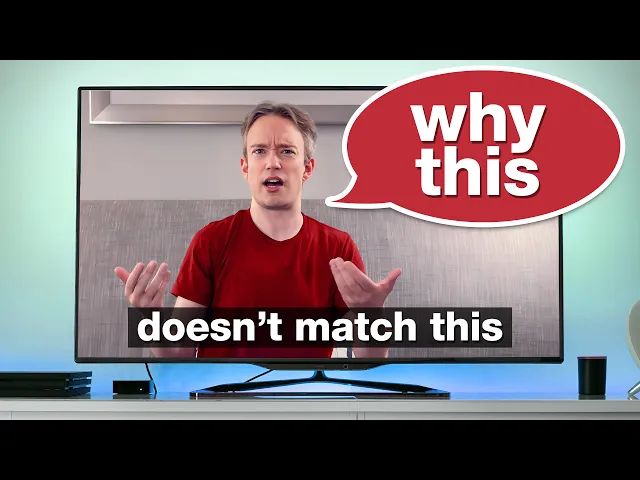
Why don't subtitles match dubbing?
Tom Scott
0:00 This video has been dubbed and subtitled into several languages.
0:03 On most devices, you can call up YouTube’s settings, and switch between them.
0:06 And if you do, you’ll find that outside the original language,
0:09 English, the words in the subtitles and dubbing often don’t match.
0:13 Which happens a lot, mostly in professional TV shows,
0:16 and it can be frustrating for those of us
0:18 who like to listen but also use subtitles.
0:21 The short reason why is:
0:23 subtitles and dubbing are usually done by different teams of people.
0:26 But to answer why that happens,
0:28 I need to take you on a journey that’s going to involve geese,
0:31 a roller coaster, and this advert.
0:34 This video is sponsored by NordVPN.
0:37 That’s not a joke, this video is actually sponsored by NordVPN,
0:40 who have been very useful as I’ve been travelling around!
0:42 Visit nordvpn.com/tomscott to find the best deal they’re offering right now.
0:47 Now, in most of the languages that advert was
0:50 translated into, the subtitles and dubbing pretty much match.
0:54 In French, Spanish and Portuguese,
0:55 the word order is roughly the same as in English, and it’s a simple translation.
1:00 But in the most obvious Hindi translation,
1:02 the company name sits in the middle of the sentence,
1:05 and standard practice for modern professional dubbing is
1:08 to match lip movements as closely as possible.
1:11 Now, there is a way to rephrase the sentence
1:14 in Hindi so that the company name sits at the end.
1:17 The dubbing team chose that option, and the lip movements pretty much match.
1:21 But the subtitling team didn’t see any reason
1:23 to do that, and so the lines are different.
1:26 In Japanese, which has the same problem,
1:27 the dubbing team instead found a translation
1:30 where the lip movements look close enough.
1:33 But why don’t they just take the dubbing script,
1:36 and then turn it into subtitles?
1:38 Why translate everything twice?
1:40 Well, subtitles have their own limitations.
1:43 I gave the translation teams
1:44 for this video some deliberately difficult examples.
1:47 A few years ago, I made a video on YouTube’s copyright systems,
1:50 and it included this sidebar about a song that I don’t like:
1:54 Maroon 5’s Memories is an infuriating composition that uses the start
1:57 of the melody of Canon in D but never resolves it,
1:59 which means it has the same stuck-in-your-head effect as the jingle
2:01 from Alfred Bester’s The Demolished Man, and I hate it.
2:04 The modern approach to subtitling in most
2:07 languages is that reading is faster than talking,
2:09 and that even for fast talking like that, you put every word on screen.
2:13 The viewer can always pause.
2:14 But that wasn’t always the case.
2:16 If you watch anything in English that was
2:17 subtitled more than 10 or 15 years ago,
2:19 like reruns on television or movies on DVD,
2:22 you’ll find the subtitles often summarise what’s said.
2:25 Style guides used to emphasise the skill
2:27 in “careful and sensitive subtitle editing”,
2:30 because they thought it was important that everyone got the meaning,
2:32 even if they were a slow reader, because you couldn’t easily pause and go back.
2:36 And besides, why would someone who can hear watch video with subtitles?
2:40 It’s not like we’d all end up with tiny televisions in our pocket,
2:43 or sound mixing changes would mean dialogue
2:46 was going to be suddenly difficult to hear.
2:48 In the original English version of that Maroon 5 rant that I just did,
2:52 I made a reference to The Demolished Man by Alfred Bester,
2:55 which isn’t that well-known even in English.
2:57 So for Japanese viewers, who have probably never heard of it,
3:00 the local subtitle translator decided to remove the reference
3:03 entirely and get the same meaning across in fewer characters.
3:07 Opinions can differ, but I think that’s a pretty solid decision.
3:10 If they’d just taken the breathless,
3:12 high speed performance of the Japanese voice actor,
3:14 then it would have been a worse experience for subtitle readers.
3:17 And well done to the voice actor, by the way!
3:19 That cannot have been easy.
3:21 And this is just to translate one person performing a script!
3:25 Imagine if it was a reality show, with six people shouting and talking quickly
3:29 and stumbling their words and interrupting each other.
3:31 The subtitles would have to summarise,
3:33 while the voice actors for the dub can shout over each other.
3:38 But it does mean that in this case,
3:40 for some Japanese viewers, that reference is lost.
3:43 That’s one of the other big challenges with translation.
3:46 How much do you translate the words versus translating the meaning?
3:50 Here’s another really difficult example.
3:53 “Anyone want to buy some goslings?” “They’re going cheep.” The English
3:59 version of that joke is pretty much impossible to translate!
4:02 It relies not just on a pun, but on knowledge of colloquial English.
4:05 You have to know that “going” can mean “making a noise”.
4:08 You have to know that “cheep” is the English
4:10 word for the noise that baby birds make, cheep-cheep-cheep,
4:13 and you have to know that “going cheap”, spelled differently,
4:16 is slang for “on sale at a good price”.
4:20 I loved seeing the responses from the translators on this example.
4:23 A couple of folks translated it word for word, and just gave up on the joke.
4:27 Fair enough.
4:27 But I do want to highlight a couple of them.
4:29 The Portuguese subtitle and dubbing teams came up with the same joke!
4:34 And so did the Spanish subtitler.
4:35 ‘Ganso’ in both languages means ‘goose’, and ‘cansado’ means ‘tired’,
4:39 so they combined them into the word ‘gansado’,
4:42 and now I’m asking if anyone wants
4:43 the goslings because I’m goose-slash-tired of them?
4:47 Brilliant.
4:47 And both the French and Spanish dubbing teams came up
4:49 with their own puns based on their languages’ words for bird noises,
4:53 because yes, the sounds that animals are said to make differ in each language!
4:58 And I love this!
4:59 This is translating meaning and intent, not just words.
5:03 In case you’re wondering, I did try several AI translation tools,
5:05 as well as just asking a large language model to translate this stuff,
5:09 and as of right now, as of 2023, capturing that nuance, that meaning,
5:13 that performance, definitely still requires humans.
5:16 At least for the goose clip, the translators didn’t have to match my lips.
5:19 But they did have to match the goose’s honk!
5:22 Because I talked over it,
5:23 so they had to go to another bit of the video that you didn’t see,
5:26 copy and paste the background noise and a different goose honk from there,
5:30 and synchronize them up.
5:31 Someone had to lip-sync a goose.
5:34 Beak-sync, actually.
5:35 I— they— they don’t have lips.
5:37 …I don’t think they have lips.
5:38 All of which comes together for this example.
5:41 Last year, I made a video where I
5:42 tried to get over my phobia of roller coasters.
5:44 And, spoiler, I did!
5:45 And just after my terror changed to joy,
5:48 on a ride called Nemesis, I shouted this: Yes!
5:54 Have it!
5:57 The original English is “have it”.
5:59 How on earth do you translate “have it”?
6:01 It’s got no literal meaning.
6:02 And more than that, it’s kind of obscure slang?
6:04 Different people in different parts of Britain
6:05 might use it for different things, and it’s almost impossible to Google.
6:09 In my context, it’s a cry of excitement,
6:11 triumph, adrenaline, encouragement, success.
6:14 It’s the sort of thing that you might yell after your team scores a goal,
6:17 or to cheer on your friend after
6:19 they’ve successfully downed two pints of lager back-to-back.
6:22 It feels very male?
6:24 Very “drunken lads’ night out’?
6:26 I did pass a note with all that context on to the translators,
6:29 but for many productions they won’t be working with notes.
6:31 They’ll only have the original show, and maybe the script, if there is one.
6:36 So, here is that cry in all the video’s languages.
7:04 Subtitling teams have their choice of any word or phrase,
7:07 but they have to fit the words on the screen.
7:09 Dubbing teams can get their voice actors to emote in the studio
7:13 as much as possible… but the lip movements have to match.
7:17 That’s why subtitles and dubbing differ.
7:20 And if you want a perfect example
7:22 of that: …this advert has also been translated into five languages!
7:25 And no matter which one you speak,
7:27 you can push NordVPN’s magic Quick Connect button,
7:29 and your phone and computer can pretend
7:31 they’re in any one of around 60 countries, from Albania to Vietnam.
7:35 So if you’re travelling and want websites
7:37 to stop automatically translating for you, it’s easy!
7:39 Or if you want to watch stuff from another country,
7:42 but it’s blocked where you are, you can.
7:44 (Just check the streaming service’s terms and conditions
7:47 first.) NordVPN works on Windows, Linux, Mac,
7:50 iOS and Android, up to six devices at the same time,
7:53 and there’s a 30-day money-back guarantee.
7:55 So if you’re not sure: try it anyway.
7:57 When I first used it, I thought I’d only use it occasionally,
8:00 but over the last year… it really has come in handy for me,
8:04 time after time after time.
8:05 I keep endorsing NordVPN because it keeps being a thing I actually use.
8:10 You can go to nordvpn.com/tomscott, or scan the QR code,
8:13 for the best deal they’re offering right now,
8:15 even if you’re watching this in the future.
8:19 I think that worked.
8:21 Lovely.