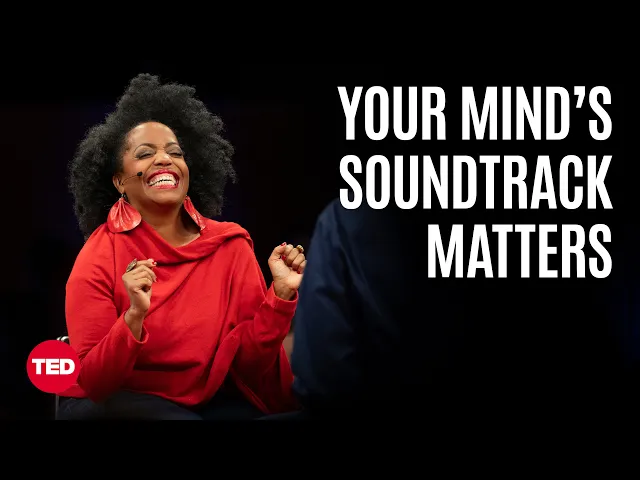
How to Tune Your Inner Voice | Rhonda Ross, Daniel Alexander Jones | TED
TED
0:03 Daniel Alexander Jones: My friend.
0:05 It's good to see you, let's do it.
0:07 So first of all, yours is truly,
0:09 and I can attest to this,
0:10 it's a liberatory practice.
0:13 And I witness you as part of, really,
0:15 a grand tradition of artists
0:18 who focused on capital-F Freedom in everything that they did.
0:23 So here we are in a time of tectonic upheaval,
0:27 of assaults on body and soul
0:31 and exponential demands on our attention.
0:36 In the midst of all this, you make offering to us.
0:39 Can you please tell us all about your work with mindset
0:43 and where in your life journey it comes from?
0:46 Rhonda Ross: Yes, well, my goodness.
0:49 I’m so happy to be here,
0:50 and I’m so happy to be here with you,
0:52 after all these years of having these types of conversations.
0:57 So...
1:01 I’m a singer-songwriter, I'm a performer, I'm an actress.
1:05 And when I graduated Brown,
1:07 I went on to do work in that field,
1:13 and it went really great.
1:16 DAJ: Yeah, right.
1:17 RR: And I got on a soap opera, and I got an Emmy nomination.
1:22 And I met and married my husband,
1:25 and everything was really good.
1:28 And I was really happy.
1:30 Until things weren't good.
1:33 And then I wasn't happy.
1:35 And all of a sudden, the Emmy went to somebody else,
1:39 the soap opera I was on was canceled,
1:43 my husband and I were—
1:45 he's here, by the way.
1:46 (Laughter) My husband and I were physically separated
1:52 because I had moved to LA,
1:53 and he hates LA.
1:56 And so I was out there trying to work,
1:58 and he was in New York.
2:00 We were trying to get pregnant.
2:02 You can't get pregnant 3,000 miles away from each other.
2:06 DAJ: Haven't figured that out yet.
2:07 RR: And I went in—
2:08 and I was unemployed, I wasn't working—
2:11 and I went into...
2:14 really one of the darkest times of my life.
2:17 And I remember in the moment thinking,
2:21 "What just happened?
2:23 Just a few years ago, everything was great."
2:27 Like what just happened?
2:28 And I started blaming my circumstances.
2:32 The agents, you know, all the things,
2:34 all the circumstances in my life.
2:38 And because none of those were under my control,
2:41 I felt victimized, and I felt stuck
2:43 and I felt like, you know,
2:46 the world was against me.
2:48 DAJ: Yeah.
2:49 RR: And after weeks and months
2:53 of really being in my darkest place,
2:55 I recognized that I couldn't stay there.
2:58 I had to figure out a way out of that,
3:01 even if I couldn't change my circumstances.
3:04 And I started to study and read
3:07 and come to find out there's all of this information
3:10 about the power of thought
3:12 and this idea that between our circumstances
3:16 and the way we feel about our circumstances,
3:19 live our thoughts, what I call our soundtrack that's on loop in our mind,
3:27 and our inner voice.
3:29 And it's what's coming out of that space that determines how we feel,
3:33 not the circumstances.
3:35 But we spend so much time blaming the circumstances,
3:38 feeling victimized by the circumstances,
3:41 and then trying to manipulate and control
3:43 and do what we can do with these circumstances.
3:47 When the truth is, the power to feel better,
3:50 to feel optimistic and at peace and empowered
3:53 and all of those things, is actually within ourselves.
3:57 And that's what I call emotional sovereignty.
3:59 So that's what I've been practicing
4:02 and then teaching for the last 25 years,
4:08 through my music, through my art,
4:10 through my mindset coaching and all of that.
4:12 DAJ: I love that.
4:13 And part of, you know, in our journey, one of the things is,
4:16 we work in a field where it's an intergenerational field.
4:20 So we had the great honor, both of us, of sharing a mentor later,
4:25 who passed away a couple years ago at 99 years old.
4:29 Her name was Vinie Burrows.
4:30 She was a great lady of the American theater.
4:33 And I'm thinking about what you're talking about,
4:35 about blaming circumstances versus doing something else.
4:38 And I know with Vinie, right, that she started on Broadway in the 1950s,
4:42 and like many Black actors of that time,
4:44 she was limited in what they would allow her to play.
4:48 And she was so profoundly frustrated by it.
4:51 And then she dropped into her own agency,
4:54 and she created one of the first solo performance pieces
4:59 that we now are very familiar with that kind of work
5:02 in the 1960s and '70s,
5:04 and by the end of her life,
5:05 she had performed over 6,000 performances all over the world, right?
5:11 And so one day, I was walking down in the Lower East Side where she was,
5:15 you know, and we can kind of picture her in our mind.
5:18 And I saw her at a distance and you know,
5:20 you always say hello to your elder.
5:22 So I said I was going to go say, "Hey, Miss Vinie."
5:24 And she came up to me,
5:26 grabbed me by the hand, shook me,
5:29 and she had a grip.
5:31 And she said, "Life is motion.
5:35 Life is motion!
5:37 Life is motion!" And she walked away.
5:41 (Laughter) And so I'm curious if you can talk,
5:46 because I think even today, we've heard so much
5:48 about how we deal with all of these stresses
5:51 as we're in motion, as we're in our lives.
5:53 Can you talk about how your practice has helped you harness life in motion?
6:00 RR: I wasn't going to tell this story, but I'm going to tell it.
6:04 I'm so glad you mentioned Vinie.
6:08 And yes, the work that I do
6:10 is something that has helped me as life is lifing, right?
6:16 Because I’m constantly being reminded that there is this space,
6:21 and there’s this soundtrack, and I can shift it.
6:24 And the story I’m going to tell:
6:27 we were in Minneapolis
6:29 and I was doing your play, "Phoenix Fabrik."
6:31 And Vinie was in the play.
6:33 And this might be a little TMI.
6:35 DAJ: OK.
6:36 RR: Sorry.
6:38 But I was having a miscarriage.
6:41 And I had just found out that I was having a miscarriage.
6:44 And so I went to rehearsal,
6:46 and I was on the phone outside, pacing,
6:49 talking to my husband on the phone,
6:51 and Vinie was watching me through the windows.
6:53 And when I came in, she said, "What is it?
6:56 What is it?" She was very dramatic.
6:58 And I said, "I'm having a miscarriage."
7:01 And she said, "No!"
7:03 And she grabbed me and she said,
7:05 "It's the end of the world."
7:08 And I said, "Yes."
7:10 And she said, "But it isn't."
7:12 (Laughter) I'll never forget that.
7:15 And so it's perspective,
7:19 it's reframing, it's taking these circumstances
7:23 and looking at them in all the different ways.
7:27 And we assume this thing happens.
7:30 I'm having a miscarriage, I must be devastated,
7:32 I must be all of the things.
7:34 But there is a space where you get to decide
7:39 how you're going to translate that circumstance.
7:41 How are you going to do it?
7:43 I had another friend of mine say—
7:47 during my third miscarriage—
7:49 say to me, "Your body's getting ready for the one."
7:53 And I remember taking that.
7:56 Instead of giving up and all of that, I said,
7:58 "Oh I'm getting ready for the one."
8:01 Yeah.
8:02 And so, all to say,
8:05 this work is...
8:09 is about recognizing the agency that we have.
8:15 We have so much more power than we give ourselves credit for,
8:19 because life is going to life, right?
8:22 Things are going to happen.
8:24 And it doesn’t mean you’ve got to like what those things are
8:27 or choose them or want them, but they're happening anyway.
8:29 So how can you take that and use it to empower you,
8:34 to lift you up
8:36 instead of letting it knock you down, right?
8:40 So that's the work.
8:41 And I was going to tell another story, but I'm going to skip it.
8:45 But I've got lots of stories.
8:46 But how I tried to work this into my life as I'm moving through it.
8:53 Even to this day,
8:55 I've been doing this work for over 20 years, 25 years,
8:59 and still I have to do it.
9:03 I had a meltdown on 125th Street two weeks ago.
9:05 (Laughter) Because my son wasn't where he said he was going to be.
9:10 And even though we track him,
9:12 the tracker said he was here, and he wasn’t there.
9:15 And I'm literally standing there on 125th Street,
9:17 "Raif, Raif!" looking, like, I couldn't figure it out
9:22 because I had skipped this part.
9:26 And it wasn’t until I grabbed hold of “wait a second,
9:30 cool out.” Yes, here are the circumstances,
9:33 he's not where he's supposed to be.
9:35 But you can decide how you frame that.
9:39 You can decide whether that terrifies you,
9:42 or whether it cools you out,
9:44 or whether you know he's OK.
9:46 Whether you give it some time.
9:49 Because real talk, it was only like five minutes.
9:52 Do I have parents out here?
9:54 (Laughter) DAJ: But what I love about this is
9:58 this gives me a concrete example of something.
10:01 I imagine many of us in this room engage,
10:04 which is we can think of things in these very macrocosmic big-picture ways.
10:09 But it's hard sometimes to translate down to the microcosm,
10:12 to the subtle things, the everyday choices,
10:16 and vice versa.
10:17 Something can be a storm inside of you
10:20 that can totally take you down,
10:23 and no one else will know about it.
10:24 And how do you navigate the flow of the world outside?
10:28 So it's very powerful.
10:30 And I want to call your beautiful son's name Raif Kendrick—
10:33 RR: Raif-Henok Emmanuel Kendrick.
10:36 DAJ: Call his name, he's a beautiful human being.
10:38 Like really radiant human being.
10:40 And I feel like I see in him you and your husband Rodney's love.
10:46 But also this work,
10:47 he's a mature young man from that process.
10:53 And thinking also about this idea,
10:56 I want to move us into a conversation about connection, continuum
10:59 and generation, right?
11:01 And a dear friend of mine, Alexis Pauline Gumbs, a great scholar,
11:05 once was talking about Harriet Tubman.
11:08 And she said, on the night before the Combahee River raid,
11:11 where Harriet Tubman freed, I believe, over 700 enslaved folk,
11:16 she woke from a vision that she had—
11:18 and many of you know, she had had an injury,
11:20 and she would go into these states of vision.
11:23 And she woke and said,
11:25 "My people are free."
11:28 Not "going to be free."
11:30 They are free.
11:32 Present tense, right?
11:34 And so I think that's a story that you carry in
11:39 that changes the outcome of something.
11:42 The stories we tell ourselves and we give ourselves
11:46 versus the stories that are told about us,
11:50 the stories that are told to us
11:52 and the expectations that others have
11:53 of how we're going to move in the world.
11:55 So I'm curious about, you know,
11:58 purpose and freedom, present tense for you and wherever you want to take that.
12:05 RR: Oh, my God.
12:07 DAJ: Yeah, that's how we roll.
12:08 RR: That's how we roll.
12:12 So I just want to go back to what you said
12:15 about "my people are free."
12:18 This idea of affirmation.
12:21 So, the program, the process that I have,
12:26 I called it "tune your inner voice."
12:29 Tune your inner voice.
12:31 And there's a few different steps to it.
12:35 So step one, I call it the crucial first step,
12:39 is to acknowledge that there's this space
12:42 and acknowledge that you have agency in this space,
12:44 and acknowledge that it's your thoughts that determine how you feel
12:48 and you are the thinker of your thoughts.
12:50 So you have the ability and the power.
12:51 So that's the crucial first step.
12:53 You can't move anywhere beyond until you do that.
12:56 The next one, and Jessica mentioned it,
12:59 is to really investigate what you're feeling.
13:02 What is happening inside of you?
13:07 Sit with it.
13:08 We gaslight ourselves, right?
13:10 "I shouldn't feel that."
13:12 "Oh, I can't be feeling that."
13:13 You know, all of that.
13:14 But sit with it, name it.
13:16 There's science behind naming a feeling
13:20 and how already the feeling starts to kind of dissipate when you can name it.
13:24 And in my process, I have people really, really name it.
13:28 Like not just, "Oh, I'm upset," but like, what is it?
13:32 Is it anxiety?
13:34 Is it terror?
13:35 Like what is it?
13:37 So we sit with that for a while.
13:39 That's step two.
13:40 Step three is to find the thought that is really triggering that feeling, right?
13:47 Not the circumstance, the thought.
13:49 And I call it an automatic screwy thought
13:52 or an automatic sabotaging thought, an AST.
13:56 And so you find that thought and again, you name it and identify it,
14:01 and then you're like,
14:02 nobody could feel good with a thought like that,
14:05 because usually it's a thought like, you know,
14:07 "I'm a piece of"— whatever, right?
14:09 You know, and you say,
14:10 "No wonder I've been feeling"
14:11 like, "That's what's been going on in my mind?"
14:14 You know, so really looking for the thought.
14:16 And then we shift the thought
14:18 into what I call an INT,
14:21 an intentionally nourishing thought.
14:24 And that is like an affirmation.
14:27 But because it's come through this process,
14:30 it's your customized affirmation.
14:34 Because, we talked about this,
14:36 you can't free yourself through somebody else's stuff.
14:41 You've got to have done it for yourself.
14:43 And so this INT becomes...
14:48 The words that work for you,
14:51 the words that cool you out
14:55 that allow you to breathe.
14:57 So you find those words, the affirmation,
15:00 the INT or a mantra that you can have in your mind.
15:05 And then, because I come from music and I understand the power of it,
15:11 we then take that INT and attach it to a melody,
15:15 make it a song.
15:16 So I call it a songtra.
15:17 That's what you mentioned earlier,
15:19 songtra for emotional sovereignty.
15:22 Songtra is now your personalized affirmation,
15:26 your personalized mantra, to a melody that can stick in your head,
15:30 because that's what music does.
15:32 And so I want to speak to—
15:35 when you have an affirmation,
15:38 a mantra that becomes your soundtrack and it's on loop in your mind,
15:44 it changes everything.
15:47 It changes the lens that you are seeing the world.
15:50 And whether you use that songtra in advance, in preparation,
15:56 just walking through the world, which I use my songstras like that,
15:59 you could also use them in the middle of crisis.
16:02 DAJ: That is fantastic.
16:03 RR: The thing happens and you think, "Wait."
16:05 And you sing your mantra to yourself.
16:07 You cool yourself out.
16:09 DAJ: One thing that I know you emphasize a great deal
16:14 is that this can work for everyone, right?
16:16 One does not need to be a musician.
16:18 You don't need to have any particular background.
16:20 It's a process by which we share a resource, right?
16:25 You know, I always use this quote,
16:27 one of my favorite quotes is from the great Grace Lee Boggs, activist.
16:31 And she said, at the end of her life, and she lived to be 100,
16:34 she said, you know,
16:35 "I stopped thinking of things in terms of decades,
16:38 and I started thinking of them in terms of centuries."
16:40 And I do want to just take time to acknowledge
16:43 that you belong to tradition, right?
16:45 And of course, your incredible parents, Diana Ross and Berry Gordy,
16:48 who were way makers, and they broke molds.
16:51 And also your years of study with Abbey Lincoln,
16:55 the great jazz musician,
16:57 the music we call jazz, right?
16:59 And all of these other artists that you've collaborated with.
17:02 But I'm thinking about, you know,
17:05 I think of this all as a relay race.
17:08 That we get from our ancestors
17:10 something that we should not set down,
17:12 but we must carry forward, but in our way.
17:15 Coming back to your thing of your voice, your particular inflection.
17:19 And I just, in our closing moments,
17:21 I'd like for you to reflect on how you have walked with lineage
17:25 and/or what you think that idea of a relay race says to you.
17:29 What are you doing in your leg of the race?
17:31 RR: Lord.
17:32 How much time do we have?
17:34 DAJ: You've got two minutes.
17:35 RR: I can do this.
17:36 DAJ: You can, I know you can.
17:39 RR: Whew.
17:40 You said so much.
17:43 I do come out of jazz.
17:48 My husband, Rodney Kendrick,
17:49 I want to say his name,
17:50 he's an incredible pianist.
17:52 And he taught me so much, with Abbey Lincoln,
17:55 about making your own music.
18:00 That there is no such thing as jazz.
18:02 That Duke Ellington made Duke Ellington’s music,
18:06 and Thelonious Monk made his music.
18:08 So to that idea,
18:12 yes, I'm making my own continuation.
18:17 And what I want to say is, this is personal work.
18:22 It's individualized work.
18:24 But when you do it, it reverberates out.
18:28 And Eric Liu, he's going to speak here later,
18:34 he said this morning, when I told him what emotional sovereignty was,
18:37 he said, "Oh, I love that,
18:39 because sovereignty is not just 'get off my lawn.'
18:42 Sovereignty is also 'I'm responsible for my lawn.'"
18:45 DAJ: Thank you.
18:47 RR: And I said, "I'm going to say it later."
18:49 And so I say that to say
18:51 when we are responsible for our own lawns
18:54 and our own selves and our own mindset
18:55 and our own feelings, that reverberates.
18:58 We're no longer victimized
19:01 by what other people do in our circumstances,
19:03 but we also don't become the victimizers.
19:07 We don't have to be out there controlling and manipulating
19:10 and making people do the things.
19:12 Thank you.
19:13 Making people do the things.
19:15 DAJ: Yes.
19:16 RR: And I think at scale, it's big.
19:19 I think when we look at all the unkindness,
19:24 all the inequities, all the violence,
19:29 all the cruelty, all the genocide,
19:32 it is because somebody has decided that somebody else has to do something
19:35 for them to feel better.
19:37 And the minute we stop that, it ends.
19:39 DAJ: Thank you.
19:40 (Applause) That's right.
19:44 That's beautiful.
19:46 Perfect answer, right?
19:48 So you see what I tell you?
19:50 She's the truth.
19:51 Yes, indeed.
19:52 Thank you.
19:53 (Applause)