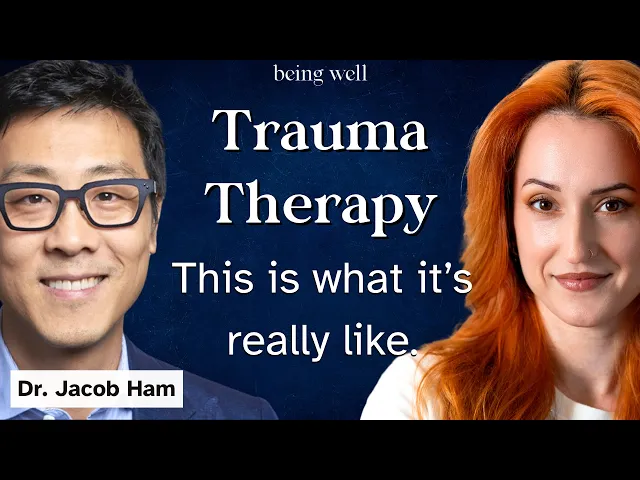
What Trauma Therapy is Really Like | Dr. Jacob Ham, Elizabeth Ferreira, Being Well
Forrest Hanson
0:00 Hello and welcome to Being Well.
0:01 I'm Forest Hansen.
0:02 If you're new to the podcast, thanks for joining us today.
0:05 And if you've listened before, welcome back.
0:08 I am so excited to tell you about today's episode.
0:11 I have been really looking forward to this.
0:14 Today we did something that we've never done on the podcast before.
0:17 Elizabeth joined me for a guest conversation.
0:21 She was a little nervous about it.
0:22 She did fantastic during this whole thing.
0:25 And if you're not familiar with her, Elizabeth is
0:27 an associate sematic therapist and she's also my fiance.
0:31 And we were joined by a very special guest, Dr.
0:33 Jacob Hal, who is an incredible expert on trauma and complex PTSD.
0:40 I mostly got to be a fly on the wall while Dr.
0:43 H and Elizabeth talked about being a trauma therapist.
0:47 Uh what is it like to sit with clients?
0:50 How have they been changed by the work that they do?
0:52 What are some of the major themes that tend to come up over and over again?
0:56 They really talked a lot about establishing relationship
1:00 and what it's like to be in that relationship
1:03 with another person who is processing some of the hardest
1:07 things that a person can process in life.
1:10 And I think that this is a conversation that of course you will get an enormous
1:13 amount out of if you're a clinician
1:16 or if you're interested in therapy in general.
1:19 But I also think there's a lot here if you're just a person
1:22 who's trying to deal with this kind of material in your own life.
1:25 Uh I'm not a therapist, but I feel like I learned a lot from Dr.
1:28 H and Elizabeth today.
1:30 And this was just such a cool experience.
1:32 It was a very unique conversation.
1:34 They they they have kind of a similar vibe
1:36 and they really just sat in it with each other.
1:38 I don't know if that's their nature as people or if
1:41 that's the way that this kind of work changes you.
1:44 I suspect that it's a little bit of both.
1:46 and I was pretty quiet for most of the conversation.
1:50 Episodes of the podcast are typically edited for clarity and length.
1:54 And this episode is mostly unedited in part
1:58 because there was just such a natural
2:00 flow to the conversation that I wasn't even really sure where to put the edits.
2:04 It was extremely organic and I just really hope you enjoy it.
2:09 So here is my conversation with Dr.
2:12 H and Elizabeth.
2:14 So, Elizabeth, how are you doing today?
2:16 I'm really anxious, but I'm hanging on.
2:21 I'm grounding down staying in my body.
2:25 I'm really excited for this.
2:26 We've never done a guest interview with Elizabeth before,
2:30 but today we're joined by one of my all-time favorite guests on the podcast, Dr.
2:34 Jacob H.
2:35 Dr.
2:35 H is a licensed clinical psychologist
2:37 and associate clinical professor in the department
2:40 of psychiatry at the Icon School of Medicine at Mount Sinai.
2:43 and he's also the director of the center for complex trauma there.
2:46 You might also be familiar with Dr.
2:47 H if you read Stephanie Fu's bestseller,
2:50 What My Bones Know, a memoir of healing from complex trauma.
2:53 Dr.
2:53 H was the clinician that she worked with in that book.
2:56 So, Dr.
2:57 H, thanks for doing this with us.
2:58 How are you doing today?
2:59 It's so good to be back.
3:02 Thank you for having me again.
3:03 And I too am super nervous for some reason.
3:07 But I
3:07 Yeah, it's really interesting that that both of you have been like mentioning
3:10 that as part of this process where Elizabeth
3:13 expressed some nerves to me even over email.
3:15 You did.
3:16 Um I don't know.
3:17 Do you have any idea why that is?
3:19 Was Elizabeth, were you nervous before I said I was nervous?
3:24 Yes.
3:24 Or Huh.
3:25 Interesting.
3:29 Yeah.
3:28 I think part of my nerves is like I still
3:34 feel pretty young in my work as becoming a therapist,
3:39 but also working towards, you know, specializing in CPTTSD.
3:43 And I've been really lucky that in basically all my associate uh journey so far,
3:50 like that's the population I've been able to work with.
3:53 And so I feel like I've just been sort of in this big bubble of it.
3:59 And I think part of why I'm nervous is because the longer I've done this work,
4:05 the less I feel capable about talking about it.
4:09 It's almost like I struggle more and more to really define
4:13 or find words that fit in what is like happening in the room.
4:19 And I think part of my nerves is, "Oh my god, we're supposed to talk about it."
4:30 That is really cool to me because it should
4:33 be really hard to describe what happens in the room.
4:36 I think we not we're not trained very well for that.
4:43 Mhm.
4:41 And that's all I've been doing.
4:44 So, we'll have to I would love to talk about that kind of stuff because
4:50 my area of focus is really on what happens in the room moment to moment.
4:58 Yeah.
4:58 And yeah, I think that's where all the work happens,
5:01 but it's hard to be trained in it and it's hard to understand it too.
5:07 And that's why I'm really excited about this training community
5:10 that I'm trying to launch this year at some point.
5:14 because all we're going to do is just
5:17 practice moment to moment material with each other.
5:23 Yeah.
5:21 And it's not it it really is uh practice.
5:26 There's no shortcut to figuring out how to do this.
5:29 And I didn't feel like I got it until uh more than 10
5:33 years after I started like 10 years after where you are in your career.
5:40 Wow.
5:39 And even when you do get it,
5:41 like part of when Force and I were talking about what to talk about,
5:46 um part of the things that I was thinking
5:48 about talking about though I don't know how yet is,
5:52 um how exciting this past year has been for me
5:56 as a therapist because I've learned so much new material from the work.
6:00 I feel like the thing that helped me to get so
6:05 to learn faster and faster is to um one let my mistakes beat
6:11 me up and hurt a lot and to not let them um
6:18 make me tight in what I try to do in the room too.
6:22 But you also need a lot of support and you need someone
6:25 to like cry a shoulder to cry on after you mess up.
6:29 Yeah.
6:28 And you need to feel like it's normal stuff to happen.
6:34 And then um and you almost have to forget everything you've
6:37 learned cuz in the room you shouldn't be thinking about that stuff.
6:41 You should just be in the moment.
6:44 And then and then everything you learned
6:46 and then you'll start to organize what you've learned
6:50 into very very practical momentto moment material that I can hopefully maybe we
6:54 can get to some of that stuff but it's really hard to explain.
6:58 And what I would also encourage you to do is to start writing.
7:01 Oh, I do.
7:03 Okay, good.
7:04 I write a lot.
7:05 Like uh journaling about it or what?
7:08 What do you mean by that?
7:09 No, write to your clients.
7:13 I I do that.
7:16 Okay.
7:15 I have a I have a secret space that I I write all the things I wish I could say.
7:21 Oh, interesting.
7:23 And then I look at it and I see what can I actually say in real life.
7:27 What's funny is that in my supervision of people,
7:32 usually after they tell me what's going on in the therapy,
7:37 then the answer is you you should just say that to them.
7:42 And the more and more you trust what comes up for you and the more
7:45 you hone that craft of speaking what you're saying in a way that is helpful,
7:54 the work becomes liberating.
7:56 energizing because you're using your whole self.
8:00 Like I think that we get tired
8:02 because we're holding ourselves down or compartmentalizing ourselves.
8:07 But if you learn to hone all of yourself as part of the tool to use,
8:12 then you're just energized and flowing.
8:16 I'm excited.
8:17 Yeah.
8:18 No.
8:18 Um, this is really affirming cuz I've been in my own bubble thinking I'm just
8:25 like a cook like like cooking and I'm like I have no idea what's happening here,
8:30 but it seems to be working.
8:31 Um, yeah.
8:34 Like, so I'm I'm very open about this, but I also have complex trauma.
8:42 And so there are parts of me that can
8:45 almost always relate to people I'm working with.
8:50 And it feels like there those parts of me like kind
8:56 of show up in the room that resonate at like the same experience
9:00 with my clients and it creates um not just I understand you
9:09 cognitively but like I know what this feels like in this experience.
9:15 And the more and more I've done this work,
9:19 the more I've been I disclose that in the room like I kind of join and I share.
9:26 And it's been a journey because I can get
9:31 very activated or triggered depending on what shows up.
9:36 And my practice has been to always make sure
9:39 I'm a few steps ahead of whoever I'm working with.
9:44 Um, so if something shows up and I
9:47 feel my own material really coming into the room,
9:52 I go, "Ooh, that's kind of interesting." And how do I hold that?
9:56 And how do I hold the other person?
10:00 And how do I kind of even use that as a part of the tool?
10:04 Yeah, you spoke it very clearly.
10:06 That's the art.
10:07 Every time it happens, you have to ask that question.
10:09 And there's no right answer for that.
10:11 Mhm.
10:12 And I've spent years playing with more disclosure and less disclosure.
10:21 Yeah.
10:20 And seeing what it does to my attention,
10:23 whether it's with the client still
10:25 or whether it whether I become distracted myself.
10:31 Mhm.
10:32 And again, there's no right answer
10:33 because each moment requires a different thing.
10:36 Yeah.
10:37 And certain people want more disclosure and other
10:40 people really don't want it because it interferes.
10:44 It does feel like you're taking your attention away from them.
10:48 And so the only real solution is to keep wondering is this the right move?
10:53 Is this working?
10:54 And I and to invite them to be wondering too.
11:00 Yeah.
11:00 So it's completely consensual moment to moment and co-created what's happening.
11:06 That's how I describe it.
11:08 It's cocreated and I tend to ask like I will
11:12 be like hey I'm noticing something I could talk about it.
11:17 Do you want to know?
11:18 Like I give them the opportunity to kind of define how much
11:22 of me do you want to show up in the room right now?
11:25 Yeah.
11:25 I I do the exact same thing.
11:27 But what I also know is that no one is ever gonna say no.
11:31 I don't I really don't care what you have to say.
11:33 So they they always politely say yes.
11:36 So I don't know what the workound is yet for that.
11:39 I've had people say no.
11:40 I've had people go ah maybe later.
11:44 That's cool.
11:45 That's when you really know that the work
11:47 is good and the relationship is strong cuz
11:51 and and like I will be on the wrong path
11:53 and they'll be like no that's not what I'm talking about.
11:55 you this is what I really want you to pay
11:57 attention to and then it just reggrounds me in
12:00 I I don't want to interrupt your guys flow here because you're you're
12:03 just in such a good spot but you said something a second ago Dr.
12:06 home that I was really interesting interested in and really curious about.
12:11 You talked about the feeling of having made a mistake and needing
12:16 like somebody to talk to or I forget what your exact phrase
12:19 was like you know a shoulder to cry on whatever it is
12:21 after you feel like ah I just really messed up in there.
12:24 I don't know if I've ever heard uh two therapists talk to each
12:29 other about that feeling of like messing up with a client in that kind
12:32 of a way and having it be a really emotionally meaningful experience
12:36 for them and processing around it or thinking about it, relating to it.
12:42 And I I just think that for people who go to therapy,
12:44 it could be kind of meaningful to hear for starters
12:46 that their therapists care that much uh to be impacted in that way.
12:50 And um yeah, I don't know if that's something that you want to want
12:53 to talk about or share about or you guys could kind of explore together,
12:56 but I just thought it was a really interesting thing to say.
12:59 I can I can say that in training we really encourage it.
13:05 We we have like students at all levels of training that come through
13:11 our our hospital system and um I will tell them in the beginning of the year
13:17 if you if you like try to impress me with all the amazing work
13:22 you're doing then I'm going to want to knock you down a few levels.
13:26 But if you come in and tell me about what you're struggling
13:29 with then it's going to make me want to root for you more.
13:33 And so I encourage them to actually talk
13:36 about that their their growth edges I guess.
13:40 And then when we start supervision especially in a group format we will
13:45 um I'll say okay what are the highlights or heartaches for this week
13:48 and we'll start we'll figure out what moments or clients need our attention
13:54 from what pulled us emotionally whether to celebrate or to feel bad.
14:02 That's where all the learning.
14:03 That's where all the work is.
14:04 That's where the ruptures are happening.
14:05 That's where the trauma is showing up.
14:08 Yeah.
14:08 I'm I'm a bit of an anarchist.
14:10 I I feel like I strive for the mistake.
14:14 Like the way I think about it is I'm in my associate ship.
14:17 I work under my supervisor.
14:18 I'm the safest I will ever be right now.
14:21 So, why not swing big and try to make as many mistakes as possible?
14:27 Um, and what I have found is that when I just accept
14:32 that like I'm going to make all of these mistakes and how
14:35 exciting that I get to make a mistake is that's when
14:39 the work gets really alive in the room even with the client.
14:43 Um and then you know inside of myself it
14:47 gives me a moment to even notice what is
14:53 important that I look at inside of myself when
14:55 it's like ooh I made a mistake like ooh what's
14:59 happening here and then how do I how do
15:02 I show up because I think for some people
15:05 at least people who I work with there's not
15:09 that much experience of somebody owning the mistake of saying,
15:16 "Oh, yeah, that was me.
15:17 My bad." Like, how do I understand you
15:21 better and understand how to be with you better?
15:24 Yeah.
15:24 Those are beautiful moments cuz the repair feels so good.
15:31 Mhm.
15:30 It makes me think about how um
15:36 the the opposite experience when someone's demanding an apology.
15:40 Mhm.
15:41 And there have been times when I will say, "I honestly can't give you one.
15:45 It doesn't feel right to me to give you one.
15:48 I can't.
15:49 It feels like I'm colluding with something." And and then I will say, "Now,
15:54 I could be wrong because I could be so defensive
15:57 right now that I'm intellectualizing and going clinical on you.
16:00 Or it could be that there's really something
16:02 here that we should be looking at." And so
16:06 I just kind of like I feel like in my book I've been playing with this visual
16:11 of like therapy is like playing a card game or poker but at every turn we just
16:19 lay all our cards down on the table and try to figure out what the best move is.
16:22 And the goal isn't to win.
16:24 It's to just keep the game going for as long as possible.
16:28 Yeah.
16:29 you said something that I'm I was like
16:32 and but now I'm having a hard time remembering it.
16:36 Oh, this is funny.
16:37 This is why I'm forgetting it.
16:39 So, what you just named is right at my clinical edge
16:44 at the moment is when the client's demanding an apology and I'm like, ooh.
16:51 And I'm I tend to dissociate cuz that's also
16:55 a very tricky place for me with my own trauma.
16:58 So when I'm being confronted, um,
17:02 younger therapist Elizabeth would just be like, "Oh yeah, I'm so bad.
17:06 Yeah, fall on the sword." Like, "Yeah, deepest apologies.
17:09 That was my fault." And now I'm I'm noticing I'm at the like
17:16 shaky edge of I don't really want to give you an apology,
17:22 which is spooky to say, and then why do I not want to give the apology?
17:27 And then I I still get pretty fuzzy.
17:31 Like I can get pretty dissociated even just holding it.
17:35 Yeah.
17:36 Like I'm always remind like we play with powerful forces in this space.
17:42 Yeah.
17:42 It's happening.
17:43 Like it's so cool.
17:44 As I talk about it, my going away part starts to show up and I'm like
17:51 I think we're at the heart of working with CPTTSD right now.
17:58 Mhm.
17:57 It always gets hairy.
17:59 That trauma always comes into the room.
18:03 Yeah.
18:03 And no amount of training,
18:04 no manual will ever teach you what to do in this moment.
18:10 And it really is as simple as helping some helping the therapist
18:16 stayed where you are like the way that you are doing right now,
18:21 not dissociating and just trying to feel as much as you can.
18:27 And then figuring out a way to name what's inside of you
18:32 or what's inside of them or what's happening between the two of you
18:37 in a way that's heartfelt,
18:40 a little heartache and still um fighting for the connection to persist
18:51 instead of like disappearing on each other.
18:54 That's really hard to do.
18:58 Yeah, you're you're naming my stuff very accurately,
19:02 which is my clinical edge at the moment is to be able to lean
19:08 in and confront that really uncomfortable moment of like I hear you demanding
19:15 something from me and I there's a part of me wants to slow
19:20 down so that we really pay attention to why this demand is showing up.
19:24 But yet for me my the past infiltrates the present for me because
19:30 when I used to do that as a child like confront it meant disconnect.
19:37 So, this is why this is such like the edge for me clinically.
19:44 And I'm I'm kind of in this um like I have to dig my way
19:51 through all of this sort of jello to kind of get get to the other person,
20:00 right?
19:59 And then in your own in your own self,
20:04 the next steps would be two possible paths.
20:07 One would be to do the inner child work with the timid,
20:11 the scared girl who still has this desire to stand up for herself.
20:17 And even the word confront is very interesting.
20:20 But I don't want to get too linguistic about this, but the flavor
20:24 of it is still there's aggression or fear of conflict in it.
20:27 Mhm.
20:28 The other path after you help reintegrate her is to um
20:36 it's it's this the difference between fighting against versus fighting for.
20:43 Mhm.
20:42 And when you have this strong parental maternal sense of like no,
20:48 we're going to do this because I'm not willing to lose you.
20:53 Mhm.
20:54 So, you're going to we're going to have a hard conversation right now.
20:57 So, it's not confronting.
20:59 It's like it really is like advocating,
21:01 championing for something that you really care about.
21:06 And you can't force that reframe.
21:10 I think you have to every one of us has to do
21:12 both at the same time or whichever one needs more attention.
21:15 Maybe you can just snap into no you this this matters.
21:19 We're not going to let trauma interfere with our connection right now.
21:22 Or if it's here, we're going to we're going to, you know,
21:27 look at it, but it's not going to take over.
21:31 Mhm.
21:31 And that's like a that's like a firm limit setting that if you work with kids,
21:37 families, or couples, you learn to do more because they're they come in and they
21:42 want you to be strong enough to maintain safety for them.
21:48 Yeah, I find that I know what you're
21:52 talking about because with couples I can do it.
21:55 With couples, this does not really show up as much, which is interesting,
22:01 but it shows up more individually because the like
22:05 attention or the focus is like um all on me.
22:13 I am the couple.
22:14 Yes.
22:15 And then it's like
22:19 yes
22:19 and and so but I know what you mean about like
22:22 the being with and the kind of in pursuit of maintaining
22:27 the connection and like I'm not going to let either of us
22:33 run away from this moment like no let's let's go for it.
22:36 Let's I'm going to hang on to you and you hang on to me.
22:41 Yeah.
22:41 And I think this is a nice moment where
22:43 we can like bring in the general the the clients
22:45 who are listening in in these moments when
22:50 uh someone might feel the need for an apology.
22:55 Then what I tell my clients is um to that we're not trying
23:02 to say it's either or that it's your stuff or what's really happening
23:06 like I I really made a mistake or it's your stuff coming up
23:10 but I feel like there has to be a sequence of actions taken first.
23:14 We have to inquire about whether your stuff is activated and we
23:21 have to do the work to kind of mend or hold that stuff.
23:26 And it takes some of the edge off of what's happening in the moment.
23:31 And then we can do the repair that still needs to be done in the present moment,
23:36 but it'll be done with more grace or clarity or compassion towards each other.
23:42 Otherwise, you're just on a war path to try
23:44 to write wrongs that you've experienced your whole life.
23:48 And even an apology now won't necessarily satisfy
23:52 the depth of that hurt that's been activated.
23:59 And it's really hard.
24:00 It's hard.
24:01 It's hard for people,
24:02 especially when they're so used to uh fighting for their lives,
24:07 fighting for a voice.
24:11 And so it can take I have people where it
24:14 takes a year of fighting until they're like, "Wait a minute.
24:18 Are you Is this one of those moments when you you're
24:20 saying that maybe it's not just something didn't just happen between us?
24:24 Like it could be it's so hard.
24:28 It's and it feels like um reality is taken off from underneath their feet.
24:33 Like they can't trust anything they see anymore.
24:37 It makes them feel more unsettled and unsafe
24:41 cuz they don't know where the enemy is anymore.
24:43 I'm really lucky because some people I've working
24:47 with have been for three or four years.
24:50 So our relationship, clinical relationship is really strong and there
24:59 is this really wild chaotic space when
25:10 they come in in that moment of I don't know what up is down.
25:15 I feel so unsafe.
25:17 There's something I need to communicate with you.
25:21 and there's enough of their own awareness to even kind of be
25:28 where I'm at a little bit at the moment of like,
25:30 oh, I can feel my stuff and yet I feel the stuff I need to do.
25:36 Um, and sometimes I've been in the moment um,
25:44 with people I work with where we both get to own,
25:47 yeah, this is really scary and I'm okay with it being scary.
25:51 I'm still here.
25:52 I'm not going to jump out of this.
25:55 So, we're both scared.
25:58 Now, what?
26:00 I think you've already reached the end cuz
26:03 it's no longer a you versus me anymore.
26:05 It's like we're both like feeling overwhelmed.
26:11 Mhm.
26:10 And then there's nothing to do but to grieve
26:15 at at that point to feel the the heartache of that moment.
26:20 That's what I'm always afraid to actually name when
26:23 people ask me about the work is the grieving part.
26:27 Like I cry with my clients and they cry with me and It's funny.
26:36 There's a part of me that's wanting to show up to be like,
26:39 but I don't put my stuff on them.
26:43 Um, but no, there's there's there have been moments
26:50 where I feel I'm really seeing the other person.
26:56 And the only way that happens is when they really see me in return.
27:01 like there's an opening that happens.
27:04 So, as much as I'm seeing them,
27:06 they're also seeing me and at times we grieve for each other.
27:11 There were two different threads there.
27:14 The first one when you said um that little guilty critical part that says
27:20 that you're putting your stuff on patients clients
27:24 and then the coexperience of humanity, shared humanity.
27:31 Which way do you want to go?
27:33 Let's go into the the guilty part.
27:37 Okay.
27:37 Let's go where I'm having the hardest time staying present.
27:41 That's perfect because that's all that's always the first guardian at the gate.
27:49 Yeah.
27:49 And the hardest one to pass.
27:52 Um, my first gut reaction was a little railing against anger about
28:03 the way that supervision and training
28:05 happens because um it's very fear-mongering.
28:12 It's all about like it almost feels like
28:14 policing and it feels like like uh Yeah.
28:21 And it it makes you so tight.
28:24 And as a traininee, I was I was so distracted
28:28 by the image or the sense of my supervisor watching over my shoulder.
28:35 I most of my mistakes and I made a lot of mistakes
28:40 as a earlier in my training was because I was trying
28:44 to impress my supervisor who wasn't even in the room and supervisions
28:49 would be about talking about what happened the week before and then
28:52 they would give some suggestions about how to look how to think
28:56 about it and then I would be so eager to implement
28:59 those the next week but it's like that river's already passed
29:02 like there's no way I it would be an artificial misatuned intervention.
29:09 Finding a doctor you actually like can feel
29:11 like hunting for a needle in a hay stack.
29:13 Sure, you want somebody who's in network and nearby and has open time slots,
29:20 but let's be honest, that's just the beginning.
29:23 You also deserve somebody who really listens to you and explains
29:26 things clearly and hopefully helps you feel calm and comfortable.
29:30 It can feel like too much to ask for sometimes,
29:32 but that dream doctor is out there
29:34 and our sponsor ZuckDoc makes it easy to find them.
29:37 Sockdoc is a free app and website that helps you find
29:40 and book highquality in-et network doctors so you can find somebody you love.
29:45 Whether you're looking for dermatology, dentistry, primary care, or urgent care,
29:51 you can find in-et network appointments with more
29:53 than 150,000 providers across all 50 states.
29:58 When you're ready, you can see
29:59 their realtime availability and click to book instantly.
30:03 And while you're on ZDOC, you can view thousands of verified patient reviews.
30:07 I think those reviews are one of the best parts of the site.
30:11 Stop putting off those doctor's appointments.
30:13 And go to zdock.com/beingwell to find
30:18 and instantly book a doctor you love today.
30:21 That's zoo doo.com/beingwell.
30:27 zoddock.com/beingwell.
30:30 Thanks, Zdoc, for sponsoring this message.
30:36 One of my trainees said that one of their supervisors had
30:41 told them this incredible thing that I have now taken for myself,
30:45 which is that in supervision with me,
30:48 what I encourage the trainee to do is to follow their instincts.
30:54 And then supervision is for trying to make sense of why
30:58 that was the right move to really trust that your body's much wiser
31:04 than everything you've learned in grad school and then to um just
31:11 you're just honing your instrument that's all and making it more therapeutic.
31:16 So even even this co- experience of grief like
31:22 there are ways that I've done it where it
31:25 I did have I I would share my stuff but then as I got better at I would
31:30 say you have no idea how much I relate to this and then I would just leave it
31:33 at that and I would be acknowledging that it's
31:35 here but I wouldn't necessarily have to say it.
31:39 Mhm.
31:39 Yeah.
31:39 that that moment of crying, I'm in them.
31:42 I'm thinking about what that's like for me.
31:47 And I so want them to see it, but but not in an artificial way,
31:53 but in a in a way of protect of enhancing
31:56 the safety of the moment cuz it's so vulnerable.
32:01 It's also really interesting cuz people will get uncomfortable.
32:05 They might some of them will say like they will feel like
32:08 taking care of you or they'll feel that so they'll try to take
32:12 care of you or they will feel it and want to resist it
32:15 and say like enough like whatever
32:18 it's and that becomes interesting material too.
32:21 Mhm.
32:22 But then with other people,
32:24 they're so grateful for that form of witness, witnessing.
32:31 And you really do have to be tracking whether or not.
32:35 Well, no, it's not whether or not.
32:37 It's both when your stuff comes up and you hold your inner child
32:41 in your arms as you're as you're gazing upon your patient or your client.
32:45 And so it's just adding more and more layers of complexity
32:49 to your experience and more ability
32:50 to hold layers of complexity in your experience.
32:54 Also along with crying, the other thing that I've added to my repertoire
32:59 of shared humanity is is literally dry heaving.
33:05 like literally throwing up in the sessions
33:08 when we're going over incredibly difficult,
33:11 gnarly abuse stories that are like beyond
33:15 the pale of what anyone should ever experience.
33:17 And it will make you nauseiated.
33:20 And this woman, woman, one of the first times I did it,
33:22 she's like, "Oh my god, thank you so much." Yeah.
33:26 I was like, and I'm like like wiping my mouth.
33:30 But yes, it was like that, right?
33:32 It was gross, right?
33:33 what happened.
33:35 Yeah.
33:35 What I what I can add to that is I'm I'm
33:37 having a moment of feeling pretty grateful for my own supervisor.
33:44 Um because I don't feel like I have to impress her.
33:48 I feel like I come in raw and bleeding and I'm like,
33:51 "Here's all my that's coming in and I did this and uh
33:56 and maybe I can name something pretty vulnerable for me, which is,
34:16 I feel like my training in my supervisor really encourages me
34:21 to return to my gut feeling to kind of trust what I'm doing
34:29 and the the guilty part or the parts that can be like are
34:35 a part of my own way that I have protected my own self.
34:44 So it takes me actually a great deal of effort to allow somebody else
34:53 to really see me and to allow my authentic emotional expression to come out.
35:01 So at times I feel like I am digging through
35:05 something to really be able to meet in that moment.
35:11 And for me sometimes it there there
35:15 are two processes happening at the same time.
35:17 I am holding the agony of my client and then I am
35:24 holding my own agony in in how to remain relational and remain connected.
35:33 I still have those moments too especially
35:35 when hard things are happening in my life.
35:37 So it never goes away.
35:38 It's not just because you have a history of it.
35:40 It's just because you're going to have hard times in life, too.
35:46 And you do get better at it.
35:50 Like, it's so it's so anxietyprovoking to be in the beginning
35:54 of this cuz it's so harrowing like and complex traumas.
36:00 It's it means that the relationship is going to be super messy and ex either
36:08 explosive or full of ruptures and withdrawals
36:12 and difficulty getting them to engage with you.
36:16 And people are always impressed that this is the kind of work we like to do.
36:29 I don't want to console you about this.
36:34 It there is a pull like a natural pull to be like, "Oh, you'll be fine.
36:37 You'll be okay or whatever." But I like how you're holding it now.
36:42 There is a there's the right level
36:46 of tenderness towards the process that you're in.
36:49 It feels like Mhm.
36:54 So the like the the seeds have been planted
36:58 in the right soil and there's just patience to let that grow.
37:04 Mhm.
37:06 That feels right.
37:08 There's no need to rush this.
37:12 How's that as a response?
37:15 It feels good cuz that's something
37:17 my supervisor says is we're just planting seeds.
37:20 Like we're planting seeds right now.
37:25 And I don't feel there really is something to be soothed.
37:30 I've entered this seat as becoming a therapist almost exactly
37:34 at the same time I started to do my own trauma work.
37:38 So it has been a consistent parallel process for me.
37:42 So my own inner work is a part of the work.
37:50 And even though at times I'm confronted with things where I go,
37:53 "Holy this is um I get excited about it because I've had the experience
38:02 of as soon as I learn to hold
38:08 myself better and with more accuracy and attunement,
38:14 the better I can do that with somebody
38:17 else." And I get excited because it's like,
38:21 oh my god, like another entire like world has opened up.
38:26 What's in here?
38:27 So, I'm driven more by the curiosity of it
38:30 rather than the discomfort of being in it, if that makes any sense.
38:39 it I you're lucky to already have that attitude
38:47 and like I didn't get that way until much later I
38:50 don't think and even with that attitude like I get
38:56 the like the I don't know if I can swear here.
39:01 Yeah, go ahead.
39:02 I I get the kicked out of me on a regular basis.
39:07 Yeah.
39:06 And it happens in waves.
39:08 It happens in like three month cycles and right now I'm in a consolidation cycle
39:12 where the last year was like brutal but but I learned so much from it.
39:19 So I do I try to welcome the growth
39:24 that's about to happen but it still is devastating.
39:30 It's so hard.
39:31 It's so hard to feel like you you failed.
39:34 You've hurt someone.
39:36 he disappointed someone like you think it's bad being a new therapist.
39:42 Try being a a a known therapist where
39:45 people come and expect like something better than
39:48 average and then you you mess up or you disappoint and like it's a longer fall.
39:54 Mhm.
39:55 But then I learned that it just burns off more stuff, you know,
40:00 like whenever I at some point whatever notoriety I was getting made my ego
40:09 way too big and it was really it really messed up my practice.
40:13 And then letting that hurt or letting
40:16 those mistakes purify me made me so much better.
40:23 And I was so grateful to have had that chance to burn off more ego like stuff.
40:29 But it's still like, you know, 9,000 degrees 9,000 degree crucible.
40:36 It's like the best way to look at it.
40:38 It's a crucible.
40:40 You know, that tempering of steel to purify it.
40:45 And I do wish that I had a support system around me
40:48 where we could all just commiserate about how hard the work is.
40:52 I didn't.
40:53 But
40:55 I'm mindful of you, Forest.
40:57 I feel like we've been locked in.
41:03 I mean, there's so much here.
41:04 Um, for starters, this has been totally great for me and to be just
41:08 a fly on the wall for for you guys to to talk about this.
41:12 Uh, and I think it's been certainly for me just fascinating to to hear.
41:18 Um, what's standing out to me as you're talking is
41:22 just what you said when we first started this, uh, Jacob,
41:26 how attentively how how closely you're listening
41:32 to what's happening in the moment with the person
41:35 in front of you and how that's really I
41:40 don't quite know the right way to put it,
41:41 but I guess like the focus of the work.
41:44 Um because most of the time when you particularly when you read
41:48 and this might get a little too abstract here but when you read
41:50 about therapy or you read about therapeutic approaches like you know ACT CBT
41:55 IFS whatever somebody's doing in the room there's a lot of talk about
41:59 the therapeutic relationship and how important it is but the way it's
42:03 often framed is the therapeutic relationship is what lets you get the treatment
42:08 in and the treatment is the CBT or the ACT or the IFS
42:12 or the whatever and the relationship is
42:15 the container that lets you deliver that treatment.
42:18 That's like the structure of it.
42:20 Um, that's not how you guys are presenting the work that you're doing.
42:23 You're presenting it as like the relationship is the treatment,
42:26 for lack of a better way of putting it.
42:28 How you're you're talking about the repair moment
42:33 and the moment where you fall apart with your client
42:35 and they see you cry or you dry heave
42:38 in front of them or whatever it is that you're doing.
42:40 And it's because you're just kind of there
42:42 with them to some extent as they're going through it.
42:46 Um, and we were doing that, you know,
42:48 around a campfire 10,000 years ago or whatever.
42:52 Uh, so there there's just something in that that's really standing
42:55 out to me in how you guys are talking about this.
42:58 And I I don't know if I have access
42:59 to like quite the right language to describe it.
43:03 Um, but it seems so distinctly different from the way when I talk to an expert
43:09 in one of those other modalities that they
43:12 kind of talk about the technique of the work.
43:15 Um, one framework I have is that all those manualized
43:19 ideas are actually deeply embedded in what we're doing.
43:26 Mhm.
43:25 And I probably could pull out the threads
43:29 of the techniques that are in the moment to moment material,
43:36 but I also think that it's important to think about making a manual.
43:43 Like who makes a manual?
43:44 What's the process of making a manual?
43:47 One, you're usually like someone who's been doing the work for a long time.
43:51 Well, there's a couple of ways.
43:53 And so the first way is from doing the work for a long time.
43:57 And you're like, "Oh my god, I've learned so much and I want to be
44:00 able to share it with the next generation." And here,
44:04 what are the things that I see that I'm doing that I
44:07 haven't been able to put words to like Elizabeth was saying.
44:11 But then once you do that, then it becomes dogma and it's stiff.
44:15 It's not built into the bones of of your work.
44:18 you're learning it from the outside and you're trying
44:21 to give someone a shortcut to practicing the right skills,
44:25 but it should be I I think that it has to be um in the interactions.
44:32 Although more behavioral therapies try to avoid
44:37 the the relational part and just give the knowledge.
44:43 Um, and I really do feel mixed about that because
44:46 I I can see the merits of that for some people,
44:49 the more dogmatic didactic forms of therapy.
44:54 Um, and then the other ways that I've seen people make manuals is um is
45:00 the industrial commodification way where they've been trained
45:05 in a bunch of things and they're like,
45:06 "Oh, I like this from this and this from that." and then
45:08 let's just rearrange it and repackage it and call it something else.
45:14 And that is also valid.
45:17 I feel like even in my work, I'm I've um I carry of like five or six different
45:25 schools of therapy that I really like and that fit my personality.
45:29 And I feel like it's the therapist's job to be upfront about how they work,
45:35 what and how they like to practice so that they can draw in the right
45:38 kind of clients and patients who fit how they want to heal too or grow.
45:43 And if I think about who's listening,
45:46 it does make me want to answer this this other question,
45:51 which is that a lot of people reach out and say, "Hey,
45:54 where do I find either someone who works like you
45:57 and what exactly do you do again?" Or they ask like,
46:02 "I want I'm looking for someone who does EMDR
46:04 plus a little IFS and a little sematic work.
46:07 Do you know anyone?" Or as if that's going to be the answer.
46:13 And so in a way I do want the world to stop doing that.
46:18 And at the same time it still is useful but it's not the real thing.
46:23 And it but then I don't know what the real answer is.
46:28 And if I I don't know if we talked about MMA and UFC before it.
46:33 Uh I don't think so last time.
46:34 I don't think we used it as a metaphor.
46:36 It might have crept in there but you mind if I do that?
46:38 Yeah.
46:38 Go ahead.
46:38 Totally.
46:39 Hey there.
46:40 Thanks for watching and sorry for the brief interruption.
46:42 But it turns out that over 60% of the people
46:44 watching this right now are not subscribed to the channel.
46:47 So, if you could just take a moment to hit the subscribe button,
46:50 it would really help me out.
46:51 I'd appreciate it a lot.
46:52 All right, back to the show.
46:54 In the early days of the UFC, it was always like, you know,
46:58 fighter one who's like studies jiu-jitsu versus fighter 2 studies
47:01 judo and let's see which style is going to the win.
47:05 And then like maybe in UFC 50 plus,
47:10 I don't remember when they stopped doing that because everyone was,
47:13 you know, a little tie boxing, a little striking, a little grappling,
47:17 a little wrestling and and then it just keeps growing.
47:21 It just keeps morphing like it's such
47:23 an alive thing and everyone gets to witness it.
47:29 I I wish that therapy had that forum for practice.
47:33 I mean, we have it individually, but then we can't share what we're learning.
47:38 That's the hard part.
47:40 And the other thing that I the other lesson I learned
47:45 from that is that once you get to a black belt,
47:48 that just means you're qualified to compete.
47:50 Or not even some guys wear like purple belts in certain things,
47:55 but it just gives you the qu it gives
47:57 you like a it's your ticket into the the ring,
48:00 but it doesn't mean that you're going to be that good at it.
48:04 And so like just because someone's been certified or trained
48:08 in a certain way doesn't mean that they're good at it.
48:11 So stop privileging the model and work with the person that's in front of you.
48:18 That's why you have to just go try them
48:20 out and see if they're good enough for you.
48:23 They don't have to be the best.
48:24 They just have to be the right person for you at that stage of your growth.
48:28 And it's okay to outgrow them and move on to something else.
48:32 And I have plenty of patients who come and they
48:35 they will see me and they'll add a EMDR person
48:39 or a sematic person or hypnotherapist or do all kinds
48:44 of other stuff on top of what they're doing with me.
48:51 I totally agree.
48:51 And the way that I can talk about this is through metaphor.
48:57 I think being a therapist, I view it as you're you're a painter.
49:03 And why would you limit the amount of colors you have on your palette?
49:07 Like CVT is a color, IFS is a color.
49:10 Like there's all these different mediums you can you have access to, but the art
49:15 of therapy is is the style of the painting that you create.
49:20 And people can, you know, make copies of Van Go and all of that, but they're
49:26 not enjoying the process of creating that painting.
49:30 Like the the only way you can like move the brush in just that way.
49:38 Um, and I find it almost impossible when
49:44 people reach out to me over email and go,
49:48 "Who works like you?" And I'm like, I have no idea.
49:52 For one, I'm still figuring out what my style is.
49:56 I'm just throwing stuff at the wall.
49:58 I'm figuring out how I work.
50:00 Yeah.
50:00 I don't know.
50:01 It changes every 3 to 6 months.
50:03 So, it's a very it it feels very challenging that question.
50:08 Um, and and also the image changes depending on who I'm with.
50:14 The style is slightly different.
50:17 Um, some people I work with, we barely do any sematic work at all.
50:24 Other people I work with, that's the whole thing.
50:27 Um, and I think with trauma, what I've learned is you have to stay flexible.
50:34 like you have to remain uh open and willing
50:40 to learn a a different medium or a different style
50:45 cuz then you're you you practice being unlimited and what
50:51 I've experienced in tiny tiny amounts is if I
50:57 get too committed to I'm a somatic therapist whatever
51:01 that means I don't know now um I can't see
51:07 as much of the other person because I'm trying
51:09 to like put it all through just that one tiny frame.
51:13 But if I let that go and I'm like, well,
51:16 there's all these other frames that you could also
51:19 apply to this and then the technique kind of disappears.
51:23 And if I go back, I can I can do a session
51:26 and then I could tell you all the kind of this is here,
51:29 this is what I did here, and blah blah blah.
51:31 But in the room it it's not I'm not thinking about it.
51:34 It's not the technique isn't present.
51:37 And what you said reminds me of how
51:40 like nowadays I've become so either reductionistic
51:44 or essentializing that I feel like all my work
51:48 is just about helping people not be tight.
51:54 Cuz even asking do you do like what kind of work do you do?
51:59 Like what's the technique?
52:00 That's a tight question.
52:02 And if you can just become supple and open,
52:09 then the next bit of your own work is right there in front of us.
52:16 It's always the next step that needs to be taken.
52:18 And it's really pretty simple.
52:21 And then it's not about the framework.
52:24 It's about like, okay, do I know how to help you to take this next step?
52:28 And it's often about like it's it's often just about like can I breathe,
52:35 can I allow, accept, tremble, cry, uh uh see my whole self?
52:49 And then and then people get overwhelmed and tight and they're like,
52:54 "Okay, now what do I do?
52:55 Cuz this is too much." like how do I like uh come back from this?
53:01 How do I what what do I do?
53:02 What's my homework?
53:03 How do I like Yeah.
53:04 Yeah.
53:05 recover.
53:06 And then again, okay, breathe, relax, ask your body what it wants next.
53:12 And it'll say ice cream or chips or a a bath.
53:17 And you're like, good.
53:19 It's not rocket science.
53:22 It's really just about constriction, which makes us want answers.
53:25 and clear solutions and then supple surrender to I don't know process
53:34 the universe whatever your inner intelligence is
53:37 telling you is needs to happen next.
53:42 Well, I'm I'm going to ask a what helps question which, you know,
53:46 the last time we did this doctor got me into a lot of trouble.
53:49 So, I'm ready.
53:51 I'm I'm going to answer it.
53:53 I promise.
53:54 No, no, no.
53:54 It's it's totally great.
53:55 I I'm not trying to create like a universal theory of anything here.
53:59 Uh but I think that what you were saying there
54:01 about that feeling of like openness and relaxation is is such
54:06 a cool way in to so many of the little
54:10 things that I feel like you guys have been talking about.
54:12 Um, if you think about going all the way back to when you were talking
54:16 about like an asking for an apology
54:18 or like a really pointed request from somebody,
54:21 uh, or when Elizabeth was talking about, okay,
54:24 we had this repair moment and early on I felt
54:26 like my only option was to just go belly up.
54:29 Um, or to not repair at all to be like, you know, screw you.
54:32 Like those are the two choices.
54:33 It's very like black and white thinking in that way.
54:36 um or hey uh last time uh years ago when we talked about this we talked a lot
54:41 about cognizing and the the problems with abstraction
54:44 and those kinds of like very technical top downy models.
54:49 I think all of those things have a bit of a shared
54:51 feeling um of like kind of tightness or contraction or um
54:56 forward pointedness you know that feeling of like really sitting forward
55:00 in the chair as opposed to kind of sitting back in the chair.
55:03 Um, and so maybe that's I I don't know.
55:06 I'm trying not trying to like explain to you guys what you do.
55:08 I'm really more asking here.
55:10 Uh, maybe that's kind of part of what you're looking for.
55:12 It's just that how do we increasingly sit in a way
55:16 where you feel kind of more open and more flexible?
55:19 Um, and maybe there's a little bit more of like
55:22 a don't know mind kind of associated with it.
55:24 I'm sort of feeling that too in it.
55:26 Um, and maybe that's actually sort of the I don't know,
55:30 target's not quite the right word,
55:32 but what you're what you're looking for, where you're trying to get to.
55:36 I think that's all it is.
55:39 Now, as soon as I say that with conviction,
55:42 then the counterpoint that I always come
55:45 up with is not everyone's ready for that.
55:48 And people are at an earlier stage where they do need training wheels.
55:51 they need the how-tos and the structure.
55:55 And I don't know whether that's true.
55:59 Um actually and then I was going to say that um then usually I
56:08 suggest they go somewhere else with to find
56:12 someone who likes giving tips and skills.
56:18 Um, but then I think about my patients who ref
56:24 who keep arguing with me cuz I will say, "No,
56:28 I'm not going to tell you what to do." And then they will say,
56:31 "No, you need to tell me.
56:32 I really need to know what you think." And then they do
56:36 it in such a sweet way like like some people will say
56:39 like my mind just needs something concrete which is such a loving
56:45 a self-aware uh way to ask for a need to be met.
56:51 Then I know that it's the right thing and then
56:53 I say okay let me break it down for you.
56:55 This is what you're doing.
56:56 This is what you're missing about what you're
56:58 seeing and and I think this is what you should be doing with your life
57:02 or this is the decision I think you should make.
57:04 And then they're like, "Thank you." And then they're like, "I disagree with you,
57:07 but" and then then, you know, like they still want to make their own decisions.
57:13 So it doesn't hurt to give the advice because it
57:16 just becomes part of the fodder of the process for them.
57:21 So you don't have to I we we as therapists
57:24 don't have to be afraid of even going in that route.
57:28 You just have to be open to whether or not it's landing for them or whether,
57:32 you know, they're like, "No,
57:34 please stop giving me advice or tell me what to do." Yeah.
57:37 My I know what you you mean.
57:39 There's always the moment where they're like, "Well,
57:44 just just tell me like or how do I fix the fixing part rolls in and okay,
57:50 what am I supposed to do with it?" And I I I I really make it difficult,
57:58 I think, uh for them to get a straight answer from me.
58:03 Like it has to be said to me in a specific way for me to go, "Oh, okay.
58:10 I'll I'll say it, but I always preface with, but you're probably not
58:14 going to remember this next time when we meet." And then I say it,
58:19 and then they're like, "Oh." and it just passes by.
58:25 Yeah, it's a very rich moment.
58:27 And the more we slow down and really understand where it's coming from for them,
58:33 it it's so beautiful sometimes,
58:36 like sometimes it becomes I didn't ever have parents who cared enough
58:41 to to know what was going on in my life and give me advice.
58:45 And other times it is um just I'm so
58:48 anxious I can't even think straight or it's like
58:51 I just need to I just need some to feel
58:54 like someone's with me on this in this process.
59:00 Mhm.
59:01 And yeah and and then to try it and say like okay what was that like?
59:07 I just gave you the advice you asked for it.
59:09 Was that did it feel good?
59:11 What and I'll say like did that feel right to me too?
59:14 And then we fold it into the way we work.
59:17 How do you guys feel about uh answering a question from a listener?
59:22 Oh wow.
59:22 Cool.
59:23 Yeah.
59:23 So I think that this could actually be a good way in here.
59:26 We've talked a lot about the practice of therapy and I
59:29 think that there are things in here that hopefully are
59:32 helpful for people uh in terms of thinking about their own
59:35 process with whatever it is that they're they're dealing with.
59:38 Uh but also what you guys mentioned is that um
59:42 it can be difficult to sometimes talk about things
59:44 because you want to protect your clients and you
59:46 don't want to get too specific about any individual case.
59:49 So sometimes a question is kind of uh helpful for this cuz it gives you
59:52 something to just explore together and I'm
59:54 really curious to hear you guys do that.
59:56 So here's the question.
59:58 I'm 50 years old and I'm still trying to figure
1:00:00 out how to let go of some old stuff.
1:00:03 I'm also reaching the period in my life where you just start losing everybody.
1:00:08 I'm afraid to open myself up because I've been hurt in the past
1:00:12 and I know that more grief is to come in the future.
1:00:15 I try telling my therapist to just brainwash me.
1:00:19 They think I'm kidding, but I'm kind of not.
1:00:22 I want to dump my garbage and be less empathic actually and less sensitive.
1:00:27 And it sounds like a joke even as I'm writing it.
1:00:30 But I don't feel like these are traits that are serving me.
1:00:34 So my question is, how can I brainwash myself?
1:00:48 The the the feeling of that question is sweet and adorable.
1:00:56 It's not a real question.
1:00:57 It's a very complex question actually cuz I don't think they mean it literally.
1:01:04 They know they're being there's a little self- aacing facitiousness in it,
1:01:08 but there's still this real poignant yearning to be free
1:01:12 of all the suffering that they can't be free of.
1:01:15 So I want that person to sit in the felt sense
1:01:22 of asking that question first for as long as they can tolerate.
1:01:27 And oh, I know what's going to happen next.
1:01:30 There's going to be a pull towards grieving more,
1:01:33 but then the desire to be done with it.
1:01:36 They're going to be right back in that dilemma.
1:01:38 I've suffered enough and it doesn't seem to end.
1:01:43 I'm tired of suffering.
1:01:45 Then you stay there and you stay there and at some point clarity does come.
1:01:55 At some point, if the fatigue is the true self, then the body will just say,
1:02:01 "I really need a break." And it'll be it'll be said
1:02:05 with such poignency that there's nothing to do but say, "Oh, let's go.
1:02:09 Let's go to King Spa together." I know.
1:02:12 I don't know if you guys have a King Spa out out there.
1:02:15 I don't think we do out here, but I've never been either,
1:02:18 but it's this outrageously enormous building of Korean spa.
1:02:23 It's like a It's like a Disneyland for spa treatment or something.
1:02:27 I I don't know that I'm thinking about going.
1:02:30 And as the break, the need for rest is acknowledged.
1:02:34 Then the need for grieving can also percolate.
1:02:38 And they they take turns.
1:02:41 And then in each moment, you just have to know which one is more alive.
1:02:46 And then see whether you're willing to do the thing
1:02:49 that's most alive with as much love as you can.
1:02:54 And either way is great.
1:02:56 When a person says that they've been hurting for so long
1:03:00 and it doesn't seem to end to me that I don't
1:03:02 believe that that feels like what the mind says when it's
1:03:06 trying to convince the body to be done with this process.
1:03:10 And it also signifies that the pain is feeling overwhelming.
1:03:14 But it could be overwhelming because
1:03:15 they're clenching too tightly as it's happening.
1:03:19 and if they just were to relax into it that it would pass through them faster.
1:03:26 So that's the complexity of the moment that I would
1:03:31 be thinking about and I wouldn't know how it would land,
1:03:34 but I'm ready to see it move one way or the other and then
1:03:39 feel whether or not it feels right and resonant with the person's true self.
1:03:45 and I would just ask them to stay there as long
1:03:48 as we can until their body knows which way to go.
1:03:52 Did that make any sense?
1:03:55 Mhm.
1:03:55 I I think so.
1:03:55 That piece in particular about I want to be less empathic and sensitive.
1:04:02 And that's something, Elizabeth,
1:04:03 that I feel like I've heard you mention occasionally both
1:04:06 in your own life and also in work with clients,
1:04:09 like the desire to feel less in that way.
1:04:11 Mhm.
1:04:12 Um, and I don't know if I you have any feelings about
1:04:15 that or if there's anything that that kind of like wakes up for you.
1:04:18 Yeah.
1:04:19 What with that question?
1:04:30 From my own experience,
1:04:31 I think there's some pain that is so big it takes two bodies to hold it.
1:04:39 So there's there's a big grief that I'm hearing can't be grieved alone.
1:04:47 And so my kind of thing is like, okay, how do we make the grief so enticing?
1:04:55 Like how do we make this space so fun and playful
1:05:02 and interesting that you want to play with me in it?
1:05:07 like you'll let me play with you with this grief, with this sensitivity,
1:05:12 with this suffering until you play with it so long that you realize,
1:05:17 oh, this isn't so bad.
1:05:21 Um, it it hurts less actually.
1:05:27 And and in that you let me take some of it with you.
1:05:37 And in there we can get curious about the weight of being so sensitive.
1:05:48 and giving a space to talk about all the things you
1:05:54 really feel that maybe you feel too silly or odd talking about.
1:06:01 And so it's easier to be like,
1:06:03 just hypnotize me and cut it off so I don't have to feel it.
1:06:05 It's like, well, okay.
1:06:06 Well, I'm I'm interested.
1:06:09 What's the taboo in all of that that you don't want to actually like talk about?
1:06:14 And in there, I I find a lot of play.
1:06:17 like I I kind of I think that's sort of what it's growing into me
1:06:20 as my therapeutic superpower is I can um
1:06:25 always find the play in something absolutely terrible
1:06:29 in the middle of um in the middle of the experience
1:06:32 of the grief it is there's no shortcut there's no way around how brutal
1:06:39 it is and so there are sometimes when it's just flooded flooding
1:06:43 through and overwhelming and you're right that it takes two bodies to hold.
1:06:48 That's a beautiful phrase and it reminds me of this other experience I
1:06:53 had where I was porously processing someone
1:06:57 else's grief and someone else held me
1:07:00 as that was happening and I was able to uh let it coarse through me
1:07:09 and then afterwards this uh I heard this voice in my head start to sing,
1:07:16 you have to be held to behold.
1:07:18 be held to behold over and over and again.
1:07:21 And it yeah, it it made me um appreciate that my needs have to be met too.
1:07:32 I have to take care of myself as I'm taking care of others.
1:07:36 like there's just this infinite layer
1:07:38 of like holding and beholding that's happening between
1:07:45 us all in this jewel net of Indra idea too if I'm going to use
1:07:50 a Buddhist idea what was the other thing oh the playfulness thing the image
1:07:58 that I often have is that um there are some people who are just
1:08:01 definitely afraid to go there and I too am still afraid to touch some
1:08:06 traumas in my life and I brace and um when I'm with patients who
1:08:13 are um kind of very ambivalent about entering that they the image that I
1:08:21 often see is that we're in the in the entry entrance to a hedge maze.
1:08:26 It's like the Minotaur's maze.
1:08:29 And for some reason they start talking about how lovely
1:08:32 the hedges are or like how square it's been cut or whatever.
1:08:37 And uh sometimes I will say you're talking about the hedges again.
1:08:43 Yeah.
1:08:42 If I feel like pressing kind of pushing them into the maze.
1:08:47 And then other times um I will say it but not
1:08:52 to push but to acknowledge that this is hard and this is enough.
1:08:57 Even standing here is enough and we can either stay here
1:09:01 or we can change topics and you can feel if you Oh,
1:09:07 the other beautiful thing about co-miserating with people is that you
1:09:11 can feel when they have had enough cuz you've had enough.
1:09:14 Mhm.
1:09:15 And then you can go onto something light and it's a it's like a little
1:09:20 bit of a you're holding hands and winking at each other as you're moving there.
1:09:24 Like decades ago, I had this girl
1:09:27 who we would alternate sessions where one session
1:09:30 would be hard conversation and then the other
1:09:33 session she was like a teenage girl.
1:09:35 We she would ask me,
1:09:36 "What do you think about this purse?" And then she would like Google
1:09:39 bags and then I would try to give her my best advice about handbags.
1:09:44 Mhm.
1:09:44 And it was so sweet cuz I knew what
1:09:46 she was doing and she knew what she was doing, but we didn't have to say it.
1:09:51 And it Yeah.
1:09:53 It was like, okay, yeah, we can do this.
1:09:56 This feels regulating.
1:09:57 And there was such agency in the implied agency in the fact that she was like,
1:10:01 okay, I got to ask you about this bag.
1:10:03 And it can happen very more quickly than, you know, alternating sessions.
1:10:07 It can just happen in moments.
1:10:09 And then I say, you know, you just change topics.
1:10:11 And she's like, I know, leave me alone.
1:10:12 and I'll just like I want to keep
1:10:14 talking about this and I'm like okay that's fine.
1:10:18 It's sweet when it's so collaborative.
1:10:20 I think that as we wander toward the end here unfortunately and you know
1:10:25 I feel like we could easily do this for another hour or two here.
1:10:29 Uh, something that I'm I'm curious about because we've mostly focused
1:10:33 this on people who who do this work are kind of like peeling back
1:10:39 the curtain on what you're thinking about or exploring or feeling or relating
1:10:44 to as you're there with another
1:10:46 person who's doing something that's very difficult.
1:10:49 Um, and it's to some extent kind of the unexplored country in therapy.
1:10:58 We've learned a lot more about these things over time,
1:11:01 but it it just feels more artistic to me when you guys
1:11:07 talk about it than when I hear people talk about therapy in general.
1:11:11 And one of the things that I was really wondering about,
1:11:13 and maybe it's a place where we could end today,
1:11:15 is how do you feel like you've been changed yourself by doing this?
1:11:20 I think that the Buddhists were right
1:11:22 that the the whole like polishing the mirror metaphor.
1:11:26 It's nothing but a destructive act of of ego.
1:11:31 Destroying the ego.
1:11:33 It's brutal.
1:11:34 Becoming a good therapist is brutal if you don't hide from the real work.
1:11:39 Um but in that what's left is is presence polished presence.
1:11:49 um aliveness, like really being able to mirror an experience
1:11:56 that is so universal and so individual at the same time.
1:12:02 Um what's changed for me, I feel like I've uh realized my purpose in life
1:12:09 in a way that I fought for many years.
1:12:12 Like if you if I think about how I left the monastery or chose
1:12:16 not to go into the monastery because of my immigrant needs to be a doctor.
1:12:20 I ended up still being a monastic by the end.
1:12:24 And the practice I'm not on a mountaintop.
1:12:26 I'm just in an office,
1:12:28 but it's easier for people to reach me than having to climb the mountain.
1:12:33 Um, it really does feel like a like a meditation practice
1:12:40 like a it's like a not a sitting doing nothing meditation.
1:12:44 It's like a walking and breathing and connecting while being
1:12:49 nobody meditation or being everybody and or and anybody meditation.
1:12:57 It overtrains my ear and not and my mouth is a little atrophied.
1:13:01 So, I'm not good with people outside of a therapy context.
1:13:10 I imagine my homunculus and it's like just all ear and heart and no
1:13:15 cocktail whatever part of the homunculus represents
1:13:19 the cocktail version of myself is completely atrophied.
1:13:23 I'm so grateful for it.
1:13:27 Like we can't help but grow through the through the work.
1:13:30 I was just imagining whoever's listening to this and I was
1:13:34 in a moment praying that this conversation helped them in some way.
1:13:38 I had a supervisor, one of my first supervisors like give me this phrase
1:13:45 as a reflection and it has stayed with me throughout my entire process so
1:13:52 far which is he told me he's like you dance in the chaos
1:13:57 of creation and I feel like this work has made me a much better dancer.
1:14:08 Um, I've I've become more liberated in my kind
1:14:12 of excitement and and play that can kind of come up.
1:14:18 Like I I find the maze in the minotaur to be the playful thing.
1:14:23 I'm like, "Oo, how fun.
1:14:24 We're about to be destroyed and then what's going to happen?"
1:14:28 Like I cuz I've done it so many times that I'm like,
1:14:33 "Oh, this is going to be great." and they're going,
1:14:35 "What?" And I'm like, "Oh, don't worry about it."
1:14:42 So, it's it's made me, I think,
1:14:46 even inside of myself, even when things are absolutely terrifying,
1:14:51 and I'm in my own parts that go can sometimes say something like,
1:14:58 "Are you freaking kidding me?
1:15:00 Another growth moment." and to have a louder side of me go like,
1:15:06 "Yeah, and how exciting.
1:15:09 Um, life's about to get so much bigger.
1:15:12 There's going to be so much more um that you get to dance in." That's so cool.
1:15:17 That would be the ideal supervision for you, you know,
1:15:20 like someone who's just like can't wait
1:15:23 to see what dance movie you pull out next.
1:15:29 Or that's the spirit you should surround yourself with as you learn to grow.
1:15:36 This has been really fantastic for me.
1:15:38 I hope that you guys have also enjoyed it.
1:15:40 I've loved listening to everything that you've been talking about and uh Dr.
1:15:43 Hal, as always, I really, you know, appreciate your time.
1:15:46 Thanks for doing this with us.
1:15:48 Thank you.
1:15:49 I really do hope it's useful for your listeners.
1:15:53 Yeah, I I try to forget about it as we're doing
1:15:55 it because I want to just get lost in what's happening,
1:15:57 but I knew that you were watching over us, too.
1:16:00 So, thank you for that.
1:16:01 Oh, it's very sweet and I really appreciate that.
1:16:05 I love today's conversation with Dr.
1:16:07 Jacob and Elizabeth.
1:16:09 And to be honest, I really don't know how to recap this one.
1:16:13 It's very difficult to look back over
1:16:16 my experience of it and give you this really
1:16:20 clearly defined narrative thread that that pulls it
1:16:24 all together with some nice takeaways for the future.
1:16:27 particularly if you're somebody who is yourself working through
1:16:30 some of the things that they talked about today.
1:16:32 And there were some moments during the conversation that for me were really just
1:16:35 deeply touching and very emotional like when
1:16:37 Elizabeth was talking about that that desire
1:16:41 to to have less sensitivity when she was talking about being a sensitive person
1:16:44 and relating to that with a client and and it was just very touching.
1:16:49 It was very affecting and I think that that's most of what
1:16:52 I'm going to take from this conversation is the feeling of it.
1:16:54 Kind of like I said during that moment with Dr.
1:16:56 how it feels like so many of the themes are tied together by this idea
1:17:01 of creating openness and curiosity and less uh this or that thinking, you know,
1:17:07 less I have to either go belly up when I repair with somebody or I
1:17:11 have to fight them about it and more ability to live in the middle.
1:17:16 And it's funny how even as I'm doing this recap right now,
1:17:18 I'm noticing myself like watching myself more
1:17:21 and uh not wanting to generalize so much.
1:17:25 I think that that's some of like Dr.
1:17:26 H coming in and sort of floating over my shoulder as I'm recording this.
1:17:30 But thematically, what you often see with people
1:17:32 who've gone through these kinds of experiences
1:17:35 is that there isn't so much of that hanging out in the healthy middle there.
1:17:40 There was more polarization inside of the family system
1:17:43 or they weren't allowed to express themselves at all.
1:17:46 So repair was just only belly up.
1:17:48 Uh Elizabeth talked with me a lot about
1:17:50 that in terms of her experiences when she was growing up.
1:17:53 she only had one option which was to just kind of submit.
1:17:57 And I think people can really empathize with that.
1:18:01 And it's hard to appreciate how difficult it is
1:18:05 to gain a new relational move with another person
1:18:09 to gain the move of hanging out in protest
1:18:13 for a little while or saying to the clinician,
1:18:16 "No, I disagree with that." or expressing hurt
1:18:19 and frustration related to something that happened in the room.
1:18:23 Something I I was occurring to me during the conversation
1:18:26 and there wasn't quite the right moment to mention it is
1:18:28 that there are a lot of people who have never been
1:18:31 able to say that to the person that they feel wronged them.
1:18:36 And so just the opportunity to express that can
1:18:40 be such a powerful moment in a person's
1:18:43 life and it can really help them reclaim the sense of oh wait I'm allowed to do
1:18:49 that and that's part of why that relational dynamic
1:18:52 with the therapist is so important in trauma treatment
1:18:55 because you're you're creating a space where somebody can
1:18:59 risk this um incredibly scary movement with another person,
1:19:06 they can risk relationship where for most people who have complex PTSD,
1:19:12 relationship is how the hurt got in.
1:19:15 And so, it's this incredibly brave move on the client's part
1:19:20 to open themselves up to that kind of vulnerability with a therapist.
1:19:24 And as I hope that people really got and heard from Dr.
1:19:27 H and Elizabeth, therapists really value that.
1:19:30 They appreciate that.
1:19:30 They understand the the poignency and the vulnerability and the responsibility
1:19:39 of the seat that they're in and it messes them up.
1:19:43 I I don't know another way to put it.
1:19:44 I've had so many experiences with Elizabeth where she comes home after a day
1:19:49 of working with people and she is so affected by the work that she's been doing.
1:19:55 And that's real.
1:19:57 and learning how to how to process the feeling of, "Wow,
1:20:00 I really messed up in there." Or like, "Wow,
1:20:02 I wish that it had gone differently with the client." And I I
1:20:06 hope that people listening to this really
1:20:09 take that feeling of like common humanity.
1:20:11 You know, your therapist is a person, too,
1:20:12 and they're thinking about all of this stuff, too.
1:20:14 And it's actually leaning into that relational space that often
1:20:18 makes the work go so much better and be so much richer and uh creates a lot
1:20:24 of opportunities for people to really get a different experience.
1:20:27 I hope you enjoyed the conversation.
1:20:29 Something that Dr.
1:20:30 H mentioned again uh after we stopped recording to Elizabeth and me
1:20:33 is how he is trying to put together this training platform for clinicians.
1:20:37 It's a little unclear the exact form that it'll take.
1:20:41 he's still working on it and he said something like it'll be
1:20:43 about 6 months from when we post this episode that that is
1:20:47 going to be live but as we learn more about it
1:20:49 we will pass it along to people who listen to the podcast.
1:20:52 I know that that's something that a lot
1:20:53 of clinicians would be interested in and I
1:20:56 think it's great that he's offering tools
1:20:58 to to give people more support who do this work.
1:21:00 Also, I just want more like Dr.
1:21:02 H content in the world.
1:21:04 Uh, I wish there was more of his stuff that was out there cuz he
1:21:07 just has such a unique perspective and is such a unique person doing this work.
1:21:11 If you've been listening to the podcast for a while
1:21:13 and you would like a way to support us, hey, you can just subscribe.
1:21:16 Piece of cake.
1:21:17 Uh, you can listen on Spotify or Apple, you can watch on YouTube.
1:21:20 You can also subscribe on YouTube.
1:21:22 That helps us out.
1:21:23 Leave a comment on the podcast, a rating and a positive review.
1:21:26 Hopefully, we really appreciate it.
1:21:28 And if you'd like to support us in another way, you can find us on Patreon.
1:21:31 It's patreon.com/beingwellodcast.
1:21:34 And for the cost of just a couple of dollars a month,
1:21:37 you can receive some bonuses like transcripts
1:21:39 of the episodes and ad free versions.
1:21:42 So until next time, thanks for listening and I'll talk to you soon.