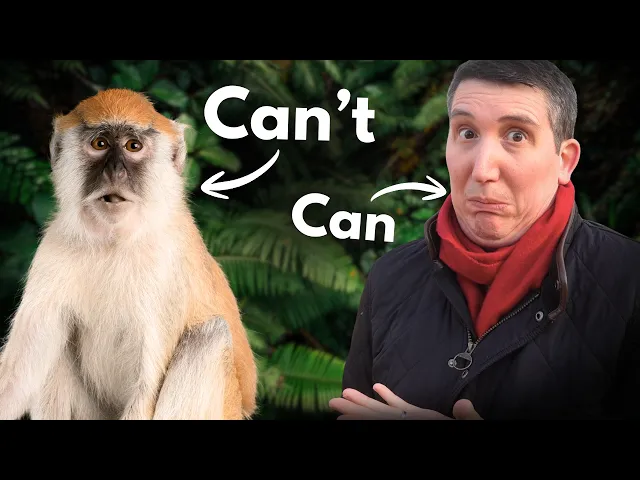
Why animals can't talk (but almost can)
RobWords
0:00 What would it sound like if a monkey proposed?
0:03 "Will you marry me?" How would an elephant call your name?
0:07 Can parrots really speak?
0:09 And does the giraffe have anything to say at all?
0:13 You're about to find out as we
0:15 explore the spoken language of the animal kingdom.
0:18 It's time to talk with the animals in another RobWords.
0:24 These are the Barbary macaques at Berlin's Tierpark Zoo.
0:29 Did you know that no nonhuman primate has ever been taught to speak?
0:34 You've perhaps seen videos of Nim Chimpsky,
0:37 the chimpanzee who was raised to use American Sign Language,
0:42 and other members of that species have
0:45 found remarkable ways to communicate with us.
0:48 [Video narrator] “Tim, please tickle Lana.” “Yes”, replies Tim.
0:55 “Lana, come here.” [Rob] That's absolutely incredible, isn't it?
1:00 But it's not speech.
1:02 It's not vocal language.
1:04 And one of the reasons that a chimpanzee has never
1:06 said a word is that their anatomy makes it basically impossible.
1:11 They lack the long vocal tracts that we have,
1:14 the versatile tongues for shaping the sounds, and also the mouths that we have,
1:19 which are kind of small but enable us
1:22 to control the noises we make with incredible precision,
1:27 when you think about it.
1:29 But they also don't appear to have the neural
1:32 wiring that allows us to make these complex, voluntary sounds on demand.
1:38 However, research conducted within the last decade suggests some primates,
1:44 if they could get over that sizable neurological hurdle,
1:48 might be physically speech ready.
1:51 In 2016, researchers set out to challenge the idea that monkeys,
1:55 specifically macaques like we have here at the Tierpark,
1:59 couldn't speak if they wanted to.
2:01 So instead of– as had been previously done– poking
2:04 around the vocal tracts of dead or sedated monkeys,
2:09 they took X-ray footage of macaques doing
2:13 various things like eating and making sounds.
2:17 And from that, they tried to work out
2:20 what sounds the macaque might be capable of making,
2:23 given the amount of different movements that their vocal
2:27 tract and their mouth could actually perform.
2:30 And what they concluded was that it was a lot.
2:34 They said “if a macaque monkey had a brain
2:37 capable of vocal learning and combinatoric operations over speech sounds,
2:42 its vocal tract would be able to produce clearly intelligible speech.” So
2:49 the researchers reckoned that the macaques would be able to make, for a start,
2:53 five different vowel sounds,
2:55 which maybe doesn't sound like very much– English has a lot more than five–
3:00 but actually five vowel sounds is around
3:02 about the average for languages around the world,
3:05 so that wouldn't get in the way of them being understood by humans.
3:08 They also reckon that they'd be able to produce
3:10 quite a lot of consonant sounds as well.
3:12 What are called stop consonants like “kuh” and “guh”, like that.
3:16 And then other sounds as well, like “wuh” and “muh”.
3:20 They'd have been capable of producing those.
3:23 So you might be wondering: “If a macaque could talk,
3:26 what would it sound like?” Well,
3:29 the researchers anticipated that question and attempted to recreate that sound.
3:35 I'm going to warn you here: this is creepy.
3:38 This is what a macaque would sound like if it got down on one knee and proposed.
3:44 “Will you marry me?” And again.
3:46 “Will you marry me?” Yeah, like I say, a bit creepy.
3:51 And did you also detect a slight sort of accent in there?
3:55 “Will you marry me?” Now,
3:56 that's because of what I was talking about, about the vowel sounds.
3:59 So English has anywhere between fifteen and twenty something vowel sounds,
4:04 depending on who you ask.
4:07 And so if a macaque could only actually produce five vowel sounds,
4:11 it would have to re-appropriate some of those sounds and apply
4:15 them to some of our vowel sounds that it doesn't have.
4:17 And that's how you end up with a macaque that sounds a little bit exotic.
4:23 “Will you marry me?” It's comprehensible, isn't it?
4:26 But it is also extremely hypothetical.
4:29 These macaques might have speech ready bodies,
4:32 but they do not have speech ready brains.
4:36 So let's talk about some of the remarkable things
4:38 that some monkeys already do because they are worth talking about.
4:42 These are vervet monkeys and unusually for monkeys,
4:45 they like to spend their time on the ground,
4:48 but that makes them susceptible to threats
4:50 that other monkeys are less likely to experience.
4:53 However, they've come up with a very
4:55 clever way to deal with that additional threat.
4:58 This lookout vervet will make a different sound depending on what the danger is.
5:05 For example, this sound means, “Snake!
5:10 Watch out!
5:10 Stand up and look down.” This sound means, “Watch out!
5:15 Eagle!
5:15 Get deep into the trees where the birds
5:19 can't fly at you.” And this sound says, “Careful!
5:23 Leopard!
5:24 Get into the trees and get to the end of the branches so that big cat
5:30 can't grab you.” Each of these sounds carries
5:32 a different meaning and triggers a different behaviour,
5:35 making them almost like words.
5:40 However, “almost” is the key word there because they
5:43 are not words for reasons that I will explain.
5:47 Now when you think of whalesong, you perhaps think of this.
5:51 [Whale] WhoooOOooooOOoo.
5:52 However, they don't all communicate like that.
5:54 Sperm whales, for example, communicate exclusively with clicks.
5:59 And an amazing bit of new research suggests that what they do
6:02 with those clicks might be remarkably similar to something that humans do.
6:08 Thanks to this video's sponsor, Ground News,
6:10 I can see that researchers at UC Berkeley studied around nine thousand
6:14 recordings using AI models described as “ChatGPT
6:18 for whales” to identify vocal patterns,
6:21 and what they concluded was that sperm whale clicks appear to work
6:25 like the vibrations that create human vowel sounds, just much slower.
6:32 It challenges the previous idea that these clicks were some sort of Morse code.
6:37 Pretty cool.
6:39 Ground news is a website and app
6:41 that brings together news sources from around the world,
6:43 and helps you to understand the coverage.
6:46 On the sperm whale story alone, it found eighteen articles,
6:49 and for each one it tells us important information about the outlet,
6:52 such as who owns it, any potential political bias,
6:56 and most importantly, how reliable it is.
6:59 For example, it rates Smithsonian mag as Very High Factuality,
7:02 meaning you can have confidence when reading it.
7:05 I've been working with Ground News for years now,
7:07 because I think it's never been more important to understand
7:10 who your news sources are and whether they can be trusted.
7:14 And ground News gives you all of the tools you need to do that.
7:18 If you want to get access to it,
7:20 go to ground.news/robwords or use my QR code to get 40% off the Vantage Plan,
7:25 which is what I use.
7:27 That's around $5 a month.
7:30 Give it a go.
7:32 So we've heard how macaques might be able to make sounds like humans,
7:37 and how the clicks of sperm whales are like a very slow vowel movement.
7:42 But there are animals that can produce
7:45 sounds that sound almost exactly like human speech.
7:48 In fact, they can be indistinguishable.
7:51 I'm talking about birds.
7:53 Now, I was hoping to show you a few here at the Tierpark,
7:56 but because of an outbreak of bird flu in Europe,
7:59 they've kept them all safely inside.
8:01 However, let's talk about these guys.
8:05 Let's talk about parrots, because parrots are the closest thing we
8:11 have to a non-human animal that can speak.
8:15 Would you like to hear an African grey
8:18 parrot reciting parts of the Quran in Arabic?
8:21 Yes.
8:21 Here you go.
8:23 [Mudalal the parrot speaking Arabic] An even more impressive
8:31 African grey called Alex is said to have been
8:34 the first non-human to ask an existential question when
8:39 one day he looked in the mirror and said, “What color?” The answer was grey.
8:46 So parrots can produce speech-like sounds,
8:48 but they do it in a different way to we do it.
8:53 So we have a larynx at the top of our trachea, right?
8:58 So we have air that goes up and then
9:00 through the voicebox and then out through our mouths,
9:03 and that's how we make sounds.
9:05 Birds have something else.
9:08 They have something called a syrinx instead of a larynx,
9:10 which sits at the bottom of the trachea and manipulates
9:14 the sound down there before sending it up through the windpipe.
9:18 And usually that comes out as a squawk or whatever.
9:22 But with parrots, they, like us,
9:24 have very versatile tongues that can further manipulate the sound,
9:29 and they have beaks that they can open or close just about as much as they want,
9:34 again giving them more control over the sound.
9:38 This means they can essentially talk …but they're not talking.
9:44 Now, Alex was sadly cut down in his prime in 2007 at the age of just 31.
9:50 They can live twice as long as that.
9:52 He had more to learn.
9:53 But his legacy was leaving linguists to reassess whether
9:58 humans really are the only animals that can truly speak.
10:03 So let's talk about what human language does that other animals don't achieve,
10:08 because linguists have put a lot of thought into this.
10:12 Back in 1960, a fellow called Charles
10:15 Hockett proposed thirteen design features for language.
10:19 It was a list of thirteen things that make languages languages.
10:24 Now, nowadays they are best described as features of spoken
10:28 language because in the 65 years since Hockett published his list,
10:32 sign languages have been rightly recognized as fully fledged languages,
10:36 despite not having all of these features.
10:40 Now, Hockett didn't intend his list to be
10:42 used to compare humans and other animals, but by looking at it,
10:45 we can see that there is, at the very least,
10:48 a trio of these thirteen features that no
10:52 non-human species has managed to nail down.
10:55 Firstly, what he called “traditional transmission”.
10:58 Languages are transmitted non-genetically by social learning and teaching,
11:03 whereas animals, their noises tend to be wired in their instinctive.
11:08 Though we have taught other animals to say things,
11:11 they haven't taught these things to each other.
11:14 The second feature is “displacement”.
11:15 This is a really key one.
11:16 It's the ability to talk about things that are not present in the here and now.
11:20 Humans can say, “I saw a dog yesterday.” Other animals cannot.
11:26 And a third is “productivity”.
11:29 The fact that human language is inexhaustive.
11:32 I can right now say a sentence that has never been uttered before:
11:37 “My ginormous aardvark just bikini-waxed a bison.” And what's more,
11:43 you can understand it.
11:45 The possibilities are endless.
11:47 Whereas with animal sounds, they're limited to a specific repertoire.
11:52 At the same time, that repertoire can be pretty impressive.
11:56 Some animals are capable of noises that we couldn't even dream of.
12:00 Elephants, for example, can produce sounds so deep that we can't even hear them,
12:06 let alone replicate them.
12:08 I'm going to come out of there because it's a bit silly.
12:10 But when you think of elephants, you probably think of trumpeting trunks.
12:16 But that's not actually the sound that keeps elephant societies together.
12:20 That is the elephant rumble.
12:24 Elephants produce deep rumbling sounds that can
12:27 travel huge distances and say things like,
12:30 “Hey, I'm over here!” to other elephants in the vicinity,
12:34 or “Guys, it's time to go.” when the herd
12:37 has finished its brief stop at the watering hole.
12:40 But what's amazing about these rumbles is that often they are infrasonic.
12:47 That means they occur at frequencies that are
12:50 below the levels that humans can hear.
12:53 We know when they're being made a lot of the time
12:55 because they produce harmonics that we actually can hear.
12:58 But the sounds themselves, most of it is inaudible to human beings.
13:03 But recent research suggests that one of the things
13:05 the elephants are doing with these rumbles is remarkably human-like.
13:10 It suggests they're calling each other by name.
13:15 The researchers at Colorado State University said that “African
13:20 elephants address one another with individually specific name-like calls”.
13:26 I'll allow them to explain.
13:28 “We played back calls that we had high confidence,
13:31 that had names and and calls that we
13:33 had high confidence that they weren't, uh, labeled.
13:37 And we played those back to individuals.” [Low rumbling sound] [Low rumbling
13:45 response] “And we found responses to the calls that we assumed had
13:50 a good chance of vocal labeling.” Not only that, but when the Elephant
13:54 was played a clip that featured the name of a different elephant,
13:58 they just ignored it because it wasn't addressed to them.
14:02 Now, with all this name stuff, you might be thinking,
14:05 “Yeah, well, other species do that too.” Well, yeah, but no.
14:09 Not like this they don't.
14:11 Dolphins and parrots call each other by “name”
14:14 by actually imitating the signature call of the addressee.
14:19 It's like calling Homer Simpson “D’oh!” instead of calling him Homer.
14:25 But what elephants are doing is creating
14:29 these abstract sounds to refer to specific individuals.
14:34 It's amazing because it's what we do.
14:38 That's exciting, isn't it?
14:39 But do you know what else is exciting?
14:42 That I am doing my first ever live show.
14:46 RobWords Live is coming to London's Bloomsbury Theatre on 11th April, 2026.
14:53 I am extremely excited about it.
14:55 It's going to be an evening of etymology and general word nerdery.
14:59 If you want to join me for it and let me see that lovely face of yours,
15:03 I'll leave a link below to where you can buy tickets.
15:06 Come join me for RobWords Live.
15:09 Now if you spend a lot of time in the forest,
15:11 as I clearly do, you'll be well aware of the call of the red deer.
15:17 However, did you know that red deer stags actually have two types of calls?
15:22 They have what zoologists call their “common roar”,
15:24 the one unsurprisingly, they use most often,
15:27 and they also have their “harsh roar”,
15:29 which is the one that they use a bit more sparingly.
15:32 It's, as the name suggests, harsher on the ears and is most likely used
15:37 for grabbing the attention of ladies during the rut.
15:40 I don't know why I said that in a sexy way.
15:42 The common roar is actually really fascinating though,
15:45 because it is distinct to the individual and intrinsic to the sound
15:50 is objective information about the stag who is emitting it,
15:55 including an honest appraisal of the stag's size.
16:00 That means that despite the image we like
16:02 to think of, of stags going antler to antler,
16:05 they actually don't come to blows as often as they might,
16:09 because from the roars alone,
16:11 two stags can establish who would win if they did fight.
16:16 And usually that's enough to encourage the lesser stag to just,
16:20 you know, leave it out.
16:22 So a roaring stag might seem like it's spoiling for a fight,
16:25 but actually it might just be trying to avoid one.
16:29 So the stag roars, the elephant trumpets or grumbles,
16:33 the cat meows and the dog barks.
16:36 But what does the giraffe do?
16:40 Well, let's talk about an animal from whom we barely hear a peep,
16:43 because actually, giraffes are capable of making sounds.
16:47 Well, firstly, they can snort, they can produce bursts,
16:52 and as this video shot right here at Berlin's Tierpark shows,
16:56 they can also grunt.
16:57 Just listen carefully for it.
17:00 [Brief snort] [Replay of snort] But it is true that you
17:06 will very rarely hear an adult giraffe make a sound.
17:09 And that's weird, because giraffes are pretty sociable animals,
17:14 and animals with similar social structures like elephants,
17:17 can barely keep a lid on it.
17:19 So what's the deal with giraffes?
17:22 Well, it was thought that one of the reasons they don't make
17:24 a lot of sounds is that they can't because of their long necks.
17:27 It somehow makes getting the sound up and out there a bit harder.
17:31 And it's also thought that maybe they're doing what I was saying elephants do,
17:35 which is make ultrasonic sounds that we can't hear.
17:39 There are certain movements that giraffes make that seem a little bit bizarre,
17:43 but some zoologists think might be associated with production
17:46 of a noise that our ears don't pick up.
17:49 However, research carried out here in Berlin
17:52 and at two other zoos in Copenhagen and Vienna,
17:56 found that giraffes were making another
17:59 noise that we previously didn't know about.
18:02 They were humming to one another.
18:05 The researchers set up microphones in the stalls
18:08 where they put the giraffes here at night,
18:11 and they recorded hundreds of hours of audio.
18:14 And in among those hundreds of hours of basically silence, they heard this.
18:22 [Deep humming sound] Okay, so it sounds like someone having trouble
18:34 on the toilet in the middle of the night.
18:38 [Replay of deep hum] But that sound is remarkable.
18:40 And it only occurs sixty five times in the nine
18:44 hundred hours of audio that the researchers recorded.
18:48 But they describe that hum as probably a contact call,
18:53 a sound made by the giraffes to reassure each
18:56 other from their separate stores that they're still there.
19:00 So the lion roars, the elephant trumpets, and the giraffe does what?
19:05 Well, it hums.
19:08 And that brings to an end our conversation with the animal kingdom.
19:12 But one key question remains, doesn't it?
19:15 If animals can't speak, why can we?
19:18 Well, that's a question that I will answer on this channel in the coming months,
19:22 so do keep an eye out for that.
19:25 Thanks to Tierpark Berlin,
19:26 Colorado State University and Professor Julian Pine from Liverpool
19:30 University for all their help with this video.
19:33 Thanks to you for watching it as well.
19:35 I recommend you maybe watch this one next.
19:39 Check out Ground News and of course RobWords Live tickets in the links below.
19:44 And until next time, take care.