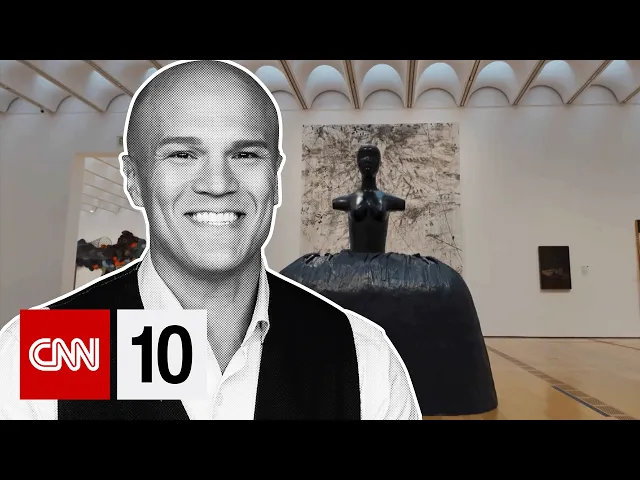
Curators and Curiosity: The many careers that bring art museums to life | March 25, 2026
CNN 10
0:11 Hello and welcome to the show.
0:13 I'm Coy Wire.
0:14 It is Wednesday, March 25th.
0:15 It is also your word Wednesday here on CNN 10.
0:18 So, listen up.
0:19 See if the vocabulary word that you submitted helped us write today's show.
0:23 Let's get to it.
0:24 We begin with the ongoing chaos at airport
0:27 security lines across the United States this week.
0:30 Mostly a result of the partial government shutdown,
0:32 which is now in its second month.
0:34 As of this taping, lawmakers are still working towards
0:37 a funding deal to reopen the Department of Homeland Security.
0:40 The issue at the center of the shutdown and is causing
0:44 extreme delays and frustration at some of the country's busiest airports.
0:48 At Houston's George Bush Intercontinental Airport,
0:51 travelers have faced long lines at all hours of the day
0:55 with warnings that wait times could exceed 4 hours.
0:58 At Atlanta's Hartsfield-Jackson International Airport,
1:01 the busiest airport in the world by passenger volume,
1:05 lines snake through baggage claim all the way outside at times.
1:09 Officials stopped posting wait times because lines
1:12 were too long for computer systems to track.
1:14 This is insane.
1:16 We didn't think it was going to be this bad.
1:18 I got there 3 hours early and I made it
1:20 to my gate like 20 minutes before they were boarding.
1:23 It was bad.
1:24 The delays are largely due to a growing number
1:27 of Transportation Security Administration or TSA officers calling off.
1:32 They haven't been paid in more than a month
1:34 and many say they needed to find part-time jobs.
1:37 DHS says more than 450 officers have quit since the shutdown began.
1:42 Many have continued working without pay.
1:44 Some relying on things like food banks to get by.
1:47 My son usually goes to spring break camps
1:50 and I can't afford that right now because I mean,
1:53 there's no money coming in and it's just I don't know what to do anymore.
1:57 There's no babysitter.
1:58 I might to my last like almost $100.
2:02 On Monday, the federal government deployed Immigration and Customs
2:05 Enforcement or ICE agents to some of the hardest-hit airports.
2:09 ICE agents are considered essential employees and are paid during shutdowns.
2:13 Officials say more could be deployed this week
2:16 to support TSA with things like crowd control.
2:18 This is about going to helping TSA do their mission and get the American public
2:23 through that airports quicker as they can
2:24 while while adhering to all the security guidelines.
2:27 Some critics, including TSA workers,
2:30 appear skeptical that the move will help improve an already untenable situation.
2:35 I don't believe that they're trained in a way
2:36 that they can help us since I've been here,
2:39 I've seen them outside standing around.
2:42 I don't know if if they are doing anything, I don't know.
2:45 I guess the question that now has to be asked is this going to be the new norm?
2:49 You know, is is every weekend, you know,
2:51 going to be a 5-6 hour wait at the checkpoints
2:54 to get get on your flight if you can even make it.
2:57 I do say that I think they should just
2:59 find uh Department of Homeland Security, pay those workers.
3:02 They're here for a reason.
3:04 Protect us every day and I don't think ICE agents
3:08 should really be up there just filling in the hole.
3:11 Pop quiz, hotshot.
3:12 Which layer of the atmosphere contains the oxygen
3:15 and nitrogen humans and animals use to breathe?
3:17 Troposphere, mesosphere, thermosphere, or stratosphere?
3:24 If you said troposphere, you're a breath of fresh air.
3:27 The stratosphere protects our planet from harmful UV rays,
3:30 but pollutants like vehicle emissions and burning fossil
3:33 fuel can damage both layers of our atmosphere.
3:37 A newly released global study is sounding the alarm
3:39 on the global rise in air pollution in certain cities.
3:43 The report from IQAir analyzes air pollution data from 9,500 cities
3:48 in 143 countries with a 23% jump in unhealthy air particles.
3:54 The report ranks Loni, India as the most polluted city on the planet,
3:58 likely driven by dust storms,
4:00 seasonal smog, industrial emissions, and crop burning.
4:04 Only about 14% of cities worldwide met
4:07 the World Health Organization's air quality guidelines in 2025,
4:11 down from 17% the year before.
4:14 But the good news is there are plenty of cities
4:16 and countries taking care of the air up there.
4:18 According to NOAA and NASA,
4:20 scientists say the hole in the ozone layer is shrinking.
4:24 Last year, it was the fifth smallest since 1992.
4:28 A survey of largely unexplored limestone caves in northwestern
4:32 Cambodia has just uncovered a range of new species.
4:35 They include a turquoise pit viper, a flying snake,
4:39 several geckos, two micro snails, and two millipedes.
4:42 The conservation charity Fauna and Flora surveyed the region
4:46 between November of 2023 and July of 2025.
4:50 It explored 64 different caves across 10 hills.
4:54 Our next musings take us to the museum with a behind-the-scenes
4:58 look at the High Museum of Art in Atlanta.
5:01 Turns out there are a lot of career paths
5:02 available to those of us with an interest in art.
5:05 We got to explore one exhibit that blends fashion, creativity,
5:09 and innovation and learn the different careers
5:11 that bring big ideas from runways to museum floors.
5:15 Check it out.
5:18 [music] Here at the High Museum in Atlanta, Georgia, if you love art,
5:21 did you ever think about making a career out of it?
5:23 Creativity isn't just in the art we see.
5:26 It's something some people do [music] for a living.
5:29 From bold fashion exhibitions to hands-on learning programs,
5:32 [music] a whole team works behind the scenes
5:35 to make art meaningful for visitors of all ages.
5:38 One of their most eye-catching [music] projects was the Viktor& Rolf fashion
5:42 exhibition and we got to learn about the work behind the wow.
5:47 They create these designs that are sculptures.
5:50 So, they push the edge and they're very theatrical.
5:54 They're very unexpected, upside-down dresses and perforated things and things
5:59 that a lot of people say to me, "That's impossible to wear." And I said, "Yeah,
6:02 they want to challenge you to think about what fashion
6:05 is and fashion as sculpture." And that I think is
6:08 a very [music] big part of what we wanted to convey
6:11 here at the High is that sure, fashion is art.
6:15 Absolutely.
6:15 [music] It's design, but it is also art.
6:18 And when you walk through these galleries,
6:20 we wanted you to feel it was almost like a theatrical production or an opera.
6:25 From vision to fruition.
6:29 Immediately we begin working with our in-house exhibition designer
6:33 and her team to envision what this is going to look like.
6:36 What are the paint colors?
6:39 [music] Where is the music going to be playing?
6:40 How do all of these sort of technological aspects,
6:43 how are those integrated into the exhibition for our venue?
6:47 Months of design, construction,
6:49 and collaboration helped bring the international show from Munich to Atlanta.
6:55 But exhibitions are only part of the museum's mission.
6:58 I work in our learning and civic engagement department and it's
7:01 my job to try to make us a more thought-provoking institution.
7:06 So, my job is to research, to learn more about our visitors.
7:09 Her work focuses on how people,
7:11 especially young visitors, connect [music] with the art.
7:14 I'm so wowed by the personal connections these young people make, you know,
7:18 with these works of art because it's not so
7:20 much about exactly what the artist wanted you to know,
7:23 that intent, but it's what the artist made you feel.
7:27 And young people are so open and so they make amazing connections.
7:30 [music] I almost always learn something new when I talk to kids in front of art.
7:34 Just like these awesome students we ran into on a field trip.
7:38 Rise up!
7:41 [screaming]
7:40 Museums rely on many careers, from educators to event planners to storytellers.
7:45 It's a business, right?
7:46 So, we need a a chief of financial officer.
7:49 We need accountants, right?
7:51 We need people who are great at logistics and can help us manage a huge event.
7:55 Um people who raise money.
7:56 People who um know how to tell a great story.
8:00 We have a big PR and marketing department.
8:02 That's an important part of our business.
8:04 So, it's a there's a lot of different kinds of jobs at an art museum.
8:08 For chief curator Kevin Tucker,
8:09 that career began with curiosity about how things are made.
8:13 And [music] even as technology evolves,
8:15 Kevin says human creativity remains irreplaceable.
8:19 AI is just another tool in the toolbox and I
8:22 think it has to draw from existing bodies of creativity,
8:26 existing bodies [music] of work.
8:28 But what I think is so very special about
8:31 the individual's interaction with art in the creative process is just
8:35 that, individuality and the individual expression I think is always going
8:40 to be conveyed by those works that are touched by individuals.
8:44 The museum's goal to leave visitors inspired
8:47 to see the [music] world in a new way.
8:49 What's the one thing you hope people take away from this exhibit?
8:53 I'm going to say two.
8:54 Okay.
8:55 And that's excitement and curiosity.
8:57 And I think if you're curious, excitement follows.
9:01 You know, that's one of those things [music] because
9:02 you're discovering new things as you walk through the galleries.
9:06 And it's always been my hope that visitors walk away and go, "You know what?
9:09 I want more.
9:10 I want to know more about art and I want to be involved in that." So,
9:14 if they walk away excited and curious, I'm happy.
9:24 Today's story getting a 10 out of 10,
9:26 a group of students from Bangor, Maine reaching for the stars, literally.
9:30 We're sending yeast to the stratosphere.
9:32 The science project called Yeast in the Stars will expose active baker's yeast
9:37 to UV radiation and freezing temperatures
9:40 and then measure the changes back on Earth.
9:42 It's all part of NASA's TechRise Student Challenge,
9:45 a nationwide competition where students design real experiments
9:48 for flights from high-altitude balloons to suborbital spacecraft.
9:54 These students are one of 25 teams selected.
9:57 I was super duper happy when I uh heard that our school won.
10:01 Students built the project themselves, learning skills like coding,
10:05 soldering, and engineering along the way.
10:07 We're learning how to solder.
10:09 We're learning hands-on stuff.
10:10 Wiring, and they're learning a lot, too.
10:12 And mounting is it's amazing.
10:15 The team presents its work to NASA in May,
10:18 turning a classroom idea into a real mission in motion.
10:22 All right, superstars, we have a shout-out going to Ms.
10:25 DeJarnette at the Arts Based School in Winston-Salem, North Carolina.
10:29 Thank you for making us part of your day.
10:30 Rise up.
10:31 Thanks to everyone subscribing and commenting
10:34 on our socials and our CNN 10 YouTube channel.
10:36 You make this the best 10 minutes in news.
10:38 And we would be remiss if we did not give
10:40 a huge congratulations to our Your Word Wednesday winners, Mr.
10:44 Galati's class at Acadia Middle School in Clifton Park,
10:47 New York for submitting untenable, an adjective meaning unable to be defended,
10:52 maintained, or justified against criticism.
10:54 Thank you for increasing our vocab today.
10:57 I'll see you tomorrow, everyone.
10:58 I'm Coy Wire, and we are CNN 10.