So... We Aren't Even Trying To Hide it Anymore?
How Money Works
0:00 Earlier this week, the president announced on True Social that there had
0:03 been productive talks with Iran to deescalate the situation in the region,
0:06 which inferred a loosening of shipping traffic in the street of Hermuz,
0:10 which in turn meant the potential for lower oil
0:12 prices and a more positive outlook on financial markets.
0:14 Now, putting to the side for a second that these productive
0:18 talks may or may not have happened at all.
0:20 What actually got people's attention was
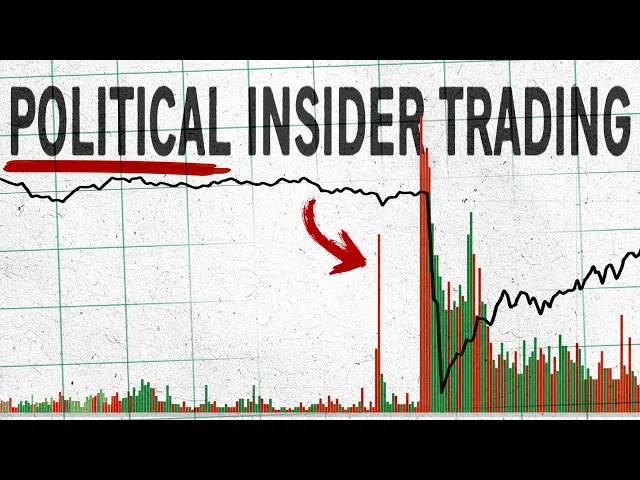
0:22 that just 16 minutes before this announcement,
0:23 there was a huge spike in futures trading within these markets.
0:27 clearly suggesting that someone on the inside knew what
0:29 was about to happen and was profiting off it.
0:32 Depending on the details of the trades,
0:34 this mystery speculator could have made as much
0:36 as $60 million within the span of 20 minutes.
0:39 But perhaps this isn't surprising to you anymore.
0:41 Insider trading has effectively become the expectation in Washington
0:44 at this point as everyone from senior elected
0:47 officials all the way down to junior public servants
0:50 consistently outperform the top hedge funds on the planet.
0:53 It's not great, but well, people have just become numb to it.
0:57 These days, it's barely worth reporting on.
1:00 It's obviously immoral at best and borderline treasonous at worst.
1:03 But at this point, we know nothing is going to be done about it.
1:07 And with everything else going on, it is easy
1:09 to assume that in the grand scheme of things,
1:11 this isn't actually hurting us individually as much
1:13 as everything else in the economy at the moment.
1:15 Most people don't really have stock investments worth worrying about.
1:18 And even if they did,
1:20 it's hard to see the impact this kind of cheating actually has.
1:24 This disheartening indifference is part of what makes
1:27 this week's lucky trade in particular so interesting.
1:30 People actually cared about it.
1:31 And there were probably two reasons for this.
1:34 First, it was happening in a market that was clearly hurting them right now.
1:38 Someone making life-changing amounts of money
1:40 speculating on oil prices just inherently doesn't
1:42 sit right while most people are struggling to put gas in their cars.
1:46 The second was simply how brazen it was.
1:48 The only reason we even know this happened at all was because whoever they are,
1:53 they made trades with hundreds of millions of dollars
1:55 in notional value within the span of just 60 seconds.
1:58 And they did it 15 minutes before the market altering announcement.
2:01 The point is that if this was insider trading,
2:04 they didn't even have the common decency
2:06 to spread their trades out over a few hours.
2:09 If they did, there is a good chance we would never even know.
2:12 Instead, they are literally giving us the bird with trading volume.
2:15 Now, this particular example may be infuriating,
2:17 but if there is some good that may come of it,
2:21 it is showing that this happens all the time.
2:23 The insiders are usually just a little bit better at hiding it.
2:26 Looking back at a few of the key changes that have enabled
2:29 what should be shameful behavior to become so blatant is the first step,
2:33 but this itself also raises some much more important questions like,
2:37 well, how much money has actually been made off political insider trading?
2:41 And more importantly, how much is all of this actually costing you?
2:45 Now, should members of Congress be allowed to trade stock?
2:48 Well, a bipartisan group of lawmakers says no
2:50 to ban members of Congress from trading stocks.
2:53 We heard from Representative Tim Burchett of Tennessee before the first
2:56 hearing on this in the House in more than 3 years.
2:59 spike in oil prices overnight really suggests that markets believe this conflict
3:03 could last longer than initially in expected and there are plenty of reasons
3:08 for that over the weekend in terms of escalatory rhetoric by the US
3:12 and we uh still have this restriction on the movement of oil and gas.
3:17 So if you pay attention to a lot
3:19 of market moving announcements you will notice that a lot
3:21 of them follow a similar pattern and once
3:23 you see it it becomes pretty hard to ignore.
3:26 On Friday, the 23rd of May, the White House announced 50% tariffs on EU goods,
3:30 sending panic into the markets that had already closed for the night.
3:34 Then on the 25th of May, the tariffs were delayed and the language softened,
3:37 resulting in a massive rebound.
3:39 The indefinite suspension of Mexico tariffs were announced on a Monday morning,
3:43 while a new 100% tariff on Chinese goods were announced on a Friday night.
3:47 Strikes on Iran started late on Friday here in America
3:50 and the military operation in Venezuela was either late
3:53 on a Friday night or early on a Saturday morning
3:55 depending on what side of the country you were on.
3:58 Then of course the market rally this week was driven by the announcements
4:02 about deescalating the uh ongoing situation that was first started on a Friday.
4:06 All of these are also just examples from the last 12 months.
4:10 The blindingly obvious pattern is that good
4:12 news announcements will be made on Monday morning, right before markets open,
4:16 and bad news will be buried at the end
4:18 of the week after markets have already closed.
4:20 Now, this isn't actually anything new or even that partisan either.
4:24 Before the 24-hour news cycle, it was simply considered good politicking to dump
4:29 bad news on a Friday afternoon after newsrooms had
4:31 submitted their prints and leaving enough time that it
4:34 would be old news on a Monday morning.
4:36 But today, as the market has become
4:37 a live updated indication of national competence,
4:40 for some reason, these incentives have clearly
4:43 shifted in ways that are directly profitable.
4:45 Every single one of the major announcements listed
4:48 in this video so far came with suspicious corresponding trades.
4:51 And this has only become easier for two reasons.
4:54 The first is that bet on everything markets utilizing
4:57 cryptocurrencies have made it easier to well bet on everything.
5:01 In the past, if you had privileged knowledge about most events,
5:04 it was difficult to actually turn that into a profit on financial markets.
5:08 These platforms have also made these bets harder to track for those people
5:11 who are important enough to be entrusted with some insider knowledge,
5:14 but are not yet important enough to be above the law.
5:17 The second reason is that Washington is simply creating
5:20 more market moving noise than it ever had before.
5:23 Just from a financial perspective,
5:24 government spending now represents a higher share of GDP in a given
5:28 year than it did at the height of the Second World War.
5:31 Even beyond that, while we may have become desensitized,
5:33 massive stimulus measures, global trade altering tweets,
5:36 and Fed policy meetings getting hundreds of thousands
5:39 of live viewers is really not normal.
5:41 And more so than ever before,
5:43 financial performance is very closely tied to government decisions.
5:46 A study published by the International Review of Economics and Finance
5:49 found that financial instability was marketkedly
5:51 higher when Congress was in session.
5:53 And it also found that this was when they did a vast majority of their trading,
5:57 which was a surprise to well, absolutely nobody.
6:00 And well, yeah.
6:01 The third reason is probably exactly what you already were thinking,
6:05 which is that even for the individuals who have
6:08 been identified as clearly abusing their positions for personal profit,
6:11 the punishments have been very light.
6:12 both from a legal perspective and in terms
6:14 of how much it affects their chances of re-election.
6:17 Again, people have become so numb to this that for a lot of outlets,
6:21 it's barely worth reporting on.
6:22 In fact, I will admit that I almost fell into the same trap.
6:26 When this market activity started gaining attention,
6:28 I almost brushed it off as simply being business as usual.
6:31 But then something changed.
6:32 People actually gave a[ __] The attention
6:36 this particularly egregious insider trade is
6:37 getting is a great excuse to shine a spotlight on the wider problem
6:41 to show just how much these games are making for the people
6:44 that play them and to work out how much this is all costing you.
6:48 So, it's time to learn how many works to find
6:51 out why aren't they even trying to hide it anymore.
6:54 This video is sponsored by ODO.
6:55 If you're running a business and you're still managing your sales in one app,
6:59 your inventory in another, and you're accounting somewhere else entirely,
7:02 you're basically running three businesses at once,
7:04 and none of them are talking to each other.
7:07 ODU brings all of that into one platform.
7:09 Your CRM, accounting, sales, inventory, manufacturing, marketing,
7:12 all sharing the same data automatically, so nothing falls through the cracks.
7:17 When a sale comes in, ODO doesn't just log it.
7:20 It reserves your stock, schedules production, generates the invoice,
7:23 and updates your books without you having
7:25 to manually bridge the gap between five different tools.
7:28 It tracks your inventory in real time,
7:30 and sends you automated purchase suggestions before you run low.
7:33 So, you're never scrambling to restock at the worst possible moment.
7:37 And the best part is you only install the apps you actually need.
7:40 So, whether you're a oneperson operation or managing a full team,
7:43 you can start lean and scale up as your business grows.
7:46 You can try the full platform free for 15
7:49 days with no credit card required or use
7:51 any single app free forever whenever when you
7:53 sign up using the link in the description.
7:55 All right, so one of the reasons why people may be so ambivalent
7:58 about things like congressional stock trading
7:59 is because it doesn't clearly impact them.
8:01 A vast majority of shares and other financial assets
8:04 in our economy are already owned by already very wealthy households,
8:07 large institutions, or foreign investors.
8:09 The kind of front-running insider trading
8:11 that has allowed Congress to effectively
8:13 double the return of the stock market might be a zero- sum game,
8:17 but the indirect losses the market bears to fund their gains are spread out over
8:20 a lot of people who probably won't feel it in the grand scheme of things.
8:25 Now, this is not to excuse this behavior,
8:27 but instead it is to show why it's become so easy to ignore,
8:30 but just tracking the data,
8:32 or at least the data we are actually allowed to see by going
8:35 back through Stock Act disclosures can give us some really interesting insights.
8:39 The first and perhaps most important point
8:41 in this data is that active traders in Congress,
8:43 as in people who are frequently buying and selling
8:46 assets or using complex financial instruments like derivatives,
8:49 are in the minority.
8:50 At least from the official disclosures,
8:52 most house reps and senators largely have buy
8:54 and hold portfolios with the occasional trade here
8:57 and there that wouldn't really be considered outside
8:59 the ordinary for most relatively wealthy career professionals.
9:01 Now, that might sound like I'm devil's advocating a bit here,
9:05 but it's actually the opposite.
9:07 It instead shows that the outperformance in congressional stock trades
9:10 are largely driven by a small group of extremely active traders.
9:14 In fact, most of these elected officials actually
9:16 did worse than the market as a whole.
9:18 According to the data that has been disclosed from 2025,
9:21 just under a third of congressional portfolios outperformed the S&P 500,
9:25 but that was the same year where Congress as a whole was
9:28 up over 20% above the already strong returns of the broad market.
9:31 In plain English, what this means is that there are a few dozen
9:35 elected officials who are making absolute
9:36 bank and pulling up the average considerably.
9:38 Congress as a whole on average is now making over 10,000 trades a year,
9:43 largely concentrated amongst just a handful of people.
9:46 The median number of trades made by a congressperson was just three,
9:49 raising the question of how these other people have time to do anything else.
9:54 Now, I know this goes against the narrative that all of them are in on it,
9:57 but that's actually a good thing.
9:59 It shows that people who are clearly gaming the system are a minority
10:02 and that we can actually hold these officials to a higher standard.
10:06 But before you get too optimistic,
10:08 remember this is still a how money works video.
10:10 So the second thing we found when we compiled this data
10:13 is who those Congress members making all of this money actually were.
10:16 The reality is that it was largely more senior
10:19 Congress people who were sitting on lots of committees.
10:21 And almost every year since these disclosures were introduced,
10:24 the party that has controlled the House outperformed the party
10:27 that was in the minority on their stock trades.
10:29 These special committees give them access to even
10:31 more information than they would get as regular lawmakers,
10:34 letting people like Nancy Pelosi trade in Nvidia while shaping the chips
10:38 act or Tommy Tuberville dabbling corn
10:40 futures while serving on the Agricultural Committee.
10:42 Now, mercifully, much smarter people than me at the National Bureau
10:45 of Economic Research actually found
10:47 the same trend to corroborate these findings.
10:49 The study revealed that lawmakers generally perform similar
10:51 to their peers until they are put into a leadership role,
10:55 at which point they outperform their peers by 47 percentage points on average,
10:58 which in the world of investing is an unfathomably large gap.
11:03 In 2025, these insiders again considerably outperform
11:06 the market and their peers in Congress.
11:08 The only people from this group to actually lose money were Chip Roy,
11:11 who got absolutely hammered on a single energy stock and has
11:15 since become a major advocate of limiting congressional stock trading,
11:18 and Mitch McConnell, who reported a net trading loss of 1.8% in the year.
11:22 And that is probably the closest I will ever get to defending Mitch McConnell.
11:26 Oh, yeah.
11:27 And the third thing we found out when pouring through
11:29 this data is that even though it is technically publicly available,
11:31 they have made it about as difficult as humanly possible to find.
11:35 The user interface that you need to use in order to find disclosures looks
11:38 like it was straight out of the 1990s
11:40 and the information is presented very unintuitively.
11:42 Throw on some low poly gifs and you can almost hear the dialup tone.
11:47 Again, for a law passed in 2012.
11:50 Now, thankfully, if you don't feel like
11:51 subjecting yourself to this, you can also find
11:53 a lot of this information on third party websites that track this data as well.
11:57 So, I will leave a link to that below.
11:59 Unfortunately, the reason that there are so many third party
12:02 tools that track this data so closely is because, well,
12:05 people just try to make money by copying the trades of their elected officials,
12:10 which is not great, but at least it gives us some user-friendly transparency.
12:14 Finally, of course, the Stock Act only
12:16 applied to members of Congress and their staff.
12:19 It doesn't include the president,
12:20 cabinet members, or other highranking officials,
12:22 and it certainly doesn't include the off-the-book transactions like
12:25 the one that inspired this video in the first place.
12:28 But even still, from what we know, how much is all of this actually costing us?
12:33 Well, collectively, from what has been legally disclosed,
12:35 Congress specifically only does about a billion dollars
12:38 worth of trading volume in a single year,
12:40 which is clearly an insane amount of money
12:42 for a totally random representative cross-section of our country.
12:45 But it's also not enough to meaningfully move markets by itself.
12:49 The real cost, of course,
12:50 is how these financial incentives alter their decision-making.
12:53 Is someone on the agricultural committee going to propose
12:56 policy that helps farmers but hurts their corn futures?
12:58 Will someone who owns millions of dollars
13:00 worth of Nvidia bail out the AI industry?
13:02 And is it worth undermining trust in our geopolitical
13:05 channels to make a few million on oil futures?
13:08 These decisions impact how much we pay in interest,
13:11 the validity of our trade deals, and the strength of our currency.
13:14 Our economic uncertainty index is now higher than it
13:17 has been at any point outside of the pandemic,
13:20 which just on our debt alone means we need to offer higher interest
13:23 rates to offset the increased risk that now comes with lending to America.
13:27 This has more than doubled our interest repayments over the past 5 years alone.
13:31 Something that we are all eventually going to pay through higher taxes,
13:35 higher inflation, or just good old-fashioned economic default.
13:38 Again, this is also just one avenue where
13:41 this political self-s serving is coming back to bite us.
13:44 Is insider trading exclusively responsible for our debt risk premium?
13:47 Of course not.
13:48 But it does mean that there are direct financial incentives not to fix it.
13:51 But if you want to know how much worse this particular problem can get,
13:55 go watch this video next to find out why we haven't had a debt crisis yet.
13:59 And don't forget to like and subscribe to keep on learning how money works.