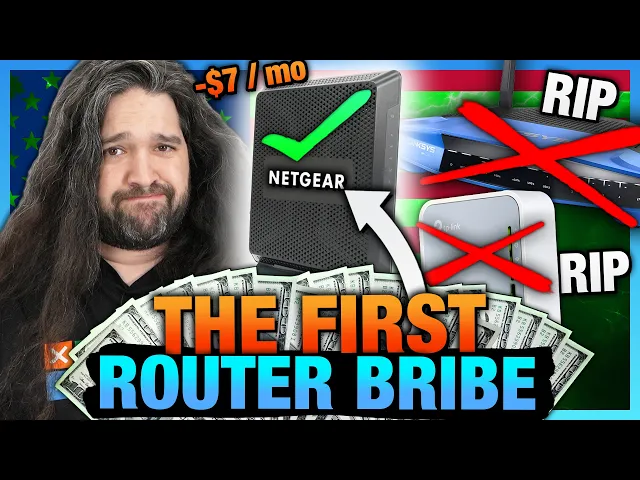
You'll Subscribe to Your Router, Too | The First Router Bribes Are Here
Gamers Nexus
0:00 The sale of new routers is effectively banned in the United States.
0:03 And there are some interesting links as to why that might be the case.
0:06 The FCC halted the sale of new foreignade
0:09 consumer router models to the US in the supposed
0:12 name of national security and in a move
0:14 that might further consolidate power to the internet service providers.
0:18 ISPs have moved increasingly to requiring
0:20 router rentals as part of providing internet,
0:23 ensuring that you pay every month forever for your router.
0:26 Not all of them have done this yet,
0:28 but it's something that we've seen starting to roll out,
0:30 including for some of the people on our team
0:33 who have been forced to rent routers.
0:35 But that's not the only problem here.
0:36 The US government doesn't seem to have a plan
0:38 for where we're going to get our routers.
0:41 Currently, the US doesn't make any, except maybe Starlink,
0:44 helmed by government contractor and man who cheats at Diablo, Elon Musk,
0:49 who just so happens to be running ads against stories
0:52 about how the FCC just banned his competition from the market.
0:56 The end result is that routers will almost definitely become more expensive.
0:59 Ironically, security will probably become worse
1:02 because there'll be fewer newer advancements, less innovation for consumers,
1:06 and there's also less of a reason to update old models,
1:10 which are currently the only models that can continue to sell in the US market.
1:14 Over time, companies naturally update their old products less.
1:18 Technically, there are ways to get exemptions.
1:20 Like while we were editing this video, the FCC granted many of Nectar's
1:23 routers conditional approval after the company spent,
1:26 you'll never guess it, 560 grand lobbying the US government since 2023.
1:31 An action with some shady background that seems
1:34 maybe anti-competitive that we'll look at in this video.
1:37 As for the US, it hasn't made routers for over 24 years.
1:41 And the NSA came in just last week to tell everyone to update their routers.
1:45 Definitely not so they can force push an update to spy on you through them.
1:49 That is, just to be clear,
1:50 that is definitely not why the NSA said you should update your routers.
1:56 That is not the reason.
1:57 It is not because the NSA wants to be the one with the back door in them.
2:02 This the the Russians or the Chinese or the North Koreans.
2:06 That's the reason.
2:08 Most recently, the US indicated that the ban also, to quote the register,
2:12 quote, extends to portable Wi-Fi hotspot
2:15 devices that provide internet access almost anywhere.
2:18 End quote.
2:19 So, in addition to portable hotspots,
2:21 which classically might be considered a different
2:23 type of device from just a router,
2:26 this could also feasibly include phones under the definition
2:29 of routers because they can also be hotspots.
2:32 This regulation has the potential to be so sweeping as to include nearly
2:36 any device that can connect another device to the internet in some form.
2:40 Aside from the fact that one of these things basically
2:43 can be the eye to everything you do on the internet,
2:45 which would be useful for the government to control,
2:47 the FCC maintains a covered list of equipment that it deems a security risk.
2:52 On March 23rd, 2026, it updated its covered list to include, quote,
2:56 "Routers produced in a foreign country except routers which have
2:59 been granted a conditional approval by DOW or DHS." End quote.
3:03 Virtually all consumer routers are made outside the United States,
3:06 even those by US-based companies.
3:09 US residents can keep using existing routers and buying inventory that's already
3:13 in the country or old product models
3:15 that companies decide to continue to import.
3:17 But that'll only go as long as inventory continues to exist
3:20 and as long as these companies decide to keep selling the old stuff here.
3:24 As the EFF notes, and we agree,
3:26 this could make consumers more vulnerable, not less.
3:29 So, new routers with the newer hardware
3:30 and software security features and with just
3:32 better speeds and higher speed ports will
3:35 without an exemption be banned from import.
3:38 And existing routers, existing models can continue to be sold,
3:42 but they'll slowly lose access to updates over time.
3:46 And likewise, you don't need to look far to see why that matters.
3:50 ASUS had a severe security vulnerability that turned its routers into a botnet.
3:55 TPLink was targeted by Russian state sponsored hackers.
3:59 And Cisco has a running list of security advisories like all these companies,
4:03 but plenty of them affect routers and networking devices.
4:06 Being made in the US doesn't magically make these risks disappear.
4:10 This is all happening after the Trump administration
4:12 cut a thousand jobs from federal cyber security work.
4:15 And while the Trump admin is trying to cut cyber security funding weeks
4:19 ago pitching a $77 million cut
4:22 to the Cyber Security Infrastructure Security Agency,
4:25 this would reduce the AY's budget to just $2 billion annually,
4:28 down from $2.5 billion last year.
4:31 To put that into perspective,
4:32 that's just 2.8 days of Nvidia's revenue for a quarter
4:36 spent on the entirety of the federal government's cyber security agency.
4:41 The NSA urged in the past week
4:43 for everyone to reboot routers for security updates.
4:45 comes at a suspicious time when the government
4:47 is increasingly in bed with companies like Flock,
4:50 Rain and Palunteer to build what we think is a global surveillance apparatus.
4:54 This router ban is poised to set the stage for mass surveillance via
4:58 potential government back doors and mirrors
5:01 what the US constantly claims China does.
5:04 State approved vendors going through government selection processes.
5:07 And all of this is going to affect consumers in a lot of ways.
5:10 I mean, it'll be obviously options and choice and access to innovation,
5:14 technology, and generally things getting better, but also security and price.
5:21 This stuff's probably going to cost more in the US going forward,
5:24 and that's going to be on older models.
5:26 So, the move is helmed by none other than FCC chair Brendan Carr,
5:31 whom we'll talk about in this, and we think companies like Starlink
5:35 and the ISPs potentially stand to benefit a lot from this action.
5:38 Before that, this video is brought to you
5:40 by Thermaltch and the TR200 WS micro chassis, a microATX Stout case.
5:46 It includes an optional 5 and a quarter bay
5:48 for either a screen or 5 and a quarter drives.
5:50 The case has a highly perforated side panel,
5:53 a color accent front styled like other popular cases,
5:56 can fit radiators and closed loop liquid coolers
5:58 in the top up to 360 mm claimed support,
6:01 and a total of seven 120 mm fan mounting locations between the top,
6:06 bottom, and rear of the case.
6:07 Max CPU tower cooler clearance is claimed
6:09 at 175 millimeters and GPU clearance at 365 millimeters.
6:13 The chassis provides a portable, highly compatible box for your builds.
6:17 Learn more at the link in the description below.
6:19 The FCC explained its reasoning behind this rash move.
6:22 The FCC wrote that foreignade routers
6:24 quote pose unacceptable risks to the national
6:26 security of the United States or the safety and security of US people.
6:30 Routers produced abroad were directly implicated in the Volt, Flax,
6:33 and Salt Typhoon cyber attacks, which targeted critical American communications,
6:37 energy, transportation, and water infrastructure.
6:40 End quote.
6:40 Now, that might sound like a different cyber
6:42 attack that we know about called data centers.
6:46 This was the energy and the the water and the but that one's okay because money.
6:53 There's only one problem with this reasoning,
6:56 which is that the only reason American routers weren't
6:59 implicated in these cyber attacks is because there are none.
7:06 It's that's literally the only reason.
7:08 The FCC said that it's because the US shouldn't be quote dependent
7:12 on any outside power for core components
7:14 necessary to the nation's defense or economy.
7:17 One of these core components that is necessary
7:19 to both our nation's defense and economy is routers.
7:22 Allowing routers produced abroad to dominate
7:24 the US market creates unacceptable economic,
7:27 national security, and cyber security risks.
7:29 End quote.
7:30 US Representative Molinar,
7:31 chairman of the House Select Committee on the Strategic
7:33 Competition between the United States and the Chinese Communist Party,
7:36 that's the name of the committee, praised the move and wrote,
7:38 quote, "Today's tremendous decision by the FCC
7:41 and the Trump administration protects our country against China's
7:44 relentless cyber attacks and makes it clear
7:46 that these devices should be excluded from our critical infrastructure.
7:49 Routers are key to keeping us all connected,
7:51 and we cannot allow Chinese technology to be at the center of that." End quote.
7:55 Except, first of all, that's the wrong country.
7:58 A lot of these routers actually come from Thailand, Vietnam, and Taiwan.
8:03 A lot of the companies are headquartered in Taiwan.
8:06 But okay, secondly, this pulls the routers
8:09 under direct supervision of the US government,
8:12 and it's really just a different flavor of surveillance at that point,
8:16 if that's the accusation.
8:18 At the tip of the spear is FCC chairman and South Park co-star Brendan Carr.
8:22 Carr was famously mired in controversy around
8:25 free speech with allegations that he was
8:27 trying to threaten network broadcasters over what
8:30 late night talk show hosts had been saying.
8:32 So, I hate to say this, but ensuring
8:33 broadcasters are operating quote in the public interest.
8:37 I don't believe that means ensuring that no one on TV uh is
8:41 ever mean to the president or says something the president may not like.
8:46 It doesn't help that car was recorded saying things like this.
8:49 I mean, look, we can do this the easy way or the hard way.
8:52 these companies can find ways to change conduct to take action frankly uh
8:57 on Kimmel or you know there's going to be additional work for the FCC ahead.
9:02 Carr previously served as an adviser to Ajet Pi
9:05 former FCC chairman infamous for the repeal of net neutrality.
9:08 Pi's actions enabled ISPs to throttle block and effectively modulate
9:13 performance of the internet based on how you used it.
9:15 And remember ISPs spend millions of dollars lobbying every year.
9:19 and ISPs benefit from you renting your routers.
9:22 Back in 2024, the Biden administration
9:25 considered banning Chinese founded company TP Link,
9:28 which according to the Wall Street Journal accounts for 65%
9:31 of home and small business routers in the US.
9:34 Biden's administration also oversaw the banning
9:36 of computer cooling manufacturer Deepcool.
9:39 The US has been relatively banhappy
9:41 across multiple recent administrations is the point.
9:44 TP Link was also sued by Texas Attorney General Ken Paxton over
9:49 allegations that it allowed quote the CCP to access American consumers devices.
9:54 End quote.
9:55 The Attorney General put out a press release that said
9:57 quote TPLink's products have been used by the People's
10:01 Republic of China's PRC's state sponsored hacking entities
10:05 to launch multiple cyber attack operations against the United States.
10:09 Further, TPLink's ownership and supply chain are tied to China.
10:13 Through these ties, TPLink is subject to the PRC's national data laws,
10:17 which require Chinese citizens and firms to support
10:20 PRC intelligence services by dulging Americans data.
10:23 End quote.
10:24 So, by that logic, apparently, sadly,
10:26 the difference has become not whether a government has access to your data,
10:31 but which one and which one you prefer.
10:34 I will say it's sort of silly to say that TPLink supply
10:38 chain has ties to China as if that's some some big gotcha moment.
10:43 Like probably basically literally everything in that attorney general's own
10:49 home has ties to a supply chain somewhere in China.
10:53 But okay, it's just kind of a broad thing to be like it has ties
10:58 to that the this MOSFET came from China
11:01 and the capacitor was China or China adjacent.
11:05 TPLink was founded in Shenzhen, China, but is now headquartered in California.
11:10 Its US product manufacturing has been in Vietnam since 2018.
11:13 The company says it doesn't sell products to mainland China.
11:16 According to the Times of India,
11:18 TPLink CEO and his wife have also applied for permanent
11:22 residency in the United States through Trump's gold card program.
11:26 We're gonna say bribe,
11:29 no gift political contribution to gain entry to the country.
11:35 And that gets to the heart of these bans.
11:37 The way around it seems to effectively be bribes,
11:42 sorry, political contributions.
11:44 The FCC's fact sheet elaborates, quote,
11:46 "Foreign-Made consumer grade routers are prohibited from receiving
11:49 FCC authorization and are therefore prohibited from being imported
11:52 for use or sale in the US." This update
11:55 to the covered list does not prohibit the import,
11:58 sale, or use of any existing device models the FCC previously authorized.
12:02 End quote.
12:03 The FCC also wrote, quote, "All routers authorized for use in the United
12:07 States may continue to receive software and firmware
12:09 updates that mitigate harm to US consumers
12:12 at least until March 1st, 2027." End quote.
12:15 So, existing models will remain allowed, but these companies will of course want
12:19 to move past the existing models to implement
12:21 things like hardware security features and software
12:24 security features and just better product features.
12:28 not just you know RGB routers but maybe like 25 gigabit
12:33 or something starts to become more popular one day that becomes
12:36 limited here and uh they won't want to maintain the current
12:40 models forever especially for patches and updates and so we may
12:44 fall behind other markets technologically but if they want products made
12:47 in the US this doesn't do it at some point almost
12:51 everything comes from China all the way down the supply chain
12:55 phosphorus Cyber Security and Omnia Research have both spoken into this matter.
12:59 Router manufacturers can apply for limited 18-month conditional approvals,
13:03 which requires disclosure of a router's components,
13:06 origins, production, and supply chain risks.
13:09 But with this ruling, we noticed that even the decades old definition of what
13:13 a router is and what it does is apparently up for debate,
13:18 not by the companies, but by the US government.
13:21 Cisco defines a router as a device
13:23 that quote receives and sends data on computer networks.
13:26 Routers are sometimes confused with network hubs, modems, or network switches.
13:31 However, routers can combine the functions of these components and connect
13:35 with these devices to improve internet access or help create business networks.
13:39 End quote.
13:39 Wikipedia narrows it further.
13:41 Quote, a router is connected to two
13:43 or more data lines from different IP networks.
13:46 When a data packet comes in on a line,
13:48 the router reads the network address information
13:50 in the packet header to determine the ultimate destination.
13:53 End quote.
13:54 We noticed though that the FCC made
13:56 its definition of routers a lot more open-ended,
13:59 which allows it to make its bands more open-ended.
14:01 The FCC describes them as quote consumer grade networking devices that are
14:06 primarily intended for residential use and can be installed by the customer.
14:11 Routers forward data packets,
14:13 most commonly internet protocol packets between network systems.
14:17 End quote.
14:18 First of all, limiting it to consumer is suspicious.
14:22 not accurate either.
14:24 But uh secondly, this is a very broad definition and it's broad
14:27 enough to encompass things like Wi-Fi extenders or mesh systems, for example.
14:34 I this even raises the question of whether or not smart
14:37 TVs or video game consoles or computers could be classified as routers.
14:42 They could fit this definition.
14:44 They're capable of forwarding data packets.
14:46 Beyond the inevitable impacts to consumer pricing and availability of routers,
14:50 this rule introduces new security risks for consumers.
14:53 The EFF's affformentioned security concerns stem
14:56 from entering EOL faster and restricting new imports.
15:00 Separately, Bit Defender's threat research director pointed
15:03 out to the New York Times that quote, "A ban has clear limitations.
15:07 It does not address the large installed base
15:09 of existing devices which will remain in use for years.
15:13 In practice, foreign manufactured routers will continue
15:16 to dominate US households in the near term,
15:18 so any security gains will be gradual at best.
15:20 End quote.
15:21 The FCC is trying to get around this by insinuating
15:23 that existing routers may not receive security updates beyond March 1st,
15:28 2027, but this only exacerbates the issue.
15:31 For Scout Security told CNNET that quote, "The risk is very real.
15:35 If you find yourself in a situation
15:36 where that update pipeline has been switched off,
15:39 then you definitely have to consider whether you want to keep using that device.
15:42 End quote.
15:43 At a time when a lot of people can barely afford rent or food,
15:46 updating a device they don't understand for a nebulous security
15:50 vulnerability they've never heard of to protect against an attacker
15:54 from a country they can't afford to ever go
15:56 to is probably pretty low on the list of hierarchical needs.
16:02 Most normal people won't replace the devices
16:04 when they stop receiving updates because one,
16:07 they won't know they stopped receiving updates because they don't update it,
16:10 just the auto updates.
16:12 But two, they'll replace it when it stops working.
16:17 And with the direction we're going,
16:19 probably with a solution provided by an internet
16:22 service provider for just $7 a month forever.
16:26 We think that may be at play here, too, as ISPs are among the top government
16:31 technology donors and increasingly forcing router rentals.
16:34 Many modern routers can automatically update their firmware, though.
16:38 But this ruling doesn't do anything to help us past March 1st,
16:41 2027, less than a year from now.
16:43 The EFF called the FCC's approach a quote blunt instrument
16:47 end quote that impacts quote many harmless products end quote.
16:51 and they highlighted the mass quote
16:53 defunding of cyber defense initiatives end quote.
16:56 Analyzing the Salt Typhoon hack, which the FCC highlighted as a specific attack
17:00 while justifying its endeavor to ban foreign made routers,
17:03 telecom reporter Carl Bode told the Verge, quote,
17:06 "One of the core problems wasn't foreign routers.
17:09 It's a lack of oversight and regulation of telecom monopolies.
17:13 A lot of these monopolies had gotten so lax with their privacy and security
17:16 standards that they forgot to change default
17:19 admin passwords on a lot of their routers.
17:21 End quote.
17:22 So, color me not surprised when the next attacker walks into a collocation
17:28 facility and types in admin and shuts down the entire[ __] internet.
17:33 The FCC's move being able to potentially consolidate power into the hands
17:37 of ISPs is a concerning development at a time when
17:39 the government is compelling social media companies to hand over information
17:44 of people who are mean to the government on the internet.
17:47 Professor Milton Mueller told the register, quote,
17:50 "A router made in the USA likely
17:52 runs a Linux kernel maintained by global contributors,
17:55 uses Wi-Fi drivers written in Taiwan,
17:57 and incorporates open source libraries managed by developers worldwide.
18:01 By focusing on the geographic location of the assembly line,
18:04 the FCC ignores the logical supply chain of the software.
18:08 A US assembled router with a poorly written UPN or universal plug-and-play
18:12 implementation is just as vulnerable to a hijacking as a foreign one.
18:16 End quote.
18:17 And he's absolutely right on that.
18:18 The software is a major factor here.
18:20 In fact, there's open- source solutions that just make
18:23 a lot of older routers more secure by installing them.
18:26 The foreign router ban also though introduces conflicts of interest
18:31 with one specific company at the center of them.
18:35 Starlink headed up by former extra special government employee world's
18:40 richest man and offagain onag again presidential bff Elon Musk.
18:45 Starlink says that its routers are made in Texas.
18:48 Sometimes sometimes they're made in Vietnam but close enough.
18:51 Starlink makes routers for its satellite internet service,
18:53 but Musk's close ties to the federal government
18:56 enable a path to Starlink contracting for consumer routers.
19:00 Our favorite part, though,
19:01 was that our research for the story led us to this page
19:05 on a Reuters story about the ban of foreign routers.
19:09 We received a Starlink advertisement.
19:11 It doesn't help that conditional approvals are now supposed to be done
19:15 by the Department of Defense or the US Department of Homeland Security either.
19:19 That'll slow down the process, but in our opinions,
19:22 that also adds additional layers of spyware concerns,
19:25 specifically relating to the DHS.
19:27 As a result of this environment,
19:28 UCLA lead industry analyst Mike Do told the New York Times, quote,
19:32 "It's very likely that the companies producing these routers will
19:35 need to pursue waiverss from the FCC's rules." End quote.
19:38 When push comes to shove,
19:39 this may introduce more of an opportunity for basically bribery to bypass.
19:45 Sorry, let me let me get the language right.
19:49 political contributions to bypass the issues and uh
19:53 companies that already have a cozy relationship
19:55 with the government which seems to be an increasing
19:57 pool every day will have an advantage here.
20:00 Uh and also you know the giving money to them
20:03 thing but I guess we're kind of all over that now.
20:05 We're already seeing this though with TPLink's example
20:09 of a $2 million spend for two gold cards.
20:12 In a post titled, quote, "Trump cyber security policy is indistinguishable
20:16 from a foreign attack." End quote.
20:17 Vote asserted that the US national security is
20:20 being dismantled at the request of major telecom lobbyists,
20:23 stating that the salt typhoon attack was quote caused in part
20:27 by our mindless deregulation and lacks
20:30 oversight of telecom monopolies end quote.
20:33 He added that the Biden FCC tried to address
20:36 this by implementing quote some very basic cyber security safeguards
20:40 requiring that telecoms try to do a better job securing
20:43 their networks and informing their customers of breaches end quote.
20:47 However, after that Brendan Carr's FCC
20:49 under Trump rescended these safeguards, quote,
20:51 because lobbyists said AT&T, Verizon, Comcast,
20:55 and Charter told them to end quote.
20:57 In November of 2025, per RS Technica,
21:00 the FCC voted to repeal a ruling requiring ISPs to secure their networks,
21:04 saying lobbyists requested it.
21:06 In an FCC blog post bizarrely titled Halloween Treats,
21:09 which is a disturbing title for an agency helmed by a man
21:12 who was accused of trying to silence Epstein files discussions on the air,
21:16 Carr tried to argue that voting to repeal
21:18 this ruling would actually somehow bolster the country's security.
21:22 quote, "We'll stay on public safety and vote on an order
21:25 that puts us on a stronger cyber security footing." End quote.
21:28 He said, "Dropping the ruling allows the agency
21:32 to be more quote agile." End quote.
21:34 While editing, the FCC revealed many of Nectar's routers
21:37 have received conditional approvals until at least October 1st, 2027.
21:41 Necar's lobbying means it's gaining an advantage from regulation,
21:45 not necessarily from competition.
21:47 And right now, it has a monopoly on consumer imports for new routers.
21:50 Nectar has lobbyed the federal
21:52 government for more corporate protectionism recently.
21:55 According to open secrets,
21:56 Ngear started its lobbying efforts in the fourth quarter of 2023
22:00 and has spent between 60 and 80 grand every quarter since then.
22:04 From October to December 2023,
22:06 Ngeear lobbied the House and the Senate on what it
22:08 called quote strategic competition with China end quote and cyber security.
22:12 Netgear subsequently added the DHS, FCC, and Department of Commerce,
22:17 and the company lobbyed for the Routers Act,
22:20 which requires the federal government
22:21 to study quote national security risks posed
22:24 by consumer routers and modems end quote and present the results to Congress.
22:28 The bill passed the House and currently resides in the Senate.
22:32 Nectar later included the National Security Council,
22:35 Executive Office of the President,
22:37 and Export Import Bank of the US in its efforts to influence policy.
22:41 US authorities have increasingly scrutinized Netgear's China based rival TPLink.
22:46 In March 2025, during a House committee hearing,
22:49 a former cyber security director for the NSA and an open AI
22:53 adviser advocated for the US to block TPLink from the US entirely.
22:58 August 2024, TPLink captured nearly 80% of the US
23:01 retail market for mesh systems running on Wi-Fi 7,
23:05 which is the newest Wi-Fi specification in existence.
23:08 TPLink routers were among the various brands exploited by Chinese state
23:12 sponsored hackers in the massive vault flax and salt typhoon attacks.
23:17 Imagine these routers in the homes and businesses across America as a PRC
23:22 platform to launch society panic panicking
23:25 cyber attacks during the invasion of Taiwan.
23:28 We cannot have this software for prolific devices be written,
23:32 updated and controlled by a Chinese company.
23:35 Is there any uh any action the commerce
23:38 department should utilize uh to take action against TPLink?
23:43 Yes, sir.
23:43 Um Congress has the authority um on a national security basis
23:48 to block and uh and bar those devices from sale in the US
23:52 and and they I understand they are working on that today and I
23:56 would encourage everybody to uh to move swiftly and quickly on that action.
24:00 A month later, Bloomberg reported the US government would investigate
24:03 TPLink for antitrust violations around
24:06 pricing alongside national security risk evaluation.
24:09 Several months later, a bipartisan group of House representatives
24:13 asked Epstein Island Flyer and Secretary
24:15 of Commerce Howard Lutnik to investigate
24:17 TPLink and its connections to China's government.
24:20 The competition between Netgear and TPLink kept escalating.
24:24 TPLink actually sued Netgear that same month over its
24:28 allegations that TPLink had ties to the Chinese government.
24:31 TPLink alleged that Netgear had launched an quote unlawful
24:35 smear campaign end quote against them with the legal
24:38 complaint stating that Netgear had tried to quote capitalize
24:41 on anti-Chinese sentiment and fear of cyber attacks end quote.
24:45 TPLink pointed to Netgear CEO stating in an earnings
24:49 call that quote TPLink is a national security risk.
24:52 End quote.
24:52 In the very same call, Netgear also said it would increase its supply
24:57 if the US excluded TPLink from the market,
25:00 which felt like sort of a signal to regulators.
25:03 The government scrutiny of TPLink as a national security risk
25:06 has been exposed by Bloomberg and the Wall Street Journal,
25:10 raising questions about TPLink's ability to continue
25:13 to participate in the US market.
25:16 We are monitoring this situation very closely
25:19 given the the hawkishness of the new administration.
25:24 You know, we are starting to look at uh making
25:27 a small investment in supply given some of the lead
25:31 times of our products uh to be in a better
25:35 position should you know an exclusion actually happen.
25:39 And as we've talked about before, like if an exclusion were to happen,
25:43 uh that would that would require a significant working capital investment.
25:48 TPLink clapped back and pointed out Nectar's hardware had
25:50 also been affected by similar or the same cyber attacks,
25:54 which TPLink said Neckar quote failed to mention.
25:57 End quote.
25:57 In terms of what TPLink is asking for with its lawsuit,
26:01 the company says that Netgear's misconduct
26:03 has quote injured and threatens injury
26:05 to well over a billion dollars in sales end quote and it's seeking damages.
26:09 To us, it looks like Netgear is trying to posture,
26:12 at least to the US government,
26:14 as a US first company despite actually manufacturing predominantly overseas.
26:19 And it's trying to leverage its position politically to block arrival.
26:23 That's what we think.
26:24 Beyond though the obvious of enabling corporations to collude against consumers,
26:30 which seems to be a common topic
26:32 lately with these government tech company collaborations.
26:36 There are additional concerns, which is the obvious,
26:38 of potential government back doors in these devices.
26:42 Devices that have access to just about everything
26:44 you do on the internet in some capacity,
26:47 especially at a time when they're working with Palanteer, Flock,
26:49 Rain, and Nvidia in ways that we think perpetuate surveillance.
26:53 Routers have the capability of showing
26:55 significant detail about your online habits.
26:57 AVG Technologies says, quote,
26:59 "Someone with access to your router can eavesdrop on you.
27:02 Since your router handles all the internet traffic on your network,
27:06 a router hacker can see what you're doing,
27:08 which websites and services you're using,
27:10 when you're using them, and more." End quote.
27:12 A government, any government, any party, I don't care.
27:15 Having access to this type of information and the ability to oversee
27:20 communications creates pathways to exercise
27:22 authoritarian control and oppression of speech
27:26 in particular uh or just manipulate algorithms and results to brainwash
27:30 the public kind of like social media networks already do right now.
27:34 This kind of reminds us in some ways of China's great firewall as it's called.
27:38 The US government and its at least claimed
27:41 position of trying to stop some of the things
27:43 that it says other countries do is creating
27:46 a slippery slope where it itself could do those things.
27:50 19 states already require age verification such as via government ID to view
27:55 adult content and moving forward routers
27:57 may provide a more robust backdoor option.
28:00 Even basic social media platforms now like Discord are starting to require IDs.
28:04 And with the resistance to giving government ID up,
28:06 we wouldn't be surprised if at some point there's a collaborative
28:09 appearance of a deescalation where say ISPs use a unique identifier,
28:15 a subscriber ID attached to your packets to identify
28:19 you that way instead of uploading your ID to some website and it would be seen
28:23 as an improvement if it goes that direction.
28:25 But anyway, in an online FAQ posted by the commission,
28:28 the commission asked itself self,
28:31 "Are routers intended to be used exclusively in industrial,
28:34 enterprise, or military contexts covered?" And the commission answered itself,
28:38 "Sself, no." The National Security Determination's definition
28:42 of routers refers to consumer grade networking
28:44 devices that are primarily intended for residential
28:47 use and can be installed by the customer.
28:48 End quote.
28:49 Routers used by the US government
28:51 and military are actually already subject to stricter
28:54 regulations such as the byamerican act which
28:57 requires federal agencies to prioritize American products.
29:00 But even that act says this quote the provisions
29:04 of the act may be waved if the head of the procuring
29:07 agency determines the act to be inconsistent with the public
29:10 interests or the cost of acquiring the domestic product is unreasonable.
29:15 End quote.
29:15 Interesting.
29:16 that waiver option isn't in there for you as a consumer.
29:20 If the cost of the domestic product is unreasonable,
29:23 then I guess the waiver is uh go[ __] yourself.
29:26 On top of that, there's a lot of evidence to suggest
29:29 the US government has already spent
29:31 money on TPLink routers and networking equipment,
29:33 which as a reminder is the company it was just thinking of banning.
29:37 In response to the ban,
29:39 several router companies have put out statements to the press
29:41 that seemingly try to curry favor with the US government, mostly saying nothing.
29:46 Now, there's some parallels here to some other interesting bans technically.
29:50 For example, these are also banned.
29:55 How did that how did that get in here?
29:57 In December 2025, the FCC concluded that drones
30:00 pose quote unacceptable risks to the national
30:03 security of the United States and to the safety
30:05 and security of US persons end quote.
30:07 A direct quote from what they're saying now.
30:10 Though it made its initial announcement late last year,
30:13 the FCC only recently provided conditional
30:16 approvals for four drone systems in March,
30:19 none of which come from Chinese companies.
30:21 It just so happens that companies like DJI are
30:24 among the most competitive right now in the space.
30:27 Like the routers, the drone situation also introduces conflicts of interest,
30:31 seeing as how President Trump's sons are
30:33 both partial owners in Orius Greenway Holdings,
30:37 a golf club firm that is merging with a drone manufacturer called Power Us.
30:43 You know, as golf club firms are known to do, manufacture drones.
30:50 I guess it I kind of feel like
30:54 this router and drone thing sets the stage for nepotism.
31:01 No, no, that can't be it.
31:06 That's definitely not it.
31:09 The key points are these.
31:10 The ban will lead to decreased innovation
31:12 and access to technology for American consumers,
31:15 especially going forward as new technology comes
31:18 out and becomes available for other markets.
31:20 The ban will, we think,
31:21 set up a layup for ISPs to rent their routers to consumers who are looking
31:26 for an easy solution so that they
31:28 can then perpetually pay for that device forever.
31:31 The ban introduces a major conflict of interest favoring Starlink and Elon Musk.
31:37 The US claims that the concern is of attacks on routers
31:40 that happen to be made by factories in foreign countries.
31:43 The reality is that these types of attacks can
31:45 happen on any router regardless of where they're made.
31:47 A lot of it also is at the software layer, not the hardware layer.
31:51 It could be both.
31:52 But moving it to the US doesn't solve that problem.
31:54 And actually, it could make it worse and at the very least
31:57 the short term for companies that have no experience making stuff here and who
32:01 are trying to cut corners because the costs are so much higher
32:04 and there's zero supply chain for most of those components in the US.
32:08 It's also just a delusion to think that any meaningful factory capacity
32:12 can come online in less than a year in the United States,
32:16 especially when most of these components are made in China
32:19 anyway and the routers themselves are assembled often in Thailand,
32:22 Taiwan, Vietnam, and of course in China.
32:26 But there's another interesting thing here too,
32:28 which is that on the software side,
32:30 there are and have been open- source solutions where
32:33 you can continue to use old routers with publicly available
32:39 open-source firmware or software or both and use those devices
32:44 even past their usable service life from the manufacturer.
32:47 But what's interesting is that United States laws and in particular
32:51 opposition to right to repair by large corporations has
32:55 meant that in some cases router companies will brick their devices
33:00 if they detect you've installed something like OpenWRT on them,
33:04 rendering them[ __] useless if you try to put something
33:07 more secure on it because the company has stopped using it.
33:11 In some ways though, a lot of this stuff isn't news.
33:13 The FCC was looking at limitations on installing custom firmware
33:17 and operating systems on routers as early as 11 years ago.
33:22 Now, various types of bans
33:23 and corporate collusion and collaboration with governments,
33:26 it's been around for a long time.
33:27 A lot of administrations.
33:28 It's multi-administration, multi-party.
33:31 It just so happens that right now the set of people in charge in the government
33:34 and the set of people in charge in the companies
33:37 seem to get this[ __] done real fast.
33:39 And it's not good for consumers or normal people.
33:42 It's like a just[ __] complete open
33:45 corruption where even the bribes aren't disguised anymore.
33:49 Like Tim Apple literally handing Donald Trump a piece
33:53 of gold and I think it was the Oval Office.
33:56 So any if you live in the US in particular, you should be concerned about this.
34:00 uh the boogeymen that are normally described,
34:02 although you wouldn't want anyone to have
34:04 access to your data in particular, you know,
34:08 it's a lot less valuable to other governments than it is
34:11 to the government that wants to maintain control of a particular narrative.
34:16 And that's regardless of party.
34:18 Just my personal bias, full disclosure,
34:21 my personal belief is that the government of the place you live
34:24 in is probably one of the greatest
34:27 threats in terms of controlling communications devices, the roll out of them,
34:33 and you know, being able to control speech
34:35 or now with social media platforms more easily
34:38 than ever manipulate things so that you're served
34:41 stuff that keeps you kind of brainwashed long term.
34:44 It's not quite there yet, but it's certainly getting there.
34:47 Uh but anyway, ideally none of them have your data.
34:49 It's just that the data is a lot more
34:51 immediately useful to you know the place you live.
34:53 Telecom lobbyists have a lot of sway as one
34:55 of our viewers pointed out when we first reported on this story.
34:59 Quote, "Enjoy your new Palunteer Freedom Router trademark." One thing this will
35:03 definitely impact though is consumer pricing
35:06 and options availability of new technology.
35:09 Ultimately, we and say what you want, I don't really care at this point.
35:13 think that this is a play at control,
35:15 government and corporate, kind of all the same at this point.
35:18 But, uh, it could be government
35:20 oversight and control over the public's communications.
35:23 It could also be something as innocent and innocuous as serving you better
35:28 targeted ads because there's a better pipeline to get the information about you.
35:32 Uh, perhaps on that end,
35:34 then it could be useful just for making money and taking it from you.
35:39 Or again, on the other end, could be used for propaganda.
35:42 Uh either way though, on the scary side,
35:44 potentially this could be used to track political dissident,
35:47 people who say meany things on the internet about the government and its people.
35:52 And this is at a time where, you know,
35:54 we have to kind of lean into this stuff at this point
35:56 because the government and the corporations between Flock and Rain,
36:02 Nvidia, and Palanteer, which we've covered extensively on our GNCA channel
36:05 if you want to see more of this content,
36:08 they're making it kind of hard to see it any other way.
36:10 While that may sound like dystopian science fiction,
36:13 the US government's official White House app
36:15 tracks users locations and reportedly presents security risks.
36:18 Developer and Twitter user, The Realo 1026,
36:22 claimed that they decompiled the Android version of the app
36:24 and deduced that it quote has a cookie paywall bypass injector,
36:28 tracks your GPS every 4.5 minutes,
36:31 and loads JavaScript from some guy's GitHub pages.
36:34 End quote.
36:35 Atomic Computer reported the iOS version quote sends your IP address,
36:39 time zone, device model, OS version, session count, session duration,
36:43 and a persistent unique identifier to one signal
36:46 on every launch despite the permission strain claiming quote,
36:49 "This app does not use your location" and sub quote,
36:52 "and the privacy manifest declaring zero data collection.
36:55 Only 23% of the app's requests go to white house.gov.
36:59 The other 77% go to third parties." End quote.
37:02 So again, the fact that US government is
37:04 focusing on just consumer routers with this ban suggests
37:07 to us that this might be a play
37:08 at a mix of surveillance and corporate usefulness, not security.
37:13 Now, there is something you can do if you care about security and surveillance.
37:18 There are open- source solutions that you should look into for DIY routers,
37:22 and they're not too hard to put together.
37:24 For example, OpenWRT and PFSense,
37:27 which provides patches faster than a lot of the manufacturers do.
37:31 So, that's it for this one.
37:33 Thanks for watching.
37:34 Subscribe for more.
37:35 We have a lot more stuff coming up.
37:36 We've got several hardware reviews on the channel lately.
37:38 Actually, a lot more than the past few months.
37:40 So, if you want that stuff, it's up there for you.
37:42 And go to store.gamersac.net to support our upcoming deep dive travel series we
37:47 have coming up where we're interviewing a lot of companies around the world.
37:50 Or patreon.com/gamersac.
37:52 We'll see you all next time.