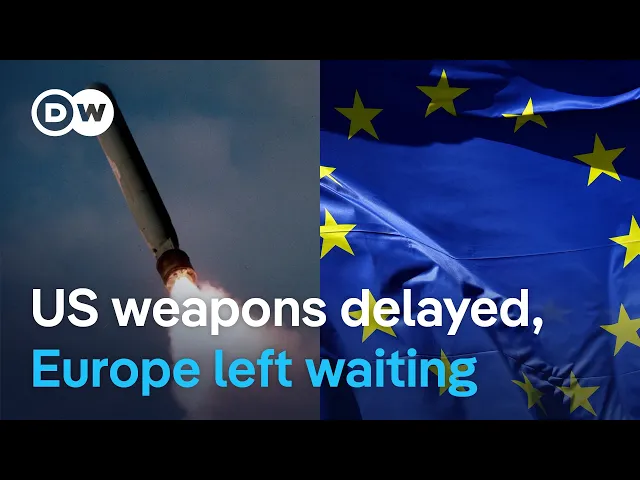
US weapons delays to Europe widen transatlantic rift | DW News
DW News
0:00 The growing rift between the US and EU is getting hard to ignore.
0:05 Their defense alliance is built on trust.
0:08 But now the Trump administration is
0:10 fast-tracking billions of dollars in emergency weapons
0:13 sales to allies in the Middle East while European partners have to wait.
0:18 Security services across Europe warned Russia is rebuilding its military
0:22 and could be ready for conflict with Europe by 2029.
0:25 Some experts believe China could have a world-class force by next year.
0:30 Does that make America squeam?
0:33 This all makes me wonder, what are the US's priorities?
0:39 Stephen Biddle can tell us.
0:40 He's a professor of international and public affairs at Columbia University.
0:43 But Stephen, first let's take a look together at the news
0:47 because the Financial Times published the story this weekend with the headline,
0:50 US warns Europe of delays to arm shipments as Iran war drains stockpiles.
0:56 It says Washington has warned European allies including the UK, Poland,
1:00 Lithuania, and Estonia to expect long delivery delays for US weapons.
1:06 And look at these deals the US is fast-tracking to its allies
1:10 in the Middle East worth over 8 and a half billion dollars.
1:13 Qatar is the biggest beneficiary you see there followed by Kuwait,
1:16 then there's Israel and the United Arab Emirates.
1:21 The Pentagon told the Financial Times it
1:23 was carefully evaluating new requests for equipment
1:26 from partners as well as existing arms
1:28 transfer cases to ensure alignment with operational needs.
1:33 It declined to provide details citing
1:35 the operationally sensitive nature of these matters.
1:40 Stephen, how unusual is this US weapons deal with Middle
1:44 Eastern allies approved using emergency powers, I should point out.
1:50 Yeah, there's nothing particularly unusual about
1:52 US weapons sales to the Persian Gulf.
1:54 We've been the biggest supplier of weaponry to the Gulf for over 50 years.
1:58 What what's unusual is one, the emergency designation,
2:03 uh which enables the Trump administration to circumvent legislative oversight.
2:07 Uh they that's not unusual for the Trump administration.
2:10 They do this on lots of issues,
2:11 but this first time they've done it on weapon sales to my knowledge.
2:14 The the second thing that's unusual about this is that it involves
2:19 a serious cost to American readiness for our own defense using our own military,
2:26 and it involves a serious uh effect
2:28 on our ability to support allies anywhere else,
2:30 and especially uh Europe, and especially Ukraine.
2:34 The these are new features.
2:37 Um the idea that we're selling weapons to the Persian Gulf isn't.
2:42 Mhm.
2:42 What what does invoking an emergency tell us though
2:44 about how Washington views the situation after the Iran war?
2:50 Yeah, I think actually it tells us less about how they
2:53 view Iran and more about how they view the US Congress.
2:56 Mhm.
2:56 Uh I I don't think this reflects some assessment
2:59 that this is a unique emergency in any objective,
3:02 uh reasonable, realistic sense.
3:05 I think what this is is the latest use of a tactic that the Trump
3:08 administration's used in all sorts of policy
3:10 domains as a way of escaping oversight.
3:13 This has been central to their tariff policies, for example.
3:16 It's been central to their policies on border security.
3:21 Um I I don't think any of it reflects any objective sense that any
3:27 of these situations are emergencies that would
3:29 require unusual speed of policy making.
3:32 I think what it represents is a recognition that they've they've
3:35 discovered that if they pull the emergency card out and play it,
3:40 they get to do what they want, and the Congress doesn't constrain them.
3:46 Mhm.
3:46 Now, you know, the the courts are increasingly skeptical of this tactic,
3:51 uh but they're they continue to use it and until the court stop it,
3:55 they're going to use it more.
3:57 Okay, let's go to, uh,
3:59 a sound bite from Trump because despite these reports that, uh,
4:04 strategic US weapon stockpiles are under strain,
4:07 he has sought to reassure Americans that the United States is
4:11 not running low on key munitions despite weeks of conflicts in Iran.
4:19 No, no, we have more than we've ever had, actually.
4:23 Because all over the world we have inventory and we can take that if we need it.
4:27 But all over the world we have tremendous amounts of inventory.
4:30 It's the best.
4:31 For instance, we're stocked and locked and loaded right now.
4:35 We have more than double what we had when this started.
4:39 Is the US running out of weapons?
4:44 That depends on how you define it.
4:45 If if it means, or do we not have enough weapons to fight the war in Iran,
4:49 the answer is no, we have enough for that.
4:51 The the problem is the rate of usage
4:54 in Iran is making it substantially less likely
4:57 that the US has enough weapons to deal
4:59 with a potential war with the People's Republic of China.
5:03 And that the United States has enough weapons to deal
5:06 with a threat from the PRC and support our European allies.
5:10 You know, the it it's it's the number of different stresses
5:18 on the US arsenal that that's creating the the problem here.
5:24 For Iran per se, a middle ranking regional power,
5:28 not the PRC, not Russia, yes, we have enough.
5:35 Uh, the trouble is we're using so
5:36 many against this middle ranking regional power
5:40 in the Middle East that the insufficiency is
5:44 for everything else we have to worry about.
5:47 Well, let's talk strategy then for a moment because in the press releases
5:53 the State Department issued for all these deals with its Middle Eastern allies,
5:58 there's a sentence repeated each time.
6:01 This proposed sale will contribute to the foreign
6:04 policy and national security of the United States.
6:08 Stephen, can you expand on that?
6:12 Uh well, the the president interprets the national security of the United
6:16 States to be whatever foreign policy priority has at time T.
6:20 He's decided notwithstanding his own national security
6:24 strategy that it's all of a sudden
6:27 critically essential to US national security to wage a war against Iran.
6:31 I mean, if you read his own national security strategy,
6:34 you would find this a surprising finding.
6:38 Um so, I I I don't think this so much
6:42 represents some deep rethink of America's interests in the world.
6:48 I I think what this represents is
6:51 the Trump administration decided that it had an opportunity
6:56 in Iran in the form of a weakened opponent
6:59 that they would like to make substantially weaker still,
7:02 and they thought they could do it quickly and easily at low cost,
7:05 especially after the adventure in Venezuela turned out
7:10 in the short term pretty well for them.
7:12 Um I I I don't think this represents you know,
7:17 some realignment of American foreign policy.
7:19 The realignment of American foreign policy arguably came
7:22 about when the Trump administration took office before
7:25 they decided to wage a war on Iran
7:27 when they significantly changed US priorities to de-emphasize Europe,
7:33 de-emphasize Russia, you know, continued to emphasize the PRC in the Pacific,
7:40 but then to create this wholly new uh emphasis on the Western Hemisphere,
7:46 which hadn't been a focus of US foreign policy in generations.
7:51 Um those things are new.
7:53 Now, whether they will continue is is another matter.
7:57 I mean, the the war in Iran is sucking
8:02 the oxygen out of the rest of US national security policy.
8:06 It it's consuming munitions that we now
8:08 don't have to deter other opponents elsewhere.
8:12 It's consuming munitions we don't have to support allies elsewhere.
8:16 It it's occupying the foreign policy bandwidth
8:22 of the rather limited number of people
8:24 that that Trump trusts to have any meaningful role in the development of policy.
8:29 Um and because there's no obvious end to the Iran war anytime soon,
8:37 uh the the likelihood that it will
8:39 continue having this kind of gravitational effect,
8:45 uh just kind of drawing all of the attention and all
8:48 of the emphasis out of the US
8:50 government's ability to think about foreign policy, um may go on for a while.
8:55 Okay, well, while that's happening,
8:58 what would you say the US's strategic priorities are right now?
9:04 I I think the strategic priority at the moment
9:07 is to try and find some way to get out
9:09 of the cul-de-sac they've driven themselves into in Iran
9:13 uh without a catastrophic results in the American midterm elections.
9:16 My my my sense about what the foreign policy echelons
9:20 in the Trump administration are actually
9:21 thinking about or worrying about is that's,
9:25 you know, preclusive of almost everything else.
9:28 I don't think they expected this to become this big thundering problem for them.
9:32 I thought they thought this was going to be quick and easy.
9:35 Uh now that it isn't, the it it's forcing,
9:40 you know, all sorts of complicated trade-offs, like, for example,
9:43 using munitions that would be better reserved
9:46 for the Pacific to wage a war that we didn't really need to wage and wasn't
9:51 particularly part of US national security strategy anyway.
9:54 Um, so I I I think that the the war in Iran is the overwhelming focus uh,
10:03 and everything else ends up being interpreted through that lens.
10:07 So, you you take, for example, US policy towards NATO, right?
10:10 The the dust-up, uh, with Germany uh,
10:15 doesn't appear to be the result of some particular
10:18 immediate change in the Trump administration's attitude towards NATO.
10:22 They've never particularly liked NATO.
10:25 Um, and there obviously got all sorts of tensions since they took office,
10:30 but I think this immediate dust-up isn't because the Trump administration said,
10:34 "Oh, we need we we think differently about NATO now." It's because of Iran.
10:39 They they want assistance in getting themselves out of the mess they've created.
10:43 They're not getting it and hence they're angry
10:46 at people that they think should be pulling, you know,
10:50 this rabbit out of a hat for them and saving
10:52 them from their own problem and won't do it.
10:55 So, now they're angry at the various people who aren't bailing them out.
10:59 So, is US defense capability stretched across too many theaters right now?
11:06 Oh, absolutely.
11:07 Absolutely.
11:08 I mean, you know, again,
11:12 this is this, like so much of the rest, is an own goal, right?
11:15 The the the US military would be sufficient together with NATO to deal
11:21 with the Russian threat and together with our Pacific
11:24 allies to deal with the PRC threat, but then, you know, we we suddenly decided
11:29 that Latin America is a major US national security focus.
11:33 We've then alienated all of the allies
11:37 that would help us in dealing with the Russia
11:39 problem in Europe and help us in dealing
11:41 with the PRC problem in the Western Pacific.
11:45 And lo and behold, if we're going to do this all by ourselves,
11:49 and we're going to start a war of choice in the Middle East,
11:53 and you know, topple various governments in Latin America.
11:57 You know, will Venezuela be the end?
11:59 Who knows?
12:00 Um and redeploy the military to the southern border,
12:04 and treat that as a national security issue.
12:06 But I mean, it No it not even you know,
12:12 a sole superpower can do everything simultaneously.
12:16 There are always limits, and this administration doesn't seem to be
12:20 able to make choices and say we're going
12:23 to focus on the things that really matter and not do all of the secondary stuff.
12:28 They seem to think that we're omnipotent and can do
12:32 everything everywhere all at the same time, and we can't.
12:35 Let's bring it back to Europe for a second.
12:36 Some leaders are calling for calm over these reports of weapons
12:43 delays and and and the shifting priorities of the US.
12:48 Finland and Estonia are frontline states on Europe's border with Russia.
12:53 Presidents Alexander Stubb and Alar Karis
12:56 responded to reports their nations may be
12:58 coming up short when it comes to the prioritization of US weapons deliveries.
13:02 Because of the global situation, in other words, the war in Iran,
13:07 uh it is a public secret that some of the stocks uh
13:11 and delivery systems in the US are either going elsewhere or being delayed.
13:17 But I don't see any need for alarm.
13:19 I know that there is a delay.
13:21 It's probably a question to our to our Minister of Defense
13:24 what kind of uh missiles or ammunition we are we are missing,
13:28 but as far as I know it's HIMARS.
13:30 It gives a signal, but in in Estonia and in Europe in general,
13:35 we should much much faster develop our defense industry.
13:40 Not relying on on different different countries in the world.
13:44 So Stephen, is Europe being deprioritized
13:48 or being pushed to take more responsibility?
13:52 I think both.
13:53 Those two things go together.
13:55 Um Yeah, and certainly in in in terms of the the the bigger picture from Europe,
14:02 um as long as there's a reasonable chance that a MAGA
14:06 Republican will be in charge in the United States, uh Europe has got to step up.
14:13 We're just not going to be reliable in ways that I wish
14:16 that we had been and that I wish we would continue to be.
14:19 But you don't think it could be a longer-term shift?
14:23 Well, I mean the the longer term depends very much
14:26 on the future of the MAGA Republican Party in the United States.
14:30 I mean NATO remains popular among American voters,
14:33 but but there's increasingly a partisan divide.
14:36 North of 80% of Democrats support NATO.
14:40 Fewer than 40% of Republicans support NATO.
14:45 So yeah, if if MAGA Republicanism somehow burned itself out,
14:51 I mean the the attitude of the American people as a whole
14:56 is not dramatically different than it it was prior to Trump.
15:01 But but when the US political system allows MAGA
15:05 Republicanism to win national elections and control foreign policy,
15:10 then NATO is never going to be a priority.
15:15 Uh the US is not a reliable uh source of assistance if push comes to shove.
15:22 Um none of that means that the American public
15:24 don't value transatlantic relations and the NATO alliance anymore.
15:29 It means that MAGA Republicans don't.
15:32 But, they're running the country right now.
15:35 And they could run the country again.
15:38 And if I were in Europe, I would take seriously the the prospect that this view,
15:44 whether it's the whether it's the majority view in the United States or not,
15:48 could shape US policy and Europe needs to hedge against that.
15:53 You mentioned relations with Germany.
15:56 Uh, this news of troop withdrawals uh, this week.
16:01 How do troop reductions of weapons strain affect deterrence in Europe?
16:08 Well, I mean I think deterrence in Europe
16:11 was on the ropes before this was announced.
16:14 Uh, I mean this announcement in itself doesn't change all that much.
16:17 It's what, a 15%ish of the US troop presence in Germany.
16:23 And it was intended primarily as a thumb in the eye to you know,
16:27 the German Chancellor.
16:29 Um, so the it it if I were Vladimir Putin, heaven forbid,
16:35 I'd be looking at this in the larger context that MAGA Republicanism has
16:42 moved away from the support of Europe and away from the defense of Ukraine.
16:47 And President Trump, heaven knows, has done those things.
16:50 And this wouldn't be telling me, "Wow,
16:53 they're pulling 5,000 troops out of Germany.
16:55 Now, I can safely do what I wanted to do, whereas before,
16:59 on the other hand, I had to worry about the Americans bailing out NATO." I mean,
17:03 I this is one more change at the edge
17:07 of a series of changes since Trump came into office that have
17:12 all kind of pointed in mostly in the same direction
17:15 of diminishing US credibility as an ally in NATO Europe.
17:21 You brought up China earlier.
17:23 Let's focus in on Asia for a moment.
17:26 There are also signals that weapons
17:29 deliveries to the Indo-Pacific could be delayed.
17:32 How significant is that and and how does this affect deterrence in that region,
17:37 especially when it comes to China and Taiwan?
17:41 Yeah, I I think this is very significant.
17:43 Again, I I think we have enough weapons to to fight the Iranians.
17:46 I'm not convinced that with all the weapons we've spent on the Iranians
17:49 that we have enough weapons to defend Taiwan if it came to it.
17:53 Um Now, you know, for the PRC to launch
17:58 a war against Taiwan is a truly monumental decision.
18:02 The potential consequences of that, you know,
18:05 are you know, cataclysmic for everyone involved.
18:10 So, I I I would like to think that the the sheer
18:13 gravity of this kind of decision would weigh on Xi
18:19 and that hopefully deterrence is reasonably robust just given the the gravity
18:25 of the war that would result if they pulled the trigger here.
18:30 That said, the business of those of us in the national security community
18:35 is to take low probability events
18:37 like invasions and make them lower probability.
18:41 And I don't think the US war in Iran has
18:43 done that and I I if if for those who who
18:48 believe that uh Xi is opportunistic and thinks he needs
18:54 to act against Taiwan quickly before the US and the Taiwanese,
18:59 you know, build capabilities to to respond,
19:02 certainly the drawdown in munitions that we've suffered as a result
19:06 of the Iran wars is an item of serious concern.
19:10 Um I I think deterrence would be more
19:13 robust if we hadn't spent a significant fraction
19:17 of our precision munition inventory uh and war
19:21 against the middle-ranking power in the Middle East.
19:24 Stephen, could you explain a bit more
19:25 about how Washington balances competing demands between Europe,
19:29 the Middle East, the Indo-Pacific without
19:32 weakening its position overall in in Asia?
19:38 Well, I mean, the the way the administration
19:40 said it was going to do it when they took office uh was we were going to rely
19:46 on the Europeans stepping up with American assistance, with American enablers,
19:52 with American intelligence and political and diplomatic support,
19:55 but we were going to rely on the Europeans
19:56 stepping up and to to deal with the Russian threat.
20:00 And the predominant weight of US military power
20:05 would be directed at dealing with the China threat.
20:10 Um, that that's not the way it's gone down.
20:14 Uh again, none of that says,
20:16 "Let's go start a big war in the Middle East and expend
20:19 half of our precision ordinance there." That that wasn't part of the plan.
20:24 Um, now, you know, as far as that goes,
20:29 the Trump administration aren't the first people to suffer this phenomenon.
20:34 The the Obama administration was the first to announce a pivot to Asia in which
20:41 the United States was going to stop getting bogged down in these you know,
20:45 forever wars as they like to call them in the Middle East
20:49 uh and reorient out of the Middle East and toward you know,
20:54 East Asia and our Pacific alliance system.
20:57 The Obama administration didn't have the kind of anti-NATO you know,
21:04 chapeau that this administration does,
21:08 but they too wanted to shift to the Pacific and they didn't do it.
21:13 The the the budget didn't change, troop deployments didn't change.
21:17 It it appears to be harder for the United States to to shift
21:22 out of the Middle East than most strategists think would be advisable.
21:29 Um even if you you support a strong transatlantic tie and a strong
21:36 US contribution to NATO as I do for whatever that's worth.
21:39 Um you can accommodate that to a significant degree while deterring
21:45 the PRC if you're not waging wars of choice in other places,
21:50 be they the Middle East or be they Latin
21:52 America or be they Greenland or or wherever else.
21:58 So the Trump administration could be capable
22:01 of juggling more than just one ball.
22:05 Well, I mean any American administration with with the the you know,
22:08 the economic and military power the United States has,
22:11 we we we can we can cope with more than one theater,
22:15 but that doesn't mean you can cope with everything simultaneously everywhere.
22:19 I mean, you know, strategy is about making choices.
22:23 It's not about doing everything at the same time.
22:26 If you try that, you you end up
22:28 being short somewhere and potentially a lot of somewheres.
22:33 Quite plausible quite plausibly Asia and Europe.
22:38 Could you sum things up for us though?
22:41 If people are listening in and thinking, you know,
22:43 this is is this just a temporary crunch?
22:47 Is this just the MAGA movement?
22:49 Or is this the start of a more permanent shift in US global strategy?
22:54 What's what's your take there?
22:58 Um I I think so much of this depends
23:02 on where American domestic politics goes in the post-Trump era.
23:06 So, I there there will be no change
23:07 on any of these scores while Trump is in office.
23:10 Um after Trump leaves office,
23:14 there will be a struggle for the control of the Republican Party,
23:17 and there will be an issue about whether the Republican
23:20 Party can win the White House and continue to, you know,
23:24 govern the United States in conjunction with the Congress.
23:27 Um and I I would hope that you know,
23:33 the you know, non-MAGA Republicans, the few that are left,
23:40 and Democrats would recognize that the broader
23:46 American public continues to support NATO,
23:49 continues to support our alliances generally,
23:51 continues to be deeply skeptical of the Russians,
23:54 and continues to support Ukraine.
23:57 And would you know, configure American strategy in a way that would
24:03 be supportive of those values that the public at large continues to hold.
24:09 The The The problem, of course, from Europe is how confident can you afford
24:15 to be that that's how American politics will evolve domestically.
24:21 I mean, young Americans, even Democrats,
24:25 tend to have different political views than old dinosaurs like me.
24:30 Um and at the margin tend to be less supportive of NATO than,
24:37 you know, older Americans of, you know, whichever party.
24:42 But, I think it a central challenge of political leadership,
24:45 you know, domestically in the United States as in everywhere else,
24:49 is leading on values that the leader
24:53 thinks are important and that the public has,
24:57 you know, sympathy for and can be led on.
25:03 And yeah, I I would very much like post-Trump American
25:09 domestic politics to return to the kind of commitment to allies,
25:18 commitment to Europe, mean opposition to aggression yeah,
25:24 um support of norms of decent international behavior that had been
25:30 characteristic of the United States since World War II and before.
25:34 But Steve, that's something you'd like.
25:36 What what can Europeans expect?
25:38 Can Europe still rely on the US for weapons?
25:42 Um or or does Europe have to compete for US support?
25:49 Well, I think Europe has to hedge its bets
25:52 against the possibility that the US won't support it.
25:54 I competing for US support I mean, it if you want to get into a bidding
26:00 war for Donald Trump's Donald Trump's favors,
26:03 that that's a I in my view, that's a losing game.
26:07 All right, he'll he'll up the ante to squeeze
26:10 anyone for as much as they can be squeezed for.
26:14 Um I as an American,
26:16 I would like American policy to move in a more traditional direction.
26:19 If I were a European, I would not be I would not be willing to assume that.
26:24 I would be hedging my bets.
26:26 I would be building my defense industrial base.
26:29 I would be reconstructing my military capabilities.
26:32 I would be leading European publics
26:37 to an increased understanding of the need for Europe
26:40 to make its own way in the world and provide for its own security.
26:43 If it then turns out that mega-Trumpism dies without the, you know,
26:50 charismatic leader uh of Donald Trump,
26:54 and the United States returns to more traditional world, then that's great.
26:59 Then you have a truly robust deterrent.
27:04 But I would if if if I were a German,
27:08 I would not be willing to bet my security on that.
27:13 I would I would hedge because I don't think it can be assumed.
27:18 Mhm.
27:20 We'll leave it on that note.
27:21 Stephen Biddle, thank you very much
27:22 for talking to us uh from Columbia University.
27:26 It's been a pleasure.
27:28 Thanks for having me.
27:31 And what do you think?
27:32 Can Europe rely on the US for weapons?
27:34 Let us know in the comments.
27:35 I'm Ben Fazulin.
27:36 I'll see you again soon.