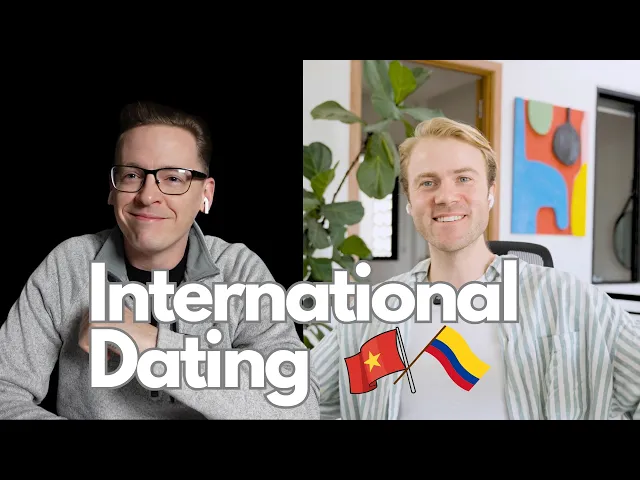
Learn Real-Life English: Dating Someone From Another Country ❤️ | Comprehensible Input
Pensando Inglés
0:00 Are you ready to learn some real life English with comprehensible input?
0:06 Well, good, because today we are going to have a real life English conversation
0:11 between two native speakers about something
0:15 that our guest today and I have in common.
0:19 We are both in a relationship with a woman from a completely different culture.
0:26 Let's go.
0:27 Hello everybody.
0:28 Today we're having what I think is going
0:30 to be a very useful and interesting conversation.
0:34 And we are going to have it with a very
0:36 special guest and friend of the channel, Jay.
0:40 Jay, how are you, my friend?
0:42 Thank you, Kyle.
0:43 I'm wonderful.
0:44 I'm doing very well.
0:45 It's a sunny morning.
0:47 Um, I'm feeling bright and yeah, I'm ready to jump in and to begin.
0:54 All right.
0:55 So, the last collaboration that you and I did, Jay,
0:59 it turns out that we share a lot of subscribers
1:02 and a lot of people who love my videos love your videos, too.
1:07 So, hello to everybody who watches both of us.
1:10 I I am positive that we both appreciate you all so much.
1:14 And I think it's really cool, Jay, that a lot of people found both of us.
1:19 I think that says something about our personalities, honestly.
1:23 Absolutely.
1:24 Yeah.
1:24 I was I was really happy to both collaborate with you last time and then
1:30 we both read the comments and just seeing all the positivity like you said,
1:35 you know, people saying, "No way." Like my two favorite subscribers subscribers,
1:40 my two favorite um creators and yeah, it was it was it was a big joy to read.
1:46 So, thank you from us to you.
1:49 You know who you are.
1:51 So, if you guys have not seen Jay's work before,
1:56 his channel is absolutely awesome.
1:58 Big shout out to you, Jay.
1:59 His quality is great.
2:01 Your filming skills are awesome, man.
2:02 Every time I watch your videos, I'm inspired.
2:05 So, thank you for making great content, guys.
2:08 English by Jay.
2:09 Awesome.
2:10 Comprehensible input channel.
2:13 Thank you.
2:14 Now, are you ready to get into this deep conversation, my friend?
2:20 Absolutely.
2:21 Yes.
2:21 I was born for this.
2:24 So, in this conversation,
2:27 we're going to be talking about an experience that Jay and I share,
2:32 which is we're both in a relationship with a woman
2:35 from a different country and a completely different culture,
2:38 but we're kind of seeing the same situation from different
2:43 points of view because I live in my home country,
2:49 the United States, and my wife Ingred came up here from Colombia.
2:56 Now Jay, can you tell us about the situation between you and Chang?
3:01 Yes.
3:01 So my situation is opposite.
3:04 I am British.
3:06 I live I lived in England my whole life and recently I traveled to Vietnam.
3:13 I now live in Vietnam where I met
3:16 my partner Chang and we live together in Vietnam.
3:20 Okay.
3:20 Now, can we start this off with just how did we meet our significant others?
3:26 How did you meet Jane when you went to Vietnam?
3:29 Okay, let me try to condense this into its shortest form.
3:34 Um, my friend Ollie was visiting me in Vietnam.
3:41 He booked his flight ticket for Thursday the 19th of April,
3:48 but he arrived one day later, he found out.
3:53 So I was in Hanoi.
3:56 Uh we were planning to travel the Hajang Loop,
3:59 which is like a motorbike tour around the north of Vietnam.
4:04 So my friend Ollie arrived one day late.
4:07 I was on my own.
4:09 Uh, I went to a coffee shop in Hanoi and I
4:15 was doing some writing and reading and I I met Chang there.
4:20 Uh, she was doing the same thing, reading and yeah, we just we connected.
4:25 We started talking about the things that we both love,
4:28 um, our passions, art, creativity, and then I went off.
4:35 I did my motorbike tour.
4:38 uh came back to Hanoi for a few days and we connected again,
4:41 met up and then yeah, maybe a few months later I had moved back down to Daang,
4:47 back down to the south and Chang decided to to move
4:51 her life here too uh by the beach and yeah, the rest is history.
4:57 It's been a lovely journey ever since.
5:00 Wow.
5:00 So am I think I'm understanding this right?
5:04 Is it fair to say that if your friend
5:07 had showed up when he was supposed to show up, you would have never met her?
5:11 Yeah, absolutely.
5:12 Yeah.
5:12 So, thank you, Ollie.
5:15 But that's just such a cool what we might call a twist of fate.
5:19 A twist of fate, which means like
5:21 something happened that should not have happened
5:23 that completely changed something big in your life.
5:27 Yeah, absolutely, Kyle.
5:28 It's strange.
5:29 We talk about it like that was so unlikely to happen yet it happened.
5:35 And then having met Chang that changed
5:39 the trajectory that changed the direction of my life.
5:44 I would say I may not have you know started a YouTube
5:49 channel and a Tik Tok channel if I hadn't had met Chang.
5:53 So yeah, it's weird these strange synchronicities in life,
5:58 strange things that that add up and and and connect and the people we meet,
6:02 the experiences we have.
6:04 Um yeah, there's something something quite magic in it.
6:08 Wow.
6:08 Wow.
6:09 And it's actually funny because my my story is
6:13 similar that I should have never met my wife.
6:15 if I should have never been able to meet my wife because
6:19 had my wife and I met a different time in my life,
6:23 I wouldn't have spoke Spanish.
6:26 And she grew up in Colombia.
6:28 She came to United States uh on a a program between Colombia and the states
6:35 where they give young people visas to come here and work as an opair,
6:40 which is another word for nanny or someone that takes care of kids.
6:44 So she came here and of everywhere in the whole United States,
6:48 she wound up working with a person 20 minutes from my house.
6:54 And it she did not speak English at the time,
6:57 but it just so happens that we met at the time
7:00 in my life where I had become fluent in Spanish.
7:03 So it's it's these strange twists of fates that have brought us both
7:07 to our to the women that we're spending
7:09 our lives with, which is really cool, I think.
7:12 Wow.
7:13 So did you first approach her in Spanish?
7:17 So this is another funny story.
7:19 Okay.
7:20 So you can imagine that the only people who
7:24 can have an awaren basically you're paying a huge
7:28 amount of money to have another person come
7:31 live with you and take care of your children.
7:33 Norm middle class people can't do this.
7:36 Okay?
7:36 It's only very wealthy people.
7:38 So this very wealthy lady who was also a little
7:43 bit uh cuckoo little bit cuckoo we might say she was
7:50 the first person who my wife wound up working
7:53 for and this person was almost treating my wife like a slave.
7:57 She couldn't leave the house.
8:00 So in her boredom she was you know
8:03 online just trying to find some way to socialize.
8:06 We met online.
8:08 She writes me in English saying, "Hi, how are you?" So,
8:12 I respond with like a a normal long paragraph of what I'm doing.
8:16 She doesn't reply.
8:17 And I'm thinking I'm like, "Hm,
8:20 maybe this girl doesn't really speak English." So,
8:23 I replied and said, "Hey, I speak Spanish." And I replied in Spanish.
8:27 She replied there.
8:29 And we hit it off there.
8:31 And I could do a whole video about the stories
8:34 of how I went and rescued her from this crazy lady's house.
8:38 We snuck her out for our first date and uh it was,
8:44 you know, one of the best days of my life when I met her.
8:47 Wow.
8:47 And yeah, it everything lined up,
8:51 everything in my life leading towards that moment,
8:54 you know, pushing me to learn Spanish, pushing her to come this way.
8:57 And it all met in one little point 20 minutes from my house where, you know,
9:03 somebody from the other side of the world,
9:05 just like you and Chang in that coffee shop, two people's paths
9:10 took them to that one spot in time.
9:13 And now look at the beautiful things that have
9:15 happened and what might happen in the future.
9:18 Yeah.
9:18 Wonderful.
9:20 I was talking with Chang last night in in bed about that.
9:23 Uh it's it's just so bizarre like
9:25 you're talking about two people's different paths.
9:27 Okay.
9:28 Ingred's born here.
9:29 You're born here.
9:30 Complete different side of the world.
9:32 Um the same for Chang and I.
9:35 And you live just completely different childhoods.
9:39 your experiences, your thoughts, your beliefs, these are just,
9:44 you know, vastly different yet at some point, right?
9:49 Your your paths intersect and then and then from there hopefully grow.
9:54 That's the that's the idea.
9:56 At least I think, you know,
9:57 in a healthy partnership is is growth from both partners and together.
10:03 Yeah.
10:03 I think it's a really a really wild thing
10:07 to to have met from completely different sides of the world,
10:10 but something that's deeply uh fulfilling if you find, you know,
10:16 someone who who vibes with you, as the young people say.
10:21 And uh just to let everybody know, Jay is no longer young people.
10:25 You've joined me in the 30 club, my friend.
10:30 Mate,
10:30 happy belated birthday, buddy.
10:31 Thank you, sir.
10:33 Yeah.
10:33 Yeah.
10:34 30 years old.
10:35 I feel um I feel in the prime of my life.
10:39 The prime is like the the best time.
10:42 Yeah.
10:42 I feel like I'm just getting started.
10:44 So, thank you for the birthday wishes.
10:46 And I'll I'll do a bit more exercise.
10:48 Make sure I don't get too much of a belly.
10:52 Absolutely.
10:52 And I feel like I'm getting better every day as well.
10:56 Awesome.
10:55 I think uh the 30s, if you take care of yourself,
10:58 really are the best time of your life.
11:01 Let's get into these deep questions about what it's actually like to be
11:06 with a partner from a different part of the world.
11:09 What is something that you have learned from your partner's culture?
11:14 Is the Vietnamese culture very different from the English culture?
11:19 Good question.
11:20 Something I've learned from my partner's culture, from Vietnamese culture.
11:26 Firstly, yes, it is very different from my culture back home in the UK.
11:34 If there's one thing I've learned since moving here,
11:41 it's that Vietnamese people are really kind
11:46 and welcoming and really just warm towards you.
11:51 They always smile.
11:52 They always help you when you're in need.
11:56 and even when you're not in need.
11:59 So yeah, it's that openness,
12:01 that warmness and willingness to help people even if they're a stranger.
12:07 So I'm a complete stranger, they don't know me, yet they always smile.
12:11 They always meet me with with kindness.
12:14 Um, I think that's a really nice behavior.
12:16 And comparing that to behavior in the UK,
12:21 people tend to be a lot more closed off with their blinkers on.
12:26 Um, they tend to be in their own world.
12:29 So, it's harder to get a smile from a stranger.
12:35 It's it's we are less likely in my culture
12:38 to help people on the streets who need help.
12:44 um in Vietnam way more likely to help people.
12:48 The people are just Yeah.
12:49 They they they show you their love.
12:52 They might not always in their culture it's
12:54 not a thing to to express love with words.
12:57 Oh, I love you so much.
12:58 Now, they don't say that.
13:00 Um they show you with kindness, with acts of kindness.
13:05 Okay, that's very interesting.
13:06 And I've heard that Vietnam is a very
13:08 safe and welcoming place to travel or live.
13:13 Now, has that rubbed off on you?
13:17 And when something rubs off on you,
13:18 it means something in your environment or the people around you rubs off on you,
13:23 meaning you start acting like that as well.
13:27 Nice explanation.
13:29 Yes, it has rubbed off on me.
13:31 Uh I I always grew up in a in a household.
13:34 My grandma um was again, we've talked about my grandma,
13:37 but yeah, she she taught me kindness.
13:40 So that's something I I hold very close in my heart,
13:43 one of the values I deeply cherish.
13:47 So yeah, I would say beyond that, just the act of being friendly with strangers.
13:55 Um yeah, and and helping people if someone is in need.
13:58 I went skiing recently for my birthday and there
14:00 was a little girl that fell on the floor.
14:02 Um and I was helping Chang stand up.
14:04 So after that, I went to help the girl stand up.
14:08 I actually fell on her first, but after that, um,
14:12 I helped her up and she skied off.
14:15 Yeah, that gave me a good feeling.
14:16 It gives me a good feeling to help people.
14:18 Um, you know this, Kyle, and you know, from us making these videos,
14:22 it's a wonderful thing to help you at home watching this.
14:27 Uh, yeah, to help in any way possible for me makes me feel good.
14:33 So, yes, it has rubbed off for me.
14:37 Wonderful.
14:37 So, you're a better person now than you
14:40 were when you first crossed the border into Vietnam.
14:43 That's a a beautiful thing.
14:45 For sure.
14:45 Yeah.
14:46 I had long hair when I first traveled to Vietnam as well.
14:48 I was a bit of a hippie.
14:50 Oh, no.
14:51 I I want to see a picture.
14:52 You have to send a picture of that later.
14:54 I'll send you a picture.
14:54 Yeah.
14:57 Okay.
14:57 You know, I I have a similar
15:00 experience with Colombians and the Colombian culture.
15:04 I it's a similar thing, but I wasn't going to put it that way in helping people.
15:09 I was going to say the closeness of family,
15:13 but I think we're really trying to get the same thing,
15:16 which is that western cultures, you know, uh like ours, you know,
15:21 English and American are not completely the same, but there are similarities.
15:26 Everybody's so busy, you know, everybody's so busy.
15:29 They're doing their own thing, working so much,
15:32 just, you know, it's super fastpaced.
15:35 But in Colombia, and it sounds like in Vietnam,
15:39 you take more time to worry if your your mom's doing okay,
15:43 if your brother and sister are all right.
15:45 You know, you check in on all your friends.
15:47 And it's it's so much so that it was shocking for me because
15:54 even though let's say for example my sister and I we love each other.
15:58 She lives in Chicago which is about an hour driving from me.
16:03 We'll text each other you know every now and then
16:07 which could be once a week or once a month.
16:10 But we're not calling each other and talking on the phone all the time.
16:13 when we see each other,
16:14 we're not giving each other big huge hugs and a kiss on the cheek,
16:17 but the Colombian culture is just so close.
16:20 It seems like they put a a much bigger
16:23 value on the personal connections with their loved ones.
16:27 Do you notice that with Ingred's family?
16:30 Like, do they meet you with big hoses and kick kicks hugs and kisses?
16:36 Yeah.
16:36 And you know what?
16:37 It's it's something that's rubbed off on me as well.
16:40 and you know with even just because you know we live in the US so
16:44 it's not like we're going to Colombia all the time but I go to her church
16:49 with her in Chicago which is mostly Colombians
16:52 or spend time with her and her Colombian friends
16:54 and now it's completely normal just to give
16:56 your friend a big hug when you see them
16:59 but I think for the average American that is not normal I
17:03 don't know about the average Brit I don't want to say cold culture,
17:10 but my wife used to call me Seco, which in Spanish means dry, dry.
17:16 But it it's a way that they use
17:18 to describe somebody who's kind of cold and distant.
17:21 But I always thought I was a warm and welcoming person until
17:25 I started hanging around Colombians who hug you and they're just much closer,
17:31 I think, in the culture, a much smaller distance between people.
17:36 M.
17:37 So, has that has that rubbed off on you, Kyle?
17:43 My wife has this friend named Lily, and she's an older lady at the church.
17:49 She's not old, she's in her 40s.
17:51 Um, and she's become a dear friend of mine, too.
17:53 And every time I see her, I give her the biggest hug,
17:56 and I just love Colombian culture has turned me into a hugger and uh
18:02 definitely opened my heart up and made me a more warm person, I might say.
18:11 Mhm.
18:11 Awesome.
18:12 I want to flip this around and ask you guys at home.
18:17 Is it normal in your culture to to hug and to be very close
18:23 with people to tell them that you love them or you know are you more distant?
18:29 Where are you from first of all?
18:31 And and what is it like in your culture?
18:34 Are you very close with your family or are you more separated?
18:40 because I know different places in the world show love in different ways.
18:43 So, how do you show love to your family?
18:46 We'll be reading those comments, guys.
18:47 Let us know.
18:50 Absolutely.
18:49 So, that's that's very interesting because, you know,
18:53 for my family, saying I love you is super easy,
18:58 but maybe showing it with hugs and affection is considered strange or unusual.
19:04 Whereas I've met a lot of Latinos,
19:07 my a lot of my Mexican friends especially, who have told me,
19:10 "My parents never say they love me." And I
19:13 think it's it comes from a hard upbringing.
19:17 You know, they had a they really struggled growing up.
19:20 So, it's hard for them to express it because
19:23 their culture was shut up and get to work.
19:25 You know, you don't sit around talking about your feelings and your problems.
19:29 You just work.
19:31 But you know that your family is there for you because of that closeness.
19:34 They just don't say it.
19:36 interesting that you mention it's because or it could
19:41 be because of the the difficulties in in growing up
19:44 like you know shut up and get to work kind
19:46 of idea that um yeah I don't know if that's
19:50 the same in Asia but I know in in Vietnamese
19:52 culture as I mentioned before it's they don't necessarily say
19:57 that they love you but they will show you
19:59 with the care and you know just yeah caring for you.
20:03 So, I'm interested why that is happening and and I feel
20:06 like you could have hit a point there like Yeah, who knows?
20:12 Vietnam has had a uh you know had had some rough times in their past as well.
20:16 Absolutely.
20:17 everywhere in the world has.
20:18 But um you know maybe the the countries like the US or England whose
20:25 harder times are a little bit further behind them in the history books,
20:30 maybe it's a little easier for us to express ourselves in that way.
20:35 Yeah.
20:35 What do I know?
20:39 Everything.
20:39 Now I have a question for you, Kyle.
20:42 What is something beautiful about mixing two different cultures?
20:51 Well, you create something new really.
20:53 And it's really cool to see these mixes
20:57 and I've got a bunch of examples of that.
21:00 Part of it is the Spanglish that my wife and I speak,
21:03 which Spanglish is a fun word that is Spanish and English put together.
21:08 So, a lot of times our conversations, you know,
21:12 get really mixed up with the language you're speaking.
21:14 She's speaking English.
21:15 I'm speaking Spanish.
21:17 I'm speaking English.
21:18 She's speaking Spanish.
21:21 Sometimes we'll take an English verb and turn it into a Spanish verb.
21:27 We'll conjugate it like a Spanish verb like I want to take a nap.
21:33 and nobody else would understand what that means,
21:36 but it's something fun, cute, and beautiful that we've we've made together.
21:40 Another thing um with my my wife,
21:46 but also any culture when you mix these cultures,
21:49 and this is something I've seen with all
21:51 the cooking that I do here on the channel,
21:54 I take all these dishes and I sometimes put a little twist on it, you know,
22:01 by what I think of as far as what this dish should have based
22:05 on my experience as a cook or the things
22:08 that I know taste and it's not disrespectful.
22:12 So when you mix cultures, you're not changing them in a disrespectful way.
22:16 You're taking the beautiful things from each of them
22:19 and pushing something new and beautiful completely forward.
22:23 Like a funny example is there's a dish called fijuada.
22:28 All of our Brazilian fans watching now will know what that is.
22:31 And I made that dish for one of my wife's Brazilian friends.
22:35 Her and her boyfriend came over.
22:37 I had the pleasure of cooking a Brazilian dish with them.
22:41 And there's something else called paasia, which is a little cheese bread.
22:45 And I made those two together because
22:47 those are the two Brazilian foods that I like.
22:50 Nobody eats those together in Brazil.
22:53 But it turned out to be absolutely delicious.
22:56 So that's something that would have never happened there,
22:58 but when cultures start to collide, you get interesting mixtures like that.
23:04 M
23:05 and the last thing I'll say about this is I think
23:09 that you know parenthood's not for everybody but if you do
23:14 have a child in a relationship like this like my wife
23:17 is pregnant so we've got a little girl on the way
23:21 this child thank you so much Jay oh we're so excited but yeah bet
23:27 this child is going to grow up perfectly bilingual without ever taking
23:32 an English class without ever taking a Spanish class because her mother's going
23:36 to speak to her from day one in perfect native level Spanish
23:41 and her father's going to be speaking to her as a native English speaker.
23:45 So that girl is going to have wonderful Spanish and English.
23:49 She's going to have family on the other side of the earth, family here,
23:54 and you know, different cultures, different traditions.
23:58 Yeah,
23:58 it's it's she's going to have such a bigger world than I had when I was a kid,
24:03 you know, and that's a really really wonderful thing.
24:07 Yeah, that's really powerful that you can you can provide that for her.
24:11 And I bet you're excited to to give her that that rich experience.
24:16 Um, yeah.
24:17 How how is she going to learn English?
24:19 So, you know, basically to our viewers at home, right?
24:22 How does a baby learn English?
24:23 What what method is she going to be able
24:25 to become fluent in Spanish and English at the same time?
24:27 What is it?
24:30 I like I like what you did there, Jay.
24:32 Comprehensible input.
24:34 My daughter is going to learn both English and Spanish
24:38 the way that you guys are improving your English right now.
24:42 It works, guys.
24:43 And it's the oldest language learning technique in the world.
24:48 Just a quick one.
24:49 If you are enjoying this conversation so far with Kyle and myself,
24:54 we actually have two parts to this.
24:57 The first part will be here on YouTube and the second
25:00 part will be over on my English learning platform
25:04 called Sprouts where you can watch comprehensible input English videos
25:09 all in one place all designed for your English level.
25:14 And after you watch the videos,
25:16 we have just released um JI which is an AI version of myself.
25:22 You can watch the video and then talk with JI about the video.
25:28 So you're reinforcing all those words
25:31 and the knowledge that you learned in the video.
25:34 And the idea behind Sprout is to create
25:37 this English learning environment for you in an inexpensive way.
25:43 So you don't have to travel to England or America,
25:45 but you can watch and consume as much English
25:50 as possible and then practice and use that English
25:53 in context and conversation to help you become fluent
25:58 in English without having to travel to those countries.
26:02 So we're continually making it more valuable for you guys.
26:06 And the second episode of this conversation will be over on Sprou.
26:11 So, I think Kyle has something to say.
26:13 Yeah, guys, on Sprout, there's tons of exclusive content from myself,
26:18 Jay, some of the best English creators in the world.
26:21 You can speak with Ji and who knows, maybe even in the future, Kyle Ai, too.
26:27 So, my friends, if you want to try out Sprout, 2 weeks for free,
26:32 click the link in the description and use my code, pensando.
26:36 I hope to see you there.
26:37 Back to the video.
26:39 Okay.
26:39 So, like I said, my daughter is going
26:42 to have traditions from the United States, from Colombia.
26:47 She's going to have a rich history.
26:50 Now, I'm wondering, Jay, I'm really curious.
26:54 Are there very different traditions in Vietnam?
26:57 Because I have no idea.
27:00 I don't know really any of the holidays in Vietnamese culture.
27:03 I don't know what the main religion is.
27:05 I have no idea.
27:06 Can you share a little bit about that with us?
27:09 Yeah, of course I can share both those things.
27:12 So the Vietnamese the main religion in Vietnam is
27:17 Buddhism and yeah there are temples all over Vietnam.
27:22 It's a very peaceful place, peaceful people.
27:26 And for me I mainly eat vegetarian food.
27:30 So yeah, there's there's loads of vegetarian restaurants, vegan restaurants,
27:38 and yeah, I think that is because of the the Buddhist influence.
27:44 In terms of holidays,
27:46 they have one main holiday per year and it's their New Year's holiday.
27:52 So, new year for people in the west
27:55 begins somewhere between the 31st and the 1st, right?
28:01 Now, there they follow the the I think it's the Chinese calendar.
28:06 Um, so here it's called Tet T.
28:10 I hope I'm saying that correctly.
28:12 And yeah, for New Year's it's a huge celebration in Vietnam.
28:16 Um, they have maybe 9 10 days off.
28:20 They move from the cities to the smaller villages
28:25 to go spend time with their family, their relatives,
28:29 grandma, grandpa, cousins, aunties, uncles,
28:33 and generally just eat a lot of food in that time, play card games.
28:39 Um, yeah, spend all that time together.
28:42 And one thing that it's symbolized by is they have these kumquat trees.
28:49 A kumquat is like a small orange and they also have cherry blossom trees.
28:56 So it's very normal to during tet they they sell them by the side of the road.
29:02 So the like hundreds of trees are lined up
29:05 by the side of the road and everyone's on motorbikes in Vietnam.
29:09 So you drive up, you tell the person that you want to buy a tree,
29:13 maybe you tell them your address,
29:15 and then they will take this huge tree which massive
29:19 pots and load them up on the back of their motorbike
29:23 as everything is transported in Vietnam and then they will
29:27 deliver that by motorbike to your house um usually to rent.
29:32 So you will take it for a short period of time.
29:34 You are renting it and then you will give it back to them after Tet.
29:40 You can also buy them too.
29:43 But yeah, for me as a as a westerner
29:46 to experience a holiday where the entire nation gets so
29:50 excited and to them it's a time of like
29:55 uh renewal as well just like New Year's for us.
29:59 So for me it's great.
30:00 I get to experience New Year's for us and then their New
30:04 Year's and one more thing it's uh culturally so a big
30:11 thing here is lucky money they instead of New Year's resolutions it's
30:15 mainly about prosperity and health for the for the year to come.
30:19 Uh prosperity meaning wealth, money, um how rich you are.
30:24 But they will they have these small red envelopes,
30:27 a small red envelope and inside they would put some cash,
30:31 some money and you would give that to your you would go
30:35 to your friend's house and you would usually give it to the kids.
30:38 Um yeah, the kids would get the look
30:40 of money and they would be very excited about it.
30:42 So for them it's like a kind of Christmas and New Year's all in one.
30:46 They're getting the money and also yeah the New Year's festivities.
30:51 It's fun.
30:53 Sounds fun.
30:54 I think I like that holiday.
30:56 Long vacation from work and a envelope full of cash.
31:00 Sounds pretty good.
31:02 So, a big part of culture is food, obviously.
31:06 And I'm curious, what what food has Ingred introduced you to?
31:11 What food do you eat when you eat with her family uh in Colombia?
31:16 So, I was introduced to a lot of foods, interesting foods in Colombian culture.
31:23 My favorite dish is a dish called bandha pisa,
31:26 which is a big platter and it has rice,
31:30 beans, aras, which is like a little biscuit almost,
31:35 uh, sausage, steak, eggs, avocado,
31:40 not vegetarian friendly, but absolutely delicious.
31:44 And uh I was lucky enough to enjoy that there.
31:48 But the eating culture itself is very different there.
31:52 Like a couple examples.
31:54 Um I I don't even eat breakfast.
31:58 I eat two meals a day.
31:59 I eat at 12:00 noon and then anytime before 8:00 p.m.
32:05 So I eat twice a day.
32:07 But I think people here,
32:09 even if they do eat breakfast, it's something very quick,
32:12 you know, something a lot of people eat on the way to work.
32:16 In Colombia, it's kind of the opposite.
32:19 They have a big breakfast with rice and chicken and vegetables and then
32:24 they could kind of snack and eat smaller things the rest of the day.
32:28 But it was very hard.
32:29 My wife and I kind of had to uh
32:32 compromise with that because if she doesn't eat until 12:00,
32:37 she feels like she's going to to faint.
32:40 But for me, it's completely normal to never eat breakfast.
32:44 Um I actually tried a very interesting food in Colombia.
32:48 I can't say it was a good one,
32:50 but I'm curious to know what you think about it and if you would try it.
32:54 So what it is, they call them or migas kulonas,
32:59 which basically means an ant with a big butt.
33:04 And what they do is they dry these ants out and then you they're crunchy
33:09 and dry and you just kind of eat them like a piece of popcorn or something.
33:14 And everybody was telling me all the time we're in Colombia, "Oh, they're good.
33:17 They're good." So I finally found a place that had them.
33:21 And these things, Jay, are probably like that big.
33:26 Big.
33:27 They're like the size of a beetle.
33:29 Okay.
33:32 Wow.
33:31 And I put maybe five or six in my hand.
33:34 They come in a bag and I just hate it.
33:38 It's disgusting.
33:39 And I'm sorry for any Colombians who are watching who love those ants,
33:43 but it was not very good.
33:45 The taste was not pleasant.
33:48 But I ate it from a beautiful view looking over the city of Bukaram Manga.
33:54 So it was a a very cool experience.
33:57 Would you try that if you were in Colombia, Jay?
33:59 Some konas?
34:01 Well, based on your your review there, I'm going to say no.
34:05 However, based on uh me being open-minded, then yes.
34:11 Okay.
34:12 Now, let's turn this around.
34:13 Have you tried any crazy things that Well, let's not say crazy because
34:19 that's a point of view.
34:20 Something that the average westerner would think is very strange in Vietnam.
34:27 That's a good question.
34:30 Not in Vietnam, actually.
34:31 In Thailand was the closest I got to trying something weird.
34:35 We just said not don't don't label it.
34:37 All right.
34:38 To the average Westerner, it's weird.
34:41 Sorry if there any Thai people watching.
34:42 Um yeah, there was markets full of uh crickets and grasshoppers and meal worms,
34:50 which is like a small worm.
34:52 Uh and yeah, like you just said there, Kyle,
34:55 it was like they were dried crispy almost like
34:59 we have something in the UK called Bombay mix,
35:02 which is like spiced Indian potato chip snacks.
35:06 So, that's the closest uh kind of comparison
35:11 that I can draw uh just in bug form.
35:15 Snacks in bug form.
35:17 They were crunchy.
35:18 Uh I actually got one stuck in my tooth.
35:22 Yeah, they were they were all right.
35:24 All right.
35:25 Not bad.
35:26 Not for me.
35:27 I guess it's an abundant protein source.
35:30 Probably very affordable.
35:32 Mhm.
35:33 So that's probably saved lives in that part of the world at some point.
35:36 So absolutely.
35:37 I mean that's why we shouldn't judge other people's food, you know.
35:41 Yeah.
35:41 No judgment.
35:42 Completely strange the first time you see it, though.
35:45 And I know there's tons of things we do here
35:47 that a lot of you guys would look at and say, "What?
35:50 Why are you doing that?"
35:53 So that's actually something really cool about dating somebody from a different
35:57 part of the world is you stop judging so much.
36:01 you become more what we might call open-minded.
36:06 Yeah.
36:05 So Jay, how has dating somebody from a different country
36:08 and different culture made you more open-minded as a person?
36:12 Very good question.
36:14 I suppose the longer you spend with someone who has
36:20 a different set of beliefs and a different ways of thinking,
36:25 uh, experiences different feelings to you.
36:28 the and the more comfortable you become with that person,
36:33 the more you can communicate these things,
36:35 talk about why you think the way you do, why you act the way that you act,
36:40 um why you believe the things that you believe.
36:43 And yeah, you just you learn to understand them much more deeply,
36:49 the way their mind works.
36:51 And the weird thing is you realize that it's
36:54 completely different from the way your mind works, from the way that you think.
36:59 Every one of us thinks in a different way.
37:02 And those thoughts are are based on how we grew up,
37:06 our childhoods, our experiences in life.
37:09 So by meeting someone from a different culture, by spending time with them,
37:14 by becoming close with them, you like you said, Kyle,
37:18 it just it just opens your mind and it it it
37:23 makes you think from other people's perspectives as well as your own.
37:27 Absolutely.
37:27 Absolutely.
37:28 So I'd like to wrap this video up.
37:31 I have one more question for you once we get talking.
37:34 Jay, I really enjoy speaking with you, man.
37:36 So we just we we could go and go and go.
37:40 So yeah, we blabber, which means just to talk and talk and talk.
37:44 So let's wrap this up with one last really good question.
37:46 Okay.
37:47 What have your experiences been like learning
37:52 your partner's language or your partner learning yours,
37:55 learning how to communicate with somebody who
37:58 grew up in a completely different language?
38:01 Yeah, it's a good question.
38:02 Uh I love the language questions.
38:05 Um, so Chang speaks wonderful English and yeah,
38:10 she basically has a a very very fluent level of English.
38:15 So I'm fortunate because the opposite is not true.
38:20 I do not speak fluent Vietnamese.
38:22 I I speak the most fundamental basic Vietnamese.
38:26 Um, so my experience with learning the language,
38:30 we I would say I'm I'm curious about Vietnamese culture and language.
38:35 She's curious about English culture or Western culture and language.
38:41 And yeah, we we we meet somewhere in the middle.
38:44 So all our communication is in English.
38:49 It would be a nightmare if we were to try
38:51 to communicate in Vietnamese because I just don't have the level.
38:54 Um and talking about language quickly.
38:57 So the way that English works,
38:59 the English language, we call it a stressbased language.
39:03 And that means that we put emphasis or stress on certain words.
39:08 So for example, um okay, I was going to say the word table.
39:14 Table.
39:15 Table.
39:16 There is a stress on the t of that sound.
39:19 The Vietnamese doesn't work in the same way.
39:21 It's called a tonal language.
39:23 So they have different tones.
39:25 One will go up, one will go down, one will be high and the same.
39:30 Um there are five or six different tones
39:32 and those tones determine the meaning of the word.
39:38 So I I think it's it's a struggle for not just myself but a lot
39:43 of other Western people when trying
39:45 to learn Vietnamese and any tonal language like
39:48 Chinese too is that it's just we have this other component this other thing
39:55 in language learning that excuse me that we have never had to deal with before.
40:01 The tones I have to listen to them
40:05 understand them and actually be able to produce them.
40:08 I have to remember the word a word in Vietnamese, a vocabulary word,
40:13 and then on top of that have to remember which tone it has
40:16 on top of that to be able to produce that tone accurately and consistently.
40:20 So, uh, it's it's a big challenge, I would say.
40:25 Conversely, I've, you know,
40:28 I've not been so committed with it with my learning Vietnamese, honestly.
40:33 Uh, I've been hugely focused on building a YouTube channel,
40:36 um, on growing sprouts and, yeah, providing English value for people.
40:40 So, I've been more focused on enhancing my command
40:45 of the English language and and, you know, growing the YouTube and business.
40:50 That being said, if any of you are Vietnamese out there,
40:53 if you're Vietnamese and you're watching right now,
40:55 please make comprehensible input content like Kyle's.
41:00 Please make comprehensible in input content like mine.
41:03 This would be hugely beneficial for I'm not not just me but anyone
41:08 learning Vietnamese because it really is the best way to learn if you're
41:12 there and talking slowly and showing me your phone and talking about
41:19 the things around you and talking about
41:21 things that I can understand the context.
41:24 It's much easier for me to to get that listening practice.
41:27 And yeah, beginners and intermediates need a lot a lot
41:31 of input just like Kyle's uh baby to be.
41:35 Yeah.
41:36 So that's that's my experience with language.
41:38 Long story short, I'm not very good at Vietnamese.
41:42 So, you know, I think that in this type of relationship,
41:47 a huge motivation as far as learning the language
41:50 is to be able to communicate with your partner.
41:53 So that my wife learned English really fast being here,
41:59 working here, being with me, and I spoke Spanish already.
42:04 So I was able to explain to her so many
42:06 things and I improved my Spanish with her a ton.
42:10 But you met the pretty girl, but she already spoke your language.
42:15 So that took away your motivation.
42:17 But I promise you, Jay, if you met her and her English was not so good,
42:23 you'd be speaking fluent Vietnamese right now, my friend.
42:26 You're absolutely right.
42:27 Yeah.
42:31 So, you know what?
42:32 This this whole conversation, it's it sounded like it's really great.
42:38 You know, these all sound like good
42:39 things about dating somebody from a different culture,
42:43 but it can't all be good, can it?
42:45 Surely not.
42:46 You think you could tell us something
42:48 bad about dating somebody from a different culture?
42:52 So, we have the pros.
42:53 We've talked about the pros and yeah, of course,
42:56 there has to be cons, some some bad side.
42:59 So, actually that is in the next video.
43:03 And you can watch that video over on my English platform, Sprou.
43:09 All right, my friends.
43:10 Thank you all for watching.
43:12 I truly hope to see you guys over at Sprout
43:14 where Jay and I will continue this wonderful conversation.
43:18 Thanks a lot.
43:19 Thank you guys.
43:19 Thank you, Kyle.
43:20 And uh bye-bye.
43:21 See you next time.
43:22 Peace.