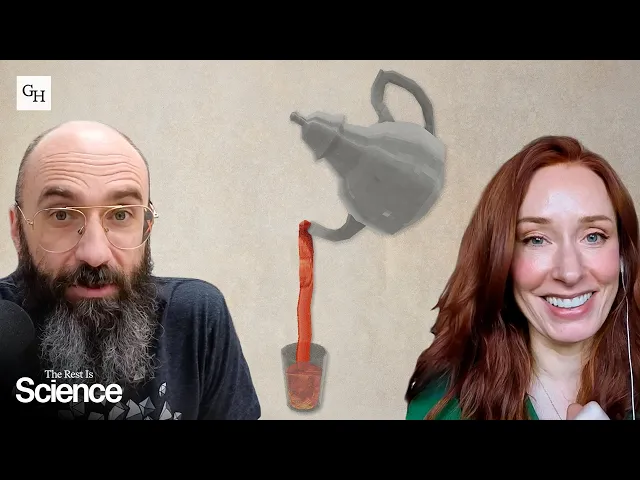
The Elegant Laminar Flow of Moroccan Tea
The Rest Is Science
0:00 You are here today to show us something very
0:02 cool about tea and I don't know what it is.
0:05 It's not my exploration.
0:07 It's your it's your reveal.
0:10 It's your exploration into my mind.
0:12 That's right.
0:13 I will be exploring your mind while you spill
0:16 the tea as they say or used to say.
0:19 I'll be honest with you.
0:20 I I'm on holiday in Marrakech staying at La
0:23 Mamounia this beautiful hotel and I have become
0:25 completely obsessed with Moroccan teapots and and so
0:30 I've insisted I've insisted basically that's where we start.
0:33 Let me just let me just going to get
0:34 this going to get this tea sitting behind me.
0:36 Hold on one second.
0:36 It comes in a teapot that is absolutely scorching hot that looks like this.
0:41 I think by the end of this you're going
0:42 to know why I'm obsessed with this teapot, okay?
0:44 Cuz it is basically a masterclass in fluid dynamics,
0:49 chemistry and the evolution of design.
0:51 All right, so it's like the whole world in a teapot.
1:01 This episode is brought to you by Cancer Research UK.
1:04 If you wanted to type out the entire human genome,
1:08 you would have to type at 60 words a minute
1:11 for 8 hours a day for about 50 years.
1:15 Okay, that's the scale of the DNA rulebook inside
1:18 each one of your cells telling it when to grow, when to divide and when to stop.
1:23 And different tissues read that same rulebook in different ways.
1:26 So a skin cell doesn't behave like a lung cell.
1:30 Cancer can begin when those instructions change.
1:33 Not one dramatic moment, but through small gradual edits over time.
1:38 Now cancer isn't one disease.
1:40 It is more than 200 types shaped by where
1:43 those changes to the rulebook happen and how cells respond.
1:48 Cancer Research UK is the world's largest charitable funder
1:51 of cancer research backing studies across all types of cancer.
1:56 Work that takes years of very
1:57 careful steady progress to deliver each breakthrough.
2:01 For more information about Cancer Research UK, their research,
2:05 breakthroughs and how you can support them,
2:07 visit cancerresearchuk.org/therestisscience.
2:19 Okay, now I'm going to try and do this without burning myself.
2:22 The key thing about Moroccan tea is it's like it's like a green
2:25 tea that they stuff with mint leaves and like an insane amount of sugar.
2:31 But crucially when they pour it, they do this really really big pour.
2:36 Now I was anyone who is actually Moroccan is going to look at what I
2:39 did there and think it was a pathetic
2:41 a pathetic version of what the professionals do.
2:44 I've got a video for those of you who are watching
2:47 on YouTube of of an actual professional doing this for me at breakfast.
2:50 Okay, so we're outside and we're watching a waiter pouring tea
2:53 into a cup that's on a tray and he starts low,
2:57 but then he lifts the pot up all the way above his head and the stream is just
3:01 falling falling falling right into the cup and I
3:04 can see that sloshing the air getting mixed in.
3:07 By the way, we're outdoors.
3:08 This is beautiful.
3:09 We got a nice blue sky.
3:10 Looks delicious.
3:12 I should say if anyone watching or listening
3:14 to this is themselves a pro at pouring Moroccan tea,
3:18 then send us in your video and we can judge it.
3:20 So the key thing to notice is that when you pour this tea,
3:24 you end up like this this down here
3:26 is all like you know tea color, fine, boring.
3:29 But what you have on the top is these really foamy bubbles.
3:33 Can you see that?
3:34 There is a good reason why you would want this on your tea.
3:37 It looks like the head of a beer.
3:39 It's a foamy, but it's the tea like air has been mixed in, right?
3:43 Is that what causes it?
3:44 Exactly.
3:45 It looks like it looks like a porter lager essentially [laughter] like
3:49 a bubbly lager and the story goes that the reason why you would have
3:53 this in Morocco is because if you are out in the desert and you're
3:56 drinking tea and there's sand kind of flying around all over the place,
4:00 what this does I mean this shows just how pathetic mine is.
4:03 When when the professionals do it,
4:04 it's a really foamy head of head of tea that stays there for absolute ages.
4:08 Mine is already puffing.
4:10 Demonstrates I'm not very good at this.
4:12 But the idea then is that if there is sand
4:14 floating around in the wind and it gets onto your tea,
4:17 it will get trapped inside these glossy bubbles
4:20 on top and then you can either blow them
4:23 off to get rid of the sand or if you kind of drink in a particular way,
4:27 then the the sand will will stay within the bubbles
4:29 and you can get access to the liquid but not below.
4:32 But even though it starts off having this really practical reason behind it,
4:36 it's also this foam is now considered as this visual indicator
4:41 that it's good hospitality and it's good quality tea and that you've been
4:44 served correctly because where it comes from I mean if you pour
4:48 normal black tea that you get in in in Britain for example,
4:51 you don't end up getting this foam and where this comes from is
4:55 this like chemical process that is going
4:58 on inside the tea because green tea leaves,
5:01 they contain this thing called saponins which is like this natural
5:06 soap-like molecule and essentially they are amphiphilic I think is the word.
5:12 Basically this molecule ends up half the molecule
5:14 one end of the molecule loves water, the other half hates it.
5:18 So it ends up orienting itself to make these kind of bubbles.
5:22 The sort of water hating tails stick out into the air bubble
5:26 while the water loving heads of this molecule stay inside the tea
5:29 and that creates this kind of protective skin around the air which effectively
5:34 lowers the surface tension and makes these bubbles form in the first place.
5:37 But also you add a shedload of sugar
5:39 to increase the viscosity of this of this liquid so
5:42 that the bubbles stay for a while and then because
5:45 you've got loads of peppermint in there and loads of mint,
5:48 you have these these kind of essential oils
5:50 which then stabilize the the bubbles even further.
5:53 So okay, it's it's good to keep sand out and it lets you know
5:57 that it's sweet enough and the and you're
6:01 you're you're you're not you're not cheating.
6:02 You're not using like dried mint basically.
6:04 You're using like the fresh good stuff.
6:06 Okay, hang on one second.
6:06 I'm actually just going to have a little sip of tea.
6:08 Hold on.
6:08 Is this only true for teas that are made with things like mint leaves?
6:12 Would you not get this from a traditional
6:14 black tea and English breakfast tea for example?
6:18 I don't know actually.
6:19 I'm not sure.
6:20 That's a good question because black tea and green
6:22 tea are from the same plant, aren't they?
6:24 They're just the way that they the way
6:27 that they process them ends up being quite different.
6:29 So I'm not sure, but definitely the aim
6:32 of black tea is not to create these bubbles, right?
6:35 No, it isn't, but it's cool that the the purpose the stated original purpose
6:42 of the bubbles is to keep out debris because the first thing I thought was oh,
6:46 that's how soap works.
6:48 Soap creates bubbles.
6:49 Surfactants create these bubbles that then lift out debris like particles
6:55 and dust and that's literally what they're being used for in the tea.
6:59 You're literally drinking soapy tea.
7:02 I mean it is a surfactant that that you're that you're doing.
7:05 Yes.
7:05 Okay, the real reason why I'm obsessed with this, right?
7:08 Is when I I mean tea is delicious, sure that's great.
7:12 But when I saw the teapots,
7:14 I immediately spotted the fluid dynamics that's going on inside
7:18 this thing cuz this is a very particular shape.
7:21 It's like the size of a pretty big coffee mug,
7:23 but of course it's a it's a jar shape
7:25 with a with a like a bell shaped kind of lid,
7:28 but the spout is starting from very low.
7:31 The other thing to [laughter] the thing to notice about this spout
7:35 because this doesn't look like a British teapot.
7:37 Okay, like a British teapot, you have the spout starts maybe halfway up the pot.
7:42 Sometimes a little lower,
7:44 but but around about halfway and the spout just curves upwards.
7:47 It's like a U-shaped spout.
7:48 This spout is S-shaped and that is
7:52 absolutely critical to getting these bubbles to form.
7:55 If you want to get proper bubbly tea,
7:58 what you need to do is you need to be able to pour
8:02 this tea from a real height like arms length away from the cup.
8:06 You want it to gather up all of the speed
8:08 and momentum and when it plunges into the liquid,
8:13 you want it to take in all of the air from around it with it.
8:16 So it's kind of like plunging right to the bottom
8:19 of the glass and creating these big bubbles and and foamy surface.
8:23 Now in order to do that, in order to be able to pour this tea from a height
8:27 which by the way has the added advantage of cooling it down to make it sippable.
8:30 Oh, sure.
8:31 Yeah, yeah.
8:32 You know, even though in the pot it's absolutely boiling.
8:35 What you need is you need the tea
8:38 to leave the spout in what's called laminar flow.
8:41 It needs to be extremely neat, extremely slippery,
8:45 extremely well-behaved tea so that you can get this stream that will behave
8:51 all the way down and you can direct it perfectly into your cup.
8:54 If it wasn't laminar,
8:56 it would spread out too much over this long falling distance
9:00 and you would just get it would rain tea all around the cup.
9:04 It would be boiling tea soap rain.
9:07 Yes, exactly.
9:08 Okay, doesn't [laughter] that sound delicious?
9:11 All right, so to get laminar flow then,
9:13 what you have got here is all of the things that you noticed.
9:17 So for starters, the fact that this the spout
9:19 starts right at the very bottom of the teapot.
9:22 This means that you are at the the the point
9:25 of the liquid that is that's under pressure, right?
9:28 You've got like the highest density.
9:30 You've also got a lot of dense tea leaves down there.
9:32 Sort of the the flavor of the tea is going to be best down there.
9:36 But it means that you've got the weight
9:38 of all of the tea all of the liquid sitting
9:41 on this on this exit as you're pouring so that you're
9:44 kind of pushing down on it as much as possible.
9:46 Then what happens is this spout starts off
9:49 reasonably wide and then it gets thinner and thinner
9:51 and thinner and thinner and thinner all the way
9:53 to the end which means you're you're reducing the aperture,
9:57 you're speeding up the tea effectively.
9:59 You are accelerating this tea all the way through
10:02 the spout to get it go faster and faster.
10:04 And what is that?
10:04 Is that like Bernoulli's principle or something?
10:07 Like the liquid speeds up as it's the cross-sectional area of the tube shrinks.
10:13 Yeah, you've got Bernoulli which is talking about the pressure,
10:15 talking about the the size of the aperture.
10:17 There's like Reynolds number stuff going on here.
10:19 There's the Venturi effect.
10:21 There's like the There's all sorts of like
10:23 really delicious fluid dynamics going on here.
10:25 The thing is is that normal teapots with the U shape,
10:28 they're doing the same thing.
10:29 They're accelerating the tea out of the end.
10:32 But this S shape is absolutely critical because if you imagine
10:35 that you were going on a slide, like a water slide,
10:39 and you kind of come round and the slide bends in one direction,
10:44 you're going to go up the slide,
10:45 you're going to be slopping about all over the place as you exit that slide.
10:50 So, crucially, this S bend, so it curves one way and then curves the other,
10:55 essentially straightens out all of these water molecules
10:59 so that when they exit from the tip, they're all pulling in the same direction.
11:03 You haven't got any little tiny little eddies or like bits
11:06 of bits of turbulence that are hiding inside of the spout.
11:09 Right.
11:10 All essential for laminar flow.
11:12 Then, you've also got this extremely sharp tip.
11:15 So, um in the '90s, there was this this group of of fluid dynamicists who
11:22 won the Ig Nobel Prize for working out how to um stop a teapot from dripping.
11:29 They did all of this unimaginable rich mathematical analysis.
11:35 Uh and the answer that they came to essentially was
11:38 what the Moroccans had already found hundreds of years ago,
11:41 which is to just have this sharp corner on the end.
11:44 And this I think brings me to what I really really like,
11:47 the reason why I find this kind of design so interesting and exciting.
11:52 Because I could literally spend maybe 4
11:56 years writing the equations for this teapot, right?
11:59 I could I could work out these extremely
12:02 sophisticated computer simulations demonstrating that this is the optimal
12:06 way to create laminar flow that behaves in this way
12:09 to to to create bubbles exactly like that.
12:13 But here's the thing, this teapot,
12:15 there was literally no maths or physics that was involved in the design of this.
12:20 And so I think this is one
12:22 of the most gorgeous demonstrations of how the evolution
12:27 of design manages to land on totally optimal
12:33 physics solutions without ever having touched an equation.
12:38 I think that's really cool.
12:40 It's beautiful.
12:40 It just It emerges through natural selection in a way,
12:44 except the pressure is our desires to have laminar flow, foamy tea.
12:51 And you try things out and then boom,
12:53 you've solved the equations, but you never had the equations.
12:56 But you never had them.
12:58 And you see this I mean, you do see this over and over again, right?
13:01 Roman arches is a really good example of like
13:04 finding this optimal way to support a structure.
13:07 You see this in Japanese steel in the way
13:09 that they heat the when they're making knives and blades,
13:13 the way that they heat it is actually this You know,
13:16 to understand what they're doing requires
13:18 this incredibly deep understanding of the material
13:21 science of the structure of of the the the materials that they're working with.
13:25 But actually, they just chanced upon it through many
13:29 many many many many iterations of design over numerous generations.
13:34 Yeah, that's right.
13:35 I love the the folk physics of it.
13:37 The like, "Look, if you warm the metal up and then you cool it down quickly,
13:42 it's going to be softer." And we call that annealing.
13:45 And today, you can look up a bunch of videos
13:47 about exactly what's happening at a molecular level and why,
13:50 but before that was really understood,
13:52 before atomic theory, before molecular theory, it was just like,
13:56 "The metal has a personality and you have to treat it this way.
13:59 You have to be mean and then tender." And I can see how much
14:02 more alive the world was when you had to just make everything an animal.
14:05 And yet, you it still gave you the right answer.
14:08 I mean, maybe it didn't allow you to fiddle with numbers
14:10 a little bit and develop whole new like hardnesses of steel,
14:15 but you would discover them on accident and it was like a blessing.
14:18 Exactly.
14:19 I think this is it actually.
14:20 You know, the sum total of of human
14:24 knowledge even without science is just really profound.
14:29 There's this Japanese idea actually that in a single cup of tea,
14:34 you'll eventually discover the truth of 10,000 forms in the universe, right?
14:40 Like this idea that you can you can you can
14:43 observe all of humanity in a single cup of tea.
14:46 And it's not that far off.
14:48 A single cup of tea gives us thermodynamics, fluid dynamics,
14:53 it gives us history and botany and human culture and tastes and flavors.
15:01 It's all there.
15:02 It's all there.
15:02 Okay, Michael, that's me spilling the tea.
15:04 Maybe less juicy than than you might have been expecting,
15:07 but um more fluid dynamics.
15:09 Hannah and I are now going to delve into questions that you all have sent us.
15:13 We certainly are.
15:15 Should I go first, Michael?
15:15 I took the first half.
15:16 Yeah, I'll go first cuz I love this question from Louis Taylor.
15:19 The question is the boiling point of water is affected by your altitude,
15:24 which we tend to measure as a height above sea level.
15:27 But if sea level changes outside of its normal range,
15:30 will that change the time it takes to boil water and therefore eggs?
15:34 And I love this because one,
15:36 it's very personal to me because I spend time pretty much at sea level in LA,
15:41 but also up over 5,000 ft in Boulder, Colorado.
15:46 And you notice a difference.
15:47 I have to now remember two different times for soft-boiled eggs.
15:53 Like here in LA, it's like 5 minutes.
15:55 We're getting We're going to It's too far.
15:57 But I need to do six and a half in Boulder.
16:00 And you can measure the water temperature and it's like, "Oh, wow,
16:03 this boiling water is not 212, you know, it's like Let me see.
16:08 Temp of boiling water, Boulder, Colorado." Yeah,
16:12 the water boils in Colorado in in Boulder at 203° Fahrenheit.
16:17 Translate that into sensible system, Fomikiji.
16:20 In C is 95.
16:22 Woah.
16:23 So, water boils at 95° Celsius in Boulder.
16:28 And that means that to cook an egg, like to soft-boil or hard-boil it,
16:32 it just needs to be in that water a lot longer,
16:34 like a couple minutes longer at least.
16:36 And pasta is the same way.
16:38 You know, normally pasta instructions would be like 10 to 12 minutes.
16:42 Boil this to be soft.
16:43 And I would go just to like 10 or even under the minimum.
16:47 But in Boulder, I've got to go past
16:49 the maximum and it's still not even al dente.
16:51 It's still like too hard.
16:54 I think that you would I think you'd particularly notice that, too,
16:57 given that for some strange reason, Americans don't have kettles.
17:02 I've always found that the weirdest thing about your country.
17:04 I can't say too much about it though because my mother had a kettle.
17:08 Oh.
17:08 My wife I married a Kiwi who lived in England for decades,
17:13 so she's got an electric kettle in our house and we use it all the time.
17:16 So, I Look, I get what you're saying though.
17:19 Um it takes even longer to boil water when
17:22 you don't have like a super fast turbo electric kettle.
17:26 But um yeah, I think constantly about how my altitude is
17:31 a is is the reason the water's taking longer to boil.
17:34 Long story short, there's just less air above
17:36 you when you're already up in a mountain.
17:39 And it's that water's that Sorry,
17:41 it's the air's weight that's pushing down on the water molecules saying,
17:45 "No, you cannot leave your liquid state.
17:48 You cannot leave this container." And if you go up high enough,
17:51 there's so much less weight from that air squeezing
17:54 on top that the water molecules can get out more easily.
17:56 They don't have to have as much energy to leave the liquid state.
18:00 So, that it boils with a lower temperature, with less kinetic energy.
18:05 And uh I always think of my altitude
18:09 in terms of a number like 5,000 ft or whatever.
18:14 And that's from sea level.
18:15 But if sea levels go up, like let's say I live at 5,000 ft.
18:20 If the sea levels rise by a foot, do I now live at 4,999 ft?
18:26 Technically, I do.
18:28 But what happens to the actual air pressure effect on boiling?
18:34 And I think that's a lot more complicated.
18:37 And I think first of all, the ice And you tell me if I'm wrong
18:40 because this is just me kind of noodling through it.
18:44 The ice that melts that then causes the sea level
18:48 to rise took up more volume than the water does.
18:53 I know that a lot of glacial ice is much more
18:55 dense than the typical ice that we'll put in a drink.
18:59 But I think that overall,
19:01 the amount of space taken up by solid matter on Earth goes
19:04 down when sea levels rise because you've exchanged some liquid water You Well,
19:11 you've exchanged some solid ice for some liquid water.
19:15 Which is a smaller volume.
19:17 But crucially, you have a hell of a lot of water
19:22 in glaciers on land that could be added to that total.
19:26 Yes, but if a glacier on land melts, Mhm.
19:30 the total volume of solid material on Earth has
19:34 gone down cuz it's turned from ice to water.
19:37 Mhm.
19:38 And so in that way, the average height of Earth,
19:44 like what we call mean sea level, Mhm.
19:47 would Well, but mean sea level is based on where the oceans are floating.
19:53 But you got to imagine that all the solid stuff on Earth is displacing the air.
19:58 And when the solid stuff that's displacing
20:00 the air gets smaller, you now have what?
20:04 A thicker atmosphere or a thinner?
20:07 I see where you're going with this.
20:09 Isn't there an additional complicating factor,
20:11 which is that there is a huge amount of gas also trapped within glaciers?
20:18 So that once that ends up melting,
20:22 there's a higher amount of air of air overall.
20:26 Right.
20:27 Let's just do like a toy model and let's imagine that the Earth becomes smaller,
20:33 like half the diameter, but it has the same amount of air.
20:37 Now we're really exaggerating this change.
20:40 But that same amount of air is now going to be much thicker everywhere.
20:45 The The atmosphere is thicker because it's got a a smaller um surface to cover.
20:51 Hang on, let me make sure I'm following you.
20:52 You take you take the sphere of Earth
20:55 and you shrink it so that it's half the size.
20:57 Yeah, and it you keep all the same air around.
21:00 All the same air?
21:02 So air Are we saying that the outer like the Karman line, as it were,
21:06 effectively, is like is in the same place or is the whole thing shrinking?
21:11 I think that the only the solid part of Earth shrinks.
21:15 So I think the Karman line would go up
21:19 because you've got the same amount of air Okay,
21:21 so imagine you've got like a a cake that's a that's
21:24 really big and you've got a one jar of frosting,
21:27 you can cover the whole cake, but it's a thin layer.
21:29 Now you make the cake half the diameter,
21:32 but you have the same amount of frosting, it's going to be a thicker layer.
21:35 So air pressure frosting pressure in our example here is
21:39 going to be greater now at each point on the cake
21:42 surface because there's a higher column of frosting above you
21:46 than when you were a big cake with a thin layer.
21:49 Let us know in the comments below what
21:51 I'm getting wrong because I am just noodling
21:55 on this and I'm thinking that if the total
21:59 volume of solid stuff that Earth is made up shrinks,
22:03 like the the total amount of mass I'm imagining it stays the same,
22:06 the volume gets smaller, the air pressure would increase,
22:09 but I think there's also so many complicating factors,
22:12 like could the atmosphere become thicker or is it going
22:15 to start getting picked off more quickly by solar wind or something?
22:18 Like I think when we talk about sea level rising 1 ft,
22:21 we're probably talking about such a small
22:23 change that other consequences might compensate.
22:29 Extra air released from melting glaciers,
22:32 thicker atmosphere being pulled off by solar wind,
22:35 I there might not be much of a change,
22:36 but if all that happened was that Earth technically had a smaller volume,
22:41 I think that the boiling point of water would go up
22:45 regardless of the fact that your altitude above sea level went down.
22:49 I like this so much.
22:50 This feels like this almost feels like a um [snorts]
22:54 you know, when they do those incredibly hard interview questions.
22:57 Yes, the Yeah, how many ping pong balls are here in New York City?
23:01 Yeah.
23:01 Right, exactly.
23:03 Or like if you were a flea trapped in a blender, how would you get out?
23:07 Like that if you were shrunk down to the size
23:09 of a flea and put into a blender, right?
23:10 That kind of thing, you know?
23:12 Yeah, this is I I want to think about this.
23:14 I want to think about this.
23:14 Maybe maybe in the comments as well,
23:16 you can [laughter] you can tell us your answers.
23:19 And um and maybe we'll come back to this in another episode of Field
23:22 Notes and we'll we'll compare cuz I
23:24 think there's an argument that it's the opposite,
23:25 but you know, there's I want to I want
23:27 to get my equations on before I before I commit.
23:30 Yeah, yeah, yeah, using no equations or anything,
23:32 just straight up what I know about stuff
23:35 and comparing stuff to cake sometimes very helpful.
23:38 I think that all else being equal,
23:41 if sea levels rose because of melting glaciers and ice caps, technically,
23:47 the boiling point of water everywhere would be
23:49 a little higher despite the fact that your your altitude
23:52 above sea level will have gone down because
23:54 mean sea level will be closer to you.
23:56 I'll tell you what, there was a question I really like
23:58 the look of by Alistair That's my best possible attempt at the pronunciation.
24:04 And I think this links in quite nicely with this because here's a question.
24:08 I was watching some climbing videos on YouTube
24:10 and it made me wonder what percentage
24:11 of naturally occurring vertical surfaces on land that are
24:16 on land have actually been traversed by humans.
24:19 Well, great question.
24:20 So I had a little go at this uh at calculating it.
24:25 And a sort of related question that I have wondered so many
24:31 times is how much of horizontal surface has ever seen a human footprint.
24:37 Like when you go out and you're kind of walking the land,
24:42 how much of Earth has no human footprint ever laid upon?
24:48 This is sort of I mean,
24:49 this question by Alistair is like the vertical version of this, I guess.
24:52 And that one does have a clear answer, right?
24:54 So I'll I'll tell you this well, clearish answer.
24:56 Because I think that humans you sort of I think it's very easy to feel
25:02 like we're spread out all over the place
25:03 that we've kind of dominated the entire planet.
25:06 But the reality is we're actually a really huddled species.
25:10 So if you take all urban infrastructure,
25:12 everything that we've built and live in, it's actually only 1% of of land.
25:18 It's tiny teeny teeny tiny.
25:20 Which is an even smaller percentage of Earth's surface.
25:24 Exactly.
25:25 So everything every number I'm going to say here,
25:27 you have to you have to basically cut it by 30 you know,
25:32 cut it to 30% of the number because as you say,
25:34 70% of the Earth's surface is is ocean.
25:37 Um even our agriculture, which is way way way way way bigger than
25:41 than the urban infrastructure is only 37% of Earth's landmass.
25:48 Managed forest is about 10%, but wilderness dominates.
25:51 I mean, you think about the Sahara Desert or you know,
25:54 the Arctic, the Antarctic, it's 52% of the of the landmass.
25:59 So if you go through and you make some assumptions about you know,
26:03 I think you can you can assume that in an urban landscape,
26:06 100% of the land, you can't you know,
26:08 you're not going to find a single patch where people haven't stepped on it.
26:12 Um which decreases as you go further down.
26:15 So in agriculture, some bits of agriculture maybe it's going to be 80%,
26:18 some bits maybe slightly less, more like 20%.
26:21 But in the wilderness, I mean, almost none of it has been stepped on by humans.
26:26 So when you kind of go through and calculate this, it's
26:29 about 15% of the Earth's surface have ever seen a human footprint.
26:34 Um which as you say, uh that's sorry, that's of land.
26:38 And then when you consider that that's only
26:41 a third of the surface because of the oceans,
26:44 5% of the Earth's total surface has ever had a human footprint on it.
26:49 Amazing.
26:50 That's amazing.
26:52 Yeah, cuz it's easy to get so sad about how there's no new frontiers.
26:57 There's there are no far-off distant lands that we've never, you know, visited.
27:01 I I was thinking about that today.
27:03 You're coming from Marrakech.
27:05 Just 200 years ago, I would have read about it in a book,
27:08 but I would never even probably correspond with any from one from there.
27:11 Now it's like, oh, we're both going to be
27:13 talking live from Los Angeles and Marrakech simultaneously.
27:18 Piece of cake.
27:18 Now are you factoring in like the the actual surface area of a footstep?
27:23 Because I could walk in a field, but I haven't walked on the entire field,
27:27 but I've, you know, been near and seen a lot.
27:30 Oh, I was cheating slightly.
27:31 I did I did some I did some rule of thumbs.
27:35 So I said that if it's a field, then it's about 80%.
27:38 80% of that would have been covered.
27:40 Interesting.
27:41 Okay.
27:41 I mean, I'm get I basically I'm guessing, Michael, at this point.
27:44 Oh, you get down deep enough, you're always guessing at everything, frankly.
27:48 Um but so there's some some estimation going on.
27:51 But to do this for the vertical surface, which is was the question, right?
27:55 This I mean, if we're if we're talking
27:57 about 5% of the horizontal surface of the Earth,
28:00 the vertical surface is almost nothing.
28:04 So [snorts] I I looked it up,
28:05 there's about a million established rock climbing routes around the world.
28:11 I mean, I was I I like I'm doing one significant figure here.
28:15 That is like again, this is some serious estimation going on here.
28:19 And then when you think about them, I was like, what do you reckon?
28:23 About 30 m?
28:24 I mean, most of them are not going to be on average about 30 m,
28:27 maybe about 2 m wide.
28:30 So once you once you run these numbers,
28:33 you're talking 60 square meters of climbing
28:36 surface for each of these million routes.
28:40 I mean, this is it's a rounding error.
28:43 We've done none of it.
28:45 Literally none of it.
28:46 Wow, we could have not climbed anything and still
28:49 pretty much touched the same amount of Earth.
28:52 It's so small in comparison.
28:53 Wow.
28:54 We think of ourselves as an invasive species.
28:56 We've we've barely got started, Michael.
28:58 We It really depends on what you mean by invasive, doesn't it?
29:02 Because we've got satellite imagery of so much,
29:05 our our emissions surround and touch so much,
29:10 but yet our flesh has touched so little.
29:13 Almost nothing.
29:14 Yeah.
29:14 And I used the word flesh just there, but usually we're wearing shoes.
29:19 And when you're climbing, you you'll well, you'll have the chalk on your hands,
29:23 but you know, I'm saying that shoes and gloves are different, too.
29:26 I've always been like, no one's really touched the moon.
29:28 No one's run on it barefoot.
29:30 Yeah.
29:31 Does it count if you there's fabric in between your skin and the moon surface?
29:38 You're you're counting contact we've made wearing shoes with the Earth.
29:42 You are absolutely right.
29:43 Let's get out there and touch grass, everybody.
29:46 Yeah, for s- for real.
29:49 Because you're right, you'd have to I mean split this by a massive fraction.
29:55 This is actually a perfect segue to a question that came in from Andrew.
29:59 So, Andrew asked, "While lying in bed,
30:02 I ran my foot along my bed cover and noticed
30:05 I could feel the fluffiness of it through my sock,
30:08 but I could also feel my sock.
30:10 It made me think about all the times I was able
30:12 to discern a texture through my socks or my socks and my shoes.
30:16 How am I able to feel and discern all
30:18 these separate textures?" I know exactly what you're talking about,
30:21 Andrew, because I got I really tripped out when
30:24 I was at Derek Muller's wedding in uh Portugal.
30:30 This is Veritasium.
30:31 Veritasium got married and I was there.
30:34 I was very honored to be there and I was walking around the streets
30:37 of Lisbon and the stones there uh that line the streets are very smooth,
30:43 but sometimes they weren't and I could tell the texture,
30:49 like the microtexture of the stones through my socks and shoes.
30:55 I don't know if this if anyone else has
30:56 experienced this, but I could like immediately tell, "Wow,
30:59 these stones are different," but they looked identical and I'd
31:01 reach down and feel them and I'd be like,
31:03 "Oh, these aren't polished as smooth," but I couldn't tell
31:07 with gross motor movements whether it was slippy or not.
31:10 It wasn't obvious.
31:11 It was something different and I think
31:13 it might have been even like the vibrations, like the microvibrations,
31:17 and that reminded me of a study I saw that looked
31:21 into how we measure how heavy things are and that it's
31:25 not as simple as we hold it and we just look
31:27 at how much our our our muscles are having to work.
31:31 We we really do feel like thousands of little micro motions.
31:35 We're sensitive to them when we reach out and grab something before we even lift
31:38 it that tell us how easy it's going to be to change this thing's velocity,
31:44 how easy it's going to be to accelerate, to pick up,
31:47 and we can tell that before we even hold it.
31:50 And as I dove deeper into this, Andrew,
31:52 I found that there's all kinds of ways to trick your sense of weight.
31:56 You can actually make things vibrate so that they feel heavier.
32:02 If you take a little device and you have it vibrate side to side,
32:06 not even up and down, but side to side, people will think it's heavier than
32:10 it really is because it's well we don't know why.
32:13 One hypothesis is that it's using more muscles and the brain goes,
32:17 "Ooh, it's taking a lot more muscle activity to hold this.
32:20 It must be heavier," um even though of course it isn't.
32:23 Um we know for certain that you can have something vibrate up and down,
32:27 especially asymmetrically, like a bigger vibration down down.
32:30 It has to be pretty fast.
32:32 Like 30 hertz, I think is like the the the real
32:35 sweet spot for making something feel heavier because of its vibrations.
32:39 And so basically, we I think learn through experience
32:44 how to tell the textures of things through other things.
32:50 You can poke uh an object with a stick
32:54 and learn if it's rough or smooth even if you're blindfolded.
32:57 And I think we learn that through time and it's very
32:59 trippy to think that it's an extension of our body, really.
33:02 We learn how to feel through sticks and um walking sticks and socks and shoes
33:10 and gloves um as though they were part
33:13 of our bodies with sensory receptors on them.
33:17 Though of course they're not, they're inert.
33:19 And we our bodies don't have to be this big, they can be large.
33:23 Yeah, you do hear that about blind people in particular where
33:26 the stick essentially becomes an extension
33:28 of their body exactly as you describe.
33:30 But in a way, I mean your it's the same
33:34 story in the sense that your brain is receiving signals,
33:39 it's receiving some data, some some input [snorts]
33:42 and it's interpreting it's it's making an interpretation
33:46 based I mean I I I sort of feel like almost every week we come back
33:50 to this idea that like reality is not reality,
33:53 it's just our brain's interpretation of it,
33:55 but it sort of feels like it's the same thing.
33:57 a little show your brain puts on for your awareness.
34:00 Like my glasses, right?
34:01 I wear these all the time and I don't think I'm looking through glasses.
34:06 This is just the world.
34:07 So, these have become part of my eyes as far as my brain is concerned.
34:11 They're not there.
34:12 They are a prosthetic that is almost all the time completely fused with my body.
34:18 Or yeah, I mean you could say for people who don't wear glasses this kind
34:21 of the opposite way around that your nose
34:23 is permanently in your field of vision.
34:26 You just don't bother noticing it.
34:28 We yeah, we ignore it just like you can
34:30 ignore that the sock is there and go, "Oh yeah,
34:32 I can feel the fluffiness of my duvet through the sock."
34:35 No one ever looks at a beautiful view and says "Oh,
34:38 let me describe this for you.
34:39 So, first of all, there's this like nose down here
34:43 and there's like the li- the bar of my glasses,
34:47 so imagine that's going over the top, you know, second fifth.
34:51 No, no, they just describe the view.
34:52 We can ignore these things.
34:54 I feel like the uh classic painters [laughter]
34:59 they really should they really missed a trick, you know?
35:02 I think it would have been so much more beautiful if you saw the Mona
35:04 Lisa and you just had Da Vinci's nose in the middle of the canvas.
35:08 Right there.
35:09 Yeah.
35:10 Yeah, he erased himself.
35:11 He did.
35:12 You know, let's embrace that.
35:14 Let's put in the like weird overgrown eyelashes that are kind of down there
35:19 and the little dust on the glasses that you keep ignoring or the floaters.
35:24 For those of you who don't use I mean I see floaters, too,
35:26 but you know, even without glasses, you've still got artifacts in your vision.
35:30 Maybe I'll stop into the Louvre on the way home on the way home from Marrakech
35:34 and just break in at midnight paint Da Vinci's nose on top of the Thank you,
35:39 I'd appreciate that.
35:40 I'm sure there's some famous works of art
35:41 in Morocco that would be easier for you to vandalize.
35:44 Do you know what else too?
35:45 That's also that's also true.
35:46 I'm also obsessed with Moroccan tiles, by the way.
35:48 Expect to see me do a video on that for a for for the internet very shortly.
35:53 I can't wait to see you talk about that.
35:56 So, anyway, I'm I'm glad that we get to touch
35:58 you guys all through your ears every single week.
36:01 Send us in your questions.
36:02 Like I said, therestisscience@golhanger.com.
36:06 Or you could sign up for our free newsletter,
36:08 therestiss.com/science and we will see you next week.
36:12 See you then.
36:15 [music]