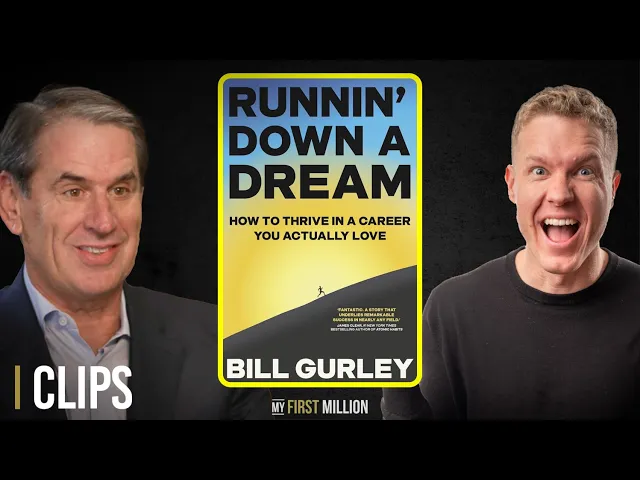
How to Find a Career That Feels Fun & Meaningful | Bill Gurley
My First Million Clips Official
0:00 There's this cool book called Grit.
0:01 We talked about it a ton here on this podcast and you cite it a bunch.
0:05 It's awesome.
0:06 I forget the exact equation but it's basically like she Angela Duckworth,
0:09 she's like I think she started the original
0:11 book with 50% passion and 50% perseverance.
0:16 And one thing we highlight,
0:18 we actually had a chance to talk to her which I'm super grateful for.
0:21 But we found this podcast she had done 10 years later where she said
0:24 it probably shouldn't have been 50/50 that it
0:27 needed to put more weight on passion.
0:29 And her her fear is that we've taught children, young adults how to grind.
0:34 So that we've taught them to persevere for the sake of perseverance.
0:38 And she believes that now that now she believes that leads to burnout.
0:43 And so if you have like all this effort without the love for it,
0:47 it it feels more like work.
0:49 And one of the things you know, my the second principle here after you
0:53 chase your curiosity is to hone your craft.
0:56 And that's a lifelong journey, always learning.
0:59 And for people that are in the right space, that comes free.
1:04 Like you just do it naturally.
1:05 You wake up and want to do it.
1:07 Like you're drawn to knowing more about the craft.
1:11 And and I think that that correlates nicely
1:14 with where she where she came out which is you
1:17 it's hard to do all the things I recommend
1:20 in this book if you don't truly love it.
1:22 I didn't realize that but passion I think is
1:25 probably I think passion's kind of a bad word.
1:27 Because like passion kind of implies that I'm going to like everything I do.
1:31 And if you like talk to like a lot of athletes,
1:33 they're like well I love competing.
1:35 I do like practicing but there's definitely days that I hate doing it
1:37 but I'm a pro and I'm going to do it no matter what.
1:39 And like I love winning.
1:40 We highlight in the book that that word's kind of clicheish and overused.
1:45 Seinfeld gave a talk at Duke where he said fascination was a better word.
1:50 I think obsession's a good word.
1:52 We titled the chapter chase your curiosity.
1:55 Like we just what is it that you you can't ignore?
1:59 Like what is this thing that you love so much
2:01 that you always want to know more about it, you know?
2:05 What was your uh You did a good job
2:07 of like listing all these exercises to like find it.
2:10 What was the uh most productive one that you found?
2:12 Well, I mentioned the one that Tito had used.
2:15 Um the the team that wrote Designing Your Life
2:17 has has one that they say is most popular, which is is battle carding.
2:22 So, like come up with three to five potential career paths,
2:26 not just one, and let your brain roll around in them for a while.
2:30 So, you you could do that.
2:31 Especially with AI today, you could imagine I'm going to do this.
2:35 What does it look like 2 years from now?
2:37 Like who are, you know, what might I like?
2:39 What might I not like?
2:40 You can you can And then, you know, you could say,
2:42 "Well, what if it were this or this?" So, that's an exercise.
2:46 Um I think having the mental relaxation to not
2:50 feel like some path you've been down is some cost.
2:52 Like I'm going to go try this, and if it works, great.
2:55 If not, I'll do something else.
2:57 Just as your parents said it's okay to quit college and go work there.
3:02 Um it's okay to quit the job you're in as well.
3:05 And I just fear we've put so much weight on economic stability.
3:11 You know, you mentioned some of those immigrants' families
3:13 and what they they pushed that that that There's
3:16 this burden to do that above and beyond what might be fulfilling in your life.
3:23 And I I think it'd be better if we got out of that.
3:26 And and or or at least this way, think of it as a a you know, a gauge.
3:31 We've gone pretty damn far to one side.
3:33 Let's let's bring it back a little bit.
3:35 Have you messed up with your like have
3:38 you had to pull yourself back with your kids?
3:40 Yeah, yeah, yeah.
3:40 I think there is a And having um they're all in their early 20s,
3:44 so they're all trying to find it.
3:46 Like I don't know if they're all even there yet,
3:48 but there is this intuition as a parent,
3:51 and I think I think it's well-intentioned to to to worry
3:56 to feel like they're on a safe path and safe is usually economic,
4:00 but it's also uh it's just risk feels like your risk like
4:05 it like and and I I love the story what your parents did
4:08 and I've got a few anecdotes I found since we finished the book
4:12 that are great on that are very similar to what your parents did,
4:15 but I think it's the exception.
4:17 I don't think it's the rule.
4:19 I think a lot of parents would have tried
4:21 to convince you to finish out and get your degree.
4:23 I think that's built into to most uh parents and and so
4:27 there are other people other than myself that that have
4:30 highlighted that the I'd call it like this industrial college matriculation
4:37 path has gotten very rigid and and it's competitive and it's grindy.
4:43 That the the like getting into college now is significantly harder.
4:47 Yeah, they've not expanded they've not
4:49 expanded the uh enrollment at these schools,
4:51 but the number of people that want to go to college has gone way up.
4:55 It's crazy.
4:55 It's crazy and and starting around 6th grade, once again,
4:59 well-intentioned parents start building the resume to get into college
5:04 and so we over-schedule children today compared to when I was young.
5:09 For sure.
5:09 And so they're they're scheduled from when they wake up to when they go to bed.
5:13 There's actually a chapter in Jonathan Haidt's book Coddling
5:16 of the American Mind called The Decline of Play.
5:19 Where we've just we've we it's harder, I think,
5:22 for a child to explore and try on different ideas because
5:27 they're caught up in this game to try and get into college.
5:30 You had this crazy stat.
5:31 You said um I think it was uh the people who won a Nobel Prize in science,
5:37 the scientists who won Nobel Prizes correct me if I'm wrong,
5:40 but they were 22 times more likely to participate
5:44 in things like acting or dance class and things like that.
5:47 What was that stat?
5:48 So, this was work that Keith Holyoak had done at UCLA and it
5:52 relates to a lot of the concepts in the back of Range,
5:55 the book by David Epstein, but it it was the people at the top of their field
6:01 um are like much more likely to have a a breadth of hobbies.
6:06 Um speak more languages, do more things,
6:10 um and and almost I think have a lens on the world
6:15 that's broader because they were able to try so many different things.
6:19 So, I read this book uh Mastery and like
6:21 the premise is like being a generalist is kind of nonsense.
6:24 You have to specialize in something,
6:26 but once you specialize then you become a generalist.
6:27 I think that's the right pathway.
6:30 Like I I do I do think you want to get
6:32 started in an area where you can differentiate yourself and then
6:36 and then in many of in both the principal chapter on mentors
6:40 and peers in here and even in the learning uh principle,
6:45 I recommend, you know, as a more advanced level once you get,
6:49 you know, up to this level then go broader.
6:51 Like start to learn outside your field,
6:53 find mentors and peers outside your field
6:56 and you'll get pulled in more innovative ways.
6:58 So, tell tell me more about that.
6:59 That like just like kind of blew my mind.
7:01 Well, I think what Keith's work um highlighted was that some of the people
7:07 that are able to reach the top of their field are able to draw
7:11 on mental models from much from a variety
7:14 of different places and where a hyper-specialist
7:19 and and David Epstein's book Range is
7:21 all about this specialist versus broad thing.
7:24 Like that's the really the the whole point
7:27 of the book and he quotes Holyoak as well,
7:29 but many different innovations in science have come
7:32 from people who repotted from one place to another.
7:35 A chemist who becomes a physicist.
7:37 The person who's a lifelong physicist has mental models that are
7:41 pretty rigid at that point in time cuz that's all they know.
7:45 And so, once again, I think this is an advanced skill.
7:48 I don't I think after you're succeeding, you start to do this.
7:52 I don't think it's the pathway to the beginning
7:54 of success cuz I think you'd just be too broad.
7:57 But, some of the smartest people I know like
8:00 like one person profile in the book is Danny Meyer,
8:02 the great great restaurant tour.
8:04 We were asking him about his mentors, and one of the mentors that had influenced
8:08 him the most isn't from the restaurant industry.
8:11 You know, and so it's it it is a more advanced skill,
8:15 but it is where you will Look, the whole goal, I think,
8:18 is to differentiate yourself along the pathway,
8:21 and that is a great way more advanced way,
8:23 but a great way to to take yourself places you wouldn't have thought of.
8:27 You had this cool line.
8:28 You said, "There's if there's one takeaway
8:30 that you should have from this book, peer groups,
8:33 more so than coaching, consulting, courses, whatever,
8:35 is probably the most powerful thing that you could use,
8:39 and it's under discussed because it doesn't feel intuitive to like want
8:43 to be peers with someone who might take the same job as you,
8:46 but it's really powerful." Yeah, I think the way you described it is right.
8:49 Like, everyone talks about mentors, and no one talks about peers.
8:53 So, I do have a chapter on mentors,
8:55 and I offer a ton of very practical advice about how to play that correctly.
9:01 But, the peer thing, the idea is that when you get on that first
9:05 rung of the ladder and you're trying to climb it,
9:07 if you could develop a friend group, it might be four, it might be six,
9:12 that are also on that same journey,
9:14 and hopefully I think outside your organization.
9:18 I think you could start maybe with one person in your org,
9:21 but for all the reasons we just talked about how
9:23 breadth of knowledge might give you insights you wouldn't have.
9:26 If they're outside your org, they're going to see different cultures,
9:29 they're going to see different management structures,
9:31 they're going to bring a different viewpoint to you
9:34 that you wouldn't have had if they were inside.
9:37 Um, and then with today's modern tools, you know,
9:40 create create if you're adventurous create a Slack channel,
9:43 if you're if you just want to do a WhatsApp group or a Signal group and share,
9:48 you know, share your learnings along the way.
9:50 When I moved to San Francisco for Airbnb and um
9:54 I didn't actually end up getting the job by the way.
9:55 They offered me a job and I got it and then when I
9:58 was in college I was like kind of crazy and I got arrested.
10:01 I got DUI and I'm sober now.
10:03 I don't do any drugs or alcohol.
10:04 I'm completely clean and and by the book
10:07 but they're like you lied on your resume.
10:08 You said you didn't have a criminal record and so I didn't end
10:11 up getting the start and so I was stuck out in San Francisco.
10:14 I was like what the hell am I going to do?
10:15 So I ended up starting a company and it worked out well but it was like super
10:18 low point in my life and when I
10:19 got there I created this thing called the Anti-MBA.
10:24 It was my version of a book club and we met
10:26 once a week and we would get a book and we
10:28 would read a book a month and talk about a quarter
10:31 of the book every single week and it changed my life.
10:35 Like having those group of guys to like and I think that like
10:38 you need a few things to make a group like that work.
10:39 I think you need like rules,
10:41 you need like some rituals and you need to like take it serious.
10:44 Yeah, and I think if there are people that are sharp-elbowed,
10:46 they're climbers that that step on other people, you kick them out.
10:50 Like I I I think you need like-minded
10:52 people who are equally gracious to one another.
10:57 Who is in your group now that's like big shot now?
11:00 Well, we one thing I've I've I've discovered lately is
11:05 setting up different like WhatsApp or Signal groups for different topics.
11:09 I think for someone coming in early into a career it's better to have
11:13 people that are on that exact journey and I'm not in that place anymore.
11:17 I have a company called Hampton.
11:18 That's my main company.
11:19 Are you familiar with YPO?
11:21 Sure.
11:21 It's like YPO.
11:22 So we have thousands of members all over the country and you it's
11:25 creates peer group and then we have
11:26 executive coaches who like lead the conversation.
11:29 It's for CEOs.
11:30 So you have to the average person has like 30-million,
11:32 20-million in revenue or so.
11:34 And it's been really cool to like watch these members like
11:37 team up and I'm in a we call them core groups.
11:40 I'm in one as well and it like you have this a bunch
11:44 of lines in there about peer groups and I'm like, "Oh, you're right.
11:46 My ads for me."
11:47 Yeah, but but but and those things exist with YPO and and your thing for CEOs,
11:52 but it could be done by anybody.
11:54 For sure.
11:54 I mean like my wife when she was pregnant, she had one for moms.
11:58 I've got a buddy of mine has one for Jewish dads.
12:02 Like like it could be anything.
12:04 You know what I mean?
12:04 But like it really does like change things.
12:07 It does.
12:07 It really does.
12:08 I think it can and and almost all of the other principles are accelerated.
12:14 So your learning is accelerated.
12:16 There's a great story in the book about Mr.
12:18 Beast that ties to that.
12:20 There's your your your network is accelerated.
12:24 So your network isn't just your network.
12:26 It's now the network of the group if people
12:28 are willing to share introductions and that kind of thing.
12:31 You know, both for mentors and other peers and and then
12:34 the group I think can be really helpful on bad days
12:37 and everyone's going to have bad days and there's a support
12:41 element that comes into play that I think is really useful.
12:45 And then also you you may be at a shitty company.
12:49 Like your your dream job may be the one you're
12:51 in and you might be at a shitty company and if you're alone,
12:54 you have no way of knowing if that's normal or not.
12:57 Like the the stuff you're exposed to.
12:59 Whereas if you had a group of eight
13:01 people that were all doing this in different companies,
13:04 you'd get different perspectives on that.