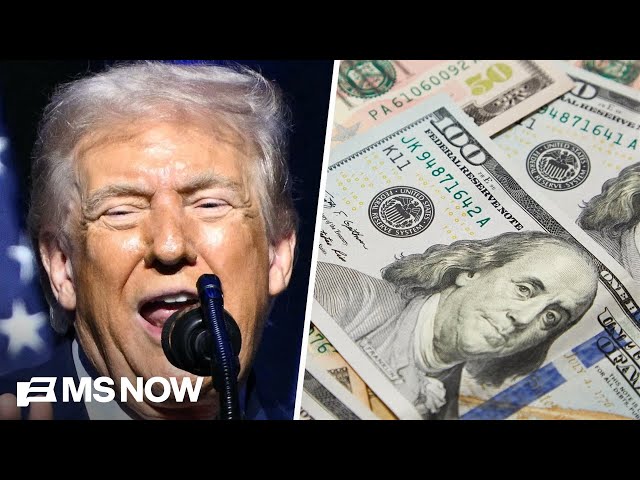
'Did you take Economics 101?' Panel reacts to admin's 'tone deaf' messaging on economy
MS NOW
0:00 Joining us, MSNOW contributo managing editor of the bulwar Sam Stein,
0:03 MSNOW political analyst and former undersecretary
0:06 of state for public diplomacy and public affairs,
0:09 Rick Stengel, and co-founder and director
0:11 of economic policy at VEDA Partners, Henrietta Trace.
0:15 Henrietta, let's talk about credit WHAT ARE CREDIT CARDS?
0:17 LET'S START WITH CREDIT CARDS.
0:18 LET'S START WITH CREDIT CARDS.
0:19 THE WAY TO THINK ABOUT THIS, I THINK THAT'S THE EASIEST
0:22 TO UNDERSTAND IS THAT THE average family spends $310 a week on groceries.
0:26 That's how much more it now costs you to fill up your truck or your car.
0:31 That's because of the war.
0:33 So now you're out a whole week's worth of groceries.
0:35 And that's why people are turning to credit cards.
0:37 Savings rates are at three-year lows.
0:40 People are the most negative and pessimistic about their job prospects,
0:45 their independent economic viability as they have been since World War II.
0:50 So people going to get credit cards is
0:52 an indicator of a very anxious nation that's run
0:55 through all of its savings and does not have
0:58 the money it's costing to get through this war.
1:00 And this is not a one-time event.
1:02 This is every single week, every time that you go to fill up,
1:06 every time you go to get groceries, and it will continue to cascade.
1:09 If you go to the doctor's office, your medical imaging costs more.
1:12 If you need to get a new phone, the semiconductors cost more.
1:15 All the fertilizer that are growing your food costs more.
1:18 Every single piece of this continues to compound.
1:20 And I think more problematic is the White House now
1:23 signaling that they want to pass a gas tax suspension,
1:25 which means they think prices are going to rise IT'S COMPOUNDING.
1:33 EXPLAIN HOW THE GAS TAX SUSPENSION WILL WORK.
1:35 SO WE HAVE AN 18 .4 CENT GAS TAX, GAS, SO IF YOU'RE BUYING GAS AT $4 .55,
1:59 56 CENTS, THIS WILL SAVE YOU 18 CENTS ON EVERY GALLON.
2:03 THAT'S FOR 90 DAYS.
2:05 SO FIRST, RIGHT OFF THE BAT,
2:06 I KNOW THAT THAT MEANS THAT And I think the straight
2:08 and gas prices are going to be high for another 90 days.
2:11 And the idea is that this is a one-time thing,
2:13 but it's going to raid all of the highway trust fund,
2:16 all the potholes and bridges and road repairs that we see.
2:19 It's a huge compounding problem.
2:21 It's very expensive, about $176 billion, if I'm not mistaken.
2:25 And those are the figures that we're going to be dealing with.
2:28 So the president is just lending some support to this idea now.
2:31 But there's a very long way to go.
2:33 And again, it's 18 that is really, really firing on all cylinders just like
2:50 the corporate sector you're seeing in the earnings reports.
2:52 And they're doing that because they have so much more money in their pockets.
2:55 In fact, I had the head of one of the big five banks in my office
2:58 yesterday going through the credit card data
3:00 and And just as Secretary Besant said, credit card spending is through the roof.
3:05 They're spending more on gasoline,
3:07 but they're spending more on everything else too.
3:10 Sam, it reminds me of the Scott Besant
3:12 line where he was talking about buying your 10th,
3:16 12th, 11th, 12th, 13th, 14th, 15th home.
3:20 What's up with this White House?
3:23 A little tone deaf to say the least.
3:25 I thought I would rank the best in one a little bit even more tone deaf.
3:28 You know, shaving off that 11th home as a way to, you know,
3:32 prepare for the costs going up is something
3:35 that only a select few of us can consider.
3:38 But Kevin Hassett, I mean, this is is he does this time and again.
3:41 He goes out there on TV, and he paints this incredibly rosy but also
3:46 incredibly detached picture of where the economy is.
3:49 And he does it because he knows that someone is watching him on TV,
3:52 and that person is Donald Trump.
3:54 And yes, credit card spending is going up,
3:56 but as we've just outlined, it's going up for the wrong reasons.
3:59 Gas is more expensive.
4:00 Cost of goods is more expensive.
4:02 People have to pay for essential services, and so they're putting it on credit.
4:06 That is not a sign of a healthy economy,
4:08 it's a sign of an economy that is coming apart at the seams.
4:10 And if in fact gas prices are not going to go down any time soon,
4:15 you can imagine that inflation is likely to get
4:17 even worse because it is compounding and goes
4:19 into all all these transportation costs that goes
4:21 into a cost for a number of other goods as well.
4:24 And so we are looking at a summer in which
4:26 people are naturally going to be going on the road.
4:28 People are going to be cooking out.
4:30 You can see right there, ground brief.
4:32 And, and the administration is looking for ways to chip at it.
4:37 So there's two things that are happening here.
4:39 One is they're painting an incredibly rosy
4:41 picture with these types of cable news hits,
4:43 and then secondarily is they're trying to find little ways to chip at the cost.
4:46 So gas tax holiday is one of them.
4:48 But the other thing that was kind of an interesting tell is
4:50 that Trump is considering getting rid of some of the tariffs on beef,
4:53 which is an emission.
4:55 We should note that the tariffs were in fact
4:57 responsible for raising prices in the first place.
5:00 So they're nipping around the edges and we'll see if it does any good.
5:03 I think in the aggregate, it's only going to be a little bit
5:05 of relief and the bigger picture problems will persist.
5:07 Rick, why just, why nip around the edges?
5:10 Why not just roll back all the tariffs.
5:13 Well, you know, the truth is every
5:15 president inherits his economy from his predecessor.
5:19 The economy that Trump inherited was an economy where inflation was going down,
5:24 GDP was I DON'T THINK IT'S GOING TO TAKE CREDIT
5:28 FOR THIS A FEW MONTHS IN, IT WOULD HAVE LOOKED GOOD.
5:31 WHAT DID HE DO?
5:32 SHOT HIMSELF IN THE FOOT WITH TARIFFS.
5:35 MAJOR KIND OF TERRIBLE MOVE IN INVADING IRAN HE HAS
5:41 SINGLE-HANDEDLY KIND OF DESTROYED A POSITIVE ECONOMY THAT HE INHERITED,
5:48 THAT HE COULD HAVE JUST ACTUALLY TAKEN CREDIT
5:50 FOR AND PEOPLE WOULD HAVE BEEN PRETTY HAPPY.
5:54 IT'S NOT A GOOD SITUATION.
5:56 I MEAN, THE OTHER THING WE DIDN'T MENTION IS
5:58 THAT THE NATIONAL DEBT NOW IS THAT THE NATIONAL
6:00 DEBT NOW IS AS HIGH AS IT'S BEEN EVER AS A PERCENTAGE OF GDP SINCE WORLD WAR II,
6:03 WHICH which is it's 100% of GDP over multiple trillion dollars.
6:08 So that also has an inflationary effect.
6:11 All of these things have inflationary effects.
6:13 And listening to, you know, that cabinet member,
6:15 it's like, did you take economics Mix 101.
6:18 Credit card debt has an inflationary effect
6:21 on every other aspect of the economy.
6:23 Yeah, and the APR on credit cards is exorbitant.
6:26 So if you miss one payment, you're paying a lot more for your bag of oranges
6:30 than you would have been paying if you just were
6:32 able to use your your debit card or your ground
6:35 beef um sam i i thought republicans were the one
6:38 that was ones that wanted to get a handle
6:40 on the national debt well they do when there's a democratic
6:44 president And that's time and time again what we see
6:46 So I was around during the Tea Party wave 2010,
6:48 this was the rallying cry And then subsequently
6:51 They got into office And during the Trump
6:55 administration The debt went up They don't
6:57 cut back on spending, they do cut taxes.
7:01 Those in combination drive up the debt.
7:04 And look, I mean, there will be cuts here and there that they will propose.
7:08 And I will give, I guess, if you're monomaniacally focused on that.
7:12 You can say, well, they're cutting back
7:13 on food stamps and Medicaid and all the things.
7:16 But they did just embrace a $1 .5 trillion defense budget,
7:19 which is an exorbitant amount of money greater than I think it was
7:24 like something like the next eight countries
7:26 combined in terms of their defense budget.
7:28 So, you know, it's selective spending cuts, constant call for tax cuts.
7:33 And so the calls for deficit reduction and debt
7:36 reduction are pretty much basically when a Democrat is president.
7:40 Where does this money come from?
7:42 Well, and by the way, if you're letting go of taxes on gasoline, on beef,
7:49 you're getting less money from money,
7:52 it's going to be the highest deficit of any president ever.
7:58 It's deficit spending.
7:59 You're not getting the tax revenue.
8:01 You're spending more than you're taking in.
8:03 They're THEY ARE TAKING INTO THE GAS PRICES FOR A FOURTH,
8:05 FIFTH, SIX TIMES, HENRIETTA,