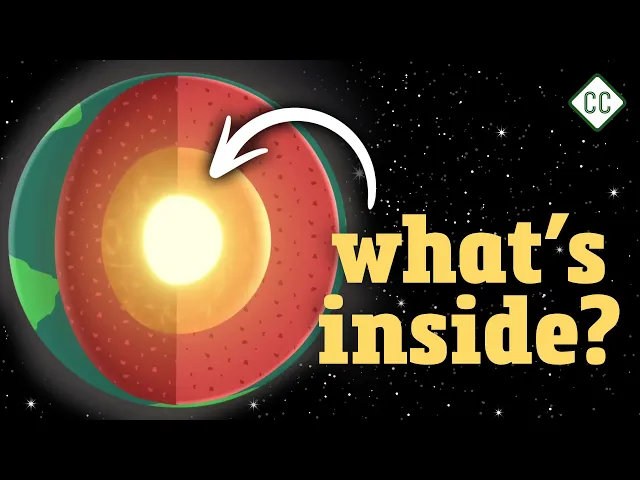
What’s at the center of the earth?: Crash Course Geology #4
CrashCourse
0:00 It was the spring of 1967 and the Cold War was underway.
0:03 The US was on high alert for attacks coming from the Soviet Union.
0:06 And on May 23rd, the radio communications suddenly jammed.
0:10 Did the USSR bug the system?
0:12 Was this an act of war?
0:14 A fleet of US Air Force bombers was poised to launch a counterattack.
0:18 An act that might have sparked nuclear war.
0:22 But just in time, vital information was relayed by an unlikely group.
0:27 Weather forecasters.
0:29 Hi, I'm Sage.
0:30 This is Crash Course Geology.
0:36 No, you didn't accidentally click on a Crash Course US
0:38 history video to understand what really happened during the Cold War.
0:41 We've got to dig deep all the way to the Earth's core,
0:44 the hot, dense center of the planet.
0:47 Last time we learned about the Earth's top two layers,
0:49 the tough crust and the taffy-like mantle.
0:51 But for a long time,
0:52 we could only imagine what was at the center of this big blue marble.
0:57 Back in 1692, Edmund Halley was the first to describe
1:00 Earth's core as something separate and disconnected from its shell.
1:04 He described an internal structure known as the hollow Earth model,
1:08 where a series of hollow spheres rotated around a central core.
1:12 He argued that both Earth's shell
1:13 and core had something called a magnetic field,
1:16 each with two poles, or points of attraction and repulsion.
1:20 Think of the magnets on your fridge.
1:22 The same forces that draw a magnet to the fridge
1:24 and push two magnets apart make up a magnetic field.
1:27 But how wasn't quite right.
1:29 He based his theory on Newton's calculations of the density
1:31 of the Earth and the Moon, which were off.
1:34 Look, Newton basically invented physics.
1:36 It's okay for him to take an L once in a while.
1:38 Hundreds of years later,
1:39 scientists developed the field of seismology to study Earth's insights.
1:42 Tracking seismic waves within the Earth helped British geologist
1:45 Richard Oldm find the first evidence of Earth's core
1:48 in 1906 and led British physicist Harold Jeff to suggest
1:51 that the core might be liquid 20 years later.
1:54 It took another decade to discover what was
1:56 really at the heart of our home planet.
1:58 Thanks to one of my geology rock stars.
2:01 Hit it, Dwayne.
2:03 When Enga Layman was growing up in late 19th century Denmark,
2:06 most people didn't expect much of girls, but that didn't hold her back.
2:10 As a kid, Layman attended a progressive co-ed school in Copenhagen,
2:13 but she didn't find the same egalitarian attitudes when
2:15 she studied math at the University of Cambridge in England.
2:18 Women could attend lectures,
2:20 but they couldn't officially enroll or use labs or libraries.
2:26 And while she eventually finished her math degree in Denmark,
2:29 what she really was interested in was earthquakes.
2:32 In the late 1920s and 30s, Layman filled index cards with information
2:36 about earthquakes from all over the world, looking them over in her garden,
2:41 storing them in empty oatmeal boxes for reference.
2:44 While she was studying a large earthquake
2:45 that had occurred off the coast of New Zealand,
2:47 she noticed that some of its seismic waves had acted weird.
2:51 They seemed to travel into the Earth's core before bouncing off of some kind
2:55 of hard boundary that didn't fit with the dominant idea of a gooey liquid core.
3:01 So in 1936, Layman published a paper theorizing
3:04 that the Earth's center consisted of two parts,
3:07 a liquid outer core surrounding a solid inner core.
3:11 Layman passed away in 1993 at the age of 104.
3:14 Living long enough to see her theory about
3:16 the Earth's core become widely accepted scientific consensus,
3:20 Layman solved one huge mystery.
3:22 But there's still so much to learn about Earth's core.
3:26 Further seismological research confirmed the makeup
3:28 of that inner core, iron and nickel.
3:30 But a 2025 study of seismic waves showed that the core may
3:34 be changing shape and even changing the direction and speed of its rotation.
3:38 There's also evidence that the inner core
3:39 isn't completely solid but sort of squishy.
3:42 And there may even be another layer creatively named the innermost inner core.
3:49 Like come on guys, Dwayne could do better than that.
3:52 What?
3:52 No.
3:52 No shade, Dwayne.
3:53 Okay, so the core of our planet is a hot ball of iron and nickel.
3:57 But it isn't just like chilling there.
3:59 That ball of metal basically functions as Earth's
4:01 bodyguard using invisible armor to protect us.
4:05 A magnetic field.
4:06 The hot metal in the core's molten outer layer is constantly in motion,
4:11 creating currents that generate a magnetic field surrounding the Earth.
4:15 That field has two poles, north and south.
4:18 Not to be confused with the geographic north and south poles.
4:22 No penguins or Santa Claus here.
4:23 Like in any other magnet, the magnetic field moves in a continuous loop,
4:27 entering Earth at the north magnetic pole
4:30 and leaving from the south magnetic pole.
4:32 In space, the influence of Earth's magnetic field
4:34 extends tens of thousands of kilometers around the planet,
4:38 creating a bubble known as the Earth's magnetosphere.
4:41 The magnetosphere is constantly moving and changing as it repels
4:45 and traps charged particles from the sun and the rest of space,
4:48 protecting Earth from radiation.
4:50 The sun is constantly pushing energy into space
4:53 in a flow of electrically charged plasma called solar wind.
4:57 That solar wind helps shape our magnetosphere,
4:59 compressing it on the sun-facing side and stretching it out in a tail
5:03 behind the shaded side so that it wraps around the Earth.
5:06 Without that magnetic field,
5:08 the Earth wouldn't exist at all because it would be Mars.
5:12 Let me explain.
5:13 Billions of years ago, the red planet may have had oceans,
5:17 a thicker atmosphere, and its own magnetic field.
5:20 But over time, Mars lost that magnetic field.
5:24 And without it, solar wind and radiation stripped the planet of its atmosphere.
5:29 No atmosphere, no water.
5:31 Its oceans that may have once made it habitable were gone.
5:34 If Earth's core didn't produce a magnetic field, we'd be in the same boat.
5:38 So, Earth's magnetosphere is pretty essential.
5:41 But no matter how tough our planet's bodyguard is, it's not indestructible.
5:45 In some cases, solar energy can cut through the core's defenses,
5:49 especially when it's really volatile.
5:52 See, the sun's own magnetic field can get tangled up as it rotates,
5:56 stretching and snapping, and then releasing energy in the form of solar storms.
6:01 These could be massive explosions of light called solar flares,
6:06 ejections of charged particles called radiation storms,
6:09 or eruptions of plasma called coronal mass ejections.
6:13 And these storms can cause major problems.
6:16 Like in 1859, English astronomer Richard Carrington
6:19 witnessed the biggest solar storm on record,
6:22 a massive solar flare followed by a series of coronal mass ejections,
6:26 though he didn't know what they were at the time.
6:28 The next day, the world was in chaos.
6:30 Telegraph systems sparked, started fires, and wouldn't send messages.
6:35 The Northern Lights were suddenly visible as far south as Hawaii,
6:39 and they were so bright in the northeastern US,
6:42 people said they could read the newspaper in the middle of the night.
6:45 They thought the world was ending, and you can't really blame them.
6:49 But what actually happened was a geomagnetic storm.
6:53 The solar storm's particles had disturbed the Earth's magnetosphere,
6:56 and that disturbance interfered with technological
6:58 and electrical systems across the world.
7:01 Which brings us back to our Cold War mystery.
7:03 That radio outage that spooked the US, you guessed it,
7:06 the culprit was really a geomagnetic storm, not an active war.
7:11 Thankfully, the US Air Force's team of space weather forecasters informed
7:15 the military leaders of increased solar
7:17 activity before any fighter jets took off.
7:19 history could have played out very differently.
7:22 As for a world today, geomagnetic storms continue to happen once in a while.
7:26 They can warm up the Earth's atmosphere, which increases drag on satellites,
7:30 causing power outages, and interrupting radio communication,
7:33 GPS signals, airplanes, and spacecraft.
7:36 Mass interruptions to internet connections, cell phones,
7:38 and electricity can have huge consequences to just
7:41 about everything that powers our modern lives.
7:43 That can all feel like a lot to worry about.
7:46 But the good news is we're not doomed.
7:48 Even if some movies make us think we are,
7:51 like you might have heard that the Earth's magnetic field can change over time,
7:56 its poles can shift or even completely reverse.
7:58 And that's true.
8:00 In the last 250 million years,
8:02 Earth's magnetic poles have reversed hundreds of times.
8:06 The last time they did was about 780,000 years ago,
8:09 so it's probably time for another one.
8:10 Movies and TV shows might have you worrying
8:12 that a pole reversal would cause global destruction,
8:15 leading us to a Mars-like future and a terrifying alien invasion.
8:19 But magnetic pole reversal won't just happen overnight.
8:23 Mathematical models suggest it could take thousands of years.
8:27 And if it does, we might not even notice many changes.
8:30 According to fossil records, sediment samples, and ice cores,
8:34 previous magnetic field reversals haven't caused any major changes
8:36 to Earth's climate or had a visible impact on life.
8:40 It could affect the way migrating animals like sea turtles and birds navigate.
8:44 But since that change would happen slowly,
8:46 those animals would likely be able to adapt over time.
8:48 The most that would happen might just be backwards compasses and confusing maps.
8:53 Does that mean North Dakota would become South Dakota?
8:57 So, it turns out it's kind of risky to live on a planet
9:00 floating 93 million miles from a giant ball of fiery gas.
9:04 But lucky for us, Earth's core provides
9:06 us with the most powerful invisible armor imaginable.
9:09 And while that armor can shift and change,
9:12 that doesn't spell the end of the world.
9:14 Though it can wreak havoc from time to time.
9:16 For now, space meteorologists are watching the skies
9:19 for us and learning more every day.
9:21 Next time, we'll learn all about minerals.
9:24 See you then.
9:25 Thanks for watching this episode of Crash Course Geology,
9:27 which was filmed in our studio in Indianapolis, Indiana.
9:30 It was made with the help of all these nice people.
9:32 If you want to help keep Crash Course free for everyone forever,
9:35 you can join our community on Patreon.