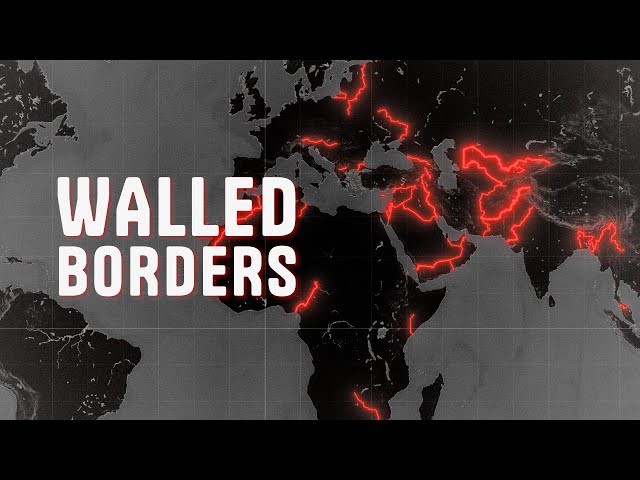
All the Walls in the World, Mapped
The Present Past
0:01 This is the Berlin Wall.
0:03 This wall symbolized a divided world.
0:06 In 1989 it came crashing down.
0:08 This sparked a dream of a world with open borders.
0:12 A dream that quickly turned into a nightmare.
0:14 35 years ago the world had less than 12 walls.
0:18 It now has more than 70.
0:20 You've heard of an orange American that loves walls.
0:23 But most walls are actually found in Asia.
0:26 You know European fences that closed the continent to foreigners.
0:29 But migration is just a part of the story.
0:32 In this video I want to show you how we got addicted to walls.
0:39 I first saw this map in a historical atlas.
0:44 It shows that the Berlin Wall coming down actually was an exception.
0:48 Since then we have been building a lot of walls.
0:51 I wanted to see if there were historical trends that explain
0:54 why we are now building more walls than ever before.
0:58 But first, what is a wall?
1:01 In history we have some great examples.
1:04 Like the wall of China.
1:05 A marvel of engineering, built to stand for the ages.
1:09 Others are less impressive.
1:10 Walls show what you think is yours.
1:14 Or they try to keep others out.
1:17 But what should we count as a wall?
1:20 Sometimes it's obvious.
1:21 A wall separates the two Koreas.
1:23 But sometimes not.
1:24 Australia guards its border with armed forces.
1:27 And a highly controversial detention system that violates human rights.
1:31 Is this a wall?
1:33 In this video walls will be physical barriers
1:35 that are placed on borders and can't be easily moved.
1:38 That does mean that some of these walls are actually fences.
1:41 With mapping these walls I found out how
1:43 the fastest growing group of walls is actually invisible.
1:46 Once upon a time there was a beautiful girl
1:50 that was raised in a tiny town in Yugoslavia.
1:54 Growing up her dreams were bigger than her mother's surroundings.
1:57 So she used her looks to become a famous
2:00 model and migrated to the land where dreams become reality.
2:03 There she met a handsome prince and together they had a love child.
2:07 But what if this child wanted to know more about his mother's family?
2:11 Her hometown was far away in some dirty migrant country.
2:15 But luckily he doesn't have to go there.
2:18 He can use MyHeritage.
2:19 MyHeritage is the leading global service
2:22 for family history research and DNA testing.
2:25 With MyHeritage it's very easy to build your own family history tree.
2:29 I started using MyHeritage some time ago.
2:32 So I have my tree all set up.
2:35 But if you just fill out the details on your siblings,
2:38 your parents, your grandparents...
2:40 MyHeritage will be sure to find them in a heartbeat.
2:43 Because I've used it some time,
2:44 MyHeritage has actually found a lot of pictures of my family.
2:48 Just look at these smooth stashes and fits from way, way back.
2:52 It's kind of amazing.
2:53 When there's a match I can just press this button to review the match,
2:57 find documents on this person.
2:59 And I can just add it to my tree.
3:01 Simple as that.
3:02 And look, the best thing is with this function, Instant Discovery,
3:06 I can add 40 people to my tree in just one click.
3:10 And there's a big chance you'll find more information on your ancestors.
3:14 Because they have more than 90 billion historical documents.
3:16 So Baron, if you want to know more about your mother's side of the family...
3:22 You can sign up for a 40 day free trial
3:25 and enjoy all the amazing features MyHeritage has to offer.
3:28 And don't worry, you don't have to be related to Trump
3:31 to start your 14 day free MyHeritage trial at the link below.
3:37 As empires came down, walls went up.
3:41 In 1945, the newly founded United Nations had 51 member states.
3:46 In 2024, we have 193.
3:48 A big reason we are building so many walls is
3:51 that we have just a lot more nations than we used to.
3:54 More nations means more borders.
3:55 More borders means more potential to disagree over the border.
3:59 The end of colonialism and the end of the Cold
4:02 War have led to a lot of border issues.
4:04 And some nations have more issues than others.
4:06 For a long time, the Indian subcontinent was ruled by the British Empire.
4:11 When the British left in 1947, they hastily divided it into India and Pakistan.
4:17 That was itself later divided into an East and West.
4:21 This division resulted in a battle over borders.
4:24 India built a lot of walls.
4:27 Today it has around 15.000 kilometers of borders.
4:31 It has walled 45% of these.
4:33 This makes it a country with the longest stretch of walls.
4:37 So India and Pakistan can't agree on their borders.
4:39 Although, here it's actually clear.
4:41 India is so proud of it, they make sure you can see it from space.
4:46 But here it goes wrong.
4:47 These dotted lines show how Google is insecure about where to put the border.
4:52 But India, they feel very secure.
4:54 They have built 800 kilometers of garden furniture to mark their border.
4:58 On the other side of the country,
5:00 they're walling the entire border of Bangladesh.
5:02 They say it's because of terrorism and smuggling activities.
5:06 But that's probably just part of the story.
5:09 Bangladesh is one of the most densely populated countries in the world.
5:13 Or the first, if we're counting real countries.
5:15 Some estimate that in 2050 up to 18
5:18 million people from Bangladesh will have to migrate.
5:21 And India is making sure they don't go there.
5:25 The second event that led to more walls is the end of the Cold War.
5:29 Since the end of the Cold War,
5:31 more than 26.000 kilometers of new borders have been created.
5:34 I know that doesn't give you much info,
5:37 but that's more than half way around the equator.
5:39 The fall of the Berlin Wall was just the start of a great unraveling.
5:43 The Iron Curtain was lifted.
5:45 The Soviet Union and its system of alliances came crashing down.
5:49 Out of the Soviet Union, 15 states emerged.
5:52 And these former friends don't always get along.
5:56 In Central Asia, almost every state has been walling its borders.
6:00 According to them, to stop migration and the smuggling of drugs.
6:05 Independent movements and Russian aggression led to walls in Georgia.
6:09 And in Europe, states that were once part
6:12 of the communist sphere see history a bit different than Putin.
6:16 If you don't mind, I will take only 30 seconds
6:19 or one minute to give you a short reference to history.
6:24 For giving you a little historical background.
6:28 Please.
6:29 The Baltic states, Poland and Ukraine have all
6:32 been walling themselves off from the former empire.
6:34 And so we see that with the end of empires,
6:37 we just get a lot more countries and a lot more borders.
6:40 And all these new nations, they want to stake their claim to their territory.
6:44 For some states, these modern conflicts have
6:47 led to being completely surrounded by walls.
6:53 This is the Middle East.
6:57 It might not surprise you that Israel has
7:00 the highest number of walls on its borders.
7:03 Some walls have been built after wars with neighboring states.
7:07 Closer to home, the walls are erected citing security concerns.
7:11 According to Israel, the wall around the West Bank is
7:15 to stop suicide bombings and attacks from terrorists.
7:18 The International Court of Justice has deemed this wall illegal.
7:22 85% of it is built on land that belongs to Palestine.
7:25 I went there some years ago and it was wild seeing these huge walls.
7:29 It felt like something from a dystopian film, but it was right in front of me.
7:37 What this impressive architecture doesn't show is
7:40 just 65% of it has been finished.
7:43 And that at many places it's just a fence.
7:46 Before the 7th October attacks,
7:48 Palestinians cut the barbed wire to illegally work in Israel.
7:52 Often border guards didn't really interfere.
7:54 It shows how these walls are not always what they seem.
7:59 Israel also built a wall around Gaza.
8:01 Israeli companies used to sell their services
8:04 in Europe and the world based on this feat.
8:06 They said that anybody can give you a very nice PowerPoint.
8:09 But few can show you such a complex
8:12 project as Gaza that is constantly battle tested.
8:15 In practice, this wall turned out to be less effective.
8:19 The border was easily destroyed by the Hamas
8:23 attacks against Israeli civilians on October 7th.
8:26 Israel has walled itself in, but Syria has been walled in by its neighbors.
8:30 The civil war and the rise of ISIS are reasons that Syria's
8:34 neighbors very much wanted to keep all that away from their doorstep.
8:39 Israel, Jordan, Turkey and Iraq all erected walls.
8:42 Only Lebanon didn't.
8:43 Civil war in Syria led to migration to Europe.
8:47 Walls would come up across the continent.
8:49 But long before that, the old dream
8:51 of a world without walls had been challenged.
8:54 So when the Berlin Wall came down, walls were just not cool for some time.
8:59 The EU was busy taking down its internal borders.
9:02 They were promising travel without passports.
9:04 And then 2001 happened.
9:06 Suddenly foreigners were seen as not so nice.
9:10 Muslims in the Western world were being equated with terrorists.
9:13 State surveillance was ramped up.
9:15 This is Bush signing the Patriot Act.
9:17 Who knew that spying on all your citizens was so much fun?
9:20 Borders became thicker.
9:21 Arab security was ramped up to protect people from real and imaginary threats.
9:27 So in times of crisis, closing down your borders was hot again.
9:32 Spain was the first country in the EU to build walls to keep migrants out.
9:37 Then no one really thought that would catch on.
9:41 But in 2015 things changed.
9:43 Migrants headed through Greece and the Balkans.
9:46 Borders were erected all over Europe.
9:49 Belarus weaponized migration by shipping migrants to the Polish border.
9:53 Because of this migration and Russian aggression,
9:55 the last 10 years the total length of border
9:58 fences in the EU rose from 315 to 2163 km.
10:04 Another 245 km will go up this year.
10:09 In the US, Trump has completely claimed border defense as a political issue.
10:15 But constructing walls to stop migration began on the Clinton in the 90s.
10:20 It has been continued by every president since.
10:23 Trump actually built just 140 km of new wall.
10:28 Biden stopped that construction when he came into office.
10:32 But since then he has started to build again.
10:34 And he invested in a smart wall.
10:36 It has these autonomous towers with night vision and radar.
10:39 Don't you love it when tech comes to the rescue?
10:42 The fact that every president has been developing the wall shows
10:46 the success of what has been called the border industrial complex.
10:49 The border security industry has been lobbying very hard to make
10:52 politicians think that migration is something you can fix with more gear.
10:57 Top security companies spend more than 5
10:59 million dollars on a 2020 Biden campaign.
11:02 And they're making a lot of fucking money.
11:04 It's because building a fence is just not good enough.
11:07 You need virtual wars, monitoring, and sniper cameras, land raiders,
11:11 and wireless telecommunications technology,
11:13 carbon dioxide programs, and immigration databases.
11:15 It's one reason why this stretch of wall that is
11:18 not even 70 km long cost 1.28 billion dollars to build.
11:22 This is more money than the United States
11:25 spends on maintaining all of its nature parks.
11:29 The issue with these walls is that they are sold as a way to stop migration.
11:35 For Westerners that feel their way of life threatened by migration,
11:38 this might seem like a good solution.
11:41 But does it actually stop it?
11:43 In Europe, walls definitely slow people down.
11:46 But migrants haven't stopped coming.
11:48 The spokesperson of Frontex, the agency that guards European borders, said,
11:53 "Any kind of physical obstacle in one
11:56 area just shifts the movement to other areas".
11:59 Like the more dangerous Mediterranean route.
12:01 It gets people in contact with criminals.
12:03 It led to more than 20,000 deaths since 2016.
12:07 If we look at the figures for 2022, when it comes to irregular migration,
12:13 300,000 people got caught crossing the border.
12:16 But 360,000 came here on a visa and just never left.
12:19 And of course you can't count the people that didn't get caught.
12:23 In the United States,
12:24 the measures don't seem to have stopped migrants trying either.
12:28 Now, it could very well be that these numbers could be higher without a wall.
12:31 But regardless of where you stand in migration,
12:33 walls don't address the root causes of it.
12:36 It's like treating depression with pills without advising therapy.
12:40 And because these walls are not working,
12:42 politicians are now resorting to building invisible walls.
12:45 They have been making deals with Egypt and Tunisia to keep migrants away.
12:49 And the US is selling gear and money
12:52 to make Central America a virtual border zone.
12:55 These invisible walls might move the burden to other countries.
12:58 The question still remains if this is going to make a difference.
13:02 Walls are as old as the world.
13:05 As long as people have built them, people have also tried to get around them.
13:08 You might say that the Berlin Wall was
13:10 a very successful example of keeping people inside.
13:13 It just needed a project that cost billions.
13:15 It employed tens of thousands of border guards.
13:18 And it had a police state that spied on every citizen.
13:21 But that wasn't enough.
13:23 It also worked because life in East Germany wasn't as bad as you think.
13:26 After a rough start, people had enough to eat.
13:30 Free childcare, free healthcare, free education,
13:32 a low cost of living and no war.
13:34 These are things that are definitely not available
13:37 in the countries where people are fleeing from.
13:39 I definitely don't have all the answers.
13:41 But should we be spending billions of dollars
13:43 on walls that fight only the symptoms of migration?
13:46 Especially when many experts say we need
13:48 migration to deal with the West's aging population?
13:50 Or should we invest in ways to help people in their country of origin?
13:54 Maybe allowing them to work legally for a time in the West?
13:57 These are hard questions that a video on YouTube won't answer.
14:01 But a YouTube video can tell you how the Berlin Wall worked.
14:05 It's a fascinating story that is the topic of my friend Neo's new video.
14:09 I wrote a script for the video and I'm very hyped about how it turned out.
14:12 It will be out in about a week or so.
14:16 So go check it out if you want to know more about how the Berlin Wall worked.