When a Tiny Land Bridge Triggered an Ice Age
PBS Eons
0:00 Thank you to Brilliant for supporting PBS.
0:04 Just over three million years ago, a giant ground sloth wandering through
0:08 a tropical forest did something that seemed unremarkable.
0:12 It kept walking.
0:13 But these particular steps were anything but [music] ordinary.
0:16 Because this sloth was doing something almost no
0:18 big mammals had done for millions of years.
0:21 It was walking from South America to North America.
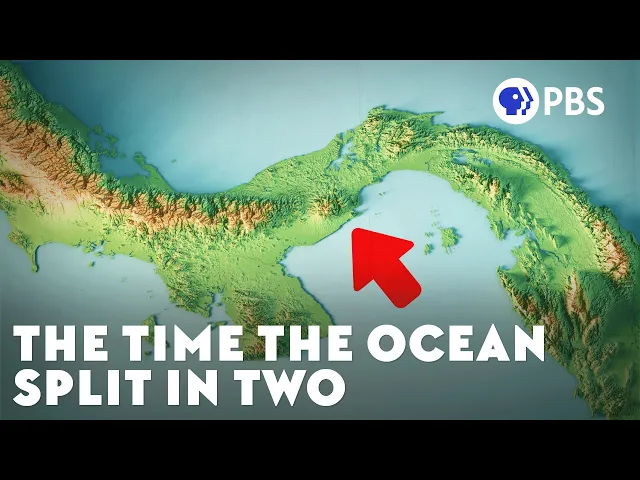
0:24 The land it walked on, the ismas of Panama,
0:26 had only recently emerged from beneath the ocean,
0:29 connecting the two continents after a 20 million-year separation.
0:32 And suddenly, South American creatures, from terror birds to giant sloths,
0:36 found themselves with an entire new continent to explore,
0:39 while North America's grumpers and saber-tooth cats migrated south.
0:42 On land, the ismas kicked off possibly the greatest
0:45 natural experiment in the history of life on Earth,
0:48 the so-called Great American Biotic Interchange, or Gabby.
0:51 But in the water, this narrow strip of land did something completely different.
0:55 It divided.
0:56 The ismist split the Atlantic and Pacific into two separate oceans.
0:59 And that division would have a much bigger effect
1:01 on the planet than the land connection ever did.
1:04 Because this tiny strip of land
1:06 probably changed ocean currents around the globe,
1:08 transformed climate patterns, and even helped trigger an ice age.
1:15 In the middle of the 19th century,
1:17 a naturalist studying fish in Central America noticed something odd.
1:20 Of the more than 150 species he
1:22 observed off Panama's [music] eastern and western coasts,
1:25 over one-third seemed to be identical.
1:27 So the oceans must have been connected at some point.
1:29 Not long after, Alfred Russell Wallace, yes, the Wallace line guy,
1:33 noticed a pattern in American fossils that would later
1:36 be recognized as evidence of the great American biotic interchange.
1:39 So scientists began to piece together that an ismas had risen
1:42 to [music] connect the continents and close off that once flowing seaway.
1:45 And over the next century, as plate tectonics came into focus,
1:48 they started to figure out the general picture of how this happened.
1:52 See, after South America broke away from Gonduana in the late messoic era,
1:55 it had been isolated for millions of years,
1:58 giving rise to bizarre creatures like car-sized gipadons and those terror birds.
2:02 Meanwhile, the Feralon plate was slowly subducting
2:04 beneath the Caribbean and South American plates,
2:07 triggering vcanism that built a chain of islands, the Panama Ark.
2:10 And over millions of years, that arc crept eastward,
2:13 eventually colliding with South America [music]
2:15 and driving uplift that pushed some of the seafloor above sea level while
2:19 also causing more volcanism that helped build land.
2:22 Eventually, this combination of volcanic activity and tectonic
2:25 collision pushed enough land up to form the ismas,
2:28 transforming the Panama Ark from an island chain into a land bridge.
2:31 But scientists still hadn't figured out one thing.
2:34 When did it finally become a complete bridge,
2:36 one that sloth could just meander [music] across?
2:38 The first solid evidence came from seafloor cores
2:41 in the 1970s which revealed that groups of tiny
2:43 marine organisms called forammenifera began diverging from each
2:47 other around 3 and a half million years ago.
2:49 Then throughout the 1980s and into the '90s,
2:52 scientists looked at DNA from marine species on both sides of Panama.
2:55 They used the fact that DNA accumulates changes
2:58 over time at a known rate to compare
3:00 how different the Atlantic and Pacific populations had
3:02 become [music] and estimate when the population split.
3:05 This method is often called the molecular clock.
3:07 And these molecular clocks also pointed to around 3 million years ago.
3:10 And the fossil record on land seemed to agree.
3:13 There were tons of terrestrial vertebrates
3:15 crossing between the continents at this time.
3:16 So a mystery solved, right?
3:18 The ismas closed about 3 million years ago.
3:20 The timeline [music] made sense, explaining why the Gabby happened when it did
3:23 and why the oceans changed when they did.
3:25 For nearly 40 years, scientists accepted it.
3:28 But then in 2015, two studies dropped
3:30 just days apart that completely contradicted this timeline.
3:34 The first study compiled fossil records from hundreds of sites across
3:36 both continents looking for patterns
3:38 that previous smaller studies might have missed.
3:40 They discovered that some animals hadn't waited
3:42 until 3 million years ago to cross.
3:45 Instead, there was evidence of earlier pulses of migration
3:47 at [music] both 20 and 6 million years ago.
3:50 And that same study found that the sea creatures backed up this timeline, too.
3:53 Taking a wider look at genetic analyses,
3:55 they found that some marine life actually began evolving
3:58 separately around the time of those pulses of migration,
4:01 as if something was already disrupting the flow between the oceans.
4:04 The land migrations and marine divergences
4:06 challenged the idea that the terrestrial
4:08 groups migrated and marine groups split about 3 million years ago.
4:12 The second study turned to geology,
4:13 specifically tiny crystals called zirkons that form when volcanic rocks cool.
4:18 Because here's the thing, are you ready?
4:19 Panama's rocks have a very distinctive signature.
4:22 They're around 50 million years old and they formed
4:25 in a specific volcanic environment that gives them a unique chemical makeup.
4:29 It's like a geological fingerprint that's only found in Panama.
4:32 So when the researchers looked at 15 million-year-old
4:34 river and shallow marine sediments in South America, they found something weird.
4:39 Zirkons with Panama's distinctive signature mixed
4:41 in, which meant that rivers were
4:43 already carrying Panama rock debris to South America 15 million years ago.
4:47 And for rivers to be eroding Panama and flowing to South America,
4:50 Panama had to be above water and connected by land.
4:53 Both of these studies pointed to the idea that maybe
4:55 the ismas existed as early as 15 million years ago,
4:58 if not earlier, way before anyone thought.
5:01 But scientists now faced a puzzle.
5:02 If the ismas formed that long ago,
5:04 why did most land animals wait millions of years to cross?
5:08 Because it's clear that the vast
5:09 majority of crossings happened much more recently.
5:11 And how are marine species still mixing
5:13 between oceans until 3 million years ago?
5:15 The evidence pointed to two different timelines entirely and both
5:18 couldn't be right unless scientists were asking the wrong questions.
5:22 Many answering the question of when did
5:24 the estim form required asking a more specific question.
5:27 How exactly did the final closure happen?
5:30 And the solution came from a surprising place.
5:32 Looking at a modern example of what ancient Panama might once have been like,
5:36 the Indonesian archipelago.
5:38 You see, between the Sunda continental shelf
5:39 on the Asian side [music] and the Sahul
5:41 continental shelf on the Australian side sits
5:44 a group of deep water islands called Waclesia.
5:46 Yep.
5:46 Named after [music] the same Wallace,
5:48 Waclesia is also a volcanic arc that creates both
5:51 a partial barrier and a partial connection between two regions.
5:54 These Indonesian islands form a chain with gaps between
5:56 them affecting migration on water and land in interesting ways.
6:00 Like we talked about in our Wallace line episode,
6:02 even narrow gaps between the islands with strong ocean
6:05 currents rushing through them can prevent land animals from crossing.
6:08 Gaps like the Wallace line, for example,
6:10 are enough to confine most creatures to their respective
6:12 sides despite being only about 30 km across.
6:15 And that's because powerful ocean currents
6:17 can help create these invisible barriers.
6:19 Yet, some creatures do make it across, at least occasionally,
6:22 and marine life can still mix through the channels between islands.
6:25 So by 2016, scientists realized what would it
6:28 mean if Panama didn't form all at once,
6:30 but instead as a complex chain of islands
6:32 first that slowly closed over millions of years.
6:34 This would explain everything in the conflicting data.
6:37 There could be early islands above water separated
6:39 by deep channels that still allowed for submarine
6:41 mixing while strong currents held off most
6:43 of the land crossings until the very end.
6:45 Armed with this new model,
6:47 scientists could finally piece together a more detailed picture
6:49 of the closure with a timeline to go with it.
6:52 Most scientists now agree that 24 million years ago,
6:55 the Panama Ark riding on the Caribbean
6:57 plate first collided with South America underwater.
7:00 At this point, the Atlantic and Pacific oceans
7:02 were still connected with deep channels open between them.
7:05 But by sometime between 15 and 9 million years ago,
7:08 some islands had pushed above sea level,
7:10 which is why there's evidence of rivers from those zirkons.
7:12 Deep channels, however, continued to separate them.
7:15 Then by around 9 million years ago,
7:17 the deepest passages closed and deep water critters became
7:20 cut off while shallow water creatures continued to move across.
7:23 As more and more land emerged from beneath the sea and got closer together,
7:26 some animals were able to island hop across,
7:29 explaining those early migration pulses.
7:31 And only around 3 million years ago did the ismas appear to close completely,
7:35 forming a continuous bridge that allowed sloths
7:38 and many others to wander across freely.
7:40 Now, it's important to note that this is
7:41 still an active area of scientific debate.
7:43 While most researchers agree with this model
7:45 of the ismas closing gradually over millions of years,
7:48 they're still arguing about the exact timing of different stages.
7:51 But this new model helped scientists develop more
7:53 detailed hypotheses about what happened next and why.
7:56 Because while scientists had long suspected that the ismas
7:59 played a role in altering the global climate,
8:01 this new timeline helped clarify that it was
8:03 the final closure that had the biggest [music] impact.
8:05 You see, for millions of years,
8:07 warm equatorial waters had flowed westward around the globe,
8:10 including through the seaway between the Atlantic and Pacific.
8:13 But suddenly, in geological terms at least, that path was blocked,
8:17 forcing these warm waters to flow north instead.
8:19 And one hypothesis suggests that this deflection
8:22 strengthened what we now call the Gulf Stream.
8:24 Caribbean waters became warmer and saltier.
8:27 And crucially, all that warm water now flowed toward Greenland and the Arctic.
8:31 Warmer water meant more evaporation,
8:32 [music] and more evaporation meant more water vapor in the atmosphere.
8:36 Vapor that atmospheric circulation was carrying toward the poles.
8:39 For the first time in millions of years,
8:41 northern latitude saw enough snowfall that not
8:44 all of it melted during the summers.
8:46 And as the snow accumulated year after year, it compacted into ice.
8:50 By 2.7 million years ago, major glaciation had begun in the northern hemisphere.
8:55 The ice age had arrived.
8:56 Now, the ismas definitely wasn't the only factor at play here.
9:00 Global ice ages are complicated, it turns out.
9:02 For example, during the period that the ismas was forming,
9:05 CO2 levels were also declining,
9:06 which played a role in the global cooling that had already begun.
9:09 And because there are competing factors,
9:11 scientists still debate how much of a role
9:13 the ismas played in intensifying those global changes.
9:16 Some scientists have even argued that the ismas actually
9:18 played no role at all in triggering the ice age,
9:21 pointing to models that fail to show this as a straightforward cause and effect.
9:24 The fact that it's been so difficult
9:26 to pin down the exact chronology of the closure
9:28 means it also has been really hard
9:29 to establish causal connections that result from that closure.
9:32 But while a scientific debate continues,
9:35 many researchers agree that this narrow strip of land [music]
9:37 probably played a key role in fundamentally reorganizing Earth's climate.
9:41 In fact, this tiny piece of land likely shaped the climate we have today.
9:44 But this geological saga wasn't some sudden
9:47 crash of continents that suddenly built the ismas.
9:49 Instead, it was a 12 million-year process of gradual closure,
9:53 islands rising, channels narrowing,
9:55 and current squeezing through ever smaller gaps.
9:57 And when the ismas finally closed completely,
9:59 [music] this small strip of land barely more than 50 kilometers across
10:03 at its narrowest seems to have had cascading effects across Earth's systems,
10:07 managing to not only reorganize life on two continents,
10:10 but also redirecting ocean currents and helping to trigger an ice age,
10:14 reminding us that sometimes relatively small changes
10:17 can leave big marks on the planet's history.
10:24 Thank you to Brilliant for supporting PBS.
10:26 Brilliant is where you learn by doing [music]
10:28 with thousands of interactive lessons in data analysis,
10:32 math, programming, and AI.
10:33 Brilliant helps build your critical thinking skills through problem solving,
10:37 [music] not memorizing.
10:38 And if you're into mathematics, Brilliant's newly updated math courses are
10:43 designed to help build your mathematical
10:45 intuition while making you a better [music] thinker and problem solver.
10:49 You'll work your way up through interactive
10:51 challenges that bring abstract [music] concepts to life.
10:55 Brilliant courses focus on useful, applicable math concepts with the goal
10:59 of achieving personal and professional growth.
11:02 To try everything Brilliant has to offer for free,
11:05 visit brilliant.org/eons or click on the link in the description.
11:09 If you go now, you'll also get 20% off an annual premium subscription,
11:14 which gives you unlimited daily access to everything on Brilliant.
11:19 One group of North American animals
11:20 that flourished in South America were the dogs,
11:23 but their fascinating evolutionary story was overlooked
11:25 by Charles Darwin during his famous voyage,
11:27 [music] which is dumb because his boat was literally named the Beagle.
11:30 Learn more in our episode,
11:32 Darwin missed an example of evolution right under his nose.
11:35 Also thanks to this month's eontologists who help connect us.
11:38 Jake Hart, John Davis, Ing, Addie, Carl Wolfful, Juan M,
11:43 Jackie Scott Rston, Andy, Eric Higgins,
11:46 Raphael Hassa, Melanie Lamb, Carnival, and Steve.
11:51 Become an Eonite at patreon.com/eons and you can get fun perks
11:55 like access to exclusive polls and videos from the Eons team.
11:59 And as always, thanks for joining me in the Andy and Eric Hagen studio.
12:02 Subscribe at youtube.com/eons for more tectonic tales.
12:13 I can cry on Q.
12:14 Do you want me to cry?
12:15 I'll do it.
12:16 I don't think that's relevant.
12:17 Just give me 45 seconds.
12:18 Can you uncry [laughter] crying right now?
12:24 Yeah.
12:24 Can I [laughter] Oh my gosh.
12:26 Suck them back in.
12:27 Suck them in.
12:28 Yeah.
12:28 No, I wasn't.
12:29 It's like a geological fingerprint that's only found in Panama.
12:32 See, I can turn it on and turn it off just like that.
12:34 [laughter]