Elon Said Death is Solvable
My First Million Clips Official
0:00 Do you know who Ted Williams is?
0:01 The famous baseball player?
0:02 Williams was one of the first people to do this.
0:04 He's frozen right now.
0:05 Did you know that this is actually a thing that happens and how this all works?
0:10 So, we talked about this company Alcor.
0:12 And so, I was like, Alcor.
0:13 Now, I was really ready for this to be like super evil megacorp, right?
0:16 Like the free You pay them tons of money
0:18 and they freeze your body and they're like whatever.
0:20 It's But it turns out, I think it's a little more innocent than that.
0:23 It's a It's a nonprofit that was started
0:25 by this this husband and wife couple who they read this book.
0:28 There was a book that was published that was very influential in the space.
0:31 And it was basically a book that argued that today you could do this thing,
0:34 which is right when you die, if you're very fast-acting,
0:37 you can essentially do put like antifreeze on your body.
0:41 So, you can freeze your body as is
0:43 it's liquid nitrogen, not It's liquid nitrogen, right?
0:47 Yeah, but it it functions almost like it
0:48 They They basically inject something in your veins
0:51 also cuz they need your cells to not
0:53 like or like your veins not collapse or something.
0:56 So, they do So, they put something in your vein
0:57 and then they use liquid nitrogen to cool you down.
1:00 And then you are cryogenically frozen for indefinitely.
1:03 And I've always thought I I had heard of the concept.
1:06 I didn't actually fully realize that there's a business behind this.
1:08 You pay $200,000 and you're frozen and that, you know,
1:12 they've frozen I think 200 people have done it.
1:14 200 something people have done it.
1:15 1,500 people have are working with Alcor saying freeze me when I die.
1:19 They just haven't died yet.
1:20 So, I didn't realize like it's a thing.
1:22 It's like a a business that exists that people pay for and, you know,
1:26 it's it's $80,000 just to freeze the head and it's
1:28 200 grand to freeze the whole body and then you, you know, before you die,
1:31 you pay a couple hundred bucks a year to save
1:33 your spot and there's like this whole operation behind it.
1:36 So, that was like already fascinating thing number one.
1:38 Okay.
1:39 So, this kind of led me down a little bit
1:40 of a rabbit hole of like I'm like a hyper normal guy.
1:44 Like I don't really do that much fringe stuff.
1:47 And I would have never considered doing this.
1:49 But I've been reading a lot of these stories with AI.
1:51 We talked about some of them on this podcast
1:53 about like the guy who cured his dog's cancer.
1:55 And then you brought up the founder of GitLab who
1:56 cured his own cancer using AI and like hyper-personalized targeted medicine.
2:02 He's trying to.
2:03 He's trying to.
2:04 No, he did.
2:05 It's in remission.
2:06 Oh, he did?
2:06 Yeah, he did it.
2:07 And by the way, I have like a whole whole update on this crazy.
2:09 I really want to have him on.
2:10 It's a It's a Let's go to that in a second.
2:12 This is It's wild.
2:13 I just like went down the rabbit hole.
2:15 So, I've been seeing this and it's like, okay,
2:17 like it's not crazy that in the next 30 years that AI
2:22 is going to figure out how to like cure a lot of disease,
2:27 death, to be able to bring back cryogenically frozen
2:29 people to be alive or to like upload their consciousness,
2:33 upload their brain into some sort of like LLM.
2:35 Like that's not like crazy to me now.
2:38 Yeah, I don't Well, so, the I like Like I always get these videos.
2:41 I get like emotional videos on Instagram all
2:43 the time and like one of my favorite
2:45 videos is when a family meets the recipient of the heart of like, for example,
2:51 if my like kid or husband or wife died and I get to and I
2:56 get to put my ear on the heart and hear It always makes me emotional.
3:01 And so, I'm like, "Oh, man,
3:01 that's like the greatest gift in a bad situation." So, I do love that.
3:05 But I'd much rather be alive [laughter] than that situation.
3:09 This led me down a little bit of a rabbit hole.
3:11 Then I saw this Elon clip.
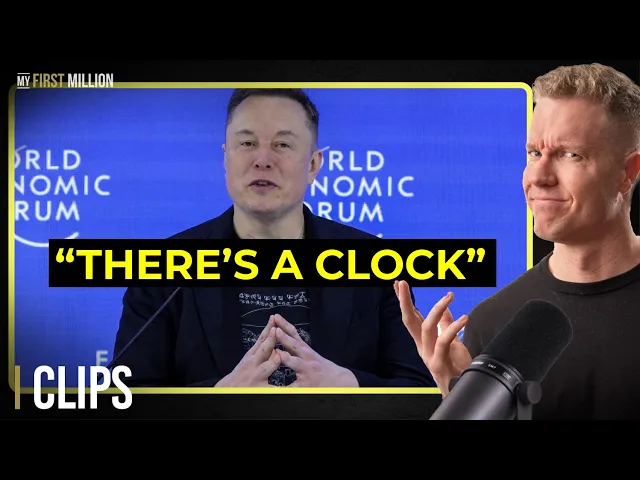
3:13 I I do think it is a very solvable problem.
3:16 When we find figure out what causes aging,
3:18 I think we'll find it's incredibly obvious.
3:20 It's not a subtle thing.
3:22 The reason I say it's not a subtle thing is because all
3:24 the cells in your body pretty much age at the same rate.
3:27 Um so, why is that?
3:28 It It That That means that there must be a clock, a synchronizing clock Right.
3:32 that is synchronizing across 35 trillion cells in your body.
3:36 So, have you ever seen this clip before?
3:39 No.
3:40 I didn't know that he cared about that.
3:41 The guy just asked him a question.
3:43 He's like, "Well, I've never I haven't spent time like looking into it.
3:46 It's not like it's not one of my missions
3:48 I'm on right now." But then he said this thing,
3:50 which is like you know, if Elon says something,
3:52 you sort of pay a little bit of attention.
3:54 So, he's saying, "No, I suspect it's solvable that the solu- that, you know,
3:59 the problem is obvious and the reason why That was
4:01 like a pretty first principle way of thinking about it,
4:03 which is like there's got to be a clock
4:06 because your entire body is aging at the, you know, roughly the same rate.
4:10 And if your body's synchronized, that means if there's a clock,
4:13 maybe the clock can be changed.
4:14 Maybe you could turn turn the the hands of the clock and slow
4:18 down the aging or reverse the aging or set it to a different time.
4:21 And you know, we've seen this with like stem
4:23 cell treatment and peptide There's all this stuff going on.
4:25 And so, you're like, "Hmm, that's interesting.
4:27 Maybe there's something there." And so, by the way,
4:29 the reason he does say why he hasn't spent much time on this and it's
4:33 pretty He's He's basically like aging {slash}
4:36 death is like a feature, not a bug.
4:38 So, he's like if people live forever,
4:42 society will like ossify because like the people in charge will
4:46 be the oldest people and the oldest people want the least change.
4:49 And like progress and change comes from some like
4:53 an out with the old in with the new mentality,
4:56 which comes like with a with a physicality of out with the old in with the new.
5:01 So, I I You make fun of me a little bit and it's deserving
5:04 I cuz I brag about how I think that we Well, Brian he told me,
5:09 "We were the first media appearance Brian Johnson has ever done."
5:13 And I take a lot of pride in that because if you
5:16 go and get past like the silliness of the whole thing
5:19 and how easy it is to like tease him for what he's doing,
5:22 if [snorts] you actually go and read his blog,
5:24 it is like pretty miraculous some of the stuff that he's doing.
5:28 Uh and the way that he looks the fun to I mean, it's easy to make fun of him.
5:32 Like it it seems quite amazing that if you
5:35 just take a little bit of what he's doing, there could be benefits.
5:38 I just signed up for a fancy doctor and I went and this was
5:41 the first time that I've met a doctor where they didn't not laugh at him.
5:45 Every doctor that I've ever talked to, they'll been like, "Oh, that guy's crazy.
5:49 Like, you know, what That's just stupid." Same with like
5:52 the the things that you and I did where you the preventative MRIs.
5:57 Pre-nup, yeah.
5:58 Yeah, they like laugh at him.
5:59 They're like, "Well,
6:00 it just sets off so many potentially false alarms." I'm like,
6:03 "That's the downside and that's why you don't want to do it?
6:05 That's incredible.
6:06 That's kind of silly." So, I I But my point being is I do think that a lot
6:10 of people are coming around to this and it is quite interesting.
6:12 It's way out of my IQ level.
6:13 To When people say disease and aging is solvable,
6:17 I think that's like a platitude that sounds cool,
6:19 but it's it's too hard for me to understand
6:22 cuz I just don't know anything about it.
6:24 But it is like interesting.
6:25 I wonder if in the history of the world has the richest people on Earth,
6:30 which now they are richer than potentially ever before,
6:32 that many of them have made this their cause.
6:36 Hmm.
6:37 Have you ever heard of this guy Aubrey de Grey?
6:39 Yeah, he's um like the researcher who does this.
6:43 He's like an academic, right?
6:45 So, he's been doing this for like decades and he kind of got canceled, I think,
6:48 cuz he was like hitting on his like lab
6:50 assistants or I don't know what was going on.
6:52 So, I'm not saying this guy's a great guy or whatever,
6:54 but he's just very fascinating guy.
6:56 He looks like Dumbledore.
6:58 He's got a huge gray beard like you know, down to his belly button.
7:02 He's like a longevity researcher who looks ancient, essentially.
7:05 And he's got this theory, which is like his theory,
7:07 if you've ever gone down the rabbit hole,
7:09 which I did one night like, I don't know, 5 years ago.
7:12 What he said is basically that death is not a mystery,
7:16 that there's these like 12 things that basically cause cell damage.
7:20 It's just wear and tear.
7:21 Like your cells in your body are like a car and the more you use them,
7:25 the more they accumulate damage and eventually enough damage, they they die.
7:28 Okay?
7:29 It's not like some mandate from God.
7:30 It's not like, you know, something that we don't understand at all.
7:33 His belief is like, "Actually, we can see the factors that relate to it
7:36 and if we can just reverse those factors,
7:37 then we you wouldn't die." The second thing he talks about
7:40 is like this idea of like longevity longevity escape velocity, LEV.
7:44 Ever heard of this?
7:46 I I've never heard of that, but is that as simple
7:47 as basically your biological age grows slower than your or sorry,
7:52 your chronological age grows slower than your biological age?
7:57 Am I explaining that correctly?
7:58 you had it right the first time, but no no, this is a different concept.
8:00 But what he says it's sort of like
8:02 the uh that guy Ray Kurzweil who talked about AI.
8:05 He talked about the singularity.
8:06 What he meant by that was like at some
8:08 point it won't be the humans that are programming AI,
8:11 but the AI will program the next AI to be better.
8:15 And then that smart AI will program the next AI to be better.
8:17 And it'll just keep And then that's when you get this explosion of intelligence.
8:21 And he's like, "No, you can't see beyond the singularity cuz once that happens,
8:25 all bets are off." Which is like kind of what
8:27 we're getting close to doing inside these research labs.
8:29 It's not just the the highly paid people at Open
8:32 AI or Claude or whatever Anthropic who are coding the models.
8:37 The models are coming up with ideas
8:39 and running experiments and coding the next models soon.
8:42 And that's like partially happening.
8:43 But once that fully happens,
8:44 the progress the rate of progress will like go exponential.
8:47 It'll hockey stick in a crazy way.
8:49 Claude did the greatest PR release ever or PR
8:52 thing where they said this model is so powerful, we we can't release it.
8:56 Too dangerous.
8:56 I'm like, "Okay, I want it." Yeah, like sign me up.
8:58 It's like the Four Lokos of of AI.
9:03 [laughter] Sorry.
9:04 Anyways, the idea being There's this There's a going
9:06 to be a point where medical research on longevity is adding
9:10 years to your life fast like adding more than one
9:13 year of your to your life lifespan than one year.
9:16 So, like the the research and the interventions
9:19 and the protocols and the the knowledge around extending extending your life is
9:23 going faster than your actual chronological age.
9:26 And when that happens,
9:27 then you sort of get at least like multi-100 year lives if not like,
9:31 you know, indefinite life.
9:33 Which is like a pretty crazy idea.
9:35 But when I read about this longevity stuff,
9:37 it reminds me of basically what's been going on with AI.
9:41 Like AI was something that's been talked about for 50 plus years.
9:44 Theorized, talked about, worked on, always seemed niche,
9:47 never seemed like a breakthrough, always seemed like a boy who cried wolf
9:50 type of industry where never really made enough progress.
9:53 And then suddenly you get, you know,
9:55 AlexNet and then then get ChatGPT and you get
9:57 these like breakthroughs and then the world's never the same again
10:01 and I kind of my prediction is that in the next
10:04 I don't know 15 years we're going to have a chat
10:07 GPT moment for life extension and that you're going to get
10:10 some breakthrough in this longevity and life extension that's going
10:16 to make it where it went from this like fringe kind
10:19 of like oh academic topic to just something that everybody does.