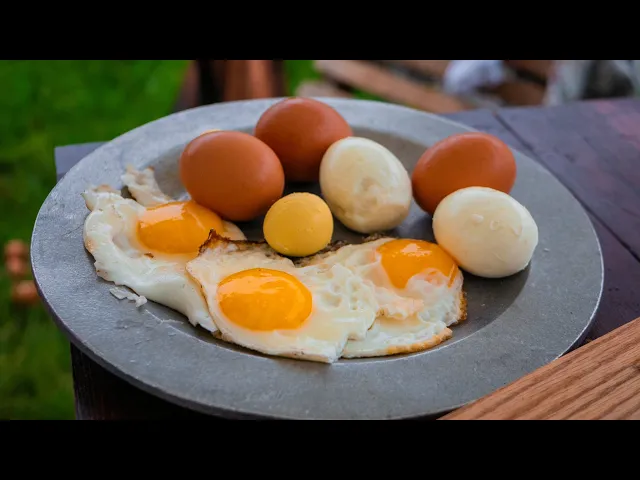
Most Egg-cellent Ingredient - Way More Than Breakfast
Townsends
0:00 I could make the argument that the egg is
0:01 the most important ingredient that we have in the 18th century.
0:05 It does so much.
0:06 It's kind of the fix-all and cure-all for anything that you want to do.
0:09 And we're going to dive into that a little bit today.
0:11 Food has evolved and chemicals have come into play and now we have things
0:15 that do a better job today than what the egg did in the 18th century,
0:18 [music] but this was the food product back then.
0:22 First of all, the egg is made up of two parts.
0:24 [music] It's the yolk and the white.
0:26 And these are used in different applications.
0:29 So, when you think about the yolk, you're thinking about something that is
0:32 thickening and it's creamy and it's silky.
0:35 So, in our time period, a way to use just the yolk would be to put
0:41 it into a sauce that you want to be silky smooth.
0:45 And that brings in some fat
0:46 and some creaminess and it binds everything together.
0:49 But you could also, and we see this a lot, which seems strange to us now,
0:54 use a hard-boiled yolk to thicken a sauce as well.
0:57 And so, we've done the beef stew episode.
1:00 That one was really strange cuz it has hard egg yolks in there.
1:03 And what you can do is you can just eat them if
1:06 you want to, depending on how you want your stew to be,
1:09 or you can break that up in your bowl, stir it about, and thicken up your stew.
1:14 And it gives the eater an option as to how they want to enjoy that food.
1:19 Secondly, we have the whites.
1:20 And so, what we see a lot of times
1:21 with the whites is we don't have all of that fat component,
1:25 and we can use that for other applications.
1:27 So, anything that we see in the 18th century that is foaming or fizzy,
1:33 whether it's in a drink where you would put
1:35 an egg white in and shake it up and it
1:37 would kind of froth and give a little bit [music]
1:40 of air into that drink, we see that a lot.
1:43 Or, if we wanted to make icing.
1:46 We've made the 12th night cake not too long ago on the channel.
1:49 That icing is you take egg whites and sugar and you get to whipping.
1:54 And then it froths up and we see different recipes for things
1:57 like clouds and foams or snowballs in the cookbooks of the 18th century.
2:03 And really, what they're doing is they're whipping air into egg
2:06 whites because egg whites will then hold that and they'll firm up.
2:09 And then they're mixing that with things like milk
2:11 and cream and they're making desserts out of it.
2:14 That's one of the major ways that they're using egg whites.
2:17 One of the most popular ways that we see eggs used,
2:19 and sometimes it's individual sections or parts of the eggs,
2:23 but often times it's the whole egg, and that [music] is as a binder.
2:27 So, a lot of the pastes that we make or the puddings that we make,
2:31 all sorts of different occasions,
2:34 they have all these dry ingredients like flour and different grains,
2:38 and you need something to hold that together.
2:41 In that occasion, that's when you would crack an egg in there.
2:44 And that just helps bring everything together and hold it into place.
2:50 [snorts] One of the king foods of the 18th century is the pudding,
2:52 whether [music] it's baked or boiled.
2:54 Sometimes not so much in boiled puddings,
2:57 but especially [music] in baked puddings or custards, you need eggs.
3:01 That's what gives you the texture that you're looking for in that dish,
3:04 and that wouldn't be able to be achieved without the lowly egg.
3:07 [music] One of the ways that the egg is
3:09 super indispensable in this time period is for the sick.
3:13 I found a quote that said the egg is
3:15 the most nourishing and exalted of all animal foods,
3:18 which is about the highest praise that I think any ingredient could get.
3:22 And that is in this medical sense where,
3:24 not to mention was it being used in medicine,
3:27 [music] but also in food for the invalids.
3:31 So, we've talked about things like panadas
3:33 on the channel and we've talked about gruel and porridges.
3:37 And all of these things are basically [music]
3:40 you're taking a grain with water.
3:42 And if you want to add any like real nourishment in there, you're adding an egg.
3:47 [music] And so, eggs were kind of during periods of time where people
3:52 had problems with their stomach or they were weak and they couldn't get up,
3:55 eggs might be the only real source of protein and fat
3:59 that you could get into them without them being sick.
4:02 And so, it [music] was just a super, super great resource in that situation.
4:07 And we need to take the concept of chickens out of our head here because, yes,
4:11 people were using chicken eggs probably mostly,
4:14 but they were also using quail eggs and turkey eggs and goose eggs.
4:17 They were using a lot more eggs in normal cooking than we are using now,
4:21 at least in America.
4:22 I don't know about other countries.
4:23 You guys will have to tell me in the comments section.
4:26 But eggs are super prolific.
4:28 There are so many different creatures that lay them.
4:31 So, even in a survival situation where you're kind of out
4:34 in the forest and you might be away from your chickens,
4:37 they were still a great resource for fat and protein and people
4:40 were using them all of the time in all sorts of settings.
4:43 So, obviously one of the reasons that this is an ingredient [music] that is
4:47 kind of like one of the best things that you can have is because,
4:50 like anything in the garden,
4:52 with [music] eggs you can kind of grow them yourselves.
4:54 So, if you have a few chickens on your property,
4:56 they're constantly producing eggs.
4:58 [music] And so, you can just multiply the number
5:01 of chickens and you can have a ton of eggs.
5:03 And you get them for essentially free.
5:05 Just the cost of feed.
5:06 And so, poor people could use them a lot, too.
5:09 We do see accounts though where the demand was
5:12 super high because for some reason they weren't getting eggs
5:15 [music] like they wanted to and they were up
5:17 to four times the cost of what they normally would be.
5:20 So, even though they were prolific and they were everywhere,
5:24 every once in a while there was a squeeze
5:25 and you couldn't get your hands on them.
5:27 Now, we haven't even talked about how eggs were being made
5:32 in the manner that we see them [music] made all the time,
5:35 at least here in America.
5:37 And that is just a fried egg or a poached egg or scrambled eggs.
5:41 They have all of those things as well and they
5:43 might not call them the same things that we do,
5:46 but a poached egg is everywhere in period cookbooks.
5:50 Not to mention omelets, usually spelled amulet,
5:53 [music] but they were using omelets just as much as we do, if not more.
5:58 They might not be putting everything that we do in them,
6:01 but they were putting things like mushrooms and greens
6:04 and onions and different breakfast meats like bacon and ham.
6:08 One of the more interesting things I came about in the cookbooks,
6:12 and we probably I don't even know if this will
6:13 make it into the final cut of the video.
6:16 I'm just saying that because I think it's cool.
6:18 Is the grand egg kind of centerpiece dish that you will see over and over
6:22 again in cookbooks where they would take
6:25 a bunch of eggs and they would hard-boil them.
6:27 They would take all the yolks out and they'd put that into a bladder.
6:30 And then they would boil that bladder until it [music] kind of held together.
6:34 They'd put that into a bowl like this.
6:38 [snorts] And then and then they would stack the whites
6:39 from that eggs around the outside of it,
6:41 put that in something and boil it again so
6:44 that the whole thing looked like this grand egg.
6:46 And I think that would be a really fun recipe to do,
6:49 but I didn't have the time or the resources
6:52 to do it for this particular episode.
6:53 Maybe in the future.
6:54 Today I've chosen a couple of recipes that I think are really
6:57 great uses of eggs that are practical and they're not super complex,
7:01 but we can use them at home and we
7:04 probably don't use them like this a lot of times.
7:08 [music] So, one of them is for an egg super
7:09 and egg drink that they might give to an invalid,
7:11 but often times what happens is a food starts as something for the sick
7:17 and then people acquire a taste for it and they want [music] it more and more.
7:19 So, we're going to do something like that.
7:21 And also just a little bit of a hearty
7:24 egg dish that we probably don't make at home,
7:26 but I think it sounds really interesting.
7:28 This first recipe comes from the Cook's and Confectioner's Dictionary.
7:31 Eggs in Moonshine.
7:32 Break your eggs into a dollop butter or oil, either melted or cold.
7:37 Throw some salt on them and set them over a chafing dish of coals,
7:41 but make not the yolks too hard.
7:44 And while they are doing, cover them and make a sauce of an onion cut
7:48 into round slices and fried in a good oil or butter.
7:51 Then put a little verjuice, salt, and grated nutmeg on them and serve them all.
7:56 One of the things that our little kitchen here has
7:58 never had is a proper chafing dish and we still don't.
8:01 So, I'm just going to use this pie pan and cover it.
8:03 And as it cooks, I'm going to have to rotate it.
8:06 So, the first thing we're going to do is we're
8:07 going to crack our eggs into our pie pan here.
8:09 If you have a chafing dish at home, go ahead and use that.
8:12 And [music] I'm just going to let the size
8:14 of the vessel that we're using govern how many eggs we use.
8:18 So, I'm guessing this will be somewhere around eight or 10
8:20 eggs and we're just going to kind of cover the whole surface.
8:22 We're not going to break the yolks.
8:24 Then we're going to cover this, set it next to the fire,
8:27 and we're going to rotate it as it cooks.
8:29 And we're going to cook it until all the whites
8:31 are cooked and the yolks are not super cooked.
8:33 And so, you can determine how cooked you want your yolks to be.
8:37 Some people like them runny or some people like them quite a bit more done.
8:40 So, that's up to you at home.
8:42 When our eggs are cooking, we're going to go ahead and work on our sauce.
8:44 And by a sauce, they basically just want us to cut
8:46 some onions into rounds and fry them in some oil or butter.
8:50 And then when that's done, we're going to put some verjuice.
8:52 If you have verjuice, if you don't,
8:54 I'm going to use lemons and that's a common replacement.
8:58 You just kind of want an acidic juice of some sort.
9:01 You could even use a vinegar if you wanted to, but [music] a lemon
9:04 juice is is usually what you use if you don't have verjuice at home.
9:07 Here's our finished dish.
9:08 There are a couple of things that you need to understand
9:10 when you're making this that might be a little bit confusing.
9:13 Number one, often times the word sauce in our time period
9:17 here does not mean what we think of as a sauce.
9:20 It just means a topping.
9:21 So, when it talks about an onion sauce here,
9:23 it's not looking for you to have so much
9:25 butter that this is just like drizzled in butter.
9:27 It's just saying we're going to prepare a topping for this, okay?
9:30 And so, the fried onions are that.
9:32 Now, you can make this however you want to as far as the yolks are concerned.
9:36 You don't want to overdo them.
9:38 If they start to get green, you've you've gone too far.
9:40 This is a nicely cooked yolk that I have on here.
9:44 It is not turning green.
9:45 It is well done.
9:46 Now, you don't have to go well done.
9:48 If you want this to have a little bit of an egg yolk being the sauce,
9:52 you're welcome to do that as well.
9:53 We're going to give it a shot.
9:59 Yeah.
10:00 this is really good.
10:01 It makes you think of something like egg salad.
10:04 I mean, I don't know if you've ever had
10:05 a fried egg sandwich and you put onions on it,
10:08 but onions and eggs just go together so well.
10:10 And with that and you see that over
10:11 and over again in recipes then and recipes now,
10:15 but the thing that puts it apart is the lemon juice
10:18 and the nutmegs cuz the nutmeg brings in this kind of semi-sweet,
10:21 also savory flavor and it's more of the scent than anything else.
10:26 The lemon brings in some acidity, so it feels like a nice complete dish.
10:30 It's not just only one note savory because of these onions.
10:34 And so you need something to attack that savory
10:36 from the onions a little bit and it does a wonderful job.
10:39 This next recipe is for a sick person generally,
10:43 but it comes from The Art of Cookery Made Plain and Easy
10:46 and it is one of those recipes that started out as, "Hey,
10:50 we're going to give this to sick people." and it
10:51 grew into something that was fashionable and people like to have,
10:54 especially in Germany.
10:55 To make buttered water, what the Germans call egg soup,
10:58 and are very fond of it for supper.
11:00 You have it in the chapter of Lent.
11:02 Take a pint of water, beat it up the yolk of an egg with the water,
11:06 put in a piece of butter as big as a small walnut, two or three knobs of sugar,
11:10 and keep stirring it all the time it is on the fire.
11:13 When it begins to boil,
11:15 bruise it between the saucepan until it is smooth and has great froth.
11:19 Then it is fit to drink.
11:21 This is ordered [music] in a cold or where egg will agree with the stomach.
11:27 What we're going to do here is we're going to get
11:28 our water in the saucepan and break an egg in there.
11:30 We're going to go ahead and stir that up, put in a little bit of butter.
11:34 It says a small walnut and then get some sugar in there, sugar to taste.
11:38 It says a few clumps, whatever you would like.
11:40 What we're trying to go for here is when we get this to boil,
11:43 we're going to stir it the whole time and we're looking for it to froth.
11:46 And once it starts to get frothy,
11:47 we know that it's done and we're going to try it then.
11:51 So here's our egg soup.
11:52 I just put it in a mug because they said
11:55 you can drink it once it's done, so might as well.
11:57 Plus I wanted you guys to be able to see the color of it.
12:01 It smells like butter and eggs.
12:04 [snorts] Let's give it a try.
12:08 Need a lot more sugar.
12:10 Yep.
12:11 But it's okay.
12:12 This is made for people that are not feeling well so that they
12:15 can stomach some nutrients and this does just a fine job with that.
12:19 Plus, this would be easy on the throat.
12:21 If you're not feeling well, this is wonderful.
12:24 I can understand why people would want this and they would kind
12:26 of become accustomed to this because it's
12:29 it is nice and hearty, it's comforting.
12:31 If somebody made this for me and said, "Hey, you want some egg soup?" I'd be in.
12:36 When our ancestors were living in a time before cooking was easy,
12:40 before they had high-speed mixers and before
12:42 they had chemicals that they could put
12:43 into food to make it do things that are impressive to us [music] now,
12:49 eggs were the secret.
12:50 [snorts] They were the thing that glued every food [music] together.
12:54 They were the binder, they were the thickener, they were the leavener.
12:58 And so, if you wanted to eat something that was beyond ordinary,
13:02 an egg was often times the answer.
13:04 And it's interesting that something so simple and that everybody had,
13:09 everybody could get their hands on, you can even take it aboard
13:12 ship and you can have eggs all the way across the ocean.
13:15 That one ingredient is the key to getting out
13:20 of the ordinary of cooking and getting into something extraordinary,
13:23 something that's fun, something that's interesting.
13:26 Often times, it was blowing people's minds and they celebrated this ingredient.
13:31 Not only all of that as far as fun cooking,
13:33 but it is [music] densely nutritious.
13:37 It is a go-to food for several meals.
13:39 They didn't think about that as a breakfast food,
13:41 they thought about it as a food.
13:44 And it was the go-to ingredient to heal the sick.
13:47 What a powerful ingredient [music] it was and how much good it did for mankind.