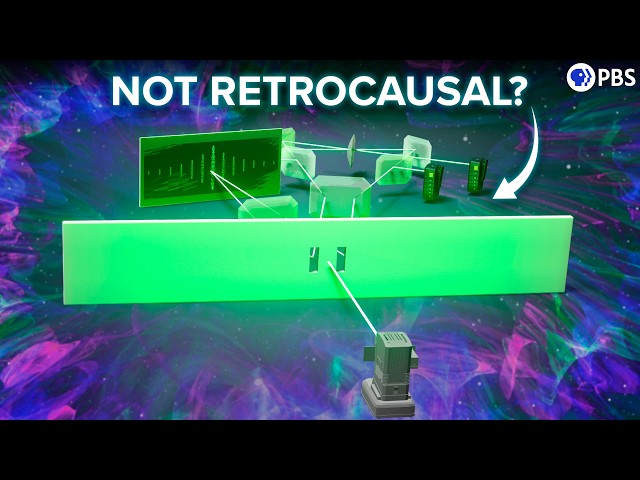
We Were WRONG About the Quantum Eraser! ft. @LookingGlassUniverse
PBS Space Time
0:00 Thank you to Cyber GhostVPN for supporting PBS.
0:02 Does quantum mechanics allow the future to retroactively influence the past,
0:06 as in the infamous delayed choice quantum eraser experiment?
0:10 Well, how about we get an actual quantum physicist
0:14 who many of you already know to show us
0:17 how to do this experiment at home and hopefully
0:21 put the matter to rest once and for all.
0:29 Hey everyone, a couple of announcements before we get started.
0:32 We wanted to let you know that your help
0:35 with liking and commenting recent episodes is working.
0:38 Thanks to that, the algorithm is sharing
0:42 current episodes with more of our community.
0:44 So, please keep it up.
0:45 And if you haven't yet,
0:47 subscribe and hit the bell so you don't miss new episodes.
0:50 We also want to let you know that over at the merch store,
0:55 we have our first ever backpack.
0:57 It's the black hole bag.
0:59 It's 28 L, made from recycled polyester for durability,
1:02 and guaranteed not to hawking radiate your quantum information.
1:06 There will be 10% off for the next 48 hours at the merch store.
1:11 Links for everything in the description.
1:13 Richard Feineman said of the double slit experiment that it has in it
1:17 the heart of quantum mechanics in reality it contains the only mystery.
1:23 Well, the mystery he was talking about is superp position.
1:27 In the double slit experiment that means a superp position
1:31 of a single particle traveling through both of the double slits at once.
1:37 The experiment hints that prior to detection at a screen,
1:41 a quantum particle plays out all possible realities
1:44 that may lead to that one measurement result.
1:48 And the shadow of these overlapping realities, these interacting trajectories,
1:52 is cast on the screen in the form of an interference pattern.
1:57 But if you prune the reality tree early, say by measurement at one of the slits,
2:04 the final pattern of particle locations reflects that.
2:07 As if the standard double slit experiment wasn't strange enough,
2:12 then we have the delayed choice quantum eraser
2:15 experiments in which the measurement of the particles
2:19 path to the screen is made after the pattern is recorded on the screen.
2:25 The most famous example is the one by Kim Yu Kulik Shei and Scully in 1999.
2:33 Such experiments have been interpreted as saying that a future
2:38 measurement can influence a past measurement retrocausal influence.
2:43 We did an episode on the delayed choice quantum arrays a long time ago.
2:50 Now, we didn't quite promote the retrocausal interpretation,
2:53 but we certainly failed to give any alternative.
2:57 Well, there are now some really solid
3:00 counter explanations to the idea of retrocausality.
3:03 A few papers have been published which get at aspects of it
3:08 and various YouTube videos also explain some
3:10 of the errors in the retrocausal interpretation.
3:12 So, it's time for us to weigh in.
3:16 Today we're actually going to do a real experiment.
3:19 And by we, I mean Mithina from Looking Glass Universe,
3:24 who's figured out a way to do the quantum eraser in a homemade setup.
3:29 She's going to show you how this experiment
3:33 gives the illusion of information traveling backwards in time.
3:36 I'm really excited to show you this experiment because 12 years ago I did
3:40 a video on the delayed choice quantum eraser where I got it completely wrong.
3:45 And it was only doing this experiment that made it finally click for me.
3:51 The delay choice quantum eraser is just
3:53 a variation on the usual double slit experiment.
3:56 So for that experiment, all you'll need is some light and two very
4:01 narrow beams that you can shine that laser at.
4:04 What do we expect to see?
4:05 Well, it depends on how we think about light.
4:08 On the one hand, we know that light is a wave in the electromagnetic field.
4:12 And like any wave, it should produce interference patterns
4:15 as components of the wave passing through the different slits overlap,
4:20 stacking up or canceling out.
4:22 At the wall, we get the classic double slit interference pattern.
4:26 On the other hand, we also think of light as particles,
4:30 which is fair because the classical electromagnetic wave is
4:33 made up of indivisible quantum particles that we call photons.
4:37 An intuitive but naive picture for particles is as a bunch of tiny balls,
4:42 spray balls at our pair of slits, and they should end up forming two
4:47 piles corresponding to passage through each slit.
4:50 Photons are really some weird in between thing between waves and particles.
4:54 If you fire individual photons, they do look like they make single hits
4:59 on the wall as though they were tiny balls.
5:02 But after many firings, the double slit pattern becomes visible.
5:05 The interpretation is that each photon really passes
5:08 through both slits as a wave and then
5:11 the final destination of the particle-like spot is
5:13 determined by the interference pattern made by that wave.
5:17 In quantum mechanics, we say that the position wave function of the photon
5:22 passes through both slits or that it exists
5:24 in a superp position of both trajectories and in fact
5:28 of all possible trajectories that reach the wall.
5:31 But when the wall measures the photon location,
5:35 that superp position collapses and a single position is chosen.
5:40 Even then, the path the photon took to get there remains undefined.
5:45 If you want to know the path taken, you have to measure it before the wall.
5:48 For example, you could place a little detector at the slits
5:52 that clocks the passing photon without actually stopping it.
5:55 Essentially, we're collapsing the position wave function
5:58 of the slits, not at the wall.
6:00 Now that we know which slit the photon passed through,
6:02 everything we see after that has to be
6:04 consistent with it only passing through that slit,
6:07 which means no double slit interference pattern.
6:09 One common misconception is that if a photon passes through just one slit,
6:15 it lands ultimately just like a classical particle in a single pile of points.
6:20 But actually, single slit interference looks like this.
6:23 It looks a lot like double slit interference,
6:27 but if you compare them side by side, you can see the difference.
6:31 Single slit interference still has dark fringes,
6:34 but just not as many as double slit.
6:36 This is a form of frownhoffer defraction with the edges
6:40 of the slits causing the interference in this case.
6:43 So photons keep behaving like waves even
6:46 if we measure which slit they traversed.
6:48 If you want to understand single slit defraction better,
6:52 Mina did a video explaining why this is and what it means.
6:56 The transition from double to single slit interference occurs
6:59 when we measure which slit the photon passed through.
7:02 We sometimes call this a whichway measurement.
7:04 That's weird enough, but at least in this case,
7:07 we have a sensible causal ordering.
7:09 You make the measurement, it collapses the wave function,
7:13 stopping it from forming a double slit pattern further down the line.
7:17 Things get a lot weirder in the case of the delayed choice quantum eraser.
7:21 In the classic experiment by Kim and collaborators,
7:25 the photons passing through the slits are actually
7:28 cloned using a beta barium borate or BBO crystal
7:32 which converts each incoming photon into a pair
7:36 of near identical outgoing photons that are quantum entangled.
7:40 The key is that both photons in this pair carry the which way information.
7:46 They both know which slit their progenitor photon
7:49 passed through before the BBO crystal duplicated it.
7:53 So now we send one of the new pair,
7:57 call it photon A, to our usual double slit detector to be observed by Alice.
8:02 The other photon B goes to Bob who can extract
8:06 the whichway information or alternatively can choose to erase that info.
8:10 The device is simple enough.
8:11 The path of photon B depends on which slit it came through.
8:15 So we can place a detector on both paths and see which one is triggered.
8:20 We can also choose to scramble
8:22 the whichway information by recombining those two paths.
8:25 So there's no way to tell them apart anymore.
8:28 The bizarre result of the Kim paper and similar experiments
8:32 is that if the whichway information is measured from photon B,
8:37 then photon A acts as though we also measured which slit it came from.
8:44 Alice sees that those photon A's have their whichway
8:49 info measured and fall according to a single slit pattern.
8:53 But if the whichway information in photon B is scrambled,
8:58 Alice sees the corresponding photon A's landing
9:01 according to the classic double slit pattern.
9:04 It acts as though it did pass through both slits.
9:08 It's like we change photon A's behavior without actually touching it,
9:12 only by measuring its twin.
9:13 And if that wasn't weird enough, in the Kim experiment,
9:16 the choice of whether to keep or discard the whichway information in photon
9:21 B is made after its entangled partner photon A reached its detector.
9:26 That makes it seem like photon A landed
9:29 according to a choice that hasn't been made yet.
9:32 And this has been referred to as retrocausal influence,
9:35 and it's what makes the delayed choice quantum eraser so befuddling.
9:39 To explain how we can get around this paradox,
9:43 I'm going to do an analogous experiment that you can do very easily at home.
9:47 And when I say it's analogous,
9:49 what I mean is that it's mathematically equivalent.
9:53 Like if you looked at the maths
9:55 of the original experiment versus this experiment,
9:58 it's exactly the same except for how you label a few things.
10:02 That's not to say though that this experiment is as cool as the other one,
10:07 because the other one involves actual entanglement,
10:10 whereas this uses a little trick to kind
10:14 of mimic entanglement without actually making an entangled photon,
10:18 which I wish I was able to do, but BBO crystals are very expensive.
10:23 So, we've got our laser here, and we've also got a double slit.
10:27 In the original experiment, for every photon A that goes through the slits,
10:32 they make a photon B which knows the slit that photon A took.
10:37 So photon B is what stores the information about which way photon A went.
10:42 So we need in our experiment some other way to store that information.
10:47 Well, we're going to do it in a really simple way.
10:51 Okay, so here's our double slit and we've put some filters in front of it.
10:56 two different filters in front of each of the slits.
10:59 In front of slit one, we have a horizontal polarization filter.
11:03 And in front of slit two, we have a vertical polarization filter.
11:07 Well, now we know that any light
11:10 that makes it through this double slit is marked.
11:13 If it's horizontally polarized, it must have come through slit one.
11:17 Whereas, if it's vertically polarized, it must have come through slit two.
11:21 In other words, the polarization is what's now marking
11:25 whether the light went through slit one or slit two,
11:28 which is convenient for us because we can
11:31 use this crystal to split the light accordingly.
11:35 So, this is called calite.
11:37 It's not as cool as BBO, which is what they used in the original experiment,
11:42 but it does have one very nice property.
11:45 If I put it here at this angle, it splits the light into two.
11:49 These two bits of light represent the two slits of the double slit experiment.
11:55 If the light is vertical, it came from slit one.
11:59 Whereas, if it's horizontal, it came from slit two.
12:03 The light in the top pattern only went through slit one.
12:06 And the light from the bottom pattern only went through slit two.
12:10 So, we'd expect that each of these patterns
12:13 are going to be single slit patterns.
12:15 And if you look closely at them, you can see that they are a double slit
12:20 pattern would have a lot more dark fringes in it.
12:23 So the calsite oriented this way is acting just like Bob's
12:27 which way measurement and collapsing the light into a single slit.
12:32 But if we rotate the calsite by 45°, we'll see why this new measurement is
12:38 now going to look like Bob's arasia measurement,
12:40 and we're going to get the double slit pattern back.
12:43 Okay, so that took me a while, but I managed to rotate this by 45°.
12:47 And I haven't yet put the double slit in there,
12:50 but I just want to show you what rotating the calite actually does.
12:54 So, if you look over there, you can see that there are two dots.
12:59 Well, there are roughly two dots.
13:01 Again, it's a little bit noisy because my cow site here is nowhere near perfect,
13:07 but roughly it's two dots.
13:09 And we're going to give the two dots names.
13:12 So, we're going to call the top one plus
13:14 and we're going to call the bottom one minus.
13:17 And it's annoying, but it's an inevitability of this geometry
13:20 that they're not aligned with each other anymore.
13:22 So, they're not one on top of each other.
13:25 So, with the magic of post-prouction,
13:27 we'll stack these so that they are one on top of each other.
13:30 That's going to make everything a little bit easier in a second.
13:33 To figure out why calsite oriented like
13:35 this is going to be an erasia measurement.
13:38 Let's see what happens when we put
13:42 in vertically oriented light into this calite.
13:45 You can see that the total amount
13:48 of light decreases but both dots are still there.
13:51 It's not like last time where horizontal light all goes
13:55 to the same dot and vertical light all goes to the other dot.
13:59 With this plus and minus measurement,
14:01 half of the vertical light will go to plus and half will go to minus.
14:06 And same for horizontal.
14:07 But then what does that tell us about light
14:10 that's going to go through this marked double slit?
14:13 So light that goes through the first slit is horizontally polarized
14:17 whereas light that goes through the second slit is vertically polarized.
14:21 And previously our calite was letting us measure the polarization
14:25 and therefore measure whether it went through slit one or slit two.
14:30 But now think about what this plus minus capsite is doing.
14:35 It's going to take light from the first slit and it's going
14:39 to have an equal probability of ending up at plus or at minus.
14:43 And same for the second slit.
14:45 So now just looking at the light after it goes through the calite
14:49 isn't enough to tell us anything at all about which way the light went.
14:54 In fact, it scramles up the light from both paths.
14:58 So it basically erases all of that information
15:01 that we had gotten by marking the paths.
15:04 So what do we expect to happen then?
15:08 Well, let's find out.
15:09 Oh man, that looks so good.
15:12 Okay.
15:13 Um, that kind of worked out better than I expected.
15:18 Um, okay.
15:19 So, have a look and hopefully you can see two double slit patterns.
15:26 So, if we use the calite in its previous orientation,
15:30 then we're using it to measure which way the light went
15:35 and that collapses the light into going into single slit interference.
15:38 But if we use the calite in this orientation,
15:42 the plus minus orientation, we're using it as an eraser.
15:46 It erases the information about which slit the light went through.
15:50 And so we're back to the double slit.
15:52 If you look really closely at these two double slits,
15:56 you'll see that they don't exactly line up.
15:59 And in fact, they seem to be offset from each
16:03 other the exact right amount that if you superimpose them,
16:07 it looks like the single slit interference pattern.
16:10 So what's going on?
16:12 Well, it turns out that this is the solution to the entire paradox.
16:17 Let's go back to the original setup to see why.
16:20 In the Kim experiment, photons are cloned by the BBO crystal and the whichway
16:25 analysis is done with only one of those.
16:28 We called it photon B.
16:31 Just as our experiment sorts the photons into two interference patterns,
16:35 the original experiment sorts the B photons into two bins.
16:40 For the measure case,
16:42 those bins tell you which slit the corresponding photon A also went through.
16:47 For the eraser case, there are still two bins,
16:50 but there is no whichway information in how photons are sorted into them.
16:54 Alice never sees a double slit
16:57 interference pattern until something very specific occurs.
17:00 At first, she sees just a blob of positions for all photon A's.
17:05 Then Bob comes and tells her which of those had a twin photon
17:10 B for which the way info was measured and for which it was erased.
17:15 The measured cases are still a blob.
17:18 Basically a blurry single slit interference.
17:20 Now, the sum of all of the cases in which the whichway
17:25 info was erased are actually a very similar mess, a blob.
17:30 So, Bob also needs to tell Alice which of those erased
17:34 photon B's ended up in each of the separate eraser detectors.
17:39 Only then can Alice disentangle the featureless blob
17:42 of photon A positions and see interference bands.
17:46 and her patterns look a lot like masers,
17:49 clear peaks and valleys that are slightly offset.
17:53 And when you merge them, you get a featureless pile.
17:57 This is a critical point that's often
18:00 glossed over in descriptions of the quantum eraser.
18:03 So to recap, the solution is Alice always sees the single slip pattern,
18:07 and that's regardless of what Bob chooses to do on his side.
18:12 But a single slip pattern is really just
18:14 two double slip patterns on top of each other.
18:17 The plus version and the minus version that's slightly offset.
18:21 Now, if Bob does happen to do the eraser measurement,
18:25 then he and Alice can reconvene afterwards and sort Alice's photons
18:30 into the plus and minus groups and they find those two double slit patterns.
18:35 In our experiment, we did this sorting via calite,
18:39 but in the real version of the experiment,
18:42 it just looks like post-processing the data to make
18:45 the single slit interference pattern into two double slit ones.
18:49 So instead of Bob's arasia measurement instantly uncolapsing the wave
18:53 function and turning the single slit interference into the double slit,
18:58 you only see this effect of his measurement much
19:01 later once he and Alice sift through the data.
19:05 The story told by the retrocausal interpretation of the delayed choice quantum
19:10 araser is that Bob's choice of measurement
19:14 retroactively influences where Alice's photon lands.
19:16 But the same logic works the other way around.
19:20 The position of photon A measured by Alice
19:23 absolutely influences where photon B can go, where it's measured by Bob.
19:29 Just for reference, I've drawn the plus double slit pattern here and the minus
19:34 one here just so that we can kind of see where they are.
19:39 And then let's say that Alice measures
19:42 her photon and it happens to land right here.
19:47 This lines up perfectly with the minus double slip pattern,
19:52 but not at all with the plus one.
19:56 Now after that Bob measures his photon B
20:00 and he chooses to do an erasia measurement.
20:03 So that means that there are two possible outcomes.
20:06 He could get a plus or he could get a minus.
20:09 But could he get a plus?
20:11 I mean that wouldn't be consistent with the result that Alice has already got.
20:16 And so actually Alice's result forces Bob's result to also be minus.
20:22 I should add that Alice's measurement of the position
20:25 of photon A only affects one thing for Bob,
20:28 and that's which of the eraser detectors Photon B will land
20:32 in, assuming Photon B makes it all the way to the eraser section.
20:37 But then one of the eraser detectors will strongly favor photons
20:43 whose twin landed in one set of bands on Alice's screen,
20:48 while the other favors the complimentary set of bands.
20:52 So, we've had this causality thing the wrong way around this whole time.
20:56 We thought that it was Bob's measurement that forced
20:59 Alice's photon to act in a particular way.
21:02 But now we can see it's the other way around.
21:06 If Alice's measurement happens first, then her outcome is what determines what
21:11 happens when Bob does his arasia measurement.
21:14 In other words, Alice's outcome is what forces
21:18 Bob's to happen in the way it does.
21:21 But that's only the case if Alice's measurement happens first and then Bob's.
21:26 But here's the twist.
21:28 Does Alice's measurement always happen first?
21:32 Or does that depend on your frame of reference?
21:36 It's possible to set up this experiment so that Bob's detections actually
21:40 happen before Alice's just by changing the path lengths for each section.
21:46 If we do that, we expect exactly the same result.
21:50 The same interference fringes are revealed when photon A is
21:54 filtered according to where photon B lands in the eraser.
21:58 In that case, it seems that B caused
22:01 A, but with the same result as when A caused B.
22:05 This makes it harder to assign a causal power to either case.
22:08 It's also hard to even imagine a causal path connecting Alice and Bob's
22:14 observations beyond the sort of spooky action
22:17 at a distance that Einstein so hated.
22:20 That said, there is a way to explain the causation that connects
22:25 Alice's and Bob's observations that doesn't need to assign a causal direction.
22:30 It all depends on what mysterious property really determines
22:33 how our photons get sorted into the two detectors
22:36 in the quantum erasor or how they are sorted into the two interference patterns
22:41 by the calcite crystal in Mithan's experiment.
22:45 What property is that?
22:47 Well, you're going to have to wait for an upcoming episode for that one.
22:51 But in the meantime, go check out Mith's channel for quantum
22:56 deep dives and more DIY quantum experiments.
22:59 It's looking glass universe, and it's amazing.
23:02 I also had a long and really fun chat with Mna about quantum mysteries,
23:07 her work, and a lot more.
23:09 It's in our new series of space-time conversations
23:12 that you can find in our community tab.
23:15 the delayed choice quantum eraser.
23:17 It's weird, but no weirder than any double slit experiment.
23:21 And in case you don't believe me yet,
23:24 we'll finalize the debunking in an upcoming Spacetime.
23:28 Thank you to Cyber GhostVPN for supporting PBS.
23:32 Navigating the internet safely can be challenging,
23:34 but if you're looking to browse the web securely,
23:37 Cyber GhostVPN is built to keep your online activity safe and private,
23:41 especially when using a public Wi-Fi.
23:43 They know that many browsers private mode may not be as private as people think.
23:48 Just turn it on before you start browsing.
23:51 And with secure servers in over 100 countries,
23:54 Cyber GhostVPN encrypts and reroutes all of your traffic to help prevent ISPs,
23:59 workplaces, and websites from tracking you.
24:01 They help you stay private and secure online
24:04 with service designed to meet most customers needs.
24:07 Cyber Ghost also allows you to choose
24:09 from different server locations around the world,
24:11 whether traveling or exploring content from other regions.
24:14 It's a feature built to offer an open and personalized online experience.
24:18 Plus, with over 38 million users worldwide,
24:21 they are committed to helping your information stay encrypted,
24:25 your IP hidden, and your online identity anonymous.
24:28 Cyber Ghost also comes with a 45day money back guarantee.
24:31 Use the link in the description to get four extra months of service,
24:36 plus an 83% discount.
24:38 And with 24/7 customer support, help is always there if you need it.
24:47 So, click the link in the description to learn about Cyber GhostVPN.