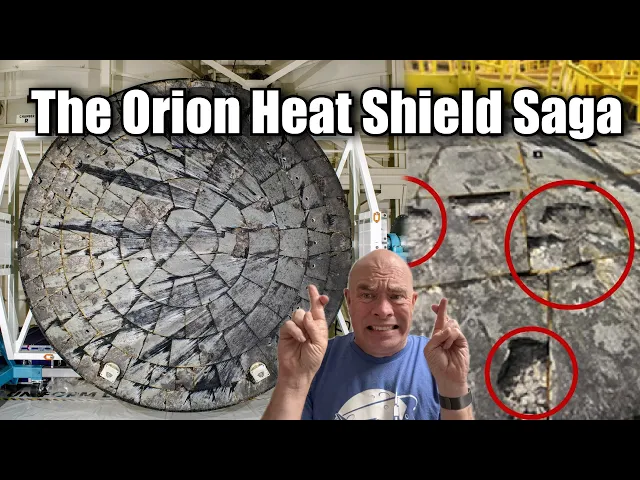
The Orion Heat Shield Saga - Everything You Need To Know
Scott Manley
0:04 Hello, it's Scott Manley here.
0:06 Orion is on its way home.
0:08 As I speak, it's about 8 hours from reentering over the Pacific.
0:12 It's been a fantastic mission, but of course,
0:14 now we are waiting to see whether the questions
0:17 over the heat shield performance will be answered.
0:19 And I'm going to say it's probably going to be fine, but I can't guarantee that.
0:24 The Orion spacecraft traces its development back to 2005.
0:28 Back then, it was the Crew Exploration
0:30 Vehicle as part of the Constellation Program.
0:33 Now, while the Constellation Program was canceled,
0:36 the Orion spacecraft continued development.
0:39 The Space Shuttle Program was considered a long one
0:41 when it took 12 years before humans flew on it.
0:44 Orion has taken 20.
0:47 And of course, one of the most important questions that had
0:49 to be answered was what kind of heat shield would be used.
0:52 And back in 2005, the the Space Shuttle
0:55 Program had been going for a really long time.
0:57 There was a lot of skill in the heat shields, a lot of understanding,
1:01 and those materials would be fine for the low Earth orbit version of Orion,
1:06 but they wouldn't be useful for lunar return.
1:08 And it turns out that a lot of the skills and knowledge that had been
1:11 developed in ablative heat shields for the Apollo
1:14 program had sort of waned and withered.
1:18 So, NASA set up the Crew
1:20 Exploration Thermal Protection System Advanced Development Project,
1:24 and they looked at about half a dozen different types of ablative material.
1:29 They also looked at the shuttle material,
1:30 but very quickly found that it wouldn't handle the heating
1:34 that was it would be endured from a lunar return.
1:37 Now, the two leading ones that came out of this were the Avcoat material,
1:41 which was used on the Apollo missions,
1:44 and something newer called PICA, phenolic impregnated carbon ablator.
1:49 Both of these are very similar in principle.
1:52 They have this phenolic resin, which is a type of resin that sets
1:55 into a plastic a thermal plastic material with strong molecular interlinks.
2:00 And as it heats up, it starts to off-gas and creates you know,
2:05 nitrogen and other gases, which carry the heat away.
2:09 So, this helps keep it cool and helps create an insulating layer.
2:12 The main difference is that PICA is has like a carbon fiber matrix, right?
2:17 So, that's carbon ablator.
2:19 Uh whereas Avcoat has a silica-based matrix to give it force.
2:23 So, it's more like fiberglass.
2:26 So, while PICA had all the advantages of modern technology,
2:29 Avcoat had the advantages of Apollo heritage.
2:33 But it also had Apollo-era manufacturing and environmental rules.
2:38 So, it included a lot of asbestos,
2:40 which is great for lots of things except for human lungs.
2:44 So, they had to modify the formulation,
2:47 and then they had to figure out how to manufacture
2:49 the stuff again because nobody had made it in a long time.
2:52 And this is video or film of manufacturing
2:55 the heat shield for the Apollo spacecraft.
2:57 As you can see, they've got this like you know,
3:00 honeycomb matrix over the surface,
3:02 and they're using these caulk guns to inject the material into each cell.
3:06 This is an enormous an enormously laborious process,
3:09 even if you do get to say your day job is caulk rocket.
3:13 And so, they had to set up a production facility using this technique.
3:17 And while they definitely considered the possibility
3:19 of automating this using like robots,
3:22 for the early samples that were used for testing
3:24 and for the very first heat shield that was built, they did this all by hand.
3:29 So, all of the candidate materials went through
3:31 extensive testing particularly at NASA Ames Arc Jet facility,
3:36 where it's essentially a wind tunnel with the air
3:39 heated by a lightning bolt in a bottle.
3:42 It's generating something like 60 MW of heating,
3:45 and that isn't even enough sometimes for some conditions.
3:47 So, they actually have big lasers in another room,
3:50 which will shine on the surface to make it even hotter.
3:53 This another test eliminated many of the candidate materials from contention,
3:57 leaving basically PICA and Avcoat.
3:59 And the decision was to go with Avcoat
4:01 because the Avcoat had the Apollo heritage,
4:05 and it had a large monolithic you know, heat shield rather than the PICA,
4:10 which was built in blocks, which meant that they had like ridges and gaps,
4:13 and there was some concern that it didn't handle those quite as well.
4:17 But PICA didn't lose out entirely.
4:19 It turned out that all the skills that had been developed in ablative
4:22 material were really useful when they started landing large rovers on Mars.
4:26 And the Mars Science Laboratory used PICA as its heat shield material.
4:30 Also, SpaceX created their own version, PICA X,
4:33 which is used on the Dragon spacecraft.
4:36 And so, development of Orion continued.
4:38 There was the Orion Exploration Flight Test EFT-1,
4:42 where the spacecraft was flown on a Delta IV Heavy,
4:45 which kind of makes sense because the Delta IV upper
4:48 stage was adapted into the Interim Cryogenic Propulsion Stage or ICPS,
4:53 which is used as upper stage for the early SLS launches.
4:57 So, that's what flew on the Artemis II flight.
5:00 But this flight on the Delta IV was the first
5:02 real flight of the Orion spacecraft of the Artemis program,
5:06 even if you think about it.
5:08 What this was going to do was you know, a number of in-flight tests,
5:11 but it was very specifically going to test the heat shield.
5:14 They were going to use the great power of the Delta
5:17 IV Heavy to boost the Orion spacecraft into a highly eccentric orbit,
5:22 so that the spacecraft would come back at very high orbital speeds and test
5:26 that heat heat heat heat shield to show that it could handle the loads,
5:30 to show that it was capable before they started putting on top
5:33 of larger rockets and having the spacecraft return from the moon.
5:37 They wanted to make sure the heat shield was going to work.
5:39 So, the spacecraft it did its mission, it came back, it landed,
5:43 it was recovered, and that heat shield was went over with a fine-tooth comb.
5:47 They applied all the science they could to make
5:50 sure that this thing had performed exactly as required.
5:53 And the spacecraft that actually flew this mission
5:55 is in the Kennedy Space Center Visitor Center.
5:58 You can actually go and check it out, and you can see the backshell off it.
6:02 You can't see the heat shield because that has been removed for testing.
6:06 So, anyway, the test was a success,
6:08 but the experience of building this heat shield led to some discussion
6:12 about whether they could really trust trust the quality of a heat shield,
6:15 which was built by such a laborious process.
6:17 It took a very long time.
6:19 Uh and because it was built up as this sort of like you know,
6:23 monolithic process, if there was a problem,
6:26 it might mean that they have to actually
6:28 go back and throw away the entire heat shield.
6:31 And so, they said, "Well, look, we have modern technology here.
6:35 Here's a new way we could build it." They They came up with a new design,
6:39 which involved essentially casting really nice
6:42 perfect blocks of the heat shield material.
6:45 So, they would say essentially set it,
6:47 and then they would machine it to the exact shape,
6:50 creating tiles that fit together almost perfectly on underlying structure.
6:56 And look, that seems like a perfectly good decision.
6:58 It's supposed to save money.
7:00 It guarantees that you know,
7:01 every single piece is perfect because you've analyzed it beforehand.
7:05 I mean, the big thing I would say against it is this was
7:08 one of the reasons why you rejected the more modern PICA material,
7:14 but you know, hey, you you've already got the contract,
7:17 so now you can change things to be cheaper, right?
7:20 So, anyway, this new improved process is used to build
7:22 heat shield for the first flight around the moon.
7:25 And once that's finished,
7:26 it's shipped off to the Cape to get integrated into the spacecraft.
7:30 Then they start working on the heat shield for Artemis II.
7:33 And in 2019, that gets shipped off.
7:36 That gets shipped off before Artemis I flies.
7:40 And so, in late 2022, Artemis I takes to the skies.
7:45 It heads up, it flies past the moon,
7:47 it swings around the moon for about a month,
7:49 and eventually comes back in December.
7:52 And it performs a skip reentry.
7:54 Now, skip reentry is something that's been well understood.
7:57 It was potentially part of the Apollo program,
8:00 and in the end they didn't use it.
8:01 But one of the advantages of the skip reentry is in theory,
8:04 it lets the heat shield cool down.
8:07 But also, skip reentry allows you to increase
8:10 or improve like the downrange capability for precision landings.
8:14 And that means that Orion can return to waters close
8:18 to the United States for a much larger part of the lunar month.
8:22 It improves the survivability from many more like return trajectories.
8:28 But as you probably know by now,
8:30 this reentry did not go exactly as they had planned or anticipated.
8:35 When the spacecraft was recovered,
8:37 they found that there were chunks that had broken off the heat shield, right?
8:41 A spallation process where the material's getting kicked out.
8:45 And initially, it wasn't clear why this happened.
8:49 Also, it wasn't clear how big a danger this was to the spacecraft itself,
8:53 whether a large enough chunk could break off
8:56 and potentially leave a hole in the heat shield,
8:58 which would result in the loss of the vehicle.
9:01 And so, there's been a lot of work done the last few years to decide whether it
9:05 was safe to fly the heat shield as is
9:07 or whether they needed an entirely new heat shield.
9:10 So, this is a photo showing some of the damage to the heat shield,
9:13 and if you zoom in, you can see these big gouges that have been you know,
9:17 broken out of the heat shield during the entry process.
9:21 And so, after a lot of work,
9:22 NASA's conclusion was that these things were broken off
9:26 or pushed out by the formation of gas underneath the surface.
9:30 And so, what happens is that the gas forms
9:33 underneath the surface inside the material, and as it expands,
9:37 it has got nowhere to go, and eventually it finds a flaw and causes a crack,
9:41 and the crack causes a chunk to pop off.
9:43 And they were able to replicate this behavior inside NASA Ames Arc Jet facility.
9:50 And so, based on these results,
9:51 the mission designers think that they could just modify
9:54 the trajectory of Artemis II so that the spallation doesn't happen.
9:59 So, how does that actually work?
10:00 How can you change the trajectory?
10:01 So, we're going to go back a little
10:04 and explain again how ablative heat shields work.
10:06 What the deal with ablative heat shields is
10:09 that they get burned up over time intentionally.
10:12 There's a made of a material a chemical that as it's
10:15 heated it absorbs the heat and undergoes a chemical
10:18 reaction which evolves gas and the gas leaks
10:21 to the surface and it provides and forms a protective layer.
10:25 And as the gas evaporates it leaves behind the heavier materials.
10:28 It leaves behind the silicon dioxide right the quartz
10:32 and that forms what's called a char layer right?
10:35 So, it's just like charred material but there's voids in this char
10:39 through which the gas can escape and the heat can
10:41 come in cause more stuff to paralyze is the technical term
10:45 it's burning without oxygen and it leaks out through this right?
10:48 But the scientists who studied the process
10:51 believe that what happened is that during
10:53 the skip re-entry they eject themselves back up into space for a bit of time.
10:58 Now, the heat shield is still hot and cooling down and it's cooling down by heat
11:02 you know radiating that heat into space but also
11:05 that heat is conducting into the heat shield
11:08 and it's not hot enough to generate that char
11:11 layer anymore the the layer with the holes
11:13 but it is hot enough to cause the stuff
11:16 to break down and begin generating those gases.
11:19 And so the heat layer would go deep enough down it would generate enough gas
11:24 pressure and then a piece would spall off and leave a hole in the heat shield.
11:30 So, there is a regime where you are not heating
11:33 the heat shield quickly enough for it to work properly.
11:36 What's really important here is that during that skip
11:39 there's a portion of the flight where you're not
11:41 generating that porous char layer on the surface and there's
11:46 still heat and the heat is generating the gas.
11:48 So, the way to fix this they think is by not skipping so far
11:53 out of the atmosphere you spend a long time with the heat building up.
11:56 You perhaps stay lower down that you continue
11:58 to generate that char layer on the surface.
12:01 And so if we look at the trajectory which was used in Artemis 1 from guidance
12:06 paper you can see that they reached an altitude of almost you know 290,000 ft.
12:13 Whereas the plans for Artemis 2 don't have it skipping nearly as high.
12:18 This means that it never really leaves
12:19 the atmosphere although the skip does allow larger down
12:22 range so that they can have more opportunities
12:25 for return that meant more launch windows really.
12:28 And so everyone is hoping that this will
12:30 actually address the problem and there seems to be
12:32 a decent amount of science to back it
12:34 up but there's certainly detractors who claim otherwise.
12:38 So, now why wasn't this spallation problem found on the original flight?
12:43 Well, I mean the main reason is again they had all this like
12:46 these cells this matrix of material where they had to fill everything together.
12:50 Well, that acted as a structure that held everything.
12:53 So, if a crack happened inside one of these due
12:56 to gas pressure the crack would not propagate sideways beyond each cell.
13:00 So, now if you've got this far in the video I'm sure there's a bunch of you
13:03 out there who said aha like the cut
13:05 costs in the heat shield that was the problem.
13:08 And there's a bunch of you out there who
13:08 said aha they changed the formula because of environmental laws.
13:12 That's the problem.
13:14 And the truth is if you come into one
13:17 of these engineering problems where you're trying to solve a safety
13:20 critical situation and you have preconceived notions of what you
13:24 want to blame that is a terrible way to approach engineering.
13:29 I'm sure if you'd used the classic 1960s Avcoat formula and made
13:33 big blocks off it would have had exactly the same problem and there
13:37 are reasons beyond cost to switch over to a tile based solution
13:42 where you're able to you accurately test and analyze every single section.
13:46 It makes a lot more sense and of course now that we understand
13:50 the problem we have a solution and that solution will fly on Artemis 3.
13:55 Remember this image the spallation being generated inside the arc jet tunnel?
14:00 Well, the section in the middle is where the spallation is happening.
14:03 The section at the top it's not happening and that's
14:06 because they created two slightly different versions of the material.
14:10 They figured out how to create a slightly more porous version
14:15 of the Avcoat so that if there is gas underneath it
14:18 will percolate all the way to the surface and release the pressure
14:21 and that is what they will be using for Artemis 3.
14:25 But then Artemis 3 now isn't going to the moon.
14:29 It may not even go beyond low Earth orbit
14:31 although it would be nice if they could do that.
14:33 That means they won't be able to test this heat shield for Artemis 4.
14:37 So, there's no guarantee there won't be any
14:39 further problems with the heat shield in this vehicle.
14:42 Regardless I hope the people have been working in the labs have
14:45 got it all right and I hope the crew comes home safely.
14:48 Godspeed.
14:49 See you on the ground.
14:50 I'm Scott Manley.
14:51 Fly safe.
15:05 [music]