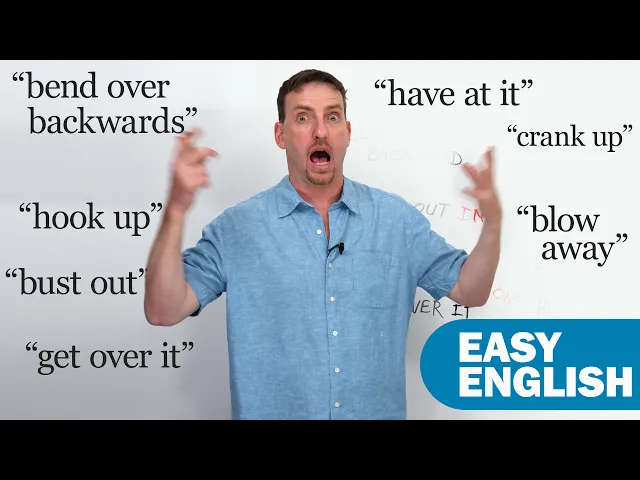
“Get over it”, “hook up”, “blow away”: 10 Everyday English Expressions
Adam’s English Lessons · engVid
0:00 Hi, everybody.
0:01 Welcome to www.engvid.com.
0:02 I'm Adam.
0:03 In today's lesson, I'm going to share
0:05 with you some slang or very casual phrasal verbs.
0:10 Okay?
0:10 So, what are phrasal verbs?
0:13 Verb and preposition combinations that have very
0:17 different meanings than the two individual words.
0:20 Okay?
0:21 So, these are all, like I mentioned, they're very casual, very informal slang.
0:27 Don't use these in your writing if you're doing some formal writing.
0:32 And also, make sure you actually understand these before you try to use them.
0:37 A couple of them could get you in trouble, but I'll point these out as well.
0:42 So, let's start with "get out".
0:44 Two meanings I'm going to tell you about.
0:47 One is a bit more literal, like "get out", "leave".
0:50 But when you tell somebody to "get out",
0:53 you're expressing a little bit of anger or frustration.
0:56 You want somebody to leave quickly.
0:59 You don't want to see them.
1:01 "Get out.
1:01 Get out of my office." Very straightforward.
1:05 Another meaning is "get out".
1:07 When somebody says "get out" like that, it means they're
1:11 very shocked or surprised by what you're saying to them.
1:15 So, somebody, my friend tells me that that girl he met at the bar,
1:19 he went home with her.
1:21 "Get out.
1:22 I don't believe you.
1:23 I'm shocked.
1:24 I'm surprised." In a good way, not in a bad way, right?
1:27 I'm not asking him to leave.
1:30 "Bend over backward".
1:31 So, if you bend over backward for someone,
1:34 it means you're trying as hard as you possibly can
1:38 to help them or to do something for them, right?
1:41 So, my boss says to me, like, you know, you're not getting the pay raise.
1:47 And I'm like, "What are you talking about?
1:49 I bend over backward for you every day
1:52 in this job." It means I do very hard work.
1:55 I'm always trying to help.
1:57 I'm doing things that are not even part of my job.
2:01 I'm bending over backward in effort, okay?
2:05 But be very careful.
2:06 If you just say only "bend over",
2:09 this could have a very, very different meaning.
2:13 A little bit...
2:14 You have to be careful when you're saying it and who you're saying it to.
2:18 "To bend over" means to bend over forward,
2:21 but that leaves another part of your body exposed,
2:24 and somebody could take advantage of you.
2:26 So, it's a little bit risqué.
2:28 It's a little bit dangerous to say.
2:31 "To bend over" generally means to let somebody take advantage of you.
2:37 "Bust out".
2:38 If you bust out in something, usually you're going to bust out in...
2:45 bust out in song or bust out a song.
2:48 Basically, start suddenly, out of the blue.
2:51 Suddenly, you decide to do something.
2:52 So, we were...
2:53 I was driving in my car with my friend, and suddenly he busted out in song.
2:57 He started just singing really loud.
3:00 "Bust out", sudden start.
3:01 Like, "bust" means, like, break very violently,
3:04 but this is, again, not a bad thing.
3:07 It's just a surprising thing.
3:09 If somebody busts out in song,
3:11 if somebody busts out a record or busts out some...
3:15 a bottle of whiskey, everybody starts drinking.
3:19 "Have at", but mostly we say "have at it".
3:23 "Have at it", go ahead, do whatever you want to do, right?
3:28 So, somebody says, "Oh, I'm going to steal your car, and I'm looking at my car,
3:33 and my car is very old and rusty, and it's not worth anything." And I go,
3:37 "Have at it." It means, "Okay, go ahead, I don't care." If somebody says,
3:42 "Have at it", it means they're giving you permission,
3:45 but generally it means they don't care.
3:48 They're actually happy if you do it, so you're not...
3:50 you don't threaten them.
3:52 If you threaten them and they say, "Have at it", they don't care.
3:57 "Get over it".
3:58 This is a very, very commonly used expression.
4:01 Something happened to me, and I'm very upset about it, and I complain,
4:05 and complain, and complain, and finally my friend says,
4:08 "Okay, okay, just get over it.
4:10 Move on." Actually, they go together.
4:13 This is...
4:14 they actually work.
4:15 Somebody can say together or just move on or just get over it.
4:20 "Get over it" means forget about it.
4:23 Just...
4:23 it happened, it's finished, it's in the past, go on to the future.
4:28 Forget that situation.
4:30 And this is generally about something bad,
4:32 and you say it to someone who's complaining too much or is upset too much,
4:37 especially about something they can't change.
4:41 Right?
4:41 So, my boss asked me to come to work on the weekend, but I had plans.
4:46 So...
4:46 but I need this job.
4:48 So, my friends say, "Okay, listen, if he wants you to come in, just go.
4:52 Just get over it.
4:53 We'll go out next...
4:55 next week or whatever.
4:56 Get over it." "Chill out".
4:59 "Chill out", just, you know, relax, do nothing.
5:01 "What are you doing this weekend?
5:03 Are you...
5:03 do you want to go to a club?" "No, I think I'll just stay home and chill out.
5:08 Just stay on my couch, watch TV, relax, maybe a glass of wine if I'm into it.
5:14 Relax." "Blow away".
5:15 If something blows you away, it means it's,
5:20 like, wow, like, really, really amazing.
5:22 So, I went to a music concert last night,
5:26 and then I met my friend today, and she asked me,
5:29 "How was the concert?" "Oh, you know, that guy,
5:32 he just blew me away." Blew me away?
5:34 Just...
5:35 it was so amazing, I didn't know how to handle it.
5:38 You can blow someone away, something can blow someone away, etc.
5:43 You can also blow something away, like,
5:46 literally, but that's not what we're looking at.
5:49 "Crank up".
5:49 "Crank up", basically, turn up real high.
5:53 So, crank up the music, crank up the heat.
5:57 "Turn up very high and very fast", that's the meaning.
6:02 "Crank", just turn, another...
6:03 it's a synonym.
6:06 "Let it go".
6:08 "Let it go" is actually very similar to "get over it".
6:12 So, again, something bad happened and you're a little upset,
6:15 okay, just let it go.
6:17 Just let it go, don't think about it anymore,
6:19 don't get upset by it anymore, let it go.
6:21 You can also let something go, it means, like,
6:24 release your hold on it, in a more literal meaning.
6:28 Okay.
6:29 I think this is actually pretty famous from the song from "Frozen".
6:33 "Let it go, let it go", you know,
6:35 I'm not going to sing for you because I don't have a good voice.
6:38 "Hook up".
6:39 Now, "hook up" has a few meanings and one
6:41 of them you have to be a little bit careful of.
6:44 "Hook up" basically means get somebody something.
6:47 So, can you hook me up with a new stereo?
6:50 I heard you have good deals at your store.
6:53 Can you hook me up with a bottle of whiskey from your country?
6:57 My friend is going to Cuba and Cuban cigars are very good.
7:01 Oh, hook me up with some cigars, I want to smoke some Cuban cigars.
7:06 "Hook up" can also mean meet.
7:08 Yeah, so I'm hooking up with my friends later, do you want to come?
7:13 I'm meeting my friends later, do you want to come?
7:17 But "hook up" can also mean to have sex with someone.
7:20 So, I hooked up with a girl last night means I slept with her.
7:25 So, you have to be a little bit careful with that one.
7:29 Again, context will usually tell people what you mean,
7:32 but sometimes if you don't provide the context,
7:36 they will imagine something that maybe you don't want them to.
7:40 Okay?
7:40 So, there you go.
7:42 Ten phrasal verbs that people use regularly, every day, very casually.
7:46 Be careful, make sure you're using them correctly,
7:49 make sure you understand what they mean,
7:52 but definitely get comfortable with them,
7:54 start using them, you'll sound more like a native
7:57 speaker once you start using phrasal verbs in regular, everyday conversations.
8:02 Okay?
8:03 If you have any questions about any of these, please
8:06 go to www.engvid.com and ask me in the comment section.
8:09 I also put a quiz there that you can
8:11 make sure you understand what these phrasal verbs mean.
8:14 And that's it.
8:15 If you like the video, give me a like.
8:18 Don't forget to subscribe to my channel and press the little bell
8:21 there if you want notifications of new videos when they come out.
8:25 And come again soon, I'll give you some more useful English for everyday use.
8:30 See you again soon.
8:32 Bye-bye.