The Hidden Engineering Behind the Falkirk Wheel
Practical Engineering
0:01 This is the Forth and Clyde Canal in central Scotland.
0:06 Completed in 1790, it was the first canal
0:08 to cross any part of the British Isles.
0:11 There are a lot of geographical terms for coastal
0:14 features where the sea indents into the land:
0:18 sounds, inlets, fjords, lochs, coves, bays, and so on.
0:21 They all have subtly different meanings
0:24 that can vary by location, but in Scotland, a lot of them are called “firths,”
0:28 and they’re pretty important when it comes to navigation.
0:31 The Forth and Clyde Canal, as its name strongly suggests,
0:34 connects the Firth of Forth to the Firth of Clyde.
0:37 It also has a branch into the heart of Glasgow.
0:40 When it was built, this canal dramatically shortened
0:43 the transit times for goods in the region,
0:46 and it also served as the testing waters for the very first steam-powered boats.
0:50 Not long after the Forth and Clyde opened,
0:53 another important canal was completed in Scotland.
0:55 The Union Canal connected the cities of Falkirk and Edinburgh,
0:59 opening up a route for coal and other minerals
1:02 from the mines and quarries around Lanarkshire to the capital.
1:05 Along the way, it passes over some pretty impressive aqueducts,
1:09 including the Avon Aqueduct near Linlithgow.
1:11 A connection to the Forth and Clyde Canal in Falkirk
1:15 would provide a direct waterway link between the two
1:18 largest cities in the country (Edinburgh and Glasgow) without
1:22 ships needing to navigate the hazardous Firth of Forth.
1:25 But there is the challenge of elevation.
1:27 Union Canal sits about 115 feet or 38
1:31 meters above the level of the Forth and Clyde.
1:35 Moving people and goods by boat has a lot of advantages: it’s cheap,
1:39 it’s efficient, it usually takes less infrastructure,
1:41 and it allows for connectivity across the globe.
1:44 But there is a major disadvantage:
1:46 the waterways that ships and boats traverse have to be pretty much level.
1:51 Boats don’t climb hills like cars, trucks, and trains.
1:54 This is the main purpose of a lock:
1:57 raising or lowering a vessel to navigate elevation changes in waterways.
2:01 In fact, locks are pretty much the only solution
2:04 to this engineering challenge… except in a few rare cases.
2:08 You’ve seen the title.
2:09 You know where I’m headed with this.
2:11 But the story of the Falkirk Wheel- the only
2:13 rotary boat lift in the world- is fascinating,
2:16 not just because of the mechanisms,
2:18 but also how it came to be in the first place.
2:22 It’s not easy to accomplish projects like this.
2:24 The Falkirk Wheel is not the passion project of some lone eccentric billionaire.
2:29 This is public infrastructure,
2:30 which means a vast array of stakeholders had to come together and agree
2:35 that this bizarre structure was worth the resources that went into building it.
2:39 It’s got some very clever engineering under the hood,
2:42 and a lot of lessons in its creation that, I think,
2:46 apply to other challenges we face today.
2:49 I’m Grady, and this is Practical Engineering.
3:01 Of course, the original connection between the Forth
3:04 and Clyde and Union canals did use locks.
3:07 A lot of locks.
3:08 This map from 1898 shows the flight of 11 locks
3:12 required to get boats up and down between the two.
3:16 You can imagine the time, resources,
3:18 and effort involved in navigating this staircase.
3:21 The process took the better part of a day,
3:24 and not only that, it used a lot of water from the Union Canal.
3:28 Even though boats can move through locks in both directions,
3:32 water only moves through in one.
3:34 Each structure always fills from the upper canal,
3:37 and always drains to the lower one.
3:39 That’s just gravity.
3:40 But, it’s important to realize that even though most locks don’t use pumps,
3:45 the energy required to raise and lower boats through isn’t free.
3:49 Each passage through costs roughly one
3:51 “lock-full” of water from the upper canal.
3:54 In addition to the inconvenience and water usage,
3:57 other factors eventually drove these canal
3:59 systems in Scotland into disrepair and abandonment.
4:02 The canals were small, and as ships got larger,
4:05 the narrow and shallow passages became
4:08 less useful for transporting materials and goods.
4:11 The railroads also started competing with the canals,
4:14 offering faster connections between major cities.
4:17 By 1930, the canals were barely used,
4:20 and by 1960, they were choked with vegetation and debris.
4:24 Motorway construction disconnected several segments,
4:26 and authorities decided to close them for good.
4:29 That could have been the end of the story,
4:32 and honestly, it wouldn’t be too surprising.
4:34 It’s been the fate of many of the world's great canals
4:37 and inland waterways as transportation technologies
4:39 and overland shipping have passed them by.
4:43 But then the year 2000 happened.
4:47 Maybe you remember this.
4:48 It was a weird time to be alive.
4:51 There was this strange tension between excitement about the new century
4:55 and fear that all our computer systems would crash into an apocalypse.
4:59 The programmers and IT professionals took good care of us on the computer side,
5:04 but there were people working hard on the celebrations, too.
5:08 One of those organizations was the United Kingdom’s Millennium Commission.
5:12 The idea was simple:
5:14 take some of the money from the National Lottery and direct it toward
5:18 interesting and impactful projects that would help mark the turn of the century.
5:22 In Scotland, a large consortium of organizations- public, private,
5:26 and volunteers- got together and applied
5:29 for a grant from the Millennium Commission.
5:31 In 1997, funding was awarded to cover approximately
5:35 half of the cost of the Millennium Link:
5:38 a massive undertaking to revitalize and reopen the canals
5:42 that once connected Scotland from coast to coast,
5:45 restore locks, build hike-and-bike trails, and rehabilitate bridges.
5:49 The work included The Kelpies, a sculpture of two huge horse heads that serve
5:54 as the gateway to the Forth and Clyde canal.
5:57 That was a pretty fascinating civil engineering project in its own right.
6:01 But of course, the Millennium Link’s flagship project was
6:04 reconnecting the Forth and Clyde to the Union Canal.
6:08 But rather than do it with locks,
6:10 the group wanted a 21st-century landmark, or I guess, more of a watermark.
6:15 A fast, efficient connection that would serve
6:18 as a capstone to the canal revitalization, draw tourists from around the world,
6:23 and serve as a symbol of the region that was
6:26 once a hub of transportation and commerce in Scotland.
6:28 And, in fact, a hub is a good metaphor for what they came up with.
6:34 The Falkirk Wheel opened for traffic in May 2002, and now,
6:38 more than two decades later, it’s pretty clear that they nailed the idea.
6:42 Here’s how it works:
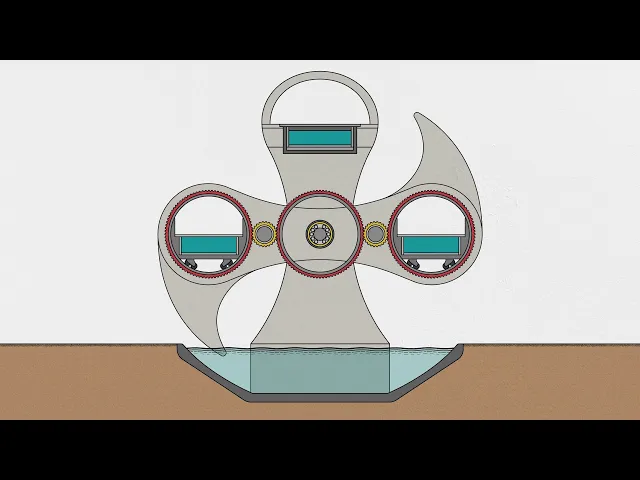
6:43 Boats bound for the Union Canal enter a circular turning basin at the bottom.
6:48 The Wheel has two opposed arms,
6:50 each with water-filled gondolas (or caissons) spanning between them.
6:55 Those gondolas are mounted on bearings that ride on circular rails.
6:59 When one goes up, the other comes down, so traffic can move both ways.
7:04 The wheel is driven at its center using
7:07 hydraulic motors that keep the motion smooth and slow.
7:10 Idler pinions mesh between two identical ring gears:
7:13 one fixed and centered on the shaft; the other surrounding each gondola.
7:18 This arrangement enables the gondolas to counter-rotate as the wheel moves,
7:23 maintaining their perfect upright position throughout the full range of motion.
7:28 The elegance of the Falkirk Wheel hides
7:31 some fairly complicated systems that make it function.
7:34 At the top and bottom,
7:35 each gondola has to be able to open and close to let boats in and out.
7:40 And the aqueduct at the top needs the same capability so
7:43 water doesn’t just flow off the edge when the wheel is moving.
7:46 The docking and undocking procedure is a delicate dance.
7:51 When a gondola reaches the top position, stow pins extend to lock it in place.
7:57 Then an extendable lance connects it to a hydraulic power unit.
8:01 A U-shaped seal extends to bridge the gap between the two structures,
8:05 and pipes fill the gap between the gates with water, balancing the pressure.
8:10 Finally, hydraulic rams open the gates on both sides,
8:14 allowing boats to enter or leave.
8:16 The whole process happens in reverse, and then the wheel is free to move again.
8:20 Part of the engineering genius of the Falkirk
8:23 Wheel is that it’s always balanced,
8:25 whether there are boats inside the gondolas or not.
8:29 This is one of those confusing things about buoyancy:
8:32 a floating vessel always displaces its own weight in water.
8:37 Theoretically, as long as the water level stays the same,
8:40 when a boat floats over an aqueduct,
8:42 there is no change in forces on the columns.
8:45 The displaced water flows away, balancing the new force of the boat.
8:50 Same thing for the gondolas.
8:51 When a boat floats in, its weight in water flows out,
8:55 maintaining a balance between the two sides.
8:57 As a result, the Falkirk Wheel doesn’t really require a lot of power to operate.
9:03 It’s about one-and-a-half kilowatt-hours for a half turn of the wheel,
9:06 often compared to the power required to boil eight kettles of water.
9:10 Where I live, that’s less than 25 cents in electricity.
9:13 And unlike the day-long climb of the industrial-revolution-era locks,
9:17 the Wheel moves boats between levels in about five minutes.
9:22 The Scottish Canals see almost no commercial shipping these days.
9:26 They’re still too small, and the road and rail networks are still faster.
9:30 But the canals do see a lot of traffic.
9:33 There’s a whole class of vessels specifically designed
9:36 for navigating the unique and historic canals of the UK.
9:40 Similar to RV culture in the US,
9:43 narrowboats ply the inland waters across England,
9:46 Wales, Scotland, and beyond, used for holidays,
9:48 touring, and even as long-term homes.
9:51 During the early Industrial Revolution,
9:53 boats like this were pulled along canals by horses
9:57 or donkeys from towpaths that ran alongside them.
10:00 Modern narrowboats are self-propelled and often equipped with domestic comforts,
10:05 including bathrooms, kitchens, heating, and internet.
10:08 The number of boats has been steadily increasing over the past decade,
10:12 offering the freedom and lower cost of a nomadic lifestyle on the canals.
10:17 Even for those not living on narrowboats,
10:19 cruises and tours along the canals offer something unique.
10:23 It’s a totally different way to experience the landscape
10:26 in some of Great Britain’s most beautiful areas,
10:28 and it offers insights into the history
10:31 of the region that you can’t get anywhere else.
10:34 And of course, you also get to see the fascinating infrastructure,
10:38 including a boat lift that you won’t find anywhere else in the world.
10:43 But it doesn’t go all the way up.
10:45 When a segment of the canal was relocated as part of the Millennium Link,
10:49 it needed to cross the Antonine Wall,
10:51 a Roman-era defensive perimeter and UNESCO World Heritage Site.
10:55 Rather than disturb it, the new canal was built into a tunnel below.
11:00 From the aqueduct at the top of the Wheel,
11:03 two new locks raise boats the remaining distance once they
11:06 pass underneath the wall to the top of the Union Canal.
11:10 The Antonine Wall marked the far northern border of the Roman Empire.
11:14 On another edge, just a handful of decades before it was built,
11:19 Mount Vesuvius erupted, burying the city of Pompeii in ash.
11:22 But there’s a twist to that story.
11:24 My friends at the podcast, RadioLab,
11:26 are just about to premiere a fantastic video about the survivors
11:30 of Pompeii and how we discovered that some people actually escaped.
11:35 This simultaneous release is part
11:37 of a collaboration with the Independent Media Initiative
11:40 to highlight some of the best educational and artistic creators on the internet.
11:45 I’m really thankful for the award the channel
11:47 won this year for my Practical Construction special,
11:50 and I’m so excited to hand off to one of my favorite shows on the internet,
11:55 RadioLab, for the next video in this collaboration.
11:58 Go check it out after this!
12:00 When I was a kid, my dad used to tell me,
12:03 “If the only reason you want something is because it’s cool,
12:05 you probably don’t need it.” You can look at me
12:08 and probably tell I took that advice to heart.
12:11 But there are situations where it’s worth doing
12:14 something just because it’s going to be impressive.
12:17 The Falkirk Wheel is a perfect example.
12:20 Locks are a perfectly functional solution to get
12:23 boats up and down to different elevations.
12:25 There are thousands of them around
12:28 the world diligently serving our inland waterways.
12:31 Scotland wanted something special,
12:33 something that would spark a resurgence in their canal system
12:36 and revitalize the sense of pride in the communities along them.
12:40 It took guts to try something completely different, and it paid off.
12:45 Millions of people have visited to watch it turn or travel through it.
12:49 The Falkirk Wheel didn’t just reconnect two canals.
12:52 It reconnected people with the idea that infrastructure
12:56 can be both useful and pretty cool.
13:01 Here’s something else that’s pretty cool: a homecooked meal that’s seasonal,
13:05 healthy, and didn’t require a trip to the grocery store.
13:08 We’ve been using today’s sponsor, HelloFresh,
13:10 for years now, even before these ones were born.
13:14 And now they’re actually old enough to help out with dinner… kind of.
13:18 “Oh, some snail shells.
13:20 Put them in the pot!” The idea is simple and perfect for us:
13:25 pre-portioned ingredients shipped right to your door
13:28 so you have dinners ready to go.
13:30 “Ahhh!
13:31 It’s burning!” These helpers can be a bit picky,
13:36 but HelloFresh has expanded their options and even made
13:39 them customizable to fit the preferences of the week.
13:42 “Just put the pepper on momma’s croutons.
13:45 I like it spicy.
13:47 “Where’s your croutons?” “These will be mine.” And in fact,
13:51 HelloFresh has kid-friendly choices that are specifically curated for the little
13:55 ones that don’t like to stray from the staples like I do.
13:59 “Don’t mind the man saying ‘Oh no’ repeatedly
14:03 in the background.” Even beyond the good food,
14:06 using Hello Fresh is just a great way to spend time together.
14:09 Having it as a kit like this makes it fun for the kids,
14:12 keeps them involved, and (I think) makes them more likely to try new foods.
14:18 “I’m cooking mushrooms on the stove!” Give
14:22 a second chance to the ‘NEW’ HelloFresh by using
14:26 my code PRACTICALFM at HelloFresh dot com
14:29 for 10 Free Meals+ Free Breakfast for Life.
14:33 This part’s verbatim: One free meal per box with active subscription.
14:37 Free meals applied as discount on first box,
14:40 new or returning subscribers only, varies by plan.
14:42 Sign up today!
14:43 Click the link below or use my code PRACTICALFM at HelloFresh.com.
14:47 Thank you for watching and let me know what you think.