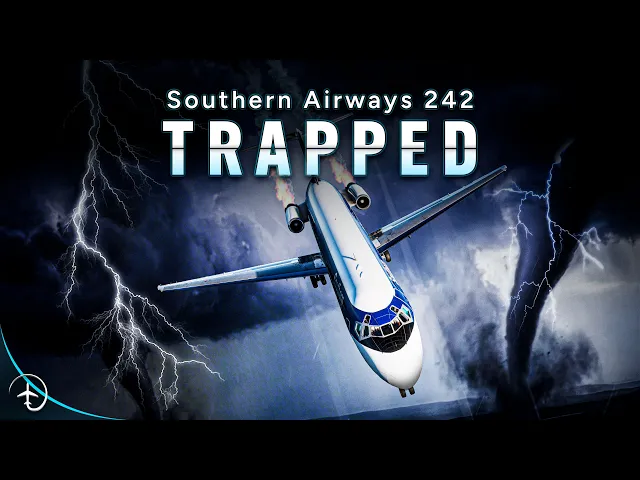
The LAST Airliner To Ever Attempt THIS! | Southern Airways 242
Mentour Pilot
0:00 It is midafter afternoon on April 4th, 1977 in Huntsville, Alabama.
0:06 Around its airport terminal,
0:08 everything is following the normal routine with bags
0:11 and carts rolling over the wet pavement,
0:13 passengers hustling through the terminal,
0:15 and a tug idling impatiently in front of the nose gear of a humble DC9,
0:20 which is getting ready to depart.
0:23 Rain has already started falling and the sky shows that flat
0:27 and washed out look that it gets when thunderstorms are nearby.
0:31 But beyond the airport area, something is now brewing.
0:36 Across Alabama and Georgia,
0:38 the afternoon weather is about to develop into something truly violent.
0:42 And the pilots of Southern Airways Flight 242
0:45 are about to find this out the hard way.
0:49 Flight 242 arrived to Huntsville after a brief hop from Muscle Shaws,
0:53 Alabama, and was now preparing for a very quick turnaround.
0:57 The coming flight was one of those legs
0:59 that on paper didn't look very complicated at all.
1:03 It was supposed to be just a short hop from Huntsville over to Atlanta,
1:07 and it was planned to last only about 25 minutes or so.
1:11 The planned cruise altitude was therefore also quite low, only 17,000 ft.
1:16 And the flight's routing ran straight from the Huntsville
1:18 departure towards a VUR beacon called Rome, which would then lead them
1:23 in towards Atlanta's Hartfield Jackson International Airport.
1:27 In an operation built around quick flights and tight schedules,
1:31 this flight was pretty standard for Southern Airways, though.
1:34 One more turnaround in a day full of similar ones, where the airplane arrived,
1:39 swapped passengers, and was then expected to move again as soon as possible.
1:43 And that pace was exactly what defined this stop in Huntsville.
1:47 The DC9 would only be at the gate
1:50 for around 10 minutes with passengers getting off,
1:53 getting on, bags shifted, paperwork quickly updated, and then closing the doors.
1:58 So, the crew therefore had to compress their checks and procedures
2:01 into a time span allowing all the things that were strictly required.
2:06 The two pilots in the cockpit were also running on the edge of their rest
2:09 limits and now had to skip lunch after having been on duty for over 7 hours.
2:15 So instead, they now used what few minutes they had to set up the cockpit,
2:20 conduct takeoff and on route briefings and build a mental
2:23 model of the short flight that they had ahead of them.
2:25 But at Southern Airways, this was pretty much standard practice.
2:29 The captain, who was 54 years old at the time,
2:32 had logged around 19,000 total hours, including roughly 3,200 hours on the DC9.
2:38 And his first officer, who was 34 years old, had around 3,900 hours,
2:43 but he was much less experienced on the type
2:46 with only around 235 hours on it so far.
2:50 Joining them for this flight would be 81 passengers as well as two cabin crew,
2:54 bringing the total number of souls on board up to 85.
2:58 The aircraft that they would soon be operating was a shiny
3:01 Macdonald Douglas DC931 with registration November 1335 uniform and it
3:08 was powered by two Pretton Whitney JTA Delta 7 Alpha
3:11 engines who will soon play a major role in this story.
3:16 Now, as the pilots were getting ready,
3:18 the weather outside was slowly starting to turn to the worse.
3:21 By time 1533, the airport was reporting
3:24 thunderstorms and moderate rain showers with a broken
3:27 ceiling of around 800 ft and with winds blowing at about 16 knots.
3:32 Now, these were still okay conditions for the upcoming flight as long
3:36 as the pilots made sure to stay clear of those thunderstorms.
3:40 I have actually flown in very similar weather myself many times.
3:44 And when you face weather like this, as long
3:46 as you have the correct weather information and stay vigilant,
3:49 it should be relatively easy to manage.
3:53 But the problem on this day wasn't
3:55 actually the weather at Huntsville Airport itself.
3:58 No, it would instead be the convective system that was evolving quickly
4:02 across the surrounding region and was
4:05 about to turn into something truly violent.
4:08 At the time Flight 242 was getting ready for departure,
4:11 severe weather conditions were already being observed across the region,
4:15 and they were worsening quickly.
4:18 Over the course of the afternoon, roughly 20 tornadoes had been confirmed
4:22 to have touched down across Alabama and Georgia.
4:24 And one had even been reported near Rome,
4:27 Georgia, right on Flight 242's planned route.
4:31 Now, none of that had happened suddenly
4:33 or in a way that nobody could have predicted.
4:36 The National Weather Service had actually begun publicizing
4:39 the severity of this situation in a series
4:41 of tornado watches and SIGATs nearly 3
4:45 hours before flight 242 was to leave Huntsville.
4:48 In fact, information about this had already been included in the paperwork given
4:52 to the flight crew before they
4:54 had left their previous destination, Muscle Scholes.
4:58 But warnings on paper sometimes doesn't have the same effect
5:01 on pilot situational awareness like a realtime weather map does.
5:05 Especially since thunderstorms and the dangers that they come with is
5:09 often highly localized and can most of the time be easily avoided.
5:13 Also back in 1977 there was no cockpit
5:17 satellite weather or iPads with live weather displays.
5:20 So getting realtime severe weather information into the cockpit depended
5:24 on a chain where weather services had to first disseminate it.
5:29 The airline had to subscribe to that service, distribute it,
5:32 and then finally the crew had to actually see and brief it.
5:36 The National Weather Services most direct realtime product back
5:40 then was a narrative warning system called RA AWC,
5:46 which was a stream of realtime reports
5:48 and coordination messages intended specifically to keep subscribers
5:52 aware of rapidly changing weather radar and warning
5:55 information which Sudden Airways hadn't subscribed to.
6:01 But they did have access to another system,
6:03 a radar product rooted through the weather
6:06 bureau called the radar remote system or WBRR,
6:11 and it produced frequent printouts of regional radar displays
6:15 and then transmitted them by fax to their subscribers.
6:19 In theory, this gave the airline briefing
6:21 office something close to a semi-live radar picture
6:25 since it was updated often enough that dispatchers
6:28 could see where the severe weather was forming,
6:30 intensifying, and how fast it was moving.
6:34 But when the pilots of flight 242 stopped in Huntsville,
6:37 the fax machine at the local Southern Airways office wasn't working.
6:42 So, their dispatchers weren't able to include any of these radar
6:45 printouts in the information pack that was given to them.
6:49 Then 9 minutes before departure, a Southern Airways dispatcher tried to call
6:54 the National Weather Service office in Athens,
6:56 Georgia to get updated information, but the line was busy.
7:00 So he soon gave up and instead the crew were
7:03 just given the latest meta observations from some on route airport.
7:08 This meant that the pilots of flight 242 were now only
7:11 equipped with some segments and reports that were several hours old,
7:15 as well as a set of weather observations from airports along the route,
7:18 which provided only snapshots of the conditions
7:20 at those specific times and locations,
7:23 which was obviously completely inadequate.
7:27 And this is probably the part that can be
7:29 a little bit hard to appreciate from the outside.
7:32 You see, a flight crew can do everything
7:34 procedurally correct and still be operating with a dangerously
7:38 incomplete picture of the actual weather situation unless
7:42 they speak up and ask for more information.
7:46 But a 10-minute turnaround will mean that there will
7:49 be precious little time to actually evaluate the weather properly.
7:52 So, a tight turnaround like that will
7:55 increase the chance of something being missed.
7:58 In any case, with the cabin soon closed up,
8:01 flight 242 left the gate and started taxiing
8:03 out of the tarmac and into the rain.
8:06 Now, the captain would be acting as pilot monitoring
8:08 and the first officer would be pilot flying for this short leg.
8:11 And eventually, the sleek DC9 lined up for departure.
8:16 From the cockpit, the weather ahead looked quite manageable,
8:19 something that the pilots should be easily able to thread their way
8:23 through using their weather radar and support from air traffic control.
8:27 So at time 1554 local,
8:30 the DC9 lifted off the runway at Huntsville and started climbing into the rain.
8:35 Immediately after takeoff, the captain began monitoring his weather radar,
8:38 looking for a safe passage forward, but all it showed at that point was rain.
8:43 So he now told the first officer, "The radar is full of it.
8:47 Take your pick." A moment later,
8:49 Huntsville departure control called up and said, "Sudden 242.
8:53 I'm painting a line of weather which appears to be
8:56 moderate to possibly heavy precipitation starting about five miles ahead.
9:01 And in response to that, the captain responded,
9:04 "Okay, we're in the rain right now.
9:07 It doesn't look much heavier than what we're in right now,
9:09 does it?" "Uh, it's a solid mass.
9:14 It appears to be a little bit heavier
9:16 than what you're in right now," responded the controller.
9:19 And that caused both the pilots to now
9:21 look a little bit closer at their weather radar.
9:24 Now, the radar on the DC9 was a fairly basic device
9:27 with a black and white display called a Bendix RDR1 Echo.
9:32 Its screen was only around 5 cm across.
9:35 So, it was nothing like the kind of color displays that we have today,
9:38 which shows storms in neat bands of green, yellow, and red.
9:43 Now, on the Bendix, precipitation would show
9:46 up as white static against a black background.
9:49 And if you wanted any sense of intensity,
9:51 you had to then change the radar into something called contour mode.
9:56 With that, the worst precipitation was identified
9:58 as a dark hole inside the block of white static,
10:02 creating a white contour surrounding a black void.
10:06 But the trouble was that those contour
10:08 holes were the same color as the background.
10:10 So this meant that a clear gap in the weather and the strongest
10:15 core of a storm could look at a glance very very similar.
10:21 Now these pilots had experience with this radar and they knew its quirks,
10:24 but it was still a system that needed to be
10:27 interpreted instead of just showing the pilots what was going on.
10:31 And on top of that, the radar also operated
10:34 in a part of the radio spectrum called the Xband,
10:37 which covers relatively high frequencies and short wavelengths.
10:41 And this meant that it was especially
10:43 vulnerable to a phenomenon known as attinuation.
10:47 So what's that then?
10:49 Well, basically this type of weather radar
10:51 worked by bouncing radio waves off precipitation
10:54 and then measuring how much of the signal that made it back to the receiver.
10:59 The stronger the returning signal, the heavier the precipitation.
11:03 But if the airplane was already in or very near heavy precipitation,
11:08 well then so much of the signal would be reflected
11:10 back that the radar waves never reached any precipitation further ahead,
11:15 causing those areas to read as clear air,
11:18 but only a faint haze shown on the radar closest to the antenna.
11:23 And the practical result of this shortcoming was that it
11:26 could become entirely impossible to determine what was a contour hall,
11:31 a radar shadow caused by signal attenuation,
11:35 or what was actually just clear air.
11:37 It would all just show up as a mess
11:39 of confusing black and white nonsense on the screen.
11:42 And what that meant for this story was that as flight
11:45 242 now climbed out of Huntsville through the cloud and rain,
11:48 the radar picture that they were using was likely being distorted in this way.
11:53 at exactly the time they needed it the most.
11:57 Now, because we pilots often fly through
11:59 dense cloud masses close to precipitation and storms,
12:02 we have to be able to count on our weather radar.
12:06 In fact, we wouldn't even dispatch without it unless we
12:09 are certain that we won't encounter any bad weather on route.
12:12 But interestingly, that's not how most of us handle our online security,
12:18 even though we know that there are threats out there,
12:21 which is where today's sponsor, NordVPN, steps in.
12:25 You see, Nord starts by encrypting your connection so
12:28 that no one can see or track your internet activity.
12:31 And they are actually the only VPN
12:34 to be accredited by independent cyber security testers.
12:38 That's because on top of the VPN,
12:40 Nord also packs a lot of cyber security features
12:44 like the dark web monitor which scans the sketchy corners
12:47 of the web and highlights if your details turns
12:50 out there as part of a data breach, for example.
12:54 As well as the threat protection pro, which detects at least 85% of all fishing
12:59 attempts and blocks them before they even load.
13:02 meaning that you will never open a dodgy link,
13:05 a corrupt website or file because Nord literally won't let you.
13:10 Right now, you can grab four extra month for free when you sign
13:13 up for their 2-year plan using this QR code or by going to nordvpn.com/pilot.
13:21 And remember, Nord will always give you a 30-day money back guarantee,
13:25 so you can try it without feeling any pressure.
13:28 Thank you, Nord.
13:29 Now, let's get back to the video.
13:32 In any case, the captain now thanked the controller for the help,
13:35 but at the same time, the confusion about what they actually had
13:37 ahead of them had not gotten much better.
13:41 The first officer now added, "I can't read that.
13:44 It just looked like rain.
13:46 What do you think?
13:47 There's a hole?" And the captain answered by saying,
13:50 "There's a hole right there.
13:52 That's all I see." Now, this search for a hole in a line
13:56 of severe thunderstorms was actually quite risky business,
14:00 especially when relying on such a primitive weather radar.
14:04 There are circumstances where there simply isn't
14:06 any safe way through a line of thunderstorms,
14:09 in which case the only thing that you can do
14:10 is to divert and await the score line to pass.
14:14 But, of course, that's easy to say.
14:16 Thunderstorms was and still is a very common occurrence around this area.
14:21 And these pilots had just flown through this very weather
14:24 just an hour or so earlier with no real issues.
14:28 So they likely now figured that it wouldn't be much
14:31 worse on this leg and they had a schedule to keep.
14:36 Getitis is a very powerful thing.
14:39 And if you combine it with a low
14:40 cruise altitude where you're basically constantly inside of clouds,
14:44 bad weather, and a primitive weather radar,
14:47 you'll have quite a dangerous mix as we will soon see.
14:51 Now, before we continue,
14:52 it's probably worth stopping here and explain a bit more about
14:55 the type of weather that this aircraft was now about to pass through.
14:58 You see, severe thunderstorms isn't just slightly more intense rain showers.
15:04 No, they are actually completely contained local weather systems built
15:08 around some very violent vertical motions in the air inside.
15:13 They can be created by, for example,
15:15 quickly rising moist air in an unstable air mass or by the heavy cold air
15:20 from a cold front lifting up the warm and moist air in front of it,
15:24 quickly cooling it down and therefore releasing its energy.
15:27 You can always recognize these storms by their dark appearance at the base,
15:32 their extreme heights,
15:33 which can reach well above most aircraft maximum service ceilings,
15:37 and their fussy diffuse white anvils at the top.
15:42 Now, thunderstorms that are created by local air pockets are often very local.
15:47 But storms created by cold fronts, like in this case,
15:50 can be massive and also create something known as squala lines,
15:54 which are literal walls of cells that can continue for hundreds of miles.
15:59 And no matter how they are formed,
16:01 the air inside of these cells is constantly moving up and down,
16:04 bringing anything inside with it.
16:07 For an aircraft, this often means severe or even extreme turbulence,
16:10 where the storm's updraft and downdrafts causes sharp and unpredictable changes
16:15 in the vertical wind that can load and unload the wings in seconds.
16:19 So, even if an airplane caught inside
16:21 of a cell like this stays within its structural limits,
16:25 its passengers and crew can still be violently thrown into ceilings,
16:28 bins can open and spill its contents,
16:30 and anyone who is not properly strapped in can be seriously injured.
16:35 On top of this, these air movements
16:37 can also cause rapid air speed changes leading
16:39 to over speeds or stalls or in extreme
16:42 cases even force the aircraft into the ground.
16:45 And the powerful updrafts often create large
16:48 hailstones that can crack or shatter outer windshield panes as well as dent
16:52 or destroy fragile composite components and leading edges.
16:57 Now, these type of violent thunderstorms can obviously occur anywhere,
17:01 but in the southern and central United States,
17:03 where warm, moisture richch air from the Gulf
17:05 of Mexico regularly meets the colder, drier air from the north and west,
17:09 this often creates exactly the kind of instability
17:12 needed to power truly extreme storms and score lines.
17:17 Now, all of that is of course well known and even back
17:20 then pilots were taught to never try and fly through convective cells,
17:24 but instead give them at least five nautical miles
17:26 of lateral clearance and ideally 20 m if possible.
17:31 Those kind of margins are needed because the dangers
17:33 from these storms doesn't just end outside of the cloud itself.
17:37 It can actually throw hazards outward and far beyond its visceral position.
17:42 Anyway, by time 1557, the weather ahead had stopped looking like a scattered
17:47 nuisance and instead now looked like a single continuous problem.
17:51 On the frequency, the controller's tone still stayed calm,
17:54 but the message changed a bit when he said,
17:57 "You're in what appears to be about the heaviest part of it now.
18:01 What are your flight conditions?" The captain
18:05 answered and explained that they were
18:06 experiencing light turbulence and what sounded
18:09 at least for the moment like moderate rain.
18:12 And the controller replied that based on his radar depiction,
18:16 it didn't look like it would get any worse.
18:18 And he then handed them over to the next controller at Memphis Center.
18:23 Now, in the cockpit,
18:24 that last statement from the controller was likely interpreted as reassurance.
18:28 And it also fit the picture that the crew
18:31 had built up that the weather head was not great, but not terrible either.
18:37 The captain could now be heard saying, "As long as it doesn't get any heavier,
18:41 we'll be all right." And the first officer agreed,
18:45 but as they penetrated deeper into the storm,
18:49 the captain soon added, "Here we go.
18:52 Hold them, cowboy." And a couple of minutes later, he added,
18:55 "I think we better slow it up here
18:57 in this crap." To which the first officer replied,
19:00 "Got you covered." So he now reduced the speed
19:04 to the turbulence penetration air speed of 285
19:07 knots in an effort to dampen the effects
19:09 of the turbulence that they were obviously experiencing.
19:13 A few minutes later, the DC9 reached its planned cruise altitude of 17,000 ft.
19:18 But instead of the weather easing off, the cells ahead now just kept building.
19:24 The captain continued looking down at his radar picture and said, "Looks heavy.
19:29 Nothing's going through that." But remember, on their primitive weather display,
19:34 the difference between a possible route and the potentially
19:38 dangerous trap could be only a few pixels of contrast.
19:43 "That's a hole, isn't it?" the first officer asked,
19:46 still looking for a possible path forward between the cells.
19:49 The captain hesitated.
19:51 Uh, it's not showing a hole, is it?
19:55 By now, the soundscape in the cockpit had also started changing.
19:59 The moderate rain that had previously sounded like a hiss had now become a roar,
20:03 and it then changed into something else completely,
20:06 as the CVR started picking up sharp
20:09 thuds that definitely didn't sound like water anymore.
20:13 The captain now ordered the first officer to handfly at about 285
20:17 knots as a hail storm now started impacting the aircraft with full force.
20:22 It started as individual thumbs and strikes,
20:25 but it then turned into a continuous hammering that rattled the entire fuselage.
20:30 So in only a matter of seconds,
20:33 the pilots had now moved from watching the weather returns
20:35 on their weather radar to being fully and truly inside of it.
20:40 The first officer now asked, "Which way do we go?
20:43 Cross here or go out?
20:45 I don't know how we get through here." And unbeknownst to either of them,
20:49 the storm that they had just flown into was now all
20:53 around them and also extended tens of thousands of feet above them.
20:57 So there was no obvious way out.
20:59 They were trapped.
21:02 Nevertheless, they now tried forcing through it because that's what you
21:05 do when you're still convinced that there is a route out.
21:09 Modern procedures today give guidance to immediately consider a 180
21:13 degree turn to quickly get back out again whilst also maintaining
21:17 turbulence penetration speed and increasing the lighting inside of the cockpit
21:21 in order to counteract any blinding effects from lightning strikes.
21:25 But that's not what now happened.
21:28 The captain instead started shouting out fragments of sentences,
21:31 pointing with words to a picture and a plan that only they could see.
21:36 I know.
21:37 You're just going to have to go go out.
21:40 And the first officer answered, "Yeah,
21:42 right across that band." To which the captain returned,
21:45 "All clear left approximately right now.
21:48 I think we can cut across there now." And the first officer replied,
21:52 "All right, here we go." As they pushed deeper into the storm,
21:58 the hail intensified again with hailstones that witnesses
22:01 later described as the size of tennis balls.
22:04 And just as they were going through this, air traffic control,
22:07 who of course had no idea of how bad things were now getting,
22:10 gave them a new clearance.
22:13 Sudden 242 descend and maintain 14,000.
22:18 This meant that the flight had already reached its planned top of descent.
22:22 So the controller was now facilitating their descent down towards Atlanta.
22:27 In the cabin, the cabin crew had been able
22:29 to feel the situation even without having access to any instruments.
22:33 The sound of hail pelting the aircraft
22:36 together with the turbulence and the general
22:38 darkness inside of the cloud would have given all of the hints that they needed.
22:44 So, one of the flight attendants now picked up the PA
22:47 handset and told the passengers to keep their seat belts fastened,
22:50 to relax, and that they should be out of this shortly.
22:54 She was doing that in a very steady and calming voice,
22:57 effectively doing the job that the pilots weren't
22:59 in a position to do at that point,
23:02 keeping the 81 passengers from panicking in a situation that would
23:05 have been truly scary and was about to get way worse.
23:11 Meanwhile, in the cockpit, after acknowledging the descent clearance,
23:15 the pilots pulled the trust levers back all the way back
23:17 to idle and then began to descend through the heart of the precipitation.
23:22 And before we get to what happens next,
23:24 I just want to talk a little bit about how jet engines work and the multitude
23:29 of things that can happen if they start ingesting a lot of water and hail.
23:34 You see, a jet engine functions by keeping
23:37 a steady stream of air moving through its core.
23:41 The compressor stages at the front pull
23:43 in squeezes and accelerate the air before it's
23:46 mixed with fuel in the combustion chamber
23:48 and then ignited to produce hot expanding exhaust gases.
23:54 Those then spins the turbine stages before
23:56 they escape at the back of the engine.
23:58 And the turbine in turn powers the compressors and the fan
24:02 in the front allowing the engine to effectively sustain itself in a loop.
24:07 You can think about it like a balloon you have released
24:09 to let the air flow out which then keeps filling itself up.
24:13 Now the massive fan in the front actually produces the majority
24:16 of the engine thrust together with the hot exhaust gases in the back.
24:21 But it's the core that provides the energy that keeps the whole machine turning.
24:26 The problem though is that when a jet
24:29 engine starts ingesting large amounts of water and hail,
24:32 some of the energy that would have normally gone into spinning
24:35 the turbine gets diverted into changing the state of that water into steam,
24:40 which lowers the flame temperature in the combustion chamber.
24:44 So this means that as the water to air ratio rises,
24:47 the temperatures that the fuel is able to produce decreases,
24:51 which then in turn decreases the effect
24:53 of the expanding gases driving the turbines.
24:56 So given a constant thrust setting, as the rain gets more intense,
25:00 the engine will also produce less compressor pressure,
25:03 less fan speed, and less thrust.
25:07 Now, this is normally very manageable and engine makers like Breton Whitney has
25:11 built in plenty of margin since obviously flying through rain is to be expected.
25:17 But if the water ingestion becomes extreme enough,
25:21 the core can be driven down towards conditions that are below
25:24 idle thrust simply because the amount of fuel required to keep it
25:28 stable under that water load exceeds what the fuel control system
25:32 can deliver and therefore also exceeds what the combustion process can sustain.
25:37 And eventually if the conditions for stable combustion can't be maintained,
25:42 well then the combustion will cease and the engines will simply flame out.
25:48 That danger then also becomes much worse at lower
25:51 power settings because of something known as the scoop factor.
25:57 You see, an engine inlet doesn't just take air in.
26:00 It actually scoops a column of air proportional
26:03 to the airplane's forward speed and the inlet's physical size.
26:08 At higher thrust settings, the engine draws most of that air through
26:12 the core and bypass ducks because it actually needs it.
26:15 But at idle thrust, the core air flow is reduced.
26:19 So the engine then simply doesn't need
26:22 to and in fact cannot swallow the full amount
26:24 of air that the forward motion of the plane is trying to ram through its inlet.
26:29 This means that the inlet flow of air will adjust so that some
26:33 of the air will be deflected around the engine instead of going inside of it.
26:37 And that works perfectly well for air since it has very low inertia.
26:44 But water droplets or hailstones have much greater
26:47 inertia and won't get pushed aside nearly as easily.
26:51 Which means that even as air flow through the core decreases,
26:54 the amount of water being ingested remains largely the same.
26:58 Or in other words, there will be much less air but nearly the same
27:02 amount of water or hail leading to a rapidly rising water to air ratio.
27:09 And at the same time, another thing also happens at lower fan
27:12 speeds that makes this situation even worse.
27:15 You see, when the fan is spinning fast, it will act like kind of a shield,
27:19 centrifugating a lot of water outwards into the engine bypass flow.
27:24 But when it's spinning slower, more of those droplets will make it in between
27:29 the blades and then continue deeper into the engine.
27:32 So all of this combined means that in very heavy precipitation,
27:36 a lower trust setting that also reduces core air flow also
27:41 increases the concentration of water reaching the core in the first place.
27:45 That higher water to air ratio then
27:47 combines with the already lower thrust output at idle and it becomes much easier
27:52 to overwhelm the engine's ability to keep running.
27:56 That's why the most dangerous place to be in a situation
27:58 like this is not cruising through heavy rain and hail,
28:02 but instead descending at relatively high forward
28:05 air speed with the thrust levers pulled back,
28:08 which is exactly what flight 242 was now doing.
28:12 descending through a biblical rain and hail storm at a high
28:16 forward air speed and with the engines at idle.
28:20 This meant that as flight 242's engines now ingested more and more water,
28:25 the turbine rotation speed soon started
28:27 falling far enough that the engine-driven
28:29 generators could no longer stay online and continue producing electrical power.
28:35 And that meant that suddenly the cockpit
28:37 and cabin lost all normal electrical power.
28:40 The instrument lighting in the cockpit now went dark
28:43 together with several other systems including the cockpit voice recorder.
28:46 And in the cabin, the normal light now suddenly dropped out.
28:50 So for the passengers,
28:51 it would have felt like the airplane had suddenly been switched off mean air.
28:55 And for the pilots up in the front,
28:56 the total loss of electrical power whilst in the middle of a thunderstorm
29:00 fighting against severe hail and turbulence must have been equally terrifying.
29:06 Now, that blackout lasted for 36 seconds, and when the power came back,
29:10 it likely did so because the thrust levers had been pushed
29:13 forward enough to bring the generators back into the working range.
29:17 When the cockpit voice recorder came back online,
29:20 the first thing that it captured was
29:21 the first officer calling out, "Got it back.
29:24 Got it back." During that blackout, the radios had also gone dead,
29:28 and air traffic control had tried several times to call them.
29:32 Only now on the fifth attempt did they get through
29:35 and controller proceeded with a request for the flight to climb
29:39 back from 14,000 ft up to 15,000 ft in order
29:42 to provide separation from some other traffic in the area.
29:46 The captain quickly acknowledged this and told the controller
29:49 that uh they were trying to get it up there.
29:52 Meanwhile, hail continued to smash into the windscreen,
29:55 and soon spiderw webs of cracks began to form on its outer pane,
30:00 making it almost impossible to see through.
30:03 But worse, what no one knew at this point was that inside of the engines,
30:07 the delicate balance of temperatures and pressures was now changing,
30:11 and not in a good way.
30:13 You see the high-pressure compressor stages operate
30:16 within a specific range of conditions defined
30:19 on one hand by airflow mass and on the other by the pressure ratio.
30:24 That is the pressure at the back end
30:27 of the compressor divided by the pressure at the front.
30:30 The more lopsided this ratio gets,
30:33 the closer the engine will get to an imaginary boundary called the surge line,
30:38 which is the point at which the smooth
30:40 front to back air flow through the core collapses.
30:44 And what does that mean then?
30:47 Well, basically the evaporated water will cool the air
30:50 as it exits the high-pressure compressor and enters the combustion chamber.
30:55 And as that cooled flow loses energy,
30:57 it also slows down and begins to stack up instead of moving cleanly backwards.
31:04 This then in turn causes an increase in pressure near the back
31:07 end of the high-pressure compressor leading to a higher pressure ratio.
31:12 And when that ratio exceeds the surge line,
31:15 air will begin forcing its way forward,
31:18 seeking equilibrium with the lower pressures closer to the inlet.
31:22 And this reversal of air flow marks the onset
31:25 of something that we call a compressor surge or compressor stall.
31:30 Now these stalls tends to happen in a cyclical
31:33 periodic way where air flow breaks down, reverses,
31:37 then reestablish itself and then breaks down again
31:40 and with each cycle hammering the engine harder than the last.
31:45 So by this point, the DC9's engines
31:47 were already operating very close to that surge
31:50 line as the vast quantity of rain and hail continued to be ingested.
31:55 Then during the blackout, the first officer likely increased thrust slightly
32:00 in response to the decreasing engine RPM,
32:02 which was ultimately what restored the electrical power.
32:07 But that also pushed the operating pressure ratio past the surge line,
32:12 causing the engines to start surging.
32:15 Now all pilots are taught to recover from an engine
32:18 surge by reducing thrust immediately to let the compressor recover.
32:22 But amid this chaos that they were now
32:25 in with the turbulence and their windshield cracking,
32:28 the pilots seem to be unaware of the surging as it started.
32:33 And remember that request from air traffic control to climb.
32:37 Yeah.
32:38 When flight 242 was asked to climb back to 15,000 ft,
32:42 the first officer advanced the trust lever at exactly the wrong time.
32:47 With the engines already surging,
32:48 the increased fuel flow and suddenly higher thrust demand
32:52 now took the situation from bad to truly catastrophic.
32:56 The violence of the surges immediately greatly increased,
33:00 producing sharp internal pressure spikes that were
33:03 soon so powerful that they forced the sixstage blades of the low pressure
33:07 compressor forward into the fifth stage stator veins.
33:12 That then caused the blades and the veins to disintegrate,
33:16 sending those pieces tumbling deeper into the engine core.
33:20 And once they reached the high-pressure compressor,
33:23 the damage multiplied and turned what had started as an unstable
33:27 air flow problem into a cascading collapse of the entire compressor system.
33:33 On top of that, with the air
33:35 flow now disrupted and compressor efficiency degraded,
33:38 the additional fuel injected with the first officer pushed the thrust levels
33:41 forward now also cause the temperatures in the engines to rapidly rise,
33:46 leading to catastrophic overheating.
33:49 aluminium components in the compressor sections began to melt
33:53 and molten slag was then sprayed through the compressor system.
33:57 So all in all, within roughly a minute,
34:00 both engines now completely failed with internal damages
34:03 so severe that restarting them would prove impossible.
34:08 In the cockpit, the indications of this now came in quick succession.
34:13 First, it was noticed as an abnormal throttle response
34:16 and then the total failure of the left engine.
34:20 The first officer called out that one engine would not spool properly
34:23 while the captain reported to ATC that they had lost an engine.
34:28 And that was then followed up just moments later of him adding,
34:31 "The other engine is going too." To which the controller just responded,
34:37 "Say again." And to that, the now flustered captain transmitted,
34:41 "We lost both engines.
34:43 Get us a vector to a clear area." Now, when he heard this, the controller took
34:48 their latest location and suggested that they should contact
34:50 Atlanta approach for vectors to Dobins Air Force
34:53 Base that was located just northwest of Metro Atlanta.
34:58 The first officer mentioned to the captain that that's
35:00 where he had performed some of his military training,
35:03 and he also added, "Tell them to give me a vector
35:05 to do if they're clear." But just a few seconds later,
35:09 as the pilots tried desperately to relight at least one of their engines,
35:13 the battered engine cores slowed down below
35:16 the threshold needed to power the plane's generators.
35:19 And the DC9 again went dark, vanishing from radar and radio contact.
35:26 And this time, the blackout would last just over 2 minutes,
35:30 just as the pilots needed vectoring and help the most.
35:35 This was now turning into a real nightmare with the pilots facing the total loss
35:39 of both engines below 15,000 ft inside
35:42 of a torrential thunderstorm and with a crackulated windshield.
35:47 The first officer was now hand flying the plane.
35:49 And back in those days,
35:51 there was no real procedure or training for responding to a dual engine failure.
35:56 That was because up until that point,
35:58 the possibility of that happening was seen as so
36:00 remote that it wasn't worth even taking into consideration.
36:05 But on board flight 242, that improbable scenario was now very real.
36:11 And with just minutes before their powerless plane would hit the ground,
36:14 the pilots had now very little time to prepare for an emergency landing.
36:19 And to make matters even worse, while they were under total blackout conditions,
36:24 the crew had performed a 180°ree turn to the west northwest,
36:28 taking them away from Atlanta and from Dobbins.
36:32 Now, because the CVR had stopped recording during that power cut,
36:36 we will never know for sure why they did
36:38 this, but it might have been because they saw
36:40 clear air in that direction and just wanted to try
36:44 to escape from the storm by any means possible.
36:47 Regardless of why, this simple action would
36:50 now have grave consequences because by the time that they managed to start up
36:54 the auxiliary power unit and restore electrical power,
36:58 they were now down to only 7,000 ft
37:00 and also pointing away from Dobin's Air Force Base,
37:03 which was more than 20 mi away.
37:06 Now, a quick way of calculating how far
37:08 an airliner will glide without power in a straight
37:11 line is taking your altitude in thousands of feet
37:14 and then tripling that to get the distance.
37:17 So, 7,000 ft would give approximately 21
37:20 miles without counting for flap and gear extension,
37:23 which will then also decrease some of the distance obviously.
37:27 So, in a case like this, I would just
37:29 double the altitude instead to get myself better margins.
37:32 And that would mean that at 7,000 ft,
37:34 they would be able to glide about 14 to 15 miles, but not 20.
37:40 In any case, after reestablishing communication with our traffic control,
37:44 the captain now declared an emergency and asked for vectors towards Dobbins,
37:48 as well as the latest weather there.
37:51 Still hoping that they could make it,
37:54 the controller gave them a direct southeast heading towards the base,
37:57 but with so little altitude left,
38:00 there was now no way that they were going to reach it.
38:03 Passing through 5,800 ft and descending fast,
38:06 the first officer therefore called their traffic
38:08 control and explained, "All right, listen.
38:10 We've lost both engines, and I can't tell you the implications of this.
38:14 We only got two engines,
38:17 and how far is Dobbins now?" The controller answered 19 miles,
38:22 which must have come as a sobering shock for the pilots.
38:26 The controller then asked whether they had been able to restart an engine.
38:30 To which the captain again repeated, "Negative,
38:33 no engines." Turning to the first officer, he then calmly said,
38:38 "Just don't stall this thing." And he then started extending their flaps,
38:42 maybe in order to increase their speed margin to stall.
38:46 Now, the first officer kept the DC9 on speed and under control whilst also
38:51 trying to get Dobbins approach charge in front of him as quickly as possible.
38:54 But both of them soon realized that they couldn't quickly find those charge.
39:00 So, the captain instead asked their traffic control for Dobin's
39:03 weather and approach info and was told to stand by.
39:07 Moments later, now down to just 4,600 ft,
39:11 the captain again asked for the distance only
39:13 to be told that they were still 17 miles out.
39:17 And with that, the math clearly didn't work.
39:20 So he now told the controller,
39:22 "I don't know whether we can make Dobbins or not." The first officer then added,
39:27 "Ask him if there's anything between here and Dobbins." The captain did so
39:32 and at first the Atlanta center controller
39:34 answered that Dobbins was the nearest airport.
39:38 But he then remembered the municipal airport
39:40 in the rural northwest Georgia town of Carterville.
39:44 So he informed the pilots that there were currently 10 mi south
39:47 of Carterville and the captain immediately
39:50 therefore asked for vectors towards it.
39:52 They were told to fly on a heading of 360 due north,
39:56 but even 10 miles at this point was still too far away.
40:01 Tragically, investigators would later discover
40:03 that Cartersville also wasn't the closest airport.
40:07 In fact, when they emerged from that blackout,
40:10 they were well within gliding range of a small
40:13 general aviation field called Cornelius Moore Airport in Georgia.
40:18 Its only runway was about 1,200 m long,
40:22 which would have been just enough for the lightly
40:24 fueled DC9 to get down with maximum braking,
40:27 but that airport was not on any of the charts carried by the flight crew.
40:31 And because it was outside of the area covered by Atlanta Center,
40:35 it wasn't depicted on their radar scopes either.
40:38 So, no one ever realized that it was an option.
40:42 Anyway, as all of this was going on in the front, back in the cabin,
40:45 the forward flight attendant had cracked the cockpit
40:48 door open to ask what was happening,
40:50 to which the pilot snapped at her to just sit down.
40:54 She therefore just backed out again.
40:56 But having seen that the windshield was shattered
40:59 and all of the chaos inside of the cockpit,
41:01 she understood that an emergency landing was imminent.
41:04 So, she now began preparing the passengers by explaining how
41:08 to open the exit doors and how to brace for impact.
41:12 She also called the flight attendant in the back and began discussing
41:15 the best way to prep themselves and their passengers for what was to come,
41:19 even suggesting that they should all take off their shoes so that they
41:22 wouldn't damage the slides if they had to use them during an evacuation.
41:27 Now, that was actually good thinking and standard procedures at the time,
41:31 but in this particular case,
41:32 it would come to have some truly negative consequences.
41:36 The flight attendants also did all of this without being told
41:39 anything by the flight crew solely based on their own assessment,
41:42 which was a great example of professionalism.
41:45 In any case, as the aircraft descended through 4,000 ft,
41:48 the pilots realized that a forced off-field landing was now their only option.
41:53 The captain said that he was picking out a clear field,
41:56 but the first officer demanded,
41:58 "Find me a highway." The captain repeated that they
42:01 should try and take the next clear open field,
42:04 but this section of Georgia was heavily forested back in 1977,
42:08 so large fields were quite rare.
42:11 And the first officer therefore continued to believe
42:14 that their only option was Georgia State Route 92,
42:17 a large two-lane highway running through what was
42:20 then the sleepy rural town of New Hope.
42:24 The captain pointed to that highway and said,
42:27 "There's no cars." But when the first officer asked if it was straight,
42:31 the captain added that it was not.
42:34 To which the first officer only replied, "Well,
42:37 we'll have to take it." The captain now called air traffic control
42:42 one last time to inform them that we're putting it on the highway.
42:46 We're down to nothing.
42:47 And as he did this, he also simultaneously lowered the landing gear.
42:52 Stealing his nerves, the first officer told himself,
42:55 "I hope I can do it." And then, "I got it.
42:57 I got it." And at one point, he even called out a car on the road, saying,
43:01 "I'm going to land right over that guy." With less
43:05 than 100 ft between flight 242 and the highway,
43:07 the first officer continued to encourage himself.
43:10 And finally, when out of altitude and time, he added,
43:13 "We're going to do it right here." While the flight attendants could be heard
43:16 yelling to the passengers in the back to bend down and grab your ankles.
43:21 As the plane descended to just a few feet above the road,
43:24 both wings began to hit trees, followed by utility poles and power lines.
43:29 The last words captured on the cockpit
43:31 voice recorder were recorded that time, 1818,
43:34 just over 20 minutes after they had left Huntsville,
43:37 as the first officer shouted out, "I got it.
43:40 I got it." followed by a curse from the captain
43:42 and the horrific sound of the aircraft breaking apart.
43:46 Both pilots had stomped on their brakes as soon
43:49 as the landing gear was on the road, but it was too late.
43:53 Within seconds, the left wing smashed into an embankment and tore off.
43:57 The plane then jawed violently to the left,
44:00 sending the nose careening into a roadside service station where it sadly
44:04 then struck and killed several motorists who had stopped to get some fuel.
44:09 A fireball quickly engulfed that service station
44:12 and the plane continued sideways through the front
44:14 yards of several houses where huge trees
44:17 soon ripped the fuselage into five pieces.
44:21 The burning wreckage then finally came to a stop after sliding for nearly 600 m,
44:26 leaving a trail of destruction and fire through the center of New Hope.
44:30 And the destruction of the airframe was so
44:32 extensive that many passengers had been killed instantly.
44:36 And even those whose seats had stayed intact had
44:38 only seconds left to escape the smoke and flames.
44:42 Some passengers escaped through openings
44:44 in the broken fuselage sections before heat
44:46 and smoke made movement impossible and others were ejected during the breakup.
44:51 And many of those who escaped did so
44:53 without shoes on which made their injuries graver.
44:58 But the two flight attendants did survive
45:00 and their cabin briefings were later found to have
45:02 been one of the few controllable factors
45:05 that increased the overall survivability of this accident.
45:08 On the ground, local volunteer responders were quickly on the scene.
45:12 But the crash had severed utilities and set multiple fires,
45:15 including that burning service station,
45:18 which turned the rescue into a race against the heat and time.
45:21 Around half of the occupants of Flight 242 perished on impact,
45:25 including both of the pilots.
45:27 And by the time that it was all over,
45:29 another 20 had died as a result of the blazing inferno,
45:32 along with nine people at the service station.
45:35 Two more then passed away in the days and months that followed,
45:38 bringing the total horrifying death toll to 72,
45:42 with 22 passengers and crew members surviving.
45:46 The investigation that followed now had to answer two questions.
45:50 How could a jet airliner lose trust on both engines in flight?
45:54 and why was it in the core of a severe thunderstorm in the first place?
45:59 Now, if you look over here, you will find the answers to both of those questions
46:03 as explained by the NTSB in the final report.
46:07 But I also want to mention that there
46:09 was another hard lesson to be learned here, that highways are not runways.
46:15 While they might be popular places
46:17 for troubled airliners to land in Hollywood movies,
46:19 in real life, they're often some of the worst places to do so.
46:23 and Southern 242 would be the last passenger airliner to ever attempt it,
46:28 at least up until now.
46:30 Today's pilots are unlikely to do something similar,
46:34 thanks to vastly better weather information,
46:37 better knowledge of how engines behave in extreme precipitation and training
46:41 on how to actually deal with a dual engine failure.
46:44 So, as always, this horrible tragedy ended
46:47 up making aviation safer in many different ways.
46:52 Now, I hope that you have checked out our new channel, Mentors Blackbox,
46:56 where my team and I explain accidents and incidents outside
46:59 of aviation in the same way as we do here.
47:02 We will be uploading new videos there by monthly.
47:05 So, please check it out and subscribe.
47:08 And when we're speaking about checking things out,
47:11 just look at some of the love that we've received from our latest episode.
47:16 Please know that we really appreciate each and every one of your comments
47:21 and I read as many of them as I possibly can.
47:25 Now, if you want to support the work
47:26 that we continue to do on all of our channels,
47:29 then consider joining my Patreon crew by scanning
47:32 this QR code or by going to patreon.com/join/mentorpilot.
47:38 It is super appreciated.
47:42 My name is Peter Hornfeld and you're watching Mentor Pilot.
47:44 Have an absolutely fantastic day and I'll see you next time.
47:47 Bye-bye.