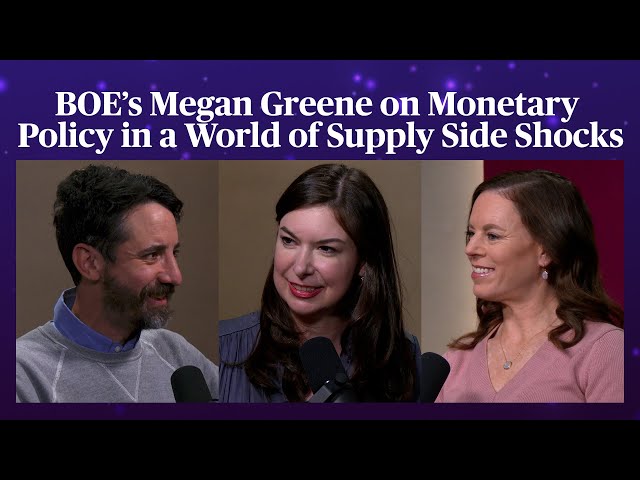
The Bank of England's Megan Greene on Monetary Policy in a World of Supply Side Shocks | Odd Lots
Bloomberg Podcasts
0:00 I think getting hit by successive shocks is just here to stay,
0:03 and I think you can identify some already.
0:06 So if economic statecraft is how, uh, major world powers are going to operate
0:12 using economic tools for foreign policy goals,
0:14 this just represent negative supply shocks for someone.
0:18 Um, and so, you know, I think we will continue to have negative supply shocks,
0:22 whether it's tariffs or export controls or, you know,
0:25 investment controls, all of these things.
0:27 Um, and then, you know, climate change, uh, whether it's, you know,
0:31 physical risk or transition risks, if it crystallizes,
0:34 that represents a negative supply shock as well.
0:37 So we're no longer at a point where we can kind of say, well,
0:39 one day we might have some of these things happen,
0:42 and I think we're already there.
0:43 And so this old adage that you should just look
0:46 through negative supply shocks because you can address them directly.
0:48 I don't think it works when you keep having them wave after wave.
0:52 Um, and I also think, uh, there's just a ton of uncertainty now, uh,
0:57 a lot of economists feel like they had a framework
0:59 for understanding how the global economy worked in it.
1:04 It doesn't work anymore, but no one's quite identified the new one.
1:07 And so in an age when you have this much uncertainty,
1:11 you need to start thinking about your very
1:14 specific forecast where you duke it out,
1:16 whether inflation's point two percentage points higher
1:18 or lower in year three of your forecasts.
1:21 It's kind of neither here nor there.
1:23 It's much more about kind of scenario analysis
1:26 and risk management when you're making decisions about interest rates.
1:30 So figuring out you know, if we thought we were in this state of the world
1:34 and it turns out we're in a different one,
1:36 how bad wood could we mess that up and how do we minimize some of those costs?
1:47 Hello and welcome to another episode of the all podcast.
1:49 I'm Tracy Alloway and I'm Joe Weisenthal Joe.
1:53 You know, one nice thing about getting old.
1:57 Go on.
1:57 I've been thinking about this a lot, actually.
1:59 The nice thing about getting old is that a lot
2:03 of people that you have known for a very long time,
2:06 and that you've sort of grown up with, you say, over the years,
2:10 start to get into really interesting positions and sometimes
2:14 senior positions or sometimes positions of, uh, of power.
2:18 I love this tech.
2:19 Right?
2:20 Yeah.
2:20 There are certain people that you don't get to know or, you know,
2:23 when you're in your 20s or whatever,
2:25 your peers or your peers, and that's great, but they probably aren't.
2:28 For example, external members of the Bank of England
2:32 Monetary Policy Committee and so forth or other such roles.
2:35 But as you can see here, you're like, oh, wow, I know that person.
2:39 I recognize that name.
2:40 As you guys like to say, who went to university in London?
2:44 I went to uni with that person.
2:45 My impression is that everyone in London
2:48 went to uni with literally everyone else,
2:50 because I've heard you and Sid say that specific
2:52 phrase so many times over the last decade.
2:56 No, not that often, Surely.
2:58 But you're absolutely right.
3:00 You've sort of given the guest away.
3:01 We're going to be speaking with someone that we've known for a long time,
3:04 and I think a lot of people have known her for a long time.
3:07 From her very public role on finance, Twitter.
3:11 That's right, as they say, and also in various columns in different
3:15 media organizations and professional roles and professional roles.
3:18 Yeah.
3:19 To me, she will always be a member of finance, Twitter.
3:23 Yes.
3:23 Various professional roles.
3:24 And now she is in fact an external member
3:27 of the Monetary Policy committee at the Bank of England.
3:29 And it's a really interesting time,
3:31 of course, to be talking about monetary policy.
3:34 I mean, I would say it's an interesting time.
3:36 It's always an interesting time to be talking about monetary policy.
3:38 But I would say it's a particularly interesting
3:40 time because I could list several reasons for that.
3:43 So obviously we are still in the wake
3:46 of the incredible inflation wave that we had post-Covid.
3:50 And at least in much of the world, inflation has not returned to target.
3:54 In fact, in some countries, uh, the rate hike cycle is begun.
3:58 So there's still the live issue.
4:00 There is the shifting political, uh,
4:03 situation in many countries in which the very premise of like,
4:06 well, how much independence should the central
4:08 bank have to operate is being read, discussed.
4:11 And it is, in fact, local elections in the UK.
4:14 Right?
4:14 That's right.
4:15 We are speaking, uh, during the week of, uh, local elections.
4:17 And then, of course, you know, okay,
4:19 Covid shocked, maybe transitory or one off thing,
4:22 but, uh, we have lots of, uh, Governor Christopher Waller in the US.
4:26 He had a good speech recently called one transitory shock after another,
4:30 of course, in this case alluding to the war in Iran.
4:32 And so what is the price in oil and so forth mean for inflation?
4:36 There are so many interesting questions right now
4:39 for anyone in the seat of a monetary policymaker.
4:43 So much, and also the interaction between
4:45 monetary policy and the bond market as well.
4:48 Right.
4:48 So we're recording this.
4:49 I feel I have to say this for every episode now.
4:51 On May 6th, yesterday we saw the 30
4:54 year UK gilt yields hit its highest since 1998,
4:58 and that was after the Boe decision
5:00 from last week to actually hold interest rates.
5:03 So there's a tension there.
5:04 Anyway, we have so much to talk about.
5:06 So much.
5:06 Truly the perfect guest.
5:07 We are of course going to be speaking with Megan Green.
5:10 Thank you so much for coming on the show, Meghan.
5:12 Thank you for having me.
5:13 It's great to see you guys again.
5:14 It's very, very fun.
5:15 Um.
5:16 Very nostalgic.
5:17 What's it like to go from, I guess, thinking and writing and tweeting
5:22 about economics to actually practicing economics, setting economic policy?
5:26 Yeah.
5:27 So first of all, I love that you guys think of me as finance Twitter,
5:31 because it certainly was not paying any of my bills over the years.
5:35 Um, now, sadly, my Twitter account is relegated mostly to baseball commentary.
5:39 Um, on the go Red Sox.
5:41 But um, but you know,
5:42 it's very different to go from kind of analyzing and forecasting
5:47 what central bankers will do to being a central banker and being,
5:51 you know, making the sausage myself.
5:53 So it's it's a very different position,
5:55 um, with a whole lot more responsibility.
5:57 We like talking to Americans who have served those who've made it.
6:01 Yeah, well, we've, uh, you know, Adam Posen.
6:03 There's hope for us, Joe, a bunch of times.
6:05 So, you know, it's plausible that you and I could be MPC members.
6:09 What is your role?
6:09 What does it mean to be an external member of the MPC at the BOE?
6:12 Yeah.
6:13 So that's a great question.
6:14 And the Bank of England is pretty unique for it's set up this way.
6:18 So the Monetary Policy Committee,
6:19 which meets every six weeks and votes on interest rates,
6:22 uh, is comprised of nine people.
6:24 Five are so-called internals and four are so-called externals.
6:28 Um, and the internal members are the governor,
6:31 the deputy governors and the chief economist.
6:33 Some of them grew up at the Bank of England.
6:34 Some of them didn't.
6:35 Some of them came in, but they're all part of the executive.
6:38 And then the four external members of the MPC,
6:40 of which I'm one, um, quite intentionally came from outside the bank.
6:44 Um, and what that means exactly is, you know, differs in every case.
6:48 So it could be from outside the industry entirely.
6:50 It could be from outside the country, as you can tell from my accent.
6:54 Um, and also from my background, I'm a little bit of both,
6:57 although actually I'm also British, so I'm not sure how.
7:00 Yeah, by passport.
7:00 I'm not sure how they're classifying me.
7:03 Um, but there's always been an American actually on the MPC.
7:06 It's not a rule that.
7:07 So you and Adam aren't the first.
7:09 No.
7:10 So there have been.
7:11 Yeah, there have been others.
7:12 Um, but the idea is just to have
7:14 to quite intentionally bring in different perspectives.
7:17 The external members sit in a different
7:18 part of the bank from the internal members,
7:20 so that we don't all collude and get stuck in groupthink.
7:24 Um, so the idea is to have different perspectives.
7:26 You know, I come from the private sector.
7:28 Many members of the MPC come from academia.
7:31 So I bring kind of the business environment, um,
7:34 corporate side of things, uh, and also from outside the country.
7:37 So I spent a lot of time looking at international spillovers.
7:40 You can see in my speeches how the UK is affected by things happening in the US,
7:44 in the eurozone, for example.
7:46 Um, so the idea is to just fight groupthink.
7:49 Um, and you can see that often in our votes.
7:51 Right?
7:52 We're also unique for reporting.
7:54 Who voted for what?
7:56 Um, every time.
7:56 And so you can see what the rules know, like figuring out which door is right.
8:01 So in the US report.
8:02 But I guess in the in the Europe they don't.
8:05 Right.
8:05 So you don't actually get those vote counts
8:07 or you don't know who if they dissented or what.
8:10 It's.
8:10 That's right.
8:10 People can out themselves if they want to do it at the Bank of England.
8:13 We're fully transparent about all of that.
8:15 And so you can see that often there are dissents.
8:17 In fact, after the last fed vote, I had a number of friends say, gosh,
8:20 the fed looks a lot like the NPC right now because they were for dissents.
8:24 Yeah, it's quite normal to have dissents at the Bank of England,
8:26 which is pretty different from most major central banks.
8:28 But it's all part of this idea of sort of personal
8:31 accountability for your votes and having different perspectives on a committee.
8:35 Um, you kind of anticipated my next question,
8:38 but how much of your role is viewed as sort of explaining, perhaps U.S.
8:43 monetary policy and its potential impact on the UK versus
8:47 actually analyzing the UK and having to know that particular economy.
8:52 And, you know, when you first joined the MPC,
8:54 did they hand you like a UK economic handbook
8:57 that you had to, like get up to speed on?
9:01 So no, there was no handbook, but I did have to get up to speed pretty quickly.
9:05 Um, including up to speed with kind of the data in the UK,
9:08 which is quite different from the US.
9:10 Um, but my, my role really is about looking at the UK economy,
9:14 trying to understand what's going on, um,
9:16 but also understanding how there's spillovers from other places.
9:20 So by way of example, before the pandemic, when the, uh, gilt yield curve moved,
9:25 about a third of that move was usually from outside the UK entirely.
9:29 So from mostly from the US and also the eurozone.
9:32 Since the pandemic, it's been about half of the moves in our yield curve.
9:36 So, you know, financial conditions are affected pretty significantly by what
9:40 we have absolutely no control over whatsoever at the Bank of England.
9:43 But it's important to understand how those spillovers might happen.
9:46 You also have spillovers via trade,
9:48 which obviously we've looked into a whole bunch through,
9:50 um, through the past year, given tariffs and economic statecraft.
9:55 It occurs to me, well, I actually don't.
9:57 What is the bill's mandate?
9:58 Of course, in the US, it's, uh, you know, the famous dual mandate.
10:02 My understanding is the ECB is a more ostensibly, singularly priced mandate.
10:07 What is the Bailey's mandate?
10:09 Yeah.
10:09 So our mandate is to achieve price stability
10:12 of 2% inflation and sustainably over the medium term.
10:16 And then subject to that, um, to support the goals of the government.
10:19 But it really is.
10:20 Whereas the fed does have a to a dual mandate,
10:23 we really have one primary mandate.
10:25 Um, and, and the rest is secondary to that.
10:28 How would you characterize the health of the UK economy at the moment?
10:32 And Joe and I got to ask this very basic question, because we don't live here.
10:37 You know, we see the headlines that everyone else does.
10:40 We see headlines about energy shocks, um, trade and tariffs, as you mentioned.
10:44 But then we walk around the city and things,
10:47 great things seem pretty crowded and people seem to be eating out.
10:51 And in central London, where the tourists come.
10:53 That's right.
10:54 Look, plenty active to me.
10:56 That's right.
10:56 How would how would you describe it at the moment?
10:58 Yeah, particularly on a Tuesday through Thursday.
11:00 So when I'm on a Friday and people aren't necessarily coming into the office,
11:04 um, look, the UK economy has been pretty weak.
11:06 Um, it's been weak since I started this rule three years ago.
11:10 Um, and the question is why it's so weak.
11:13 And most economists, you guys included, I imagine,
11:17 think of the economy through the demand side.
11:20 Um, because that's what we were all
11:21 taught for generations to just think about demand.
11:24 Um, and so demand is pretty weak in the UK,
11:26 but actually the supply side is pretty weak as well.
11:30 And has as you mentioned earlier,
11:32 Joe has been hit by a number of successive supply shocks.
11:36 Um, and so, you know, we have growth.
11:39 Um, that's it.
11:40 It's there, there's some but it's it's pretty weak.
11:44 Um, and even though you have variations,
11:47 we have monthly GDP data in the UK, which we don't have in the US.
11:50 That was a real surprise to me.
11:52 But there are, you know,
11:53 variations in the monthly GDP data about underlying GDP,
11:55 which is what we tend to look at, and we build it based on a bunch of surveys.
12:01 Um, that's pretty weak, you know, 0.2 percent growth per quarter.
12:05 Um, so that's not significant.
12:07 That said, the supply side of the economy is also pretty weak.
12:11 And so, um, if you had more demand
12:13 than that, that could actually end up becoming inflationary.
12:16 Yeah.
12:17 Just intuitively, you know, you mentioned the supply side.
12:20 And like much of the sort of developed Western world there is the okay,
12:25 there's the struggles of the industrial sector,
12:28 in large part due to competition with China.
12:30 There is the fact that if you're in a sector that's not AI,
12:34 you're probably not getting a ton of investment.
12:36 London specifically, at least in the recent, um,
12:38 I hub we established demand side is weak.
12:42 But you voted to hold rates.
12:44 So what is it about the inflationary environment such
12:47 that this weakness does not call for cuts right now.
12:51 Yeah.
12:51 So part of that story is the supply side, which is also incredibly weak.
12:55 So if you had stronger growth that could be inflationary.
12:57 Um, but I think it's worth thinking about where
13:00 the UK economy was before the war in Iran, before we had this energy shock,
13:05 because I think my and others views on where we
13:08 are right now very much depends on where we started from.
13:11 Um, so before a few months ago in February, um,
13:15 you know, we had inflation that was still above target.
13:18 It was it was coming towards target, um, but was still above target.
13:21 Um, we've had inflation above target for the best
13:24 part of five years now in the UK.
13:25 Um, so it's been above 2%, um, for all but 1 or 2 months in the past five years.
13:31 Um, and that's off the back of a couple of successive shocks,
13:35 particularly Covid, um, and also the Russian invasion of Ukraine.
13:39 Um, and so as we were looking at inflation
13:42 start to come down towards our 2% target,
13:45 it had been coming down more slowly than we had hoped since I got here, in fact.
13:50 And if you've looked at some of the forward
13:53 looking indicators for wages and also for prices,
13:55 those actually seem to be stalling out.
13:58 So we run a survey, um, called the Decision Makers Panel, the DMP,
14:02 where we asked companies about their own price expectations a year ahead
14:05 and their own wage growth expectations a year
14:08 ahead and their own price, uh, expectations.
14:11 The year ahead had pretty much stalled out,
14:13 so they weren't really coming down anymore.
14:15 Also more worrisome, in my view,
14:17 was what they thought about wages a year ahead where they
14:20 thought they were going to drop a little bit from last year.
14:23 Um, so, you know, not much, not as much as we had expected wage growth
14:27 as wage growth was going to drop a little bit.
14:29 That's right.
14:30 Not wages, wage growth.
14:31 Um, and also we have agents who are based
14:33 around the country who go and talk to firms.
14:35 They do a whole survey, um, on pay settlements and um,
14:38 pay settlements were due to come in, uh, a bit lower this year.
14:43 Pay settlement growth was due to come in a bit lower than it was last year,
14:47 so this disinflationary process had signs of stalling out.
14:50 Also if you look at inflation expectations.
14:53 So household inflation expectations were really elevated before,
14:57 uh Iran was invaded.
14:59 In fact up until, you know, February, they were above what you could explain,
15:04 looking at historical relationships between
15:06 inflation out terms and inflation expectations.
15:08 So it was a concern that, you know,
15:11 households were thinking that inflation was going to be higher, um,
15:15 that could feed through into wage setting,
15:17 which could explain why wage growth was
15:19 coming off more slowly than we'd expected.
15:21 And therefore price growth was coming off more slowly than we'd expected.
15:24 So there were already some signs of some persistence from previous shocks,
15:28 um, left in the economy.
15:30 In fact, I've been working on a speech on second round effects,
15:34 um, since before Iran was invaded.
15:36 And part of me thought, gosh, is this going to be irrelevant?
15:39 Um, you know, in six months when I finally give this speech, of course,
15:43 it's only more relevant now,
15:44 but I was already worried about some of this inflation,
15:46 persistence and some of the second round effects from the last
15:49 couple of negative supply shocks even before Iran was invaded.
15:52 And of course, since then we've now
15:54 had a negative supply shock, an energy shock.
15:57 And that stands to push inflation up and growth down,
16:00 which is a terrible situation for a central banker to be in.
16:04 So just to emphasize this point is the idea
16:06 that if we keep getting transitory shock after transitory shock,
16:10 or if we keep getting.
16:11 I think you've used the word mini waves
16:13 of inflationary bouts over and over and over again.
16:16 Expectations will be more vulnerable towards higher inflation levels,
16:21 so people will be even more worried about inflation once
16:25 we get like the third shock and the fourth shock.
16:27 That's right.
16:28 And the size of the shock matters too.
16:30 So inflation was 11% a couple years ago.
16:33 That was on the front page of every newspaper.
16:34 Households kind of knew about it.
16:36 They saw it at the grocery store.
16:37 So, um, we've done a lot of research
16:40 showing that households and businesses are, um,
16:43 possibly just more attentive to inflation and particularly
16:46 once inflation comes within a certain band.
16:49 So there's a threshold it used to be.
16:51 No one paid attention to inflation if it was below 4%.
16:55 That band has actually shifted down.
16:56 So in the UK we think that if inflation is somewhere between 3 and 3.5%,
17:01 that's the threshold at which people actually notice it a lot more.
17:04 So if you then have another negative supply,
17:06 shock and inflation go up, people will be much more sensitive to that.
17:10 We also have done research showing that people are more
17:14 sensitive to upside surprises and inflation
17:15 than downside surprises than inflation.
17:17 Um, and so that's a concern given we're now facing rising inflation.
17:21 And then for firms, um, when they're looking at inflation,
17:25 it used to be, you know,
17:26 before we had these supply shocks that firms kind of set prices on a schedule.
17:30 Um, um, and since the pandemic,
17:32 they've shifted much more to state dependent pricing.
17:35 So when inflation gets higher,
17:36 they set prices more often and pass through their higher costs,
17:40 um, through the end user in the form of higher prices, and that that's remained.
17:45 So if that you have more state dependent, um,
17:48 pricing from firms than actually you can get a pass
17:51 through from inflation expectations from them much more quickly.
17:54 So with that background in mind, you know,
17:56 with people clearly caring about higher
17:58 inflation more than they care about deflation,
18:00 being more attuned to higher inflation,
18:02 and with companies more willing to reset prices in the face of higher inflation.
18:06 To what degree does the BOE try to get ahead
18:10 of higher inflation versus wait for it to actually emerge?
18:13 Yeah.
18:14 So the way that we think about
18:16 these kinds of shocks propagating through the economy,
18:18 it's sort of in three different phases.
18:20 So the first um, the first phase is kind of direct effects.
18:25 So when you have an energy shock that automatically
18:27 makes energy prices higher for everyone in the UK,
18:30 we actually have a price cap for households, um, the Ofgem price cap.
18:34 And so households have been shielded from that bit
18:36 until July and then they'll see energy costs go up.
18:40 Um, so this could happen in stages.
18:42 But in any case, um, monetary policy doesn't kick in for 18 to 24 months,
18:46 so it kicks in with a lag.
18:48 So if we were to respond to that right now, by the time it hits the economy,
18:52 it's just too late and we could risk suppressing activity unnecessarily.
18:57 So mostly you look through direct, um, energy effects.
19:01 Then you think about indirect energy effects.
19:03 So firms that are using energy pass it on.
19:06 For example, food production is a great example.
19:08 It's pretty energy intensive both through fertilizer but also transport.
19:13 And so you see food prices start to go up, which I think we probably will see.
19:17 Um, and so those are indirect effects.
19:19 And um, the jury's out a little bit amongst the central banking
19:22 community on whether you should try to lean against indirect effects or not.
19:26 Generally, you should try to lean against some of them, um, but not all of them.
19:30 Again, because of lags in monetary policy.
19:33 The real kicker is second round effects.
19:35 And that's when actually all these price increases
19:37 start changing wage and price setting behavior, um,
19:40 so that you get individuals and households saying, well,
19:43 I can't my money's just not going as far anymore.
19:46 You're going to have to pay me more.
19:48 And then firms, you know, might say, fine, we'll pay you more.
19:51 But our in our costs are higher.
19:52 So we're going to pass that through and higher prices.
19:55 And that can turn into a bit of a spiral.
19:57 Um, we've looked at past supply shocks in the UK,
20:02 and every single one of them has had second round effects.
20:05 Um, but to vary differing degrees depending
20:07 on the state of the economy at the time.
20:10 So in 2008, 2011, 2014, 2022,
20:13 you had second round effects in all of these situations.
20:17 But the economy was very different in these different periods.
20:20 Um, we tend to look at 2022 because it's the most recent one.
20:24 And I think for a lot of people, kind of the most scarring one,
20:27 um, when you had energy costs go up so much.
20:30 Um, and in 2022, of course,
20:32 it's worth remembering we had just reopened after Covid.
20:35 So you did have pretty strong demand.
20:37 Um, and also the labour market was pretty tight.
20:40 Um, that's not the case now.
20:42 Actually, we have much weaker demand in the UK economy,
20:45 and we have a much weaker labour market, and it's continuing to weaken.
20:49 So we have slack in the labour market.
20:51 So that suggests that we shouldn't get the same degree
20:54 of second round effects now that we did in 2022.
20:58 I think that's of little comfort.
20:59 Actually those were pretty extreme second round effects.
21:02 Um, I also look at 2011 when the labour
21:05 market was actually much weaker than it is now.
21:08 You had unemployment of 8% in the UK and you had some second round effects then.
21:12 So right now the economy is somewhere in between those two.
21:16 Um, so we will get some second round effects.
21:18 Um, well, you know, it's impossible to calibrate them exactly in advance.
21:23 The trick for us also is that you you know,
21:25 we kind of know how to measure direct and indirect effects.
21:28 We can do that pretty easily.
21:30 The second round effects are pretty difficult to measure.
21:33 Um, but of course, if we wait until we
21:36 have real concrete evidence of them were too late.
21:39 Um, in responding.
21:40 So we're going to have to make a judgment,
21:42 a proactive judgment in advance about the size
21:44 of the second round effects that we're
21:46 going to want to lean against so that we can lean against them in time.
21:50 You know, of course, we have a theoretical question.
21:52 I've been meaning to ask someone about
21:55 this when the inflation started to explode.
21:58 Um, you know, in the immediate wake of the pandemic, really globally,
22:01 one of the stories that people like to tell was that monetary policy would have,
22:07 uh, weaker teeth or be less effective in the U.S.,
22:11 in part because so many American households are on 30 year fixed mortgages.
22:15 Unlike in much of the other Western world or the Anglosphere world,
22:20 where a lot of people's mortgages reset regularly.
22:23 Did that actually play out in practice?
22:26 Did BOE decisions transmit quicker to the real economy?
22:31 Because fewer households see their mortgage bill reset on a regular basis?
22:36 Yeah.
22:36 So we've done a lot of looking into the monetary transmission mechanism to see
22:40 how the change in the structure of the UK mortgage market has affected things.
22:44 Because to your point, in the UK we weren't always all on two and five
22:48 year fixed mortgages in fact used to have longer term fixes.
22:52 We've had periods with variable more today dominated by two,
22:55 and mostly it's two and five year with I think,
22:57 an increasing number of variable mortgages.
23:00 Um, and so what you find is that, um, it does transmit a bit more quickly.
23:05 Um, but it's also very different in the US.
23:08 In the UK you can import your mortgage with you.
23:10 Whereas in the US you can't.
23:12 So there's an entire supply problem in the US that you know face we
23:16 face supply problems in real estate
23:18 in the UK but for completely different reasons.
23:21 So that's a difference that's worth taking into account as well.
23:24 But it's also meant, um, even though it's a shorter fix that we have here,
23:28 it does mean that, you know, over the course of this hiking and cutting cycle,
23:32 even the rates have been coming down for a while now.
23:35 um, consumers haven't really been spending.
23:38 And I think one of the reasons for that is that even though
23:41 rates are coming down as people come off a five year fixed mortgage,
23:44 their own debt servicing costs are jumping massively from where
23:47 they were when they first took out the mortgage.
23:50 And so even though rates are coming down,
23:52 people's debt servicing costs continue to go up.
23:55 And so as you're in a rate cutting cycle,
23:57 you would expect consumers to spend a bit more.
23:59 Um, we're not finding that so much.
24:01 So this is one potential explanation for why consumers aren't spending more.
24:05 It could also be scarring from previous bouts of inflation as well.
24:10 But that's going to feed into the current conjuncture because
24:13 one of the concerns of course I'm worried about inflation.
24:16 I think that's paramount.
24:16 And I think the risks to inflation are on the upside.
24:19 But of course you have to offset that with the risk of weaker demand.
24:23 And, um, you know, if if consumers are spending
24:27 in the UK because they're scarred from previous experiences,
24:30 then they're looking at this energy shock and probably thinking,
24:33 well, no way I'm going to spend now.
24:35 I'd better save for a rainy day.
24:37 Which, by the way, could be now.
24:39 And so there is a chance that consumption, and therefore growth,
24:41 could be even weaker than we've been expecting as well.
24:44 So you have to, um, offset that with concerns about greater inflation.
24:47 Um, since we're talking about the consumer, I mean,
24:50 it feels like one of the few potential deflationary forces out there,
24:54 but still potentially a very big one is I.
24:57 Yeah.
24:57 Right.
24:57 And this idea that, well, if there are fewer jobs because of I,
25:01 then obviously people are going to be earning less and spending less.
25:04 And that's going to exert deflationary pressure on many different economies.
25:09 What have you seen so far in terms of the impact of EI on the job market,
25:13 and how are you thinking about this?
25:16 You know, kind of very new still development.
25:19 Yeah.
25:20 So the bank has done some research on how,
25:22 um, I is affecting the labor market in particular,
25:25 and there's some nascent evidence that maybe those industries that are more
25:30 exposed to AI are seeing fewer job openings than industries that are exposed,
25:35 which you can imagine.
25:36 Youth unemployment is particularly high in the UK,
25:39 so I think it's quite easy to jump to a conclusion that suggests that, you know,
25:44 it's very difficult to get a job if you're just coming out of uni,
25:47 and maybe that's an eye effect,
25:48 but I think there's actually very little evidence to directly make that link.
25:53 Um, and so there isn't much evidence of that.
25:56 It's not just the labour market, of course, though.
25:58 Um, as I mentioned already, I'm worried about the supply side of the UK economy.
26:02 So most of the supply shocks we've seen over
26:05 the past couple of years have been negative supply shocks.
26:07 I represents the one potential positive supply shock
26:10 that we might see coming down the pike.
26:12 And so, you know that could be possible.
26:14 We we look at the supply side of the economy all the time.
26:18 Now at the Bank of England when I first started,
26:19 we only looked at it once a year
26:21 because it's not supposed to move around that much.
26:23 But we've learned actually.
26:23 What does that mean?
26:24 Once a year did you have like supply side week
26:27 or something where you all got together and thought about it?
26:29 I find this very interesting.
26:31 It's not that we didn't ever talk about it in the intro.
26:33 We did like a real deep dive on the supply
26:35 side of the economy to try to measure productivity growth,
26:38 total factor, productivity.
26:40 I mean really deep dive.
26:41 And it really was a once a year event.
26:44 Um, and now we do it all the time because
26:46 obviously the supply side moves more than we had expected.
26:49 We keep getting hit by supply shocks.
26:51 Um, but you know, when we look at the supply side of the economy, um,
26:55 there is no judgment that we've put in, um, on the supply side to do with AI.
27:00 So possibly it's in our assumptions about
27:03 productivity growth just through some assumption about investment.
27:06 But generally, we haven't made a judgment
27:09 that over the next three years I will meaningfully, um, impact productivity.
27:13 And I'm not I'm not sure that that's right.
27:15 I think the timing of this is the hardest part.
27:17 Well, actually, when I think about the term supply side or supply
27:21 side shocks or I think there are sort of two things, right.
27:24 There's a supply side shock.
27:26 You can't do anything.
27:27 Suddenly the price of electricity goes up everywhere.
27:29 And we call that a supply side shock and it's not great when that happens.
27:33 And then there is also the sort of like core productive capacity of a country,
27:39 and how productive industries are and what
27:43 type of investment is there, and so forth.
27:45 Even setting aside the shocks,
27:48 the trend seems to be negative in the UK in terms of business investment.
27:54 You hear about the last steel mill or whatever that's closed there.
27:58 I read something recently.
27:59 Um, the UK might be importing salt for the first
28:03 time or whatever in your whether it's formally annual,
28:06 but now regular studies of the supply side of the UK economy.
28:10 Do you have a diagnosis or do you have an assessment
28:13 about what is driving this sort of long term deterioration?
28:18 We do, insofar as you can say there hasn't
28:20 been a whole lot of investment in the UK,
28:22 um, starting with the global financial crisis.
28:24 I think most people pin that on Brexit.
28:26 And Brexit didn't really help, but it predates Brexit.
28:29 Um, and so that has been a long term drag on, um,
28:33 potential growth, productivity growth.
28:36 Um, we assume that productivity growth in particular will,
28:40 um, rebound to its long term trend.
28:43 Um, and and I'm not sure that that's right.
28:45 I think my, my own view is that the risk to that is entirely on the downside.
28:50 But, you know, a lack of investment is part of it.
28:53 Um, and then on top of that, I mean,
28:55 I understand how you're splitting these out,
28:57 but if you keep getting negative supply shocks
28:59 and eventually that does feed through into potential growth.
29:02 Um, and yeah, and so I think that's a concern in the way that central
29:06 bankers have approached negative supply shocks has
29:09 always been you just look through them.
29:11 They're temporary.
29:12 You know, Bank of England can't do
29:14 anything about the Strait of Hormuz, for example.
29:16 Um, can't actually address it.
29:19 We have can't reverse Brexit.
29:21 No.
29:21 We have tools that are uniquely designed for demand side problems.
29:26 They can't really address supply side problems.
29:28 And so we've always learned just look through them
29:30 and consider a sort of underlying inflation, underlying growth.
29:33 Um, and I think that when you keep having negative supply shocks
29:38 and you consider that households and businesses
29:40 are more attentive to inflation, um,
29:42 that, you know, they're setting prices more often,
29:45 they some kinds of inflation are more salient for households
29:48 and businesses and other particularly food and energy inflation.
29:52 And we keep having increases in both of those things.
29:55 Um, then that eventually gets embedded into people's
29:58 expectations and, and then their wage and price setting.
30:01 And so that creates the kind of inflation persistence
30:04 that I've been worried about even before this invasion of Iran.
30:07 But now I continue to be worried about it.
30:09 I'm going to ask another sort of background American visiting London.
30:13 Um, haven't been here for many years.
30:16 Kind of question.
30:17 But when people talk about the UK as high as your last year.
30:20 Oh yeah.
30:20 I haven't lived here for many years.
30:22 When people talk about the UK's high exposure to energy volatility, why is that?
30:28 Because the other thing people talk about in relation
30:30 to the UK is like it does actually have North Sea oil.
30:33 It does have kind of its own supply.
30:36 Like what exactly is that vulnerability in this economy.
30:40 So it has some supply, not massive amounts.
30:44 Um, and I think part of the trick is it's also very exposed to gas prices,
30:50 which, you know, were what went up so dramatically when Russia invaded Ukraine.
30:54 And then in the UK, electricity prices are keyed off of gas prices.
30:59 So then electricity is particularly vulnerable as well.
31:02 So unfortunately I mean, the US has kind of energy independence at the moment
31:07 and the UK is nowhere close to that position.
31:09 I know in the US there is an entire art
31:13 to asking a monetary policy setter a question about fiscal policy,
31:18 because you have to do it very delicately.
31:20 Otherwise they might faint over in their chair
31:22 if they're presented with something outside their remit.
31:25 I don't know what Exactly.
31:27 The norms are here about how we're how we're supposed
31:30 to phrase such questions to elicit some sort of answer.
31:33 But with all that out of the way.
31:36 When you think about the upward pressure
31:39 on inflation and why you're so concerned about inflation.
31:43 Hum.
31:43 And we've talked about energy and all that.
31:46 How much does the seeming inability of government
31:51 after government to engage in fiscal consolidation.
31:54 How much is that a factor when you
31:57 think about the inflation the future trajectory of inflation.
32:01 Yeah.
32:02 So I mean I'll say what any rates that are we'll we'll tell you.
32:06 So thank you for that.
32:07 Yeah I've done all that.
32:08 I've done a lot of work clearing for you.
32:10 Yeah.
32:10 But I mean, the way that we think about fiscal policy
32:13 is we take exactly what's legislated and we put that into.
32:17 Okay.
32:17 So you stipulate that it doesn't seem like there is
32:20 any real impulse at fiscal consolidation or capacity right now.
32:24 So what does that mean?
32:25 Well, So, I mean, actually the government has legislated,
32:29 uh, some consolidation given fiscal rules.
32:32 And so that is exactly what we put into our forecasts.
32:34 And so that's just one of the conditioning assumptions is what legislated,
32:38 we assume will happen.
32:39 Okay.
32:40 Um, and then we base our forecasts off the back of that.
32:43 But so just to push further some
32:46 of these fiscal choices like the inviolability of, say,
32:49 the triple lock, which again,
32:51 I'm not asking you whether these are good or bad policies,
32:55 etc., but are these contributors to the persistent of upside inflation risks?
33:01 So I think, um, you know, it contributes to government borrowing costs.
33:06 So we're sitting in the UK a day after a long term rates went up.
33:10 Some of that is to do with the Strait of Hormuz.
33:13 Some of that is to do with two social posts.
33:16 Sure, some of that may be because there are local elections coming up,
33:19 and I think there's just a whole bunch
33:21 of positioning around that in a gilt market,
33:23 which is pretty niche, Um, and fairly small relative to the U.S.
33:28 Treasury market in particular.
33:29 So I think that's all worth considering as well.
33:31 And that all feeds through into financial conditions.
33:34 You mentioned gilt yields.
33:35 Now that you've gone from sort of finance Twitter to, you know,
33:39 hardcore economic practitioner, monetary policy practitioner,
33:42 she did have real job.
33:44 I know, I know, but not like not on a central bank.
33:49 Yeah.
33:49 Um, I, I'm complimenting the current role, not denigrating the previous ones.
33:54 That's my intent.
33:55 I'll always be economist Meg to you.
33:57 That's Meg.
33:59 But, like, how do you think about bond vigilantes are, you know,
34:03 do you have nightmares or have you gone from tweeting about bond vigilantes
34:08 to thinking about them relentlessly as you watch UK gilt yields go on?
34:12 Uh, no.
34:13 Um, so I, I neither have nightmares about them um,
34:17 nor you know, do I wish I could tweet about them.
34:21 I think, um, markets are sometimes
34:24 efficient and sometimes get things totally wrong.
34:27 And so, you know, we have an entire function at the bank that talks
34:31 to investors to get a sense of kind of what's behind their positioning,
34:35 what they think often is what do they think about us?
34:38 What do they think we should be doing?
34:40 What do they think we will do?
34:42 And I think that's all worth understanding.
34:43 Um, because like I said, sometimes they get things right.
34:47 Certainly not always.
34:48 Well, let me ask you a mechanical question about, um, the bond market,
34:52 which is are the coupon payments as the as we see yields rise.
34:59 And this is a question for all developing economies,
35:01 but and it's certainly at least a little bit of an anxiety
35:04 in the US as well as we see those coupon payments rise.
35:07 Are we anywhere near where those interest payments
35:10 themselves are creating an inflationary impulse in the UK,
35:15 which economists would call fiscal dominance?
35:17 Yeah, I mean I mostly look at this through financial conditions.
35:20 Okay.
35:20 Um, and so, you know, if you get bond yields rising then that's that's
35:24 tightening financial conditions and that feeds through into the economy.
35:27 And then there's a judgment to be made
35:29 about what monetary policy should do about it.
35:32 But that's a fiscal expenditure that that that coupon payment.
35:36 And so the question is does that is
35:39 it of a size such that that fiscal expenditure,
35:41 which the screens tell us is rising when we see the rates rising.
35:46 Does that is that large enough or is there a delta
35:49 there such that that actually itself creates an inflationary impulse?
35:53 So no, that's not a significant impact that we're looking at.
35:57 Mostly we're just looking at it through financial condition.
36:00 Got it.
36:01 Yeah.
36:01 So we talked earlier about spillover from U.S.
36:04 monetary policy.
36:05 And it is, you know, thinkable that the U.S.
36:09 could be raising rates sooner than it might be lowering rates.
36:13 How would you anticipate the feed through from a tightening of U.S.
36:17 monetary conditions to the U.K.
36:19 at this current moment?
36:20 Yeah.
36:21 So as I mentioned, there's significant read through from the US
36:25 Treasury market into the UK gilt market, rightly or wrongly.
36:28 Um, so if you look at, um,
36:31 economic indicators that come out and how they influence,
36:34 uh, our financial conditions in the UK,
36:37 um, the, the indicator if it's surprises that influences
36:41 conditions here the most is UK inflation, thank goodness.
36:44 But secondly is U.S.
36:45 inflation.
36:46 I think third might be nonfarm payrolls in the U.S.
36:49 it's not at all clear why these things
36:51 should actually be influencing financial conditions in the UK.
36:55 Right.
36:55 But I think part of that is an implicit assumption
36:58 that the fed is the world's biggest economy central bank.
37:01 And so when the fed does something,
37:04 everybody kind of has to um, I don't think that's right actually.
37:08 But you can't ignore these spillovers.
37:10 So if financial conditions were to tighten in the US,
37:13 that would feed through to the UK and financial conditions.
37:17 I mean, of course the reason matters.
37:18 But you know, if it's because of rate hikes, in the US,
37:22 it could mean that our financial conditions tighten as well.
37:25 And then that feeds through into kind of our view of how
37:29 restrictive our monetary policy stance is and how we manage inflation.
37:33 For it's our 2% target.
37:34 Can I go back to something you said at the very beginning when I
37:37 asked you about what is the the remit or the objective of the central bank?
37:41 And you said one thing is to support the government,
37:44 and that is not formally I don't think that's part of the fed,
37:48 but I know that that's like why the whole
37:51 that's why the Bank of England was founded, was to be to the government's bank
37:55 and to facilitate financing of the government.
37:58 Does that functionally change anything,
38:00 like when you think about that is like part of does that does that mean
38:04 something substantively different in terms of the conduct
38:07 of monetary policy within the BOE versus,
38:10 say, another central bank, when that sort of like part of your funding charter?
38:15 Yeah.
38:15 So to be clear, our mandate really is 2%
38:18 inflation sustainable in the medium term, Subject to that?
38:21 Yeah.
38:21 To support the goals of the government and these change.
38:24 Okay.
38:24 So, um, and this is a mandate that the Treasury sets every November.
38:29 Okay.
38:30 Once a year, they look at it, um, and you know what?
38:33 What fits in that has changed over the past couple of years.
38:36 On the margin, um, there was an incident a few years ago in which,
38:40 uh, the bank and the government,
38:41 the bank helped out the government a little bit,
38:44 but that that had nothing to do with the mandate.
38:46 Yeah, for what it's worth.
38:47 But so in my time at the Bank of England, we've,
38:50 we've only hit our inflation target for 1 or 2 months maybe.
38:54 And so.
38:54 Well I've been at the Bank of England and, and I think generally it's
38:58 the case really 2% inflation is the target
39:01 and we're working tirelessly to hit that.
39:03 So the secondary part of the mandate which is
39:06 subject to that, we haven't we haven't achieved that yet.
39:09 So that that is the primary focus.
39:11 Can you talk a bit more about just the decision making process?
39:15 Uh, on the MPC.
39:17 Because again here, Here I'm going to emphasize Meghan's many other jobs.
39:22 You've been in academia.
39:23 You've been, you know, in business settings and now you're at a central bank.
39:28 What are the sort of differences that you observe between how like the decision
39:32 making making process works at those types
39:34 of institutions versus a central bank?
39:36 This is just a long way of me asking you what the discussions are actually like.
39:41 This is Prime Minister's questions,
39:43 which is our only exposure to what our policy making it looks like in the UK.
39:47 Yeah.
39:47 So we meet every six weeks and every other time we produce a forecast.
39:51 So when we you produce a forecast, it's a more involved process.
39:55 Um, this last round was particularly
39:57 interesting because we didn't produce a forecast.
39:59 We said, you know what?
40:01 Things are so uncertain.
40:02 We're just going to produce three scenarios.
40:05 We're not going to give you weights on them.
40:06 Who knows what's happening with energy prices.
40:09 But we produce three different scenarios,
40:11 and they were based on kind of what energy futures curves might look like,
40:15 you know, how energy prices might evolve.
40:17 And then also second round effects off the back of that.
40:21 Um, and so as you can imagine, you know, in the good old days,
40:25 not good old days, in the old days when we only produced a central forecast,
40:28 um, that was, you know, a less involved process,
40:32 I would say then now producing a bunch
40:35 of scenarios to think about risk and uncertainty.
40:37 And now I think we're facing kind of 90 and uncertainty.
40:41 So radical unpredictability and uncertainty.
40:44 Um, so it's an incredibly involved process to produce these scenarios,
40:47 to think about different states of the world,
40:50 to try to identify where we might be in these scenarios,
40:54 and then, most importantly, to try to figure out how we would respond
40:57 if we were in any parts of these worlds.
40:59 Um, and so, you know, to figure out our reaction function and we look at you,
41:04 we look at the market curve, but we also look at a whole bunch of policy rules.
41:08 They're all different.
41:10 Um, and in figuring out where we forecast
41:13 from, we have to figure out where we are.
41:16 We've use a whole bunch of different models, um,
41:18 get loads of updates and research notes from our fantastic staff.
41:23 Um, to help inform us of where
41:25 we're starting from, because that's always really important.
41:27 Um, so, you know, in a forecast around,
41:30 it's about three weeks of intensive discussions and research, um,
41:34 and notes and then figuring out how to communicate that to the outside world,
41:38 I think is really important too.
41:40 So it is a really involved process.
41:43 Um, and I would say that, uh, you know,
41:45 the model where we have externals and internals
41:48 and where descent is totally normal does work,
41:51 and that we certainly don't agree on everything.
41:54 In fact, often we don't agree, um, on, you know, on important things.
41:59 And that comes out in our votes.
42:00 But I think that's how you make sure that you're making the strongest decisions.
42:04 This might be sort of like an abstract question.
42:07 You could take it however you it.
42:09 Um, a prior guest we've had on the podcast a bunch of times,
42:13 and Sung Shin recently became the head of the, uh, uh, Korea Central Bank,
42:17 and I read his opening speech,
42:19 which I thought was really interesting, and he said,
42:21 you know, central bankers like to talk about theory and put it into practice.
42:24 And you have theory is like independence is good and so forth.
42:28 These ideas you put in practice, he said.
42:30 In reality, the practice happens.
42:31 So then you sort of form a theory around it and that we're
42:35 in a moment of historical change for central banks for many reasons,
42:39 perhaps political right, populism, politics is changing and that might
42:43 change the nature of central banks,
42:45 AI, the extreme uncertainty of AI and how that's going to affect the economy.
42:50 That's a source of change.
42:51 And therefore central banks, period,
42:53 are going to be in a new period of like the old ways.
42:56 Does it feel like whether the BOE or general,
42:59 that we're going to be entering a new era of central banking, per se?
43:04 Yeah, I think we already have, in fairness.
43:07 So I've spoken to some of my predecessors,
43:09 Kristen Forbes I saw recently, for example, and she said, you're so lucky.
43:13 My entire time on the MPC, I never voted to change interest rates at all.
43:16 Oh my God.
43:17 That's right.
43:18 Now, like I've seen conceivable now.
43:20 That's right.
43:21 And so I've seen hiking cycle, holding cycle and a cutting cycle.
43:24 And who knows what.
43:26 What comes next.
43:27 Off the back of this shock.
43:28 And so I do think that that has changed.
43:31 But also, you know, I think getting hit
43:34 by successive shocks is just here to stay.
43:37 And I think you can identify some already.
43:40 So if economic statecraft is how, uh, major world powers are going to operate
43:45 using economic tools for foreign policy goals,
43:48 this just represent negative supply shocks for someone.
43:51 Um, and so, you know, I think we will continue to have negative supply shocks,
43:56 whether it's tariffs or export controls or, you know,
43:58 investment controls, all of these things.
44:00 Um, and then, you know, climate change, uh, whether it's, you know,
44:04 physical risk or transition risks, if it crystallizes,
44:07 that represents a negative supply shock as well.
44:10 So we're no longer at a point where we can kind of say, well,
44:13 one day we might have some of these things
44:14 happen and I think we're already there.
44:16 And so this old adage that you should just look
44:19 through negative supply shocks because you can't address them directly.
44:21 I don't think it works when you keep having them.
44:24 Wave after wave.
44:25 Um, and I also think, uh, there's just a ton of uncertainty now, uh,
44:30 a lot of economists feel like they had
44:32 a framework for understanding how the global economy worked.
44:36 And it it doesn't work anymore, but no one's quite identified the new one.
44:41 And so in an age when you have this much uncertainty, um,
44:45 you need to start thinking about your very
44:47 specific forecast where you duke it out,
44:49 whether inflation's point two percentage points higher
44:52 or lower in year three of your forecasts, it's kind of neither here nor there.
44:57 It's much more about kind of scenario analysis
44:59 and risk management when you're making decisions about interest rates.
45:03 So figuring out you know, if we thought we were in this state of the world
45:07 and it turns out we're in a different one,
45:09 how bad would could we mess that up and how do we minimize some of those costs?
45:14 And that's a different way of thinking, I think,
45:16 about central banking than what we had in the past.
45:18 I mean, other than scenario analysis,
45:20 is there anything else that central bankers should
45:23 do in order to deal with supply shocks?
45:25 Because this was a theme post-Covid in the U.S.,
45:28 this idea that the fed only has an interest rate and interest
45:31 rate is not a particularly adept tool at dealing with the supply side,
45:35 as you said earlier.
45:36 Central bankers are often, you know,
45:38 they're very much trained and focused on dealing with the demand side,
45:42 not necessarily the supply side of the equation.
45:44 And part of that is because they don't necessarily have the right tools.
45:48 Yeah, we don't really have the right tools.
45:50 So we've got what we've got.
45:51 Could you get tools is what I'm asking.
45:53 Yeah it's a good question.
45:55 Um, I think probably if,
45:57 if you're making decisions about the supply side of the economy,
46:01 often that comes down to questions about who choosing winners and losers.
46:05 And that's not what central independent central banks are here for.
46:08 That's what elected politicians are there for.
46:10 So I think some of these solutions have to come
46:13 from elected officials and not from central banks at all.
46:16 But understanding that, you know,
46:18 it's the multiplicative effects of multiple supply shocks,
46:21 rather than just looking at them in concert is important.
46:24 And also, you know, we we look at decompositions of inflation over the past.
46:29 And um, you can't explain them all using standard channels.
46:32 There's just kind of a wedge.
46:34 And sometimes that's a judgment that we've
46:36 made and sometimes it's just an unknown.
46:39 But being a bit more curious about these wedges,
46:42 why haven't things panned out in a way that we can perfectly explain?
46:45 Maybe there's something else going on because of these supply shocks.
46:48 I think there's a lot of work to be done in that area, too.
46:52 Um, just one more thing.
46:53 But you also mentioned communicating, um,
46:55 how the central bank, how the BOE is thinking,
46:58 um, to the market and I guess to households as well.
47:02 We might have a new fed governor, um,
47:05 very, very soon in the form of Kevin Warsh.
47:08 And he is, as far as I can tell, Not a fan of forward guidance.
47:12 I think that's fair to say.
47:14 Um, someone pedantic is going to point out that the fed
47:17 may already have abandoned forward guidance of the bond market,
47:20 um, based off of what happened in 2022.
47:23 But if we got a more formalized abandonment of forward guidance,
47:27 does that make your job at the BOE a lot more
47:30 difficult if you're trying to judge the spillover effects from U.S.
47:33 bonds?
47:34 I think we don't understand the spillovers just
47:37 from what the fed is saying about them.
47:40 We're also looking at the U.S.
47:41 economy and the fundamentals.
47:43 So, you know, forward guidance has its place.
47:46 I think you don't need it all the time.
47:47 I don't think that means we won't understand what's happening in the U.S.
47:50 economy and therefore, how that might spillover into the UK economy.
47:53 I think there are just different approaches on this stuff.
47:57 So if I look over the whole of this conversation,
48:00 you're talking a lot about, you know, being wary of inflationary risks.
48:04 And we talked about maybe the public and companies
48:07 being more primed towards inflationary risks than they were previously.
48:12 Why?
48:13 Why did you vote to hold rates last week?
48:16 Why didn't you?
48:17 Yeah.
48:17 Yeah.
48:18 Thanks.
48:18 Um, you know, I think given that it will take too
48:22 long to get evidence for second round effects to actually address them.
48:26 I think that's a fair question.
48:27 You know, if you don't hike now, then when are you going to.
48:30 To my mind.
48:31 Um, a big contribution was that we are going
48:34 to get some news over the next six weeks or so,
48:36 but, you know, over the next couple of months, um,
48:39 and a lot of that news will not be definitive evidence of second round effects,
48:43 but it will be, you know,
48:45 evidence about energy prices, which are a big feed into, um,
48:48 what's going on with the economy and with inflation.
48:51 So, you know, is there a state of the world in which, um,
48:55 the, the, um, restrictive ness that we
48:58 already have in our monetary policy stance?
49:00 Um, because we are restrictive, I think, just not hugely so.
49:04 But is there a state of the world in which actually, if the war ended tomorrow.
49:09 The Strait of Hormuz opened up completely.
49:11 Whether that restrictive ness could squeeze out the second round
49:14 effects that have already been kicked off by this crisis.
49:17 I think it's I think it's defensible
49:19 to think that possibly there are, in my view,
49:21 the risk is entirely on the upside, though, there's kind of a ratchet here.
49:25 I think, you know, the risk to energy prices and also
49:28 second round effects are probably on the upside rather than the downside.
49:31 But I do think that it's worth waiting for a little while, um,
49:35 to see kind of what happens with the progression of this war and therefore
49:39 see what we can infer about how it will propagate through the economy.
49:43 Um, before we make a move.
49:45 Megan, it was so great to catch up with you.
49:47 Um, congrats on the new role.
49:49 I know we're a little bit late to it,
49:51 but it was really great to be able to actually
49:53 ask you all the questions about what you're doing right now.
49:55 Yeah, thanks for having me.
49:56 It's great to see you.
49:57 Yeah.
49:57 Thank you so much.
49:58 That was great, Joe.
49:59 That was really fun.
50:00 It was great.
50:01 I have to say, I'm a little bit jealous that Megan probably has, you know,
50:05 like a really nice office at the Bank of England building I know,
50:08 and the Bank of England, Bank of England.
50:10 I know it would be a pretty sweet job.
50:12 I think I'm going to go through, like,
50:14 my entire career without ever having my own office in a building.
50:18 I know me to this.
50:20 I know I love my job, and I.
50:23 I'm going to leave it at that.
50:25 It would be nice to one day just like
50:27 have an office with a door and all that stuff, but, um, but there are a bunch
50:31 of interesting things to pick out of that conversation.
50:33 I mean, I thought her point about, you know,
50:37 the emphasis of central banks and economics in general
50:39 on the demand side historically versus the supply
50:42 side kind of captures a lot of the struggle
50:46 that policymakers have had with the post-Covid economy.
50:50 Right.
50:50 Like all of economics is very much focused on the idea of like, well,
50:55 you need a healthy consumer who's spending right and going out
50:58 and buying stuff versus like thinking about those supply side shocks.
51:02 I think there's, um, she made a really good point, which is it does seem,
51:07 at least theoretically, possible to truly have one supply shock after another.
51:12 And they really are just independent supply shocks, right?
51:16 At least it's conceivably possible.
51:18 A pandemic is not the same thing.
51:21 It's a war here.
51:22 As a war, there are similar they could be discrete events,
51:26 the sort of money line for me when she said,
51:29 would the rise of economic statecraft.
51:32 And if once governments start using economic tools as foreign policy,
51:37 and once that cycle gets going,
51:40 then there begin to be reasons to think that these discrete one off
51:44 supply shocks are not just going to be things that are one and done,
51:48 but that are part of a sustained new part of the world that consistent.
51:52 And you see this obviously, I mean, the tariffs are one part of it.
51:55 But all of the maneuvers that we talked
51:59 to about reshoring and strategic domestic investments for backup capacity,
52:03 etc., this is like what constitutes a sustained trend.
52:06 And so I thought it was really
52:09 just overall very interesting to hear someone like,
52:11 really wrestle with the reality of conducting policy in a period
52:17 of sustained supply side degradation shocks, what have you.
52:22 And then the question, of course, is, you know,
52:25 if the if the central bank is not
52:27 the right entity to deal with these supply side shocks,
52:31 like should it given its existing tools,
52:33 which we touched on, like should it have new tools?
52:36 I mean, a lot of people would say no.
52:39 Yeah.
52:39 Because, you know, that's veering into fiscal and you want
52:43 governments to decide that and democratically
52:45 elected governments to decide that.
52:47 But on the other hand, like if it keeps happening,
52:51 it also feels somehow unsatisfactory to just say,
52:55 like, well, we're going to have to deal
52:57 with this with like the existing toolkit.
52:59 Yeah.
52:59 And also again, but it really does cut straight
53:01 to the core of like what we want in a democratic society,
53:04 you can say, you know what?
53:06 Part of the reason we have, uh,
53:08 declining productivity is because regulations on setting
53:12 up a new factory are burdensome.
53:15 Do we want non-elected officials deciding, oh, you know what?
53:19 We're going to change environmental regulations.
53:21 We're going to change the minimum wage.
53:23 We're going to change the protected habitats.
53:26 You know, like most people would be very uncomfortable with the, uh,
53:30 we're going to change, uh,
53:32 household zoning so that there could be more construction.
53:35 Sure.
53:35 What if people would get really uncomfortable about what it would mean
53:38 for the central bank to have the capacity to address supply side problems?
53:43 But I think the other point is, like,
53:45 maybe there are more creative ways of doing
53:46 it that we haven't even thought of yet.
53:48 So, for instance, like,
53:50 could you do monetary policy on a weekly basis versus like a monthly decision?
53:55 No, seriously, if like if the entire world is changing on a week to week basis,
53:59 maybe you need to start like making
54:01 these decisions and like, yeah, I don't know.
54:05 My point is like, there may be creative
54:07 solutions out there that we haven't even thought about.
54:09 Oh, well, let's let's get on that.
54:12 Let's get on working on that.
54:13 All right.
54:14 Um, shall we leave it there?
54:15 Let's leave it there.
54:16 This has been another episode of the All Thoughts podcast.
54:18 I'm Tracy Alloway.
54:19 You can follow me at Tracy Alloway and I'm Joe Weisenthal.
54:22 You can follow me at The stalwart.
54:24 Follow our producer Carmen Rodriguez at Carmen, Armon Bennett at Adegbite,
54:28 Kel Brooks and Kel Brooks and Kevin Lozano at Kevin Lloyd Lozano.
54:33 And for more thoughts content, you should check out our daily newsletter.
54:36 You can find that at Bloomberg.com for small plots,
54:38 and you can chat about all of these topics 24/7 in our discord discord again.
54:45 And if you enjoyed this conversation,
54:46 then please like the video or leave a comment.
54:49 Or better yet, subscribe!
54:50 Thanks for watching.
54:54 You.