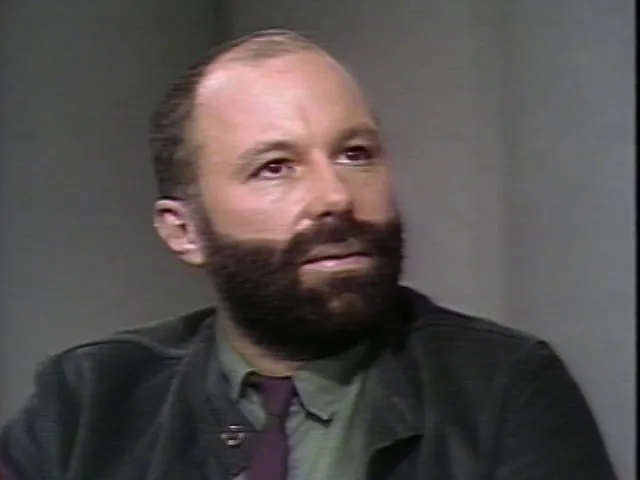
Joseph Paul D'Urso, 1981
DukeLibDigitalColl
0:03 (beep sound) (upbeat instrumental music)- Hello,
2:34 I am Barbarlee Diamonstein for Interior Design The New Freedom.
2:39 Today we'll be talking to Joe D'Urso who
2:42 is widely known as a master of minimalist design.
2:47 Client knows what they won't get when they seek his help.
2:51 Joe, perhaps you can tell us what it is that they will get.
2:54 What are the hallmarks of your design?
2:56 For what is your work best known?
3:01 Well, first of all, I would like to think
3:03 that my clients will get a lot of attention.
3:07 My interest in working with interiors and especially with residential projects,
3:12 is to really try to establish relationship with the client
3:18 that is an ongoing one that deals with the process, I think it has to evolve,
3:24 it's not the sort of thing that you can start immediately knowing
3:28 exactly what someone might need or what might feel that they desire.
3:33 But I think that is probably the thing that I most
3:36 enjoy about working is the relationship I have with my clients.
3:41 You didn't seem to leave it is less is more.
3:43 And let us try to cope with that there's always
3:45 a deeper philosophy to what it is that you do.
3:50 As I gather it, you've made the point that you
3:53 feel that your style offers a background for living.
3:57 A nearly but not precisely neutral background that permits
4:02 the personalities of your clients to come through.
4:06 Is that accurate?
4:08 I think that my interest and the interest of my clients when
4:12 they come to me is to, they recognize that, for the most part,
4:16 the space has to be transformed it may be an interesting space.
4:19 But it doesn't work for what they need for their lifestyle.
4:22 It may be a space that has exciting elements about it,
4:25 but may have been designed for family structure
4:29 or social structure of the 20s and 30s.
4:31 It's really not too unlike a set, a stage set I think,
4:34 where the action of the play really makes
4:37 the set important it makes it makes sense,
4:40 unless you see it in use it really is incomplete.
4:44 What do you do when a client comes
4:45 to you who possesses let us say a great number,
4:48 or even just a few beloved antiques and paintings,
4:53 a number of things that one doesn't, if one is not familiar with your work,
4:58 generally associate with your approach to design?
5:01 You know, it's a human thing to hold
5:03 on to something until you have something new to grasp onto.
5:06 So that in many instances, people cling to things when during the process
5:11 or after the the apartment or space is finished.
5:14 They no longer need those things.
5:15 And they kind of eliminate many of the things
5:17 they thought they need on their own.
5:20 And I question people, I say, do you really want that?
5:22 Do you really need it?
5:23 Do you understand that perhaps this is not a good example of what it is.
5:27 People often think they have a real Tiffany lamp or something like that.
5:31 And it's not it's a reproduction or it's something and I think, you know,
5:34 if you can expose people to the real thing,
5:37 they're likely to make a different judgment about things.
5:40 Well, is it ever difficult to convince
5:42 a client to simplify not only their living spaces,
5:45 but their possessions and presumably as a result of that their lives?
5:52 I think this is what people want.
5:54 I think this is why they come to a professional designer.
5:57 They're they're coming from the discipline that's involved,
5:59 they're coming to try to organize elements
6:03 that may have gotten disorganized at various points.
6:05 How do you urge or perhaps even insist that they edit their possessions.
6:12 I don't insist usually they have come to me with that already having been done.
6:18 It's a very thoughtful process.
6:19 I don't think that I'm the kind of designer that someone just picks up the phone
6:24 book and rings up and without any kind
6:26 of idea of what is involved on their part.
6:29 And what what my services will involve.
6:31 You say that by the time a client comes to you,
6:35 they are familiar with your work,
6:37 and somewhat informed about your approach to design.
6:43 It seems to me that there is a collaboration
6:48 that must take place between the designer and the client.
6:54 What is the commitment that you expect
6:56 from the client in this collaboration of yours?
6:59 And is it collaboration?
7:01 Oh, it's definitely a collaboration.
7:02 I think the collaboration can go as far as they're willing to go.
7:07 And obviously, different projects require different kinds of collaborations,
7:12 the scale of the project,
7:13 the length of the project, ideally, there's an element of trust,
7:17 and then the role is very clear that you are providing a service
7:20 and that you are listening to them and that their needs are being fulfilled.
7:25 And in a much more interesting way than they ever thought of.
7:32 This almost clutter free environment that you manage to create.
7:38 How does that measure up to the kind of, I guess disorder,
7:45 disorganization of contemporary life?
7:48 Is it possible for most people, or is it even desirable for most people to live,
7:53 well, so cleanly as a D'Urso design would have them do.
8:00 It's interesting you should use that word clean,
8:01 because I had an experience with a friend recently, who for personal reasons,
8:06 had to move back to a much smaller
8:08 apartment than the one that she was in recently,
8:11 she had sublet this apartment, and I had been there a few times,
8:16 and she was really unhappy with the space.
8:19 And one evening just spontaneously,
8:21 we decided to tackle it and see what we could do.
8:23 And I started, you know, pulling things around.
8:25 And I pulled everything away from the walls, there's quite a bit of furniture.
8:30 And as we pull the things away from the walls,
8:32 things started to fall away from walls,
8:34 you know, pictures that were stuck back there,
8:36 and boxes, and so forth and so on.
8:38 And and it was fascinating to see how we were able to eliminate
8:44 a lot of things that she didn't even realize she had, practically.
8:48 And after working for a couple of hours,
8:50 she said you know, it's really fascinating,
8:51 because now I can really see that this is it's not only logical,
8:55 but it's a clean way of living.
8:57 And so you can see everything.
8:59 You know, and I think there's a kind of that's something
9:02 be said about that, I think that if one isn't careful,
9:06 one ends up living in a storeroom?
9:09 Well, how do you help discipline the client?
9:11 This collecting urge, be the objects precious, or sentimental,
9:18 seems to be very widespread, more widespread than ever.
9:21 And it's being aware of decisions that you make.
9:24 If you want to hang something on the wall, then you no longer have a blank wall.
9:28 And if that blank wall provided a certain calm or a serenity to you,
9:35 and you put something on it, that thing that goes on it should be equal,
9:39 if not more than what was there before.
9:42 And so you just have to be constantly in touch with your environment.
9:45 And you have to be constantly questioning yourself, why am I putting this here?
9:49 Why is that there?
9:51 And by doing that, I think that you're you make the right decisions,
9:55 you make decisions that are right for you,
9:57 you can go into someone's environment and it can be absolutely almost empty
10:01 with a couple of flowers and that can be very exciting, you know.
10:04 Or you can go into someone else's, and it can be just filled with books
10:06 and filled with objects and filled with thing.
10:08 And that can be very exciting.
10:10 It's because it's felt it's real.
10:13 I guess most of us are so caught up with the business of living that we
10:16 don't have as much time as we'd like to, to look at the way we live.
10:21 You go to a museum and you see a show that you love, and you see a poster,
10:25 and you buy the poster and you take the poster and you put it on your wall,
10:29 because maybe you think that wall needs something,
10:32 you know, or you have a corner that's empty, and you go out and you buy a plant,
10:36 because you saw on a magazine that the corner
10:38 of an apartment should have a plant, and so forth and so on.
10:42 And I think that these are all we're
10:44 under all these pressures all the time to conform
10:46 and to to fill and to justify things
10:50 in material ways rather than just appreciating them
10:54 as empty spaces or silent moments in space
10:58 and really being content with the mental memory
11:02 of having seen that show instead of having
11:04 a tab evidence that you were there, you know.
11:07 Is your style, especially suited to any particular style of living,
11:11 a particular age group or economic group, for a particular kind of situation?
11:16 Can anyone live with a D'Urso interior?
11:19 I don't think I have a particular style.
11:20 I think that my clients have been very wide
11:25 in range and age group and families and single
11:30 people and I really think that I have
11:34 succeeded in solving individual problems as they come along.
11:39 And now that the decisions are really arbitrary, and they're not preconceived.
11:43 But there are certain things that I
11:45 would consider the hallmarks of your design, Joe,
11:48 I think it would be fair to say that a kind of spareness,
11:54 the use of industrial materials,
11:58 often glossy white walls and dark ray interiors.
12:04 Wouldn't you characterize that as being typical of some of your work?
12:09 Yes, I suppose if you look at it that way,
12:13 but I don't think that, I think that you
12:16 have to analyze each of those decisions separately.
12:19 And I think that if you do analyze them, and I do this with my clients,
12:22 I don't just say, this is what you're going to have.
12:25 You know, and that's it.
12:27 You've often said that neutral,
12:29 at least backgrounds that you've sometimes described as neutral,
12:32 does not mean bland.
12:34 What does neutral mean?
12:38 I don't think one can use the word neutral, really.
12:40 I think it's kind of an easy word that is used, often.
12:43 But I certainly, neutral suggests, bland, I mean,
12:49 it suggests nothingness, you know what I mean?
12:51 Like, and I don't want to think that the spaces are neutral in that sense.
12:58 But I think that hopefully they should be inspiring and they should generate,
13:06 they should generate some kind of communication between
13:08 the use of the space and the client.
13:11 You have, among other things,
13:13 recently designed a number of pieces of furniture, a number of things,
13:22 I guess, it'd be fair to say that no
13:26 furniture has long been identified with good design.
13:30 They're the folks who gave us the miss chairs and the Sara
13:34 Arm chair,- [Joe] He gave them the chairs, not the other way.
13:37 (audience applause)- And now,
13:40 D'Urso has given them a number of things that you have,
13:45 I guess helped reform and recharge their identity,
13:48 in that new Venturi and Raft show room
13:50 by some of the designs that you've created from them.
13:54 In fact, I guess you are the first
13:57 young designer that they commissioned to do new furniture.
14:02 Can you tell us something about what it is that you have created for them?
14:08 The products are categorized in three different ways.
14:13 We have what we call low tables, and high tables,
14:16 which really mean dining height tables or work high tables,
14:20 and lounge seating, which is all of them,
14:23 I'd sort of considered to be a system kind
14:27 of a concept about the function that they were solving,
14:33 the lamp seating can be had in several different sizes.
14:36 The idea there being a very relaxed and formal approach to a sofa,
14:43 where the depth and the pillow arrangement is really much more casual
14:49 and much more I think physical than many other sofas on the market.
14:54 Can that sofa also be a bed?
14:56 [Joe] Yes, it can be.
14:57 How wide is it as contrasted to...
14:59 [Joe] The seat height is thirty nine inches,
15:00 which is about the width of a twin bed.
15:03 So I mean, they really meant to be, you're meant to relax,
15:07 I think that anyone who's not relaxed and really willing,
15:12 would have a hard time on the sofa,
15:14 I've noticed people in the show room sitting on it.
15:17 And if you are kind of self conscious and you feel
15:20 you shouldn't be doing what you're doing whatever a little bit awkward,
15:23 I think you might have a problem with it.
15:25 But anyone that really is just sort
15:27 of attacks it- [Barbaralee] Able to melt into the...
15:30 And I think that that's good, because I think the ultimate use,
15:33 it will be in a situation where the person
15:35 has gotten used to it and is really using it.
15:38 And on that level, I think it offers something that's was very needed.
15:46 The high tables again, are a system.
15:48 And I think what's exciting about those is
15:50 that it's a very large range of products,
15:54 and really deals very thoroughly I think with the idea of shape.
15:59 And even in terms of materials, we have materials ranging from plastic laminate,
16:06 and then we have the wood, and we have marble and stones.
16:10 And it's interesting because we've sold a lot of other
16:14 high tables and I was looking at the sales reports recently,
16:19 and so many of them have been ordered in black,
16:21 even though we have these other materials,
16:24 models, and- [Barbaralee] How do you explain that?
16:27 I don't know, I think that people are responding to the shape
16:31 and the detailing and the proportions
16:33 and the kind of understated quality to them.
16:36 What's it like for someone as disciplined
16:39 and philosophical and as precise as you are,
16:43 working with a commercial manufacturer,
16:46 trying to combine the practical with the aesthetic.
16:50 What was that all like?
16:52 Well my big experiences in that were with Calvin Klein.
16:56 And it was fascinating to me, because one project in particular,
17:02 the Calvin Klein, menswear showroom,
17:03 I was involved with the planning of the company.
17:06 And it was interesting,
17:07 because I think that the design and the needs of the space,
17:12 which is a space that they chose, really did affect and influence and exchange
17:17 with the way that business was organized,
17:19 because we were able to all sit down together and decide how best
17:25 to express in physical form in physical space form the needs of showroom space,
17:33 office space, public relations space.
17:36 You're particularly fond of industrial objects
17:38 and a kind of industrial aesthetic.
17:41 Sometimes I expect that you're the fellow who gave us high tech,
17:45 before it was so named.
17:47 How did you first become interested in the use of that material?
17:54 It was really out of the inability to find anything
17:57 in the in the normal sources that really satisfied the needs that I had.
18:04 You know, in the high tech thing is, you know,
18:07 design is not like a vending machine where you go and you push a button,
18:11 you push high tech, and that comes out, or postmodern or whatever it might be.
18:17 I remember when I first started working on my own,
18:20 and we had all these catalogs from all the different furniture firms
18:22 and the hardware companies and so forth and so on, I couldn't find,
18:30 really there was very little that was on the market that was
18:33 sort of designer oriented products that I felt was worth using.
18:37 So I started looking elsewhere.
18:40 And it's just a simple fact that the design field, the design market,
18:49 has been very badly influenced by consumerism,
18:52 I think, and has gotten off the track.
18:55 It happened a long time ago.
18:56 And I think it's gotten to the point where something else had to happen.
19:01 And I think that the high tech thing, you know, for whatever,
19:04 again, I think there are all sorts of topics will discuss on that.
19:08 But I think that the point there for me was simply saying there
19:12 are other sources for a faucet or a chair or a light fixture.
19:20 And often these sources were really much more on fact,
19:25 because they were not trying to appeal to someone sentimentality or they
19:29 were not trying to imitate materials to make one feel cozy,
19:33 you know, or warm or any of these things.
19:35 They really were engineered products.
19:37 They were good design.
19:38 And that's where that's all that that means.
19:42 But it was not a movement, it's not...
19:45 In the light of that what's most important to you then, is it function?
19:48 Is it comfort?
19:49 Is it aesthetics?
19:50 Obviously, as a designer, I'm very interested in comfort,
19:53 I'm very interested in function.
19:54 But again, comfort is very subjective.
19:57 It's what is appropriate for that particular situation.
20:01 You know, obviously this chair might be comfortable for this situation,
20:04 but it would not be comfortable for me to live with.
20:07 Because it's not the way I live,- How is the way you live?
20:10 What is the way you live?
20:12 What's the kind of D'Urso design that you've created for yourself?
20:16 Well, you know, I think the most important thing is to find a beautiful
20:19 space to use for the period of time that we're here to use it.
20:26 And I have found a beautiful space.
20:31 And it seems to me that in New York, I have sort of a list of needs that I
20:35 would have for my ideal space and high ceilings,
20:39 fireplace sunlight, very important to me.
20:43 I have those things.
20:45 And other than that, I mean,
20:46 I haven't really been able to shape the environment in quite
20:51 the way that I perhaps would if I you know,
20:54 in certain different economic situation,
20:56 but it's a very beautiful architectural space.
21:01 I guess it's spatial complexity that most
21:03 interests you about most jobs that you have.
21:06 Let's talk about a specific one for a moment.
21:08 I'm thinking about an apartment,
21:11 an old apartment on West 67 Street in Manhattan that you have designed.
21:19 In that apartment in an older building,
21:22 were you tempted at any time to strip the detail?
21:25 Or did you perceive this job, for example,
21:28 as one of cleaning up or space manipulation?
21:31 Can you talk about that?
21:35 Well, again, what was exciting about that project was
21:37 that it was a wonderful space to begin with.
21:40 So one has a lot going going for you immediately.
21:44 Again, it was really the budget that determined much the way we
21:48 approach the design it was a very small budget to do a lot.
21:52 So even if I wanted to, to rip out all the moldings and find
21:57 the structure of the space and deal with that, it would have been inappropriate,
22:02 it would have been out of the range of the design program.
22:06 So it wasn't done.
22:07 So I think you have to, that to me is so important is
22:11 understanding the appropriateness of every aspect
22:14 of the project once you get it.
22:17 What does a D'Urso job cost today?
22:19 Does minimalism, cost less, or is the adjective minimal,
22:24 restricted only to the eye, not to the pocketbook.
22:30 Well, I think that again, it ranges enormously.
22:33 I've done whole apartments for relatively, not a lot of money.
22:38 I mean, I tell people, sometimes younger people 40 or $50,000,
22:42 for an apartment, they say, my God, that's such a lot of money, you know,
22:46 it's also relative, but it depends, and I don't have any...
22:52 [Barbaralee] It is a lot of money.
22:53 Well, it's a lot until you start breaking it down,
22:56 and you see where it goes, and you see how much it costs.
22:58 Where does it go?
22:58 In your typical, quote, budget job, where does the money go?
23:06 Well, just to paint an apartment in a decent way today
23:10 is many thousands of dollars if it's an apartment of any scale.
23:14 But because of your architectural training,
23:15 you're also involved in a lot of lighting and heat,
23:19 and air conditioning and things of that sort- You can be I mean,
23:23 you can light an apartment with one light, you can have just candle light,
23:28 it doesn't have to be expensive to be beautiful.
23:30 But I think it's understanding what you have to work with at the beginning,
23:34 and then carving it up in the way that you really feel will make it work.
23:38 In that West 67 Street apartment we talked about how special the space was,
23:47 do you prefer that kind of space,
23:50 or perhaps even a modern high rise apartment where the space is more neutral,
23:55 and you have more of an opportunity to create
23:58 the kind of design that would represent your intentions?
24:02 The nice thing about being busy,
24:04 and having 10 projects is that very often they're very different.
24:07 So you have everything, you're working on a big apartment with low ceilings,
24:13 you're working on a small apartment with high ceilings,
24:15 you're working in an old building, you're working in a brand new one,
24:18 you're working on one that's not even built yet.
24:20 So that's exciting to have many different projects to work on.
24:26 I for one, personally always relate more to older buildings,
24:32 because very often you have character, you have certain quality of construction,
24:36 you have a structure that you can really, you know,
24:38 bang around and knock around without the whole thing falling in on you.
24:42 You work alone now, but you have worked with Ward Bennett,
24:47 and I know he was a great influence on your career.
24:51 Can you say a word or two about
24:53 that, and about his significance in American design today?
25:02 I think Ward sort of embodies the whole concept of a total design,
25:07 you know, someone who really is interested
25:10 in, in every aspect of the design process.
25:13 And I've always found that to be something really, you know, to to aspire to.
25:23 On a personal level.
25:26 Having known Ward for a long time now,
25:28 a lot of the exposure that I've had in traveling particularly,
25:36 was largely responsible to my working with him
25:39 and being a friend of his and that was really,
25:42 I think, something that hopefully shows very positively in my work today.
25:48 Have you had working partnership with another person?
25:50 And would you like to?
25:52 In doing our office, the office that I share with our brand,
25:55 Mike Scheibel that was a collaborative and that worked very well.
25:58 We had a good time doing that, I think, no, I think I could.
26:02 Why don't you describe that building to us
26:04 this bizarre building that's I guess about
26:07 little more than 80 years old that you work in and what the space is like,
26:12 and what it's like, in fact,
26:13 to share space with other designers, with whom you have, I guess,
26:17 shared space for more than a decade as well- I'm sure we influence each other,
26:21 I mean, it would have to be that way.
26:23 We're friends and we share the same sources of inspiration.
26:29 That's what makes for friends.
26:32 But on a practical level, and then it makes a tremendous amount of sense me
26:37 to share a space such as that it's an exciting environment.
26:41 And the space is as you know, is very beautiful.
26:44 And we have beautiful light.
26:45 And we have beautiful view.
26:47 Let's talk about the sources of inspiration for a moment,
26:49 I know that you're very heavily influenced by architecture,
26:55 and art, are there any particular sources that you invoke?
27:04 I suppose that native architecture architecture
27:08 that really has not been designed,
27:13 in the sense what I'm talking about, you know,
27:17 a Japanese house or Egyptian architecture
27:21 of a certain period or Italian Hilltown architecture,
27:27 I mean, you can, everywhere in the world, architecture that has evolved.
27:36 Slowly and with with a real relationship to the living in a certain climate,
27:41 with a certain material of the area,
27:45 I think that's really been a very large influence to me.
27:50 What's the best and the most satisfying job you've ever done.
27:54 The one that comes to mind is the Calvin Klein men's wear showroom.
27:58 That was really exciting.
28:00 It happened at a time where I was somehow I don't now why,
28:05 or I'm sure I just sort of did it,
28:06 where I really lived and breathed the project,
28:09 I was there practically every day,
28:11 for the four or five months it was under construction.
28:13 And it's a very complicated project for me, up until that point,
28:18 I hadn't done anything nearly as large it was a raw space.
28:22 What gave Calvin the courage to do that?
28:25 Calvin always, I don't think he thinks about things that way,
28:28 he just does whatever he thinks is right and exciting for the moment.
28:34 One impact of inflation and spiraling construction costs is that most of us are
28:41 going to be able to afford only a smaller house or a smaller apartment.
28:47 And over the next 20 years,
28:49 it's been predicted that the way we live will change very radically.
28:53 Among other things, we're going to have to live in less and less and less space.
28:58 I think it's would be particularly interesting to hear you tell us what
29:02 you think the best way to scale down is, what do we do?
29:07 And how do we do that without sacrificing
29:11 our own human space needs and our own individuality?
29:17 Well, I think that there has to be,
29:18 and there will be a challenge to the direction
29:22 that new building is going in today.
29:26 I think I focus immediately on just the concept of window of what
29:31 windows have become and what they've
29:34 degenerated into being in this speculative buildings.
29:37 And I think we're almost at the point now where it
29:40 just simply will be people will not tolerate it this direction anymore.
29:45 And I don't know what the...
29:46 What recourse Do we have?
29:48 I think we need beautiful windows.
29:50 I really do.
29:52 And, and with that we'll go hopefully higher
29:54 ceilings and I think the spaces can come
29:57 in perhaps more but somehow when they're coming
29:59 in, they have to up a little bit.
30:03 For opening another window to design and doing it
30:07 in such a thoughtful and such a human way.
30:09 Thank you Joe D'Urso for being with us today.
30:12 I'm Barbaralee Diamonstein for Interior Design, The New Freedom