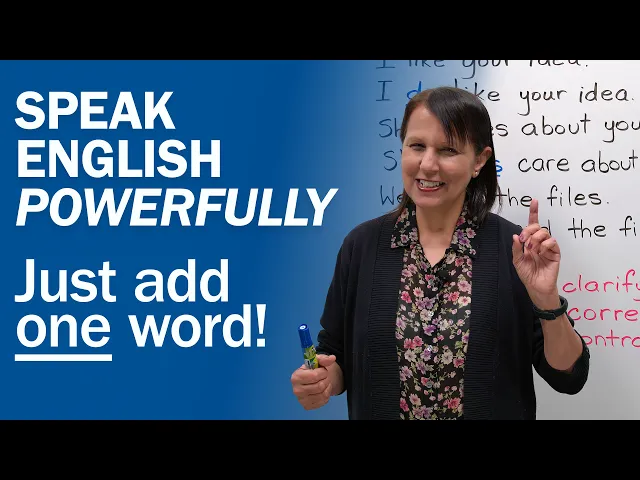
SPEAK ENGLISH POWERFULLY: Just Add ONE Word! | Free English Course
Learn English with Rebecca · engVid
0:00 Hi, and welcome to our series on Speaking English Powerfully.
0:05 Today, you'll learn how adding just one word can change how you sound instantly.
0:11 You'll see how this one word can make you sound more fluid,
0:16 more natural, and more confident in English.
0:19 Alright?
0:20 Are you ready to learn what those words are?
0:22 One word at a time, here we go.
0:26 Okay.
0:26 So, the words we're speaking about here are "do", "does", or "did".
0:35 Okay?
0:35 We only use one at a time.
0:37 Now, these are not new words for you.
0:39 These are words that you're familiar with.
0:42 You know "do" and "does" from the present tense,
0:45 but you know it in terms of asking a question or in a negative form,
0:50 or if you're just answering or giving a short answer, like "Yes, I do." Okay?
0:56 Like that.
0:57 But here, we're going to learn how to use these words in positive,
1:03 affirmative sentences.
1:05 Why?
1:07 Because they're going to add more emphasis and oomph to what we're saying.
1:13 The same with the word "did" in the past tense.
1:17 You're used to using the word "did" for questions,
1:21 for negatives, and for short answers,
1:23 but now you're going to see how to use this word "did" to emphasize something,
1:28 to put more focus on what you're saying.
1:31 And usually, we are using this technique to clarify something,
1:35 to make it more clear, or to correct something that someone said,
1:41 or to contrast it, to show the difference between what they
1:45 said and what you think and what you're trying to express.
1:49 Okay?
1:50 So, let me give you some examples so you understand exactly how it works,
1:54 and I'm sure you'll also hear the difference.
1:57 All right?
1:58 So, here we go.
1:59 Let's say someone gives you an idea, and they say...
2:03 And you say...
2:04 They say, "Okay, this is my idea", and you say,
2:08 "I like your idea." Or you could say, "I do like your idea." See the difference?
2:17 Which one is stronger?
2:19 "I do like your idea" versus "I like your idea"?
2:24 The first one sounded weak, even if it's true.
2:27 The second one makes it sound more true and more sincere.
2:32 It can also be that the person said, "Well, here's my idea,
2:35 but I don't know if you're going to like it,
2:38 you might not like it." And you say...
2:40 And if you say, "I do like your idea",
2:43 you're saying, "No, that's not true that I don't like it.
2:46 I do like it." You're emphasizing it; you're putting more focus on it.
2:50 Okay?
2:51 So it's stronger and very clear for the person to understand.
2:55 Then that person's going to be really happy.
2:57 "Yeah, really?
2:58 You like my idea?
2:59 Wow.
3:00 They're going to be thrilled." Okay?
3:02 All right.
3:03 Next.
3:04 So, this was, of course, in present, in the present tense.
3:08 The next one is also a present tense affirmative sentence.
3:13 So, let's say something happened,
3:15 and your friend had an argument with his girlfriend,
3:19 and he's feeling really sad, and then...
3:22 And you're trying to make your friend feel better, and you said, "No, come on.
3:26 Don't worry.
3:27 She cares about you." And he's feeling really bad
3:31 because he forgot her birthday or something, and he said...
3:35 And so you could say, "She does care about you.
3:37 It's not true she doesn't care about you.
3:39 She does care about you.
3:41 She just needs a little time to get
3:43 over the fact that you forgot her birthday." Okay?
3:46 Something like that.
3:47 But when we say, "She does care about you", you're emphasizing it.
3:51 Okay?
3:51 You're clarifying it.
3:53 And you're correcting, perhaps, what the other person thought,
3:56 and it's a little more powerful way to express yourself.
4:00 So you can see that you could use this in a business context,
4:03 can use this in a personal context.
4:06 Okay?
4:07 Now let's look at "did".
4:09 Okay?
4:09 "Did", that's now going to be in the past.
4:12 So somebody says, "Oh, you didn't send us the files." And you say,
4:18 "We sent the files." Nothing wrong with that, but it's just basic.
4:25 To make it stronger, what could you say?
4:27 "We did send the files.
4:30 Haven't you received them yet?
4:31 We did send them." You're emphasizing it.
4:34 Okay?
4:35 So, again, "do", "does",
4:36 and "did" are those magic words that you could add to positive
4:41 sentences to make them stronger and more intentional and with more energy.
4:48 Okay?
4:49 Now, let's look at some more examples of how
4:51 these simple words can make positive sentences sound even more powerful.
4:56 Okay?
4:58 So, the first three are from the professional world.
5:01 For example, "I do appreciate your feedback." Someone might have said,
5:07 "I hope you weren't upset or hurt by what I said." And you said,
5:12 "No, I do appreciate your feedback.
5:15 Thank you so much." Okay?
5:17 See how it sounds more serious, right?
5:20 Or "He does have a lot of experience." Yeah, I think we should hire him.
5:25 He does have a lot of experience.
5:29 Or, "We did review the contract." So, someone might have said,
5:34 "So, have you had a chance to review the contract?
5:37 I think you didn't." Right?
5:38 And you say, "No, no, we did review the contract." Okay?
5:42 Again, it sounds more serious in a professional context.
5:47 Next, in an academic environment, you could say,
5:50 "She did submit the assignment." Okay?
5:53 You're making it more certain.
5:56 Or, "We do understand the issue now." Or the topic now, or the theory now.
6:02 All right?
6:03 "We do understand." You're, again, creating more certainty.
6:09 And the last two, "I do value your opinion." Okay?
6:13 This could be in a personal context, in a social context.
6:17 "Thank you so much for your help.
6:19 I do value your opinion." This could be said to a friend,
6:25 to a relative, to a grandfather, to a child.
6:30 Okay?
6:31 "I do value your opinion." Next, "We didn't like the venue,
6:37 but we did enjoy the concert." What's a venue?
6:42 The location where an event takes place.
6:45 So, "We didn't like the venue, but we did enjoy the concert." Okay?
6:49 So, they're ending on that positive note.
6:51 So, these, again, make it sound more sincere.
6:54 When you're even in a personal or social context,
6:56 this makes whatever you're saying sound a little bit more sincere.
7:00 Now, even though I have explained that these words
7:03 will help you sound more powerful and confident,
7:06 we cannot use them, obviously, in every sentence;
7:10 otherwise, every sentence will sound too strong.
7:13 So, you want to make sure that you use them in the right
7:16 situations where you really do want to emphasize a particular point.
7:21 Okay?
7:22 Now, let's try some together, and this time,
7:24 you are going to create the answers with me.
7:27 Now, let's practice and apply what you've learned.
7:31 So, what we have on the board is we
7:34 have eight affirmative sentences that do not have any emphasis.
7:40 You are going to help me and add the emphasis.
7:42 If you like, you can pause the video, you can do them by yourself first,
7:48 and then check them with me, or we can do them together, and you can listen.
7:53 But I want you to really try to say it aloud so you feel the difference.
7:58 First, we're going to read the sentence, and then we'll read...
8:01 We will say the corrected sentence or the upgraded sentence.
8:05 Okay?
8:06 This is not...
8:07 These are not wrong; these are correct.
8:08 We're just upgrading them to sound more powerful.
8:12 So, the first one, "I sent the email." So now, what tense is that?
8:19 "I sent", it's the past tense.
8:22 So, down here, you see that I put the past tense.
8:26 Okay?
8:26 So, we have all of the pronouns, and we use the word "did" with that.
8:31 And over here, we have...
8:33 If you have any present tense sentences,
8:35 you can refer to this chart when you're trying
8:38 to figure it out if it doesn't come to you naturally.
8:41 Okay?
8:42 So, present tense, "I, you, we, they, do"; "he, she, it,
8:47 does"; and past tense, "I, you, we, they, he, she, it, did".
8:53 And since our first sentence was in the past tense,
8:56 "I sent the email", so how can we modify that to make it stronger?
9:03 We could say, "I did send the email." Say it after me.
9:09 "I did send the email." Good.
9:12 We're using the "did" from the past tense.
9:14 These first three are all in the past tense.
9:17 Okay?
9:17 I made it a little bit easier.
9:20 Number two, "They checked the accounts." Also in the past tense.
9:27 How can we make that stronger by adding "did"?
9:31 "They did check the accounts." Say it after me.
9:36 "They did check the accounts." I want you to feel it, okay?
9:40 Feel that difference.
9:42 Number three, "We had a lot of fun
9:45 in spite of the rain." How can we change that?
9:51 "We did have a lot of fun in spite of the rain." Say it after me.
9:57 "We did have a lot of fun in spite of the rain." Good.
10:02 Alright?
10:03 So, let's move now to some present tense sentences.
10:08 I understand.
10:11 What will you add there?
10:14 I do understand.
10:17 See how it sounds more sincere, more authentic?
10:20 It's a little bit more than just "I understand".
10:23 Say it with me.
10:24 I do understand.
10:27 Good.
10:28 Number five, "We need a new car." This could become what?
10:35 We- we do need a new car.
10:39 This car has got a lot of problems.
10:42 We do need a new car.
10:46 Number six, "She works very hard." Again, these sentences are not wrong.
10:52 We're just amplifying the message, making the message stronger when necessary.
10:59 So, "She works", "She", we will use what?
11:04 "Does".
11:04 She does work very hard.
11:07 It's true.
11:08 She does work very hard.
11:11 Next, these are mixed.
11:13 Could be past, could be present.
11:16 You decide.
11:17 Number seven, "I think this plan will work." What tense is that?
11:24 Present or past?
11:27 That is present right now, so it's going to be something from here,
11:31 so we're going to say, "I do think this plan will work." Let's say it together.
11:38 I do think this plan will work.
11:40 Good.
11:42 And number eight, "He helped me when I
11:46 needed it." He helped me when I needed it.
11:50 Helped is what tense?
11:52 Past tense, so we're going to add the "did".
11:54 He did help me when I needed it.
11:59 Let's say it together.
12:00 He did help me when I needed it.
12:02 Okay?
12:04 Great.
12:04 So, this one strategy is going to make you sound more natural because, yes,
12:09 English speakers do use this- do use this strategy
12:12 quite often when they're trying to emphasize something.
12:16 And you can as well.
12:17 You'll sound more natural, you'll sound more fluent,
12:20 and people will understand you more easily because you're
12:24 making these extra changes and improvements in your English speaking.
12:29 So, in this lesson, what did we do?
12:32 We added a word, right?
12:34 Do, does, or did.
12:36 In another lesson, in the same series, what did we do?
12:41 For those of you who've seen it, we removed a word.
12:44 If you haven't seen it, please go and watch it.
12:47 Each of these strategies will help you to speak English more powerfully.
12:51 Thanks very much for watching, and all the best with your English.