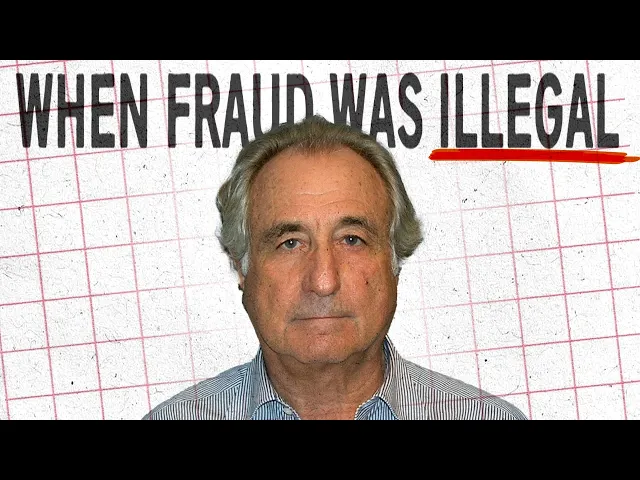
Would Bernie Madoff's Fraud Even Be That Bad By Today's Standards?
How Business Worked
0:00 All right.
0:00 So, what the[ __] did Bernie Maidoff actually do?
0:04 He is, of course, most famous for running
0:07 the largest Ponzi scheme in financial history,
0:10 swindling investors out of as much as $65 billion, depending on who you ask.
0:16 But how was that even possible?
0:18 His fraud may be all he is remembered for today.
0:22 But whether we would like to admit it or not,
0:25 he changed the landscape of modern investing in more ways than we acknowledge.
0:29 Ironically, had it not been for his Ponzi scheme,
0:32 he may be remembered even less fondly
0:35 for the other financial tools he pioneered,
0:38 like payment for order flow, dark pools, online trading,
0:42 FINRA, and the proliferation of hedge fund market makers.
0:46 But perhaps more concerningly, his crimes also tell us a lot about
0:50 the way our financial system operates to this day,
0:53 which is revealed just by asking the most logical question.
0:57 How did he think this was all going to end?
1:01 He was a veteran of the financial industry, taking money off some of the richest
1:06 and supposedly smartest investors in the world,
1:09 running an operation that by its very nature was inherently unstable.
1:13 It also raises the question of what did
1:15 his victims actually think they were investing in.
1:18 The whole system was propped up on the three pillars of obscurity,
1:24 ambiguity, and exclusivity,
1:26 which are coincidentally very common place in a lot of the biggest firms today.
1:32 Of course, nobody is saying that something like any of the several
1:36 thousand private equity funds operating in America today are a Ponzi scheme.
1:42 But the point is, if they were,
1:44 it would be very hard to find out until it was too late.
1:48 And these days, that might actually have real consequences.
1:51 Perhaps the biggest irony in the Maidoff story, though,
1:54 is that despite being one of the largest frauds in financial history,
1:58 it didn't really hurt any of its ultra-wealthy victims too badly,
2:02 at least not badly enough to enact any meaningful change.
2:05 Good old Bernie exposed a lot of flaws in our system,
2:09 and all of them were quickly glossed over as he was shipped off to prison.
2:14 Nobody wants to learn from history when there
2:16 is a profit to be made by forgetting it.
2:18 It's been 2 and 12 months since Bernard El Maidoff was picked up
2:22 and charged with what's believed to be the largest financial fraud in history.
2:26 We still don't know much more about the alleged $50 billion scam.
2:29 He was in the right settings.
2:31 He played golf at the right places.
2:33 He ate lunch at the right places.
2:35 and he went to dinner with the right people and what
2:37 he did was he was able to suck them in.
2:40 I read it and then I read it again.
2:43 It was like in shock, like nonbelieving shock.
2:46 He couldn't possibly have this isn't true.
2:49 It's impossible to be true.
2:51 He had the patina of being a respected citizen,
2:54 one of the most successful businessmen in New York,
2:56 and certainly one of the most powerful men on Wall Street.
2:59 You would never suspect him of fraud.
3:01 The beginning of Maid Off's uh
3:04 distinguished career was almost remarkably unremarkable.
3:08 He came from a financially comfortable family
3:11 and married into another financially comfortable family.
3:13 But he was still expected to get his own start.
3:16 While he was at university, he did what any student does.
3:19 He took whatever job he could get.
3:21 He worked as a lifeguard in the summers
3:23 and installed sprinkler systems in people's yards.
3:25 and he did it long enough that the paychecks
3:28 actually brought in a meaningful amount of money.
3:30 By the time he graduated, he had scraped together around $5,000 in savings,
3:34 which for a kid his age at the time was pretty impressive,
3:38 but still nowhere near start your own Wall Street firm money.
3:42 For a moment, he did the respectable thing and went to law school,
3:47 which is exactly what you're supposed to do if you want a safe,
3:51 professional career.
3:52 But he found that arguing about money was
3:55 far less interesting than actually making money because after
3:59 a year he dropped out and doubled down
4:01 on the idea of starting his own business instead.
4:04 5 grand from lifeguarding only gets you so far.
4:06 So he turned to the oldest form of seed funding and finance.
4:10 He asked his father-in-law for a small loan of $50,000.
4:15 So with roughly $55,000 in combined savings and family money,
4:19 Bernard Elm Maidoff Investment Securities opened its door in 1960.
4:23 Now at this time Bernie wasn't managing money for ultra
4:27 wealthy families or running some
4:29 mysterious hedge fund promising marketbeating returns.
4:32 He was effectively just doing the basic grunt work
4:36 of finance filling in cracks where he could find them.
4:39 In the early years, Maid Off was a market maker,
4:42 mostly in tiny companies listed on what were called the pink sheets.
4:47 Trading stocks that on a good day might only
4:49 see a handful of people actually buying or selling them.
4:52 A market maker's job is pretty simple.
4:54 You stand in the middle of other people's trades.
4:56 You post a price you're willing to buy a stock
4:59 at, and you post a price you're willing to sell it at.
5:03 The margin between these two numbers is how you make your living.
5:06 If somebody wants to sell quickly, they take your lower bid.
5:09 If somebody wants to buy quickly, they pay your higher offer.
5:12 And the gap in the middle, known as the spread,
5:15 is where you get paid for providing this liquidity.
5:18 If you've ever flipped items in Runescape or Eve Online for a profit,
5:23 you have effectively done what Maidaf was doing for the first few years
5:27 of his career on a big exchange with tight regulations and lots of competition.
5:31 This is a boring, low margin way to make a living.
5:36 Spreads are typically small, information is widely available,
5:39 and the system at least pretends to be fair.
5:42 The pink sheets were not that.
5:44 This was the part of the market where small, obscure,
5:48 and sometimes questionable companies ended up when they
5:51 couldn't meet the standards of the main exchanges,
5:54 which meant fewer buyers, barely any regular trading,
5:57 and almost no reliable information for anyone to work with.
6:01 The name itself came from the daily pricing updates that the National
6:05 Quotation Bureau would send out every day on cheap pink printer paper.
6:08 And the fact that stock prices in these companies were only updated once a day
6:14 should really tell you all you need to know about these kinds of operations.
6:18 Prices in that world could be nudged around by a few aggressive brokers,
6:21 a couple of phone calls, or a sales script that sounded convincing enough
6:25 to someone who didn't know what they were buying.
6:27 For comparison, share prices on modern, large,
6:30 and well- reggulated exchanges can often be updated by millions every second.
6:35 So, this kind of stock trading really was a different game.
6:39 Of course, the name Pink Sheets may
6:41 sound familiar to you because there was another
6:44 infamous financial swindler who got his start
6:47 doing the same thing about two decades later.
6:50 Name of the company, Aerotine International.
6:52 It is a cuttingedge high- techch firm
6:55 out of the Midwest awaiting imminent patent approval
6:58 on a next generation of radar detectors
7:01 that have both huge military and civilian applications.
7:04 Now, to be clear, not everyone operating
7:06 in this space was running a full-blown scam.
7:09 But even the most honest players were working with a certain
7:13 level of sleas that was just baked into the business model.
7:16 When you are the one posting the only
7:19 real prices in a dark market that barely trades,
7:23 you can quietly widen the spread,
7:26 treat unsophisticated retail clients a little worse than your friends,
7:30 or lean on information you got a few seconds before everyone else,
7:34 and most of the time, nobody will ever know.
7:37 This was the world Bernie Maidoff learned in.
7:40 Not a clean, well-lit trading floor with cameras,
7:43 but the gray zone of the pink sheets,
7:45 where prices were flexible, rules were fuzzy,
7:48 and nobody looked too closely at how the money was actually being made.
7:53 But a system like that was never going to stay invisible forever.
7:57 Normally, this is where you'd expect the state to step
8:00 in with a thick rulebook and a regulator nobody can afford to ignore.
8:04 But rather than building a powerful watchdog,
8:06 the solution was effectively to hand the leash to the dog and say,
8:11 "Well, you seem responsible.
8:12 Why don't you just supervise yourself?" The result was
8:16 the National Association of Securities Dealers or the NASD,
8:21 a self-regulatory organization set up so
8:23 that brokers could effectively write the rule book, enforce it on one another,
8:29 and then present the results to the public as investor protection.
8:33 On paper, the NASD was there to license brokers,
8:37 inspect firms, investigate misconduct,
8:39 and make sure that the kind of pink sheet shenanigans
8:42 we just talked about didn't get completely out of hand.
8:45 Over time, that structure was reshuffled and rebranded.
8:49 The NASD's regulatory arm was merged with bits of the New
8:53 York Stock Exchange's own enforcement division
8:55 and the combined entity became FINRA,
8:57 the Financial Industry Regulatory Authority,
9:00 the main organization that is supposed to keep
9:03 American broker dealers in line to this day.
9:06 Whether or not it actually does is a problem we'll get into later in the video.
9:11 But for now, know that Bernie Maidoff was
9:13 not some nervous outsider at odds with this system.
9:16 His firm was a major member.
9:18 He sat on NASD committees.
9:20 He was treated as a model operator.
9:23 Exactly the kind of seasoned insider you ask for input
9:26 when you're deciding how strict those rules should actually be.
9:29 So, the guy who learned his craft in the gray
9:33 zone of the pink sheets didn't just survive the cleanup.
9:36 He helped shape the body that was doing the cleaning.
9:39 But even with that new respectable layer of regulatory involvement,
9:43 he was still at the end of the day a broker competing
9:47 for business against firms that actually had seats on the big stock exchanges.
9:52 The traditional way to do that was to be on the floor yourself,
9:56 jacket on, paper in hand,
9:57 standing in a crowded room of sweaty men shouting orders at one another
10:01 and trying to get the attention of whoever was closest to the book.
10:05 Instead of trying to win by shouting over everyone on the floor,
10:08 Maidoff started leaning heavily on computers to root
10:11 and match orders instead of relying on runners, hand signals, and phone calls.
10:16 Now, give credit where credit is due.
10:18 This was genuinely quite visionary.
10:20 Back when computers still looked like
10:22 this, he was already looking at the trading
10:24 floor and deciding he'd rather have a screen to handle those conversations.
10:28 Instead of throwing his orders into the chaos of the trading floor,
10:31 he built systems that could quietly take in client orders,
10:35 match buyers and sellers automatically,
10:37 and send back confirmations without all of the theater
10:41 that went along with the traditional trading floor.
10:43 This approach didn't just make life easier for his clients.
10:47 It quietly turned his little brokerage into something
10:49 that behaved a lot like a mini exchange.
10:52 Orders came in, trades got matched,
10:55 prices were quoted on screen instead of shouted across the room.
10:58 And while all of this was happening, the NASDA was trying to work out what
11:03 the future of stock trading would look like.
11:05 They saw that the old model of colored
11:08 jackets and hand signals wasn't going to scale forever.
11:11 And they saw that what Maidoff was doing looked
11:13 a lot closer to where the industry was headed.
11:16 So when they decided to build a market for its
11:19 members that didn't rely on a physical trading put at all,
11:23 they went down the same path,
11:25 creating an electronic system that would publish quotes,
11:28 match trades automatically,
11:29 and let brokers plug in through their terminals instead of their vocal cords.
11:34 They called it the National Association
11:36 of Securities Dealers automated quotation system,
11:39 mercifully known more commonly and simply as the NASDAQ.
11:43 Over the next few years,
11:45 this screen based market stopped being a side project and quietly turned
11:50 into one of the main ways trades in American stock were actually getting done.
11:54 And Maidofff's firm was doing a large amount of the volume on Wall Street.
11:58 Bernard Elm Maidoff Investment Securities was
12:01 routinely handling orders for big institutions.
12:04 And the man who started out matching
12:06 trades in obscure pink sheet companies was now
12:09 presented as one of the people who understood
12:12 the new electronic Wall Street better than most.
12:16 Inside the NASDAQ world, his name was everywhere.
12:20 He held senior positions, sat on committees, and in the early 1990s,
12:24 he even served three one-year terms as chairman of the NASDAQ stock exchange.
12:30 He was the man that stock brokers put forward
12:34 to reassure people that the market was in safe, experienced hands.
12:39 Anyways, this is where the issue with self-regulation started to become obvious.
12:43 Groups like FINRA and the exchanges
12:46 were introduced as guardians of market integrity.
12:48 But they were also industry clubs founded
12:50 by member firms and staffed by people who
12:54 moved back and forth between the regulator
12:56 and the regulated often within the same business day.
13:00 Politically, it's sold as a win-win.
13:02 It's cheaper for the taxpayer than building large
13:06 independent public regulators and actually funding them properly.
13:09 And it sounds efficient because the people writing the rules
13:12 supposedly understand how money works better than anyone else.
13:16 In practice, even beyond the obvious problem of self-regulation,
13:20 it creates other more subtle weaknesses.
13:23 New firms and smaller players trying to do everything
13:27 unconventional get put under the microscope in excruciating detail.
13:31 While big long-standing members that generate
13:33 enormous volumes and fee income tend
13:36 to be treated with a lot more patience and understanding, firms like Madoff.
13:41 Now, to be fair to everything we've talked about so far,
13:45 this is still the legitimate half of the Bernie Madoff story.
13:49 The market making, the clever use of computers, the roles inside NASDAQ,
13:53 none of that on its own is the Ponzi scheme.
13:57 The uncomfortable part is that when you look at how his actual scam worked,
14:02 the secrecy, the exclusivity,
14:03 the lack of real oversight behind a very respectable public facade,
14:08 you start to see patterns that look a lot less like a one-off crime
14:11 and a lot more like a template
14:13 that still exists in parts of modern finance today.
14:16 So, it's time to learn how history works.
14:18 to look at how a supposedly safe, boring,
14:22 well-connected firm managed to bolt a Ponzi scheme onto
14:26 the side of its real business and why the ingredients
14:29 that made that possible are still very visible in some
14:31 of the most fashionable investment structures operating right now.
14:34 When you look at the Bernie Maidoff story,
14:37 the most interesting part is not just the fraud itself,
14:40 but how long it went unquestioned.
14:43 Smart people, sophisticated institutions,
14:45 and regulators all missed the warning signs.
14:48 That kind of failure is less about intelligence and more about how we reason,
14:53 test assumptions, and evaluate evidence.
14:55 That is why this episode is sponsored by Brilliant.
14:59 Brilliant is all about helping you unlock the thinker you already are.
15:03 Instead of memorizing facts, you learn through interactive problem solving
15:07 that builds real understanding in math, science, and computer science.
15:12 I have been spending time with their scientific
15:15 thinking course which focuses on how we form models,
15:18 test ideas and challenge assumptions.
15:20 It is not a history course,
15:23 but it sharpened the exact kind of reasoning that could
15:26 have raised red flags in cases like maid off.
15:28 Working through it changed the way I look at claims and explanations.
15:33 You start with simple logic challenges
15:35 and gradually move into evaluating evidence,
15:38 spotting weak arguments, and asking more precise questions.
15:42 It feels surprisingly relevant and genuinely engaging.
15:46 And since Brilliant personalizes your learning path,
15:49 you always feel like you are moving at a pace that makes
15:52 sense for you with practice and reviews that adapt as you go.
15:56 To learn for free on Brilliant for a full 30 days, go to brilliant.org/howis.
16:02 /howhistory works.
16:03 Scan the QR code on screen or click the link in the description.
16:07 Brilliant is also giving our viewers 20% off an annual premium subscription,
16:12 which gives you unlimited daily access to everything on Brilliant.
16:17 madoff's actual scam sat off to the side of all
16:20 of this in what was officially called his investment advisory business.
16:24 Basically, his asset management arm.
16:26 This was the part of the firm that promised
16:30 clients 10 to 20% returns regardless of market conditions.
16:35 Now, anyone who knows the first thing about market
16:39 returns will know that this is obviously just impossible.
16:43 But crucially, madoff was very selective about who he let in.
16:47 You couldn't just fill out a form, wire money, and invest in his fund.
16:51 You got introduced through a private bank, a charity board,
16:54 or a friend at an exclusive golf club.
16:57 That selectivity did a lot of heavy lifting.
17:00 If access to something is scarce and everyone around you is impressed
17:04 you're in, you are far less likely to start asking annoying questions like,
17:08 "Where exactly is this money going?" or "Can I see the trades?"
17:13 Maid off told people he was running a relatively conservative option strategy,
17:18 buying a basket of large,
17:20 well-known stocks and then using options to hedge the downside,
17:23 which for anyone who didn't want to get into the weeds,
17:27 sounded sophisticated enough to be plausible and safe enough to be comforting.
17:32 Clients got statements showing a neat staircase of positive monthly returns,
17:37 very little volatility,
17:39 and almost no visible connection to what the broader market was doing,
17:42 which should have been a giant red flag,
17:45 but instead became part of the sales pitch.
17:48 Behind the scenes, there was no complex strategy.
17:51 In most cases, there were no real trades at all.
17:54 New money came in, old investors who wanted to withdraw paid out,
17:58 and whatever was left sat in bank accounts,
18:01 while the back office produced fake trade confirmations
18:04 and account statements to keep everyone feeling calm.
18:07 At one point, there was something like $5 billion
18:11 just sitting in a regular JP Morgan bank account,
18:15 not tucked away in some exotic offshore structure,
18:18 just parked in plain sight because nobody was really looking.
18:22 I almost wish there was some more technical deception behind
18:25 the scenes to make it sound more interesting for the video,
18:28 but that really was all there was to it.
18:30 The only real cunning was in how he
18:33 presented himself and his firm to supposedly sophisticated investors.
18:36 But in that regard, there are still a lot of uncomfortable
18:41 lessons that we have not learned from the Maidoff story.
18:44 Now, obviously, most modern investment firms
18:47 are not running literal Ponzi schemes,
18:49 and it would be ridiculous to say that every
18:52 private equity fund is just made off with a PowerPoint.
18:56 But once you see how his operation actually worked,
18:59 it's hard not to notice a few uncomfortable similarities.
19:03 Today, when people talk about alternative assets,
19:07 they're usually talking about some version of the same basic idea.
19:11 raise a large pool of capital, buy real companies using a lot of borrowed money,
19:15 tinker with the business for a few years,
19:17 pay down some of the debt, and then sell the whole thing on for a higher price.
19:22 The brochure version goes something like this.
19:25 A fund buys a company, professionalizes management, cuts unnecessary costs,
19:30 maybe nudges revenue higher, uses the extra cash flow to pay down the debt,
19:35 and then exit at a better valuation because
19:38 the business is supposedly healthier than it was before.
19:41 There is nothing inherently illegal about VATS,
19:43 and in plenty of cases, it does exactly what it says.
19:47 But it is a little strange that an entire industry
19:50 can print very strong returns for long periods of time,
19:54 mostly by refinancing balance sheets, shaving expenses,
19:58 and passing the same assets from one fund to another.
20:01 A lot of the performance in the middle is very hard to measure from the outside.
20:07 Portfolio companies are private.
20:09 Valuations are based on internal models.
20:11 numbers only get updated a few times a year and there
20:16 is no daily market price shouting at you when something goes wrong.
20:20 You see a smooth line of reported returns,
20:23 but you don't really see the path the companies took to get there.
20:27 The exit routes make this even harder to ignore.
20:30 A huge share of portfolio companies aren't
20:33 sold to public markets or long-term industrial buyers.
20:37 They're sold to other private equity firms that have
20:40 just raised fresh capital and need somewhere to put it.
20:43 One fund buys the business, pays down some debt, claims improvement,
20:48 then passes it on at a higher multiple to the next fund,
20:52 which might do exactly the same thing again a few years later.
20:57 This does not make private equity a Ponzi scheme.
21:00 The industry will be quick to point out that there are real assets,
21:04 real employees, real cash flows.
21:06 But at the same time,
21:09 an industry like multi-level marketing will similarly claim they
21:12 are not a pyramid scheme because they sell real products.
21:17 The broad reality for private equity as an industry
21:19 is that over the last decade in particular,
21:22 a lot of the impressive predictable headline
21:25 returns depended on new investor dollars coming
21:29 into the system at higher entry prices
21:31 so that the existing investors could cash out.
21:35 Yes, there are more moving parts and actual businesses involved,
21:38 but if the whole system is still reliant on new investors piling in, I mean,
21:44 what would you call that?
21:45 Now, maybe you still think it's different enough, and that's fine.
21:49 But we've also made this much harder
21:51 to monitor by putting it behind a regulatory wall.
21:54 These funds only deal with institutions
21:57 and sophisticated high net worth clients,
22:00 which means lighter disclosure, fewer reporting requirements,
22:04 and a general attitude from watch dogs of, well,
22:07 they should have known what they were getting into.
22:10 If you're a retail broker calling someone about
22:13 a few thousand dollar worth of listed stocks,
22:17 FINRA will happily make you sit exams,
22:20 get licensed, and live under a detailed rule book.
22:23 But if you're structuring billion dollar buyout
22:26 deals for teacher pension funds and family offices,
22:29 most of what you do sits outside of FINRA's licensing regime
22:33 entirely simply because you're not technically
22:36 selling securities to the general public.
22:38 You see a similar pattern in private credit which has grown
22:42 into a kind of shadow banking system alongside all of this.
22:46 Bespoke loans made by funds and direct
22:49 lenders negotiated in private with light covenants.
22:53 Optimistic assumptions about downturns and positions that are
22:56 marked to internal models rather than any real market.
23:00 As long as the cycle cooperates, everything looks fine on paper.
23:05 Yields are collected.
23:06 New investments keep flowing in, marks are gently nudged upward,
23:09 and nobody outside the inner circle has much
23:12 visibility into the actual risks building up underneath,
23:16 which means frauds and bad bets can sit there undisturbed for a very
23:22 long time before anyone realizes how big the hole really is.
23:26 None of this is to say that private equity
23:30 or private credit is just made off in disguise.
23:33 The point is that we are still very
23:36 comfortable with financial structures that are exclusive, opaque,
23:39 lightly supervised, and extremely hostile to anyone who
23:43 wants to take a proper look under the hood.
23:47 And those are exactly the conditions which allowed Maid Off's
23:51 very simple fraud to survive as long as it did.
23:55 In Maid Off's case, the irony is that the headline number everyone remembers,
23:59 you know that $65 billion, well, it was never real in the first place.
24:03 That figure came from fake account statements and imaginary compounding,
24:07 not from actual cash that went into the system.
24:10 If you look at the money that actually went in, it
24:13 was somewhere in the ballpark of 18 to 20 billion of principal.
24:16 And after the dust settled, the trustees managed to claw back and distribute
24:21 something like 15 billion of that to his investors.
24:24 Which means that on aggregate, this once in a century fraud destroyed
24:29 far less real wealth than the headline suggests.
24:32 And most of the people involved were still comfortably rich afterwards,
24:36 just slightly less rich than they thought they were on paper.
24:40 The biggest irony of all of this though
24:42 is that because his scheme fell apart in 2008,
24:45 it was actually a better investment than
24:47 a lot of other investment firms on Wall Street.
24:51 Being in an outright Ponzi scheme run by Bernie Madoff meant only losing about
24:57 20% of your money at the time when plenty of totally legitimate hedge funds,
25:03 structured products, and bank balance sheets were blowing up entirely.
25:07 Obviously, that doesn't make it right.
25:09 A fraud is still a fraud, but it does underline how broken the wider system was.
25:14 You could be in a complete lie and come out
25:18 better than people who trusted products that were supposedly regulated,
25:22 transparent, and run by some of the most respected names on Wall Street.
25:26 And back then, most of the damage was
25:29 contained to a fairly narrow slice of wealthy individuals,
25:32 charities, and institutions who had chosen voluntarily to play
25:35 in that exclusive little corner of the market.
25:38 Ordinary households didn't wake up one morning
25:41 to discover that their job, their home,
25:43 and their pension were all secretly depending
25:46 on whether Bernie Madoff could keep finding new money.
25:49 Today, we may not be so lucky.
25:51 A modern private equity fund still only takes money
25:54 from rich clients and big institutions on the surface,
25:57 but underneath that, a lot of those institutions
26:00 are gambling with our retirement savings,
26:03 which they use to buy up companies with real workers,
26:06 real customers, and very real obligations to the communities they operate in.
26:12 The same goes for private credit.
26:14 Those alternative lenders are not just swapping paper with one another.
26:18 They are deciding which businesses can roll their debt,
26:22 which property developers can finish projects,
26:25 and which firms have to start cutting staff when the next downturn shows up.
26:30 If a system like that ever suffered a madoff sized honesty problem,
26:35 or even just a prolonged period where everyone simultaneously
26:38 realized the values they were throwing around were nonsense.
26:42 The fallout wouldn't be a few
26:44 embarrassed rich people quietly downsizing their yacht.
26:47 It would mean layoffs, shuttered factories, unfinished housing projects,
26:51 and pension funds scrambling to plug holes that nobody thought existed.
26:57 In other words, we've rebuilt many of Madoff's favorite conditions, obscurity,
27:02 ambiguity, exclusivity,
27:04 and very light scrutiny for anyone dealing with sophisticated money.
27:10 But this time, we've wired those conditions
27:13 directly into the plumbing of the real economy.
27:16 That's the part of the story that should worry us
27:19 a lot more than the cartoon headline about $65 billion.
27:22 The mechanics of this scam were simple, almost boring.
27:26 The environment that let it run for decades is
27:29 what matters because that environment never really went away.
27:33 It just moved into new products with better branding.
27:35 And if you zoom out even further,
27:38 you realize that none of this is especially new.
27:41 dressing up simple lies in complicated language,
27:44 hiding risk behind social status, leaning on trust instead of verification.
27:49 Humans have been doing that for as long
27:52 as we've been swapping anything of value.
27:54 Maid off wasn't some glitch in an otherwise perfect system.
27:58 He was one very flashy example in an 8,000-year tradition of people
28:03 discovering that if you mix a good story with enough opacity,
28:08 you can separate other people from their wealth for an impressively long time.
28:12 So, if you want to see how deep
28:15 that tradition really goes from ancient merchants and medieval bankers,
28:18 and maybe get a better sense of what the next version of this will look like,
28:22 go and watch our video on the 8,000-year history of scams.
28:25 And don't forget to like and subscribe to keep on learning how history works.